Connect with us

Business

Jim Cramer: The case of Nvidia, the stock I loved so much in 2017 that I named my dog after it

Published

on


Not long ago I was coming back from a haircut, a rare trip for me outside the New York Stock Exchange, and I heard a man’s voice calling me from the curb just behind Fearless Girl, a sculpture by the artist Kristen Visbal that I never fail to grin at when she catches my eye. 

“Jim, can I shake your hand?” the man asked. 

One day I will get over the fact that nice people want to stop and talk to me, tell me how they are doing in the market or how much they like “the show.” I always have time to say hello or give a fist pump, even a hug if demanded. 

This time, it was a man named Jeremy, who said, “I want to show you something.” His wife said, “It’s something that has allowed me to retire.” Jeremy opened an app filled with stock listings, and he jabbed one line, a line that said “Nvidia, $2,545,000.” Jeremy told me that’s what I made for him. That’s what allowed his wife, a schoolteacher in New Hampshire, to retire. 

“I can’t thank you enough,” he said. To which I replied with the most logical of points: “Jensen deserves the thanks, not me.” 

I was referring to Jensen Huang, the CEO of my finest stock pick ever, the tiny semiconductor business that is now one of the world’s three largest companies, jousting with Microsoft and Apple over the past couple of years for the honor. 

How did Jeremy know to buy Nvidia when I mentioned it? For the same reason tens of thousands of people bought Nvidia on June 20, 2017, when I told the world that I loved the company so much that I renamed my dog after it. That rescue mutt had been known for years as Everest, but enough of that. 

Taking into account a couple of stock splits the company has had since then, Nvidia traded at just under $4 at the time. Less than $4 invested that day would have gotten you $136 by the end of December 2024. Meaning $1,000 would have turned into $34,622—and $10,000 would have grown into a $346,218 win. Not too bad. But how did I realize that this company would become a $4 trillion holding? I renamed my dog to finally get people’s attention on what I thought, hoped, and truly believed would be the greatest stock story of all time. 

Everywhere I go now—at home or on vacation (and not just domestically), I meet people who thank me for Nvidia. I want to talk about it here not because I am a genius—I am decidedly not—but because it all comes back to process. Let me show you my work so you can have the confidence to seize on my process and build your own. 

One of my earliest (of hundreds of ) pushes for Nvidia on Mad Money was on September 30, 2009. My interest in the company’s story, which I’d known years earlier but never paid much attention to, had been piqued by, of all places, a Best Buy conference call. The electronics retailer had discussed how netbooks were becoming a big growth category, so I looked up who was making the graphic processing units, or GPUs, for those types of computers. I learned that Nvidia—a company I had previously known only as a gaming chip maker—was the leader in the space, and I recommended the stock. 

Taking into account splits, it was at 38 cents at the time. Jump ahead a few months, to June 2010. That was when I first had the chance to interview Nvidia’s CEO, a young guy named Jensen Huang. He wore a motorcycle jacket. He didn’t seem like an executive. He seemed like a gamer. A video gamer. 

I mostly liked that he wasn’t the same as everyone else I interviewed. He didn’t seem to care much about anything other than fast chips. I was instantly smitten. I redoubled my efforts to talk up the company’s stock after an interview I did a bit later with the CEO of Audi North America. I had come to his showroom to ask some questions, because the cars are universally considered to be well made. When the interview ended, I asked him why his cars ran so well. He said, “It’s the technology.” 

I knew not to be satisfied with that answer. After what might have qualified as badgering, I finally got him to tell me who made the components. 

“Nvidia.” 

“Impossible,” I said. “But they make gaming chips,” I replied. 

He wanted to know if I thought he was making it up. And I knew then that there was something special here. Nvidia had in fact pretty much cornered the market on speedy chips, not just in game consoles but in cars, too. I just hadn’t realized it. The Audi CEO told me that Nvidia’s chips were lightning fast, much faster than Intel’s. 

I couldn’t wait to get back to the office and dig in deeper. I couldn’t wait to connect with Jensen Huang and learn more. 

But he wasn’t an easy man to get to know. I emailed. I told him quarter after quarter what a terrific company he had. But I didn’t hear back. Not until I mentioned to him that my daughter was doing service work helping troubled teens not far from where he grew up in Oregon did he respond—and he did so in an incredibly gracious way. 

What I saw when I went to Nvidia’s headquarters was nothing short of phenomenal. Those gaming chips, the ones that ended up in the Audi? They were going to revolutionize the world. They were going to be used for something called artificial intelligence, real science-fiction devices that could generate near-lifelike images through mathematical computation and then make them perfect. 

There were periods between 2020 and 2022 when I recommended Nvidia multiple times a week or, between my three shows, multiple times a day. I couldn’t help myself. How could everyone not see what was about to occur? A machine aided by a Nvidia chip could see, it could hear, it could think! 

And then, one day, in November 2022, a man named Sam Altman, an old friend of Jensen’s, came out with ChatGPT, some six years after Jensen had hand-delivered Nvidia’s first AI supercomputer to OpenAI back in 2016. The world changed. One day it seemed that only a handful of people knew about AI. Then millions did, an astoundingly quick adoption. 

The rest—including in May 2023, when Nvidia had the biggest positive earnings surprise a company has ever delivered, beating expectations handily and then offering a quarterly revenue forecast that was $4 billion above expectations—is history. 

“But how can I find the next Nvidia?” you ask me. Okay, okay. You can’t afford an Audi, not that the head of Audi North America would help you anyway. You didn’t know that Nvidia’s chips could be used for more than gaming. You didn’t believe in a guy in a black leather jacket. How could you have spotted this one? 

The answer is that even if you can’t spot Nvidia, you can spot something that will make you rich, I promise you. Every once in a while—not never, decidedly not never—an Nvidia comes along. 

When I was a kid at Goldman Sachs, back in the mid-1980s, there was a fellow who ran the research department named Lee Cooperman. I was so young back then that I still had hair. I idolized Lee, and still do, because he never stopped having and talking about new ideas. One day, Lee said to me, “You ought to tell your clients to buy shares in Berkshire Hathaway.” My head was spinning. What did he mean? That was a clothing company, right? Did he wear their shirts? He was testing me. No way that Lee, one of our nation’s greatest investors, would ever be telling me to buy shares of a shirt company, would he? The one with the advertisement of the man with an eye patch? (I was thinking of Hathaway shirts, a fine company until it went broke in 2002. Not a great investment.) 

Rather than show off my ignorance, I asked him, “Why that company?” 

He looked at me like I was an idiot. “Warren Buffett. Go read his annual report, let me know.” 

I read it. Then I read it again. And again. Then I went back down to the research floor and told Lee I saw what he meant. “Then tell your clients to buy it.” That’s just what I did. After the fifth time, I gave up. The stock was selling for $1,400 a share, and who the heck wanted to buy a $1,400 stock? Certainly not anyone I was talking to. So I just dropped it. Never made another call on it because of the resistance to the price tag. Now that it is north of $700,000, that original price tag per share seems like a ridiculous reason not to buy the stock, doesn’t it? 

Again, you could say not fair: You had a genius tell you about Berkshire Hathaway. You spotted Nvidia from your day-to-day Mad Money work. Guilty on all counts. But how many times have you heard of Warren Buffett in the past 10, 20, 30, or 40 years? And you could always recall the name of my dog; everybody could.

Excerpted from HOW TO MAKE MONEY IN ANY MARKET. Published by TKTKTK. Copyright © 2025 by Jim Cramer. All Rights Reserved.

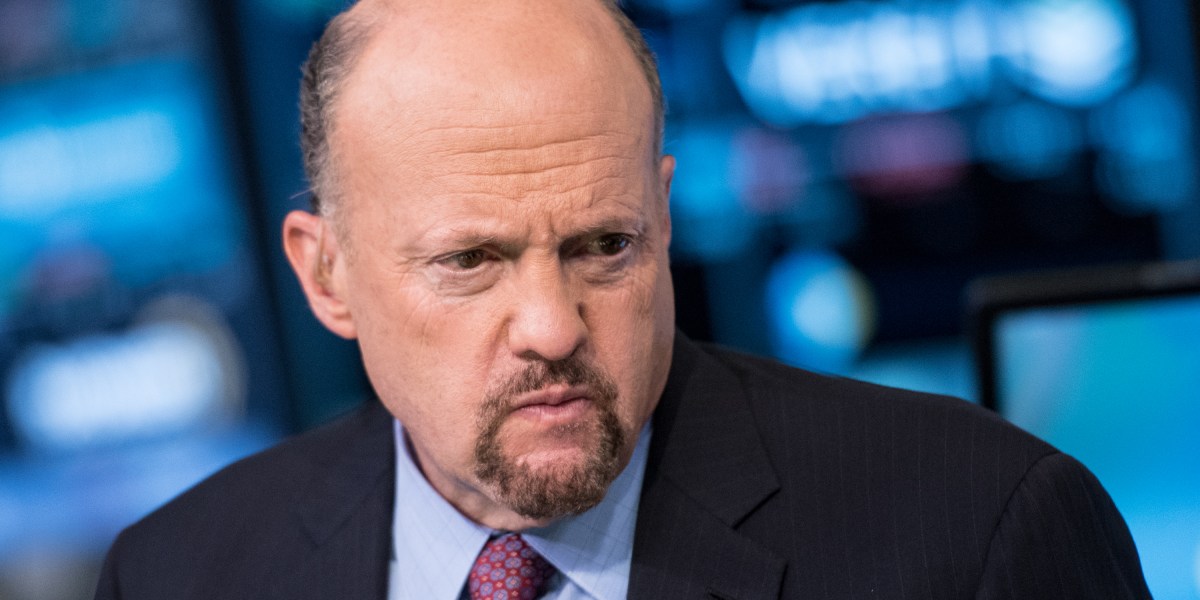

Source link

Continue Reading

Business

4 times in 7 seconds: Trump calls Somali immigrants ‘garbage’

Published

on


He said it four times in seven seconds: Somali immigrants in the United States are “garbage.”

It was no mistake. In fact, President Donald Trump’s rhetorical attacks on immigrants have been building since he said Mexico was sending “rapists” across the border during his presidential campaign announcement a decade ago. He’s also echoed rhetoric once used by Adolf Hitler and called the 54 nations of Africa “s—-hole countries.” But with one flourish closing a two-hour Cabinet meeting Tuesday, Trump amped up his anti-immigrant rhetoric even further and ditched any claim that his administration was only seeking to remove people in the U.S. illegally.

“We don’t want ‘em in our country,” Trump said five times of the nation’s 260,000 people of Somali descent. “Let ’em go back to where they came from and fix it.” The assembled Cabinet members cheered and applauded. Vice President JD Vance could be seen pumping a fist. Defense Secretary Pete Hegseth, sitting to the president’s immediate left, told Trump on-camera, “Well said.”

The two-minute finale offered a riveting display in a nation that prides itself as being founded and enriched by immigrants, alongside an ugly history of enslaving millions of them and limiting who can come in. Trump’s U.S. Immigration and Customs Enforcement raids and deportations have reignited an age-old debate — and widened the nation’s divisions — over who can be an American, with Trump telling tens of thousands of American citizens, among others, that he doesn’t want them by virtue of their family origin.

“What he has done is brought this type of language more into the everyday conversation, more into the main,” said Carl Bon Tempo, a State University of New York at Albany history professor. “He’s, in a way, legitimated this type of language that, for many Americans for a long time, was seen as outside the bounds.”

A question that cuts to the core of American identity

Some Americans have long felt that people from certain parts of the world can never really blend in. That outsider-averse sentiment has manifested during difficult periods, such as anti-Chinese fear-mongering in the late 19th century and the imprisonment of some 120,000 Japanese Americans during World War II.

Trump, reelected with more than 77 million votes last year, has launched a whole-of-government drive to limit immigration. His order to end birthright citizenship — declaring that children born to parents who are in the United States illegally or temporarily are not American citizens despite the 14th Amendment — is being considered by the Supreme Court. He has largely frozen the country’s asylum system and drastically reduced the number of refugees it is allowed to admit. And his administration this week halted immigration applications for migrants from 19 travel-ban nations.

Immigration remains a signature issue for Trump, and he has slightly higher marks on it than on his overall job approval. According to a November AP-NORC poll, roughly 4 in 10 adults — 42% — approved of how the president is handling the issue, down from about half who approved in March. And Trump has pushed his agenda with near-daily crackdowns. On Wednesday, federal agents launched an immigration sweep in New Orleans,

There are some clues that Trump uses stronger anti-immigration rhetoric than many members of his own party. A study of 200,000 speeches in Congress and 5,000 presidential communications related to immigration between 1880 and 2020 found that the “most influential” words on the subject were terms like “enforce,” “terrorism” and “policy” from 1973 through Trump’s first presidential term.

The authors wrote in the Proceedings of the National Academy of Sciences that Trump is “the first president in modern American history to express sentiment toward immigration that is more negative than the average member of his own party.” And that was before he called thousands of Somalis in the U.S. “garbage.”

The U.S. president, embattled over other developments during the Cabinet meeting and discussions between Russian President Vladimir Putin and U.S. envoys, opted for harsh talk in his jam-packed closing.

Somali Americans, he said, “come from hell” and “contribute nothing.” They do “nothing but bitch” and “their country stinks.” Then Trump turned to a familiar target. Rep. Ilhan Omar, D-Minn., an outspoken and frequent Trump critic, “is garbage,” he said. “Her friends are garbage.”

His remarks on Somalia drew shock and condemnation from Minneapolis to Mogadishu.

“My view of the U.S. and living there has changed dramatically. I never thought a president, especially in his second term, would speak so harshly,” Ibrahim Hassan Hajji, a resident of Somalia’s capital city, told The Associated Press. “Because of this, I have no plans to travel to the U.S.”

Omar called Trump’s “obsession” with her and Somali-Americans “creepy and unhealthy.”

“We are not, and I am not, someone to be intimidated,” she said, “and we are not gonna be scapegoated.”

Trump’s influence on these issues is potent

But from the highest pulpit in the world’s biggest economy, Trump has had an undeniable influence on how people regard immigrants.

“Trump specializes in pushing the boundaries of what others have done before,” said César Cuauhtémoc García Hernández, a civil rights law professor at Ohio State University. “He is far from the first politician to embrace race-baiting xenophobia. But as president of the United States, he has more impact than most.” Domestically, Trump has “remarkable loyalty” among Republicans, he added. “Internationally, he embodies an aspiration for like-minded politicians and intellectuals.”

In Britain, attitudes toward migrants have hardened in the decade since Brexit, a vote driven in part by hostility toward immigrants from Eastern Europe. Nigel Farage, leader of the hard-right Reform U.K. party, has called unauthorized migration an “invasion” and warned of looming civil disorder.

France’s Marine Le Pen and her father built their political empire on anti-immigrant language decades before Trump entered politics. But the National Rally party has softened its rhetoric to win broader support. Le Pen often casts the issue as an administrative or policy matter.

In fact, what Trump said about people from Somalia would likely be illegal in France if uttered by anyone other than a head of state, because public insults based on a group’s national origin, ethnicity, race or religion are illegal under the country’s hate speech laws. But French law grants heads of state immunity.

One lawyer expressed concerns that Trump’s words will encourage other heads of state to use similar hate speech targeting people as groups.

“Comments saying that a population stinks — coming from a foreign head of state, a top world military and economic power — that’s never happened before,” said Paris lawyer Arié Alimi, who has worked on hate speech cases. “So here we are really crossing a very, very, very important threshold in terms of expressing racist … comments.”

But the “America first” president said he isn’t worried about others think of his increasingly polarizing rhetoric on immigration.

“I hear somebody say, ‘Oh, that’s not politically correct,’” Trump said, winding up his summation Tuesday. “I don’t care. I don’t want them.”

___

Contributing to this report are Associated Press writers Will Weissert and Linley Sanders in Washington, John Leicester in Paris, Jill Lawless in London, Evelyne Musambi in Nairobi, Kenya, and Omar Faruk in Mogadishu.


Source link

Continue Reading

Business

Nearly three-quarters of Trump voters think the cost of living is bad or the worst ever

Published

on


President Donald Trump and his administration insist that costs are coming down, but voters are skeptical, including those who put him back in the White House.

Despite Republicans getting hammered on affordability in off-year elections last month, Trump continues to downplay the issue, contrasting with his message while campaigning last year.

“The word affordability is a con job by the Democrats,” Trump said during a Cabinet meeting on Tuesday. “The word affordability is a Democrat scam.”

But a new Politico poll found that 37% of Americans who voted for him in 2024 believe the cost of living is the worst they can ever remember, and 34% say it’s bad but can think of other times when it was worse.

The White House has said Trump inherited an inflationary economy from President Joe Biden and point to certain essentials that have come down since Trump began his second term, such as gasoline prices.

The poll shows that 57% of Trump voters say Biden still bears full or almost full responsibility for today’s economy. But 25% blame Trump completely or almost completely.

That’s as the annual rate of consumer inflation has steadily picked up since Trump launched his global trade war in April, and grocery prices have gained 1.4% between January and September.

Meanwhile, Vice President JD Vance pleaded for “patience” on the economy last month as Americans want to see prices decline, not just grow at a slower pace.

Even a marginal erosion in Trump’s electoral coalition could tip the scales in next year’s midterm elections, when the president will not be on the ballot to draw supporters.

A soft spot could be Republicans who don’t identify as “MAGA.” Among those particular voters, 29% said Trump has had a chance to change things in the economy but hasn’t taken it versus 11% of MAGA voters who said that.

Across all voters, 45% named groceries as the most challenging things to afford, followed by housing (38%) and health care (34%), according to the Politico poll.

The poll comes as wealthier households are having trouble affording basics, while discount retailers like Walmart and even Dollar Tree are seeing more higher-income customers.

And in a viral Substack post last month, Michael Green, chief strategist and portfolio manager for Simplify Asset Management, argued that the real poverty line should be around $140,000.

“If the crisis threshold—the floor below which families cannot function—is honestly updated to current spending patterns, it lands at $140,000,” he wrote. “What does that tell you about the $31,200 line we still use? It tells you we are measuring starvation.”


Source link

Continue Reading

Business

Apple is experiencing its biggest leadership shakeup since Steve Jobs died, with over half a dozen key executives headed for the exits

Published

on


Apple is currently undergoing the most extensive executive overhaul in recent history, with a wave of senior leadership departures that marks the company’s most significant management realignment since its visionary co-founder and CEO Steve Jobs died in 2011. The leadership exodus spans critical divisions from artificial intelligence to design, legal affairs, environmental policy, and operations, which will have major repercussions for Apple’s direction for the foreseeable future.

On Thursday, Apple announced Lisa Jackson, its VP of environment, policy, and social initiatives, as well as Kate Adams, the company’s general counsel, will both retire in 2026. Adams has been Apple’s chief legal officer since 2017, and Jackson joined Apple in 2013. Adams will step down late next year, while Jackson will leave next month.

Jackson and Adams join a growing list of top executives who have either left or announced their exits this year. AI chief John Giannandrea announced his retirement earlier this month, and its design lead Alan Dye, who took charge of Apple’s all-important user interface design after Jony Ive left the company in 2019, was just poached by Mark Zuckerberg’s Meta this week.​

The scope of the turnover is unprecedented in the Tim Cook era. In July, Jeff Williams, Apple’s COO who was long thought to succeed Cook as CEO, decided to retire after 27 years with the company. One month later, Apple’s CFO Luca Maestri also decided to step back from his role. And the design division, which just lost Dye, also lost Billy Sorrentino, a senior design director, who left for Meta with Dye. Things have been particularly turbulent for Apple’s AI team, though: Ruoming Pang, who headed its AI Foundation Models Team, left for Meta in July and took about 100 engineers with him. Ke Yang, who led AI-driven web search for Siri, and Jian Zhang, Apple’s AI robotics lead, also both left for Meta.

Succession talks heat up

While all of these departures are a big deal for Apple, the timing may not be a coincidence. Both Bloomberg and the Financial Times have reported on Apple ramping up its succession plan efforts in preparation for Cook, who has led the company since 2011, to retire in 2026. Cook turned 65 in November and has grown Apple’s market cap from about $350 billion to a whopping $4 trillion under his tenure. Bloomberg reports John Ternus has emerged as the leading internal candidate to replace him.​

Apple choosing Ternus would be a pretty major departure from what’s worked for Apple during the past decade, which has been letting someone with an operational background and a strong grasp of the global supply chain lead the company. Ternus, meanwhile, is focused on hardware development, specifically for the iPhone, iPad, Mac, and Apple Watch. But it’s that technical expertise that’s made him an attractive candidate, especially as much of the recent criticism about Apple has revolved around the company entering new product categories (Vision Pro, but also the ill-fated Apple Car), as well as its struggling AI efforts.​

Now, of course, with so many executives leaving Apple, succession plans extend beyond the CEO role. Apple this week announced it’s bringing in Jennifer Newstead, who currently works as Meta’s chief legal officer, to replace Adams as the company’s general counsel starting March 1, 2026. Newstead is expected to handle both legal and government affairs, which is essentially a consolidation of responsibilities among Apple’s leadership team, merging Adams’ and Jacksons’ roles into one.​

Alan Dye, meanwhile, will be replaced by Stephen Lemay, a move that’s reportedly being celebrated within Apple and its design team in particular. John Gruber, who’s reported on Apple for decades and has deep ties within the company, wrote a pretty scathing critique about Dye, but in that same breath said employees are borderline “giddy” about Lemay—who has worked on every major Apple interface design since 1999, including the very first iPhone—taking over.

Meanwhile, on the AI team, John Giannandrea will be replaced by Amar Subramanya, who led AI strategy and development efforts at Google for about 16 years before a brief stint at Microsoft.

Hitting the reset button

All of the above departures cover critical functions for Apple: AI competitiveness, design innovation, regulatory navigation, and operational efficiency. Each replacement brings specialized expertise that aligns with the challenges Cook’s successor will inherit.

The real test will be execution across multiple fronts simultaneously. Can Subramanya accelerate Apple’s AI development to match competitive threats? Will Lemay’s design leadership maintain Apple’s interface advantages as AI reshapes user interaction? Can Newstead navigate regulatory challenges while preserving Apple’s privacy-first approach?

What’s certain is the company will look fundamentally different in 2026—and the executive team that grew Apple into a $4 trillion behemoth is departing. The transformation could be as profound as any since Jobs handed the reins to his COO at the time, Tim Cook, 14 years ago.


Source link

Continue Reading

Trending

Copyright © Miami Select.