Connect with us

Business

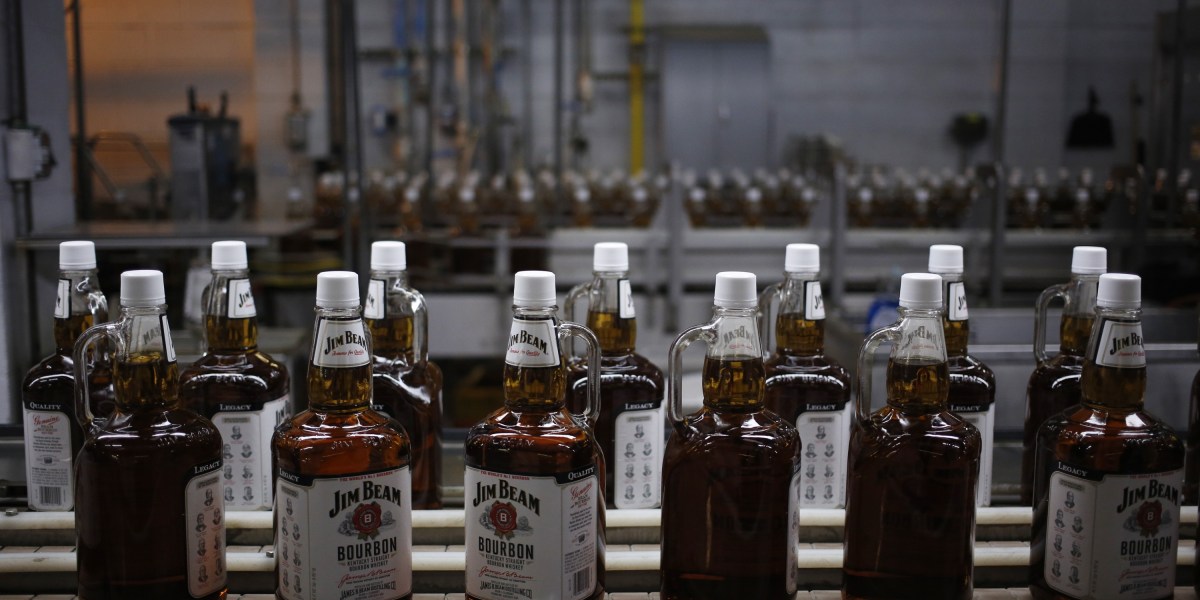
Jim Beam halts production at key US distillery amid bourbon glut

Published

on


Bourbon maker Jim Beam plans to pause production at its main US distillery for all of 2026 after slumping demand caused an oversupply of whiskey. 

The brand, owned by Japanese alcohol giant Suntory Holdings Ltd., said it’s halting whiskey distillation at the James B. Beam campus in Clermont, Kentucky after an assessment of its production levels against consumer demand, according to a statement on Monday. 

The company plans to use the downtime to invest in site enhancements. Production will still continue at the smaller Fred B. Noe craft distillery in Clermont and the Booker Noe site in Boston, it added. 

Sales of bourbon have slowed as consumers rein in spending and drinking, and as uncertainty over the impact of US President Donald Trump’s tariffs and taxes on aging barrels weigh on the sector, the Kentucky Distillers’ Association said in October. There are about 16.1 million barrels — a record — of bourbon aging in warehouses in Kentucky as of January, though most won’t be ready to bottle until after 2030, the association said.

Jim Beam, which employs about 6,000 people worldwide, did not announce layoffs. Bottling and warehousing operations will continue at the brand’s James B. Beam campus, while its visitor center and restaurant remain open, it said.

Suntory, which also owns soft drinks such as Orangina, is grappling with the fallout of Takeshi Niinami’s resignation as chief executive officer in September after Japanese police raided his home as part of an investigation into suspected illegal cannabis-based supplements. Niinami was one of the country’s best-known and most outspoken business leaders.

Join us at the Fortune Workplace Innovation Summit May 19–20, 2026, in Atlanta. The next era of workplace innovation is here—and the old playbook is being rewritten. At this exclusive, high-energy event, the world’s most innovative leaders will convene to explore how AI, humanity, and strategy converge to redefine, again, the future of work. Register now.


Source link

Continue Reading

Business

U.S. unveils plans for new ship under Trump’s ‘Golden Fleet’ bid

Published

on


President Donald Trump announced the US Navy will build a new “Trump-class” warship as part of the White House push to modernize the service’s surface fleet and restore domestic shipbuilding.

A poster displayed at the event at Trump’s gilded Mar-a-Lago estate featured an artist’s rendering of a sleek-looking warship dubbed the USS Defiant, cutting through choppy waters with a laser beam shooting from its deck and smoke billowing from a target in the background. 

Next to the ship was a picture of Trump raising his fist in the air in a near copy of the defiant pose he struck minutes after surviving an assassination attempt in 2024. Another poster shows a rendering of the vessel sailing by the Statue of Liberty

“We’re desperately in need of ships,” Trump said. “Some of them have gotten old and tired and obsolete, and we’re going to go the exact opposite direction.”

The Navy is also pursuing a new frigate based off the Legend-class cutter as it looks to shore up a surface combatant fleet that is one-third the size the service needs, the service announced Dec. 19. The ship, dubbed the FF(X), will be built by Newport News, Virginia-based HII, whose Legend-class cutter will serve as the basis for the new vessel.

The new ships are part of Trump’s “Golden Fleet” bid to revive US shipbuilding and address shortfalls in smaller ships exposed by recent military operations around the world. Overhauling shipping has been one of the top defense-related priorities, with Secretary of State Pete Hegseth saying contractors need to speed up development of new weapons systems or lose government contracts. 

Trump had already linked himself to another new weapons system, the F-47 stealth, a nod to his place as the 47th president. He’s also put his name on the newly anointed Donald J. Trump and the John F. Kennedy Memorial Center for the Performing Arts and the Donald J. Trump Institute of Peace.

The state of US shipbuilding is vastly behind China’s production rate and the Trump administration is prioritizing investing in its shipbuilding industry to narrow the output gap. Trump created a new Office of Shipbuilding earlier this year with plans for tax incentives to attract companies to the US. 

The Oval Office announcement signifies “the Navy is trying to tap into the enthusiasm of the administration for shipbuilding and say, ‘OK, you want to build ships, — let’s come up with some new ships to build because you’re going to if you have money and energy, let’s apply that toward things that the Navy needs,’” Bryan Clark, a senior fellow at the Hudson Institute, said in an interview.

Read More: Navy Cuts Orders for Frigate Trump Once Touted as ‘Beautiful’

The cruiser would replace Arleigh Burke class destroyers, which have roughly four decades of service life left and are equipped with Aegis Combat Systems that provide missile defense capability.

The Trump administration’s first attempt to build a new frigate in the president’s previous term ended with a significantly delayed and over-budget program. The original plan was to build 20 of the vessels to start, using a foreign design from Trieste, Italy-based Fincantieri SpA, whose Wisconsin-based subsidiary had been contracted to build the frigates. In order to adapt the design to meet US military standards, the ship’s cost ballooned and the increased complexity led to production delays.


Source link

Continue Reading

Business

Larry Page said in 2000 Google was ‘nowhere near’ the ultimate search engine—Gemini might be close

Published

on


Google cofounder Larry Page had a vision for search engines 25 years ago that sounds eerily close to what its AI product Gemini is making possible today.

Page, who started Google with cofounder Sergey Brin, served in his first stint as CEO from the company’s founding in 1998 until 2001 when he was replaced by Eric Schmidt, who would serve in the role for a decade.

When Google was founded, the concept of the search engine was still fairly new. Google took it to the next level with its PageRank algorithm, which looked at hyperlinks between web pages to rank the best results rather than using keywords.

“Search engines didn’t really understand the notion of which pages were more important,” Page said at the time. “If you type Stanford, you get sort of random pages that mention Stanford. This obviously wasn’t going to work.” 

In just a couple of years, Google’s innovation took it from a non-player dwarfed by market leaders like AltaVista and Yahoo to a real competitor. 

By 2000 the upstart company had captured 25% of the search market—a significant advance but still far from its 90% dominance now. Page claimed the company was making $80 million a year in ad search revenue in 2000, compared with just under $200 billion in 2024.

Yet Page had grand hopes for what the future of Google and search could look like.

“Artificial intelligence would be the ultimate version of Google,” he said in a resurfaced interview conducted by the nonprofit educational organization American Academy of Achievement, from October 2000. “If we had the ultimate search engine, it would understand everything on the web. It would understand exactly what you wanted, and it would give you the right thing. And that’s obviously artificial intelligence—able to answer any question, basically because almost everything is on the web.”

While he added at the time, “We’re nowhere near doing that now,” Google’s Gemini, which the company recently upgraded, may be the closest it has come to realizing Page’s 25-year-old vision. 

OpenAI beat Google to the punch by launching ChatGPT in late 2022, and for months the company scrambled to release its own large language model. In February 2023, Google put out Bard, which it later rebranded to Gemini.

The company has also made major strides to bring AI to search. In May, Google reimagined its iconic search engine by incorporating Gemini in a tab called “AI Mode.” Rather than presenting a list of links, this mode answers search questions in natural language. That’s as ChatGPT is replacing at least some queries once reserved for Google.

Google may also have pulled ahead of competitors with its most recent update to Gemini. The new version of the company’s flagship large language model has outpaced ChatGPT and other competitors like Anthropic’s Claude, according to industry benchmark tests, the Wall Street Journal reported

Last week, the company incorporated a version of its latest LLM, Gemini 3 Flash, into the AI Mode search tool for all users globally. Its advanced reasoning, the company argues, will deliver users better answers to more complicated questions. 

With its multimodal reasoning, Google’s most advanced AI can interpret and reason based on text, images, audio, video, and code in a single prompt. While it may not be able yet to predict a user’s needs, it maintains a 1-million-token context window, meaning it can draw on a large amount of previous information to inform its responses to user queries—especially long and nuanced prompts.

More than just a passive search engine, Gemini can also act on a user’s behalf better than previous versions. Gemini can work across Google’s ecosystem to manage a user’s inbox and send emails. When it comes to coding, the LLM can watch and respond in seconds with how to proceed. Google claims Gemini 3 can help turn an idea into a working prototype in minutes.

While 25 years ago, Page painted the “ultimate search engine” as a faraway goal, the company is moving closer to achieving his vision.


Source link

Continue Reading

Business

You could win $1.6 billion with the right Powerball ticket, officials say

Published

on


The Powerball jackpot now stands at an estimated $1.6 billion, making it one of the largest lottery prizes in U.S. history, Powerball officials said Sunday.

No ticket matched all six winning numbers on Saturday — white balls 4, 5, 28, 52, 69 and red Powerball 20. That sets up the fifth-largest U.S. jackpot ever for Monday’s drawing, according to a news release from Powerball.

The biggest U.S. jackpot was $2.04 billion in 2022. The winner bought the ticket in California and opted for a lump-sum payment of $997.6 million.

The odds of winning Monday’s jackpot, which is the fourth-largest in Powerball history, are 1 in 292.2 million, according to Powerball.

The winner can opt for a lump-sum payment estimated at $735.3 million or an annuitized prize estimated at $1.6 billion. Both prize options are before taxes.

The annuity option offers one immediate payment followed by 29 annual payments that increase by 5% each year, Powerball said.

Powerball is available in 45 states, Washington, D.C., Puerto Rico and the U.S. Virgin Islands. It is overseen by the Multi-State Lottery Association, a nonprofit group made up of state lotteries. Profits from ticket sales are used by states to support public education and other services.

This story was originally featured on Fortune.com


Source link

Continue Reading

Trending

Copyright © Miami Select.