Connect with us

Business

Jelly Roll, country-rap superstar who found music while serving prison time, pardoned by Tennessee governor in front of Christmas Tree

Published

on


Tennessee’s governor pardoned country star Jelly Roll on Thursday for his criminal past in the state, acknowledging the Nashville native’s long road back from drugs and prison through soul-searching, songwriting and advocacy for second chances.

The rapper-turned-singer whose legal name is Jason Deford has spoken for years about his redemption arc before diverse audiences, from people serving time in correctional centers to concert crowds and even in testimony before Congress.

Republican Gov. Bill Lee issued the pardon after friends and civic leaders of the Grammy-nominated musician joined in an outpouring of support.

Jelly Roll’s convictions include robbery and drug felonies. He has said a pardon would make it easier for him to travel internationally for concert tours and to perform Christian missionary work without filling out burdensome paperwork.

He was one of 33 people to receive pardons Thursday from Lee, who for years has issued clemency decisions around the Christmas season. Lee said Jelly Roll’s application underwent the same monthslong thorough review as other applicants. The state parole board gave a nonbinding, unanimous recommendation for Jelly Roll’s pardon in April.

“His story is remarkable, and it’s a redemptive, powerful story, which is what you look for and what you hope for,” Lee told reporters.

Jelly Roll and Lee meet at the governor’s mansion

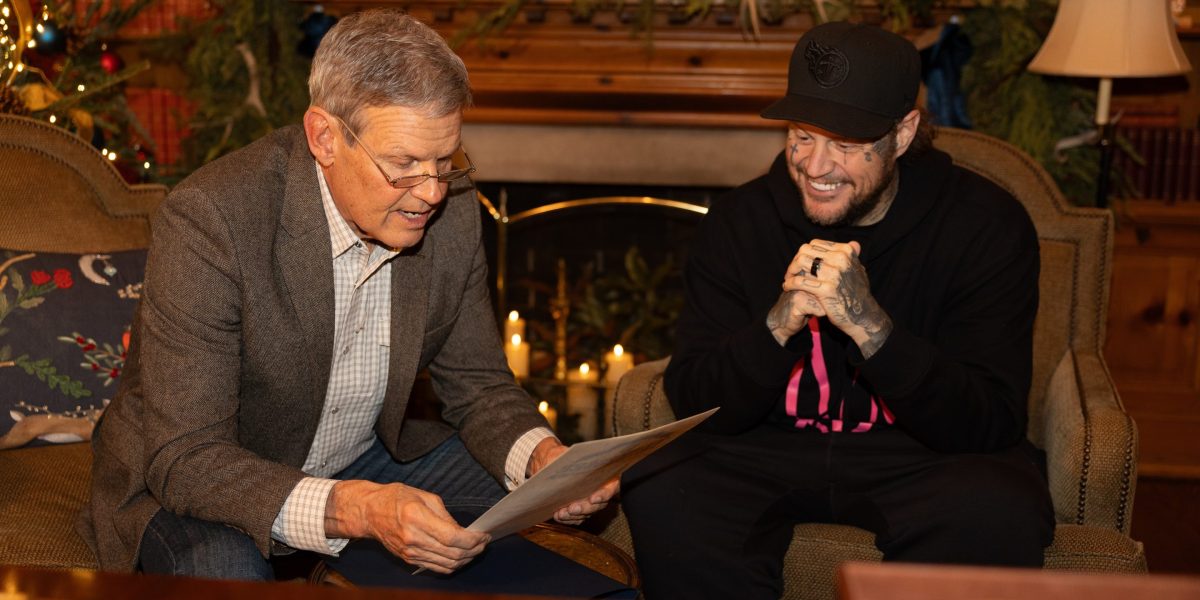
Lee said he never met Jelly Roll until Thursday, when the musician visited the governor’s mansion over the pardon news. The two hugged in front of a lit Christmas tree and a fireplace decorated with holiday garlands.

Unlike recent high-profile federal pardons, which let people off the hook for prison, a Tennessee pardon serves as a statement of forgiveness for someone who has already completed a prison sentence. Pardons offer a path to restoring certain civil rights such as the right to vote, although there are some legal limitations, and the governor can specify the terms.

Jelly Roll broke into country music with the 2023 album “Whitsitt Chapel” and crossover songs like “Need a Favor.” He has won multiple CMT Awards, a CMA Award and also picked up seven career Grammy nominations.

Much of his music deals with overcoming adversity, like the song “Winning Streak” about someone’s first day sober. Or the direct-and-to-the-point, “I Am Not Okay.”

“When I first started doing this, I was just telling my story of my broken self,” he told The Associated Press in an interview. “By the time I got through it, I realized that my story was the story of many. So now I’m not telling my story anymore. I’m getting to pull it right from the crevices of the people whose story’s never been told.”

Jelly Roll: ‘‘I was a part of the problem’

Before the parole board, Jelly Roll said he first fell in love with songwriting while in custody, calling music a therapeutic passion project that “would end up changing my life in ways that I never dreamed imaginable.”

Outside of sold-out shows, he’s testified before the U.S. Senate about the dangers of fentanyl, describing his drug-dealing younger self as “the uneducated man in the kitchen playing chemist with drugs I knew absolutely nothing about.”

“I was a part of the problem,” he told lawmakers at the time. “I am here now standing as a man that wants to be a part of the solution.”

Jelly Roll’s most serious convictions include a robbery at 17 and drug charges at 23. In the first case, a female acquaintance helped Jelly Roll and two armed accomplices steal $350 from people in a home in 2002. Because the victims knew the female acquaintance, she and Jelly Roll were quickly arrested. Jelly Roll was unarmed, and was sentenced to one year in prison plus probation.

In another run-in 2008, police found marijuana and crack cocaine in his car, leading to eight years of court-ordered supervision.

Sheriff whose jail held Jelly Roll urged a pardon

Friends and civic leaders cited his transformation in backing a pardon.

Davidson County Sheriff Daron Hall, who runs Nashville’s jail, wrote that Jelly Roll had an awakening in one of the jails he managed. Live Nation Entertainment CEO and President Michael Rapino cited Jelly Roll’s donations from his performances to charities for at-risk youth.

“I think he has a chance and is in the process of rehabilitating a generation, and that’s not just words,” Hall said in a phone interview Thursday. “I’m talking about what I see we need in our country, is people who accept responsibility, accept the fact that they make mistakes and accept the fact that they need help.”

The parole board began considering Jelly Roll’s pardon application in October 2024, which marks the state’s five-year timeline for eligibility after his sentence expired. Prominent Nashville attorney David Raybin represented Jelly Roll in the pardon case.

Lee’s office said no one was pardoned Thursday who had a homicide or a sex-related conviction, or for any crime committed as an adult against a minor.


Source link

Continue Reading

Business

Down Arrow Button Icon

Published

on


CEO burnout may be hiding in plain sight. The CEO of Calm, the world’s top sleep and meditation app, said business leaders are losing sleep, feeling drained, and contemplating quitting their jobs. But when asked how they are, they say they’re doing just fine.

Calm chief executive David Ko, speaking to an audience at the Fortune Brainstorm AI conference earlier this month, said his company did a survey of more than 250 C-suite executives, and posed a simple question to them: “How are you doing?”

“Most people said that they were doing good,” Ko said.

But when Ko broke down wellness metrics, from if leaders felt anxious or depressed to mentally present at work, the results were starkly different: 48% of respondents reported being overwhelmed, and a quarter said they were feeling anxiety or depression. Moreover, 34% said they were mentally drained, and 40% reported being unable to be mentally present on the job. Half of the survey participants said they thought of stepping down from their positions.

Ko also asked executives to compare their energy to a battery, arguing it’s a more accessible metric for individuals to assess their mental health. Only one in four executives said their batteries were “fully recharged.”

“Most leaders, like in this room, are operating at about 20%,” Ko said. “Think about what that means.”

The cost of CEO burnout

Burnout, which the majority of small-to-medium business executives report feeling, can not only result in leaders taking more sick days, higher absenteeism, and greater turnover, but can also gnaw at companies’ bottom lines. A study published by the American Journal of Preventive Medicine in April found burned-out workers can cost a workplace an average of $3,999 per hourly worker, and up to more than $20,000 per executive. The social contagion effect, in which employees pick up on the mood of their colleague or superior, can result in a “downward spiral” for the whole office, human resources experts said.

Ko said companies that have invested in mental health interventions report less burnout, higher returns in investments, and greater engagement. Nearly 85% of individuals Calm surveyed reported believing mental health directly impacts a company’s bottom line.

The CEO said mental health interventions, such as using a mindfulness app like Calm, can help employees process AI anxiety, particularly amid growing concerns of AI displacing human workers. According to a Pew Research Center report from February, more than half of employees surveyed said they’re worried about the impact of the technology in the workplace in the future. Calm, for its part, has integrated AI-guided meditations into its app, and Ko suggested his mindfulness app can not only alleviate AI anxiety through mindfulness, but also by having users engage with AI directly.

“In a world that’s currently being transformed by AI, organizations are realizing that our greatest assets aren’t just the technology,” he said. “It’s the people behind them.”


Source link

Continue Reading

Business

Down Arrow Button Icon

Published

on


Good morning. In this week’s episode of Leadership Next, Kristin Stoller and I speak with Dani Richa, chairman and group CEO of Impact BBDO International. In the annals of advertising, few agencies have had more cultural heft than BBDO. In the 1960s, it made Boomers feel part of the “Pepsi Generation” and DuPont cool with the tagline “Better Things for Better Living … through Chemistry.” Matthew Weiner even cited BBDO as the model for the fictional 1960s ad agency in his hit TV series Mad Men.  BBDO also created Snickers’ “You’re not you when you’re hungry” ad with Betty White, and many more iconic campaigns in its 134-year history. 

As a Dubai-based CEO who oversees BBDO Worldwide’s business in the Middle East, Africa and Pakistan, Richa argues that risk is a relative concept in fast-changing markets and times. He recalls thanking one CEO for taking a bold risk with a campaign, only to be told, “What? What risk? What do you mean? The biggest risk I would have taken is not doing that.”

“The starting point is choosing partners that share your values,” he said.

In an era where brands can whip up AI-generated ads—Guess’s AI-generated model in Vogue is hopefully not being a harbinger of what’s to come—Richa’s work is a reminder that technology alone will never triumph when it comes to bold ideas and creativity that’s rooted in real issues. “Big ideas that touch people, that move people, that move businesses, that never changes,” said Richa, while noting that BBDO “uses digital and social (media) like never before to amplify that messaging.”

The best ads don’t just sell products, they can change culture, politics, and the way people think. One especially memorable and award-winning campaign under his watch was “the Elections Edition” in 2022 for Lebanon’s An Nahar newspaper, which ran a blank edition, followed by an invitation for people to fill the pages with messages to politicians. It went viral, generating massive public pressure for elections and citizens’ right to vote. 

Richa compares AI to giving a camera to everyone and then realizing the best photographers produce different results. “AI is going to give you tons of stuff,” he says. “To pick the right message takes a lot of experience, a lot of creative judgment.”  

You can listen to our full conversation on Apple, Spotify or YouTube.

Contact CEO Daily via Diane Brady at diane.brady@fortune.com

Top news

OpenAI looking at $830 billion valuation

Sam Altman’s AI company is in talks for $100 billion in new investment from Softbank and others, the WSJ says. The company is also considering a possible IPO next year.

What that Trump Media-nuclear fusion deal means

The financially struggling Trump Media & Technology Group’s $6 billion merger with a nuclear fusion developer represents either a bet on more taxpayer dollars being invested in the first fusion player to go public—soon owned in part by the Trump family—or a belief that an influx of capital will speed up the launch of clean, limitless electricity that eventually will transform the global grid.

TikTok sale agreed

ByteDance, the Chinese company that owns TikTok, has reached a deal to offload 80% of its U.S. assets to Oracle, Silver Lake, and MGX, according to Reuters. The valuation is not yet known. The deal will help the company avoid being banned in the U.S.—a longstanding promise of President Trump. 

Chanel’s Claire Isnard speaks

Claire Isnard can trace her 40‑year career—including 17 years at Chanel—back to one bad exam. Had she passed, she’d likely still be in a classroom, grading essays on Italian literature. In her first-ever sit-down interview ahead of her retirement, Isnard says she’s come full circle. Despite having zero HR qualifications, she wound up as Chanel’s chief people and chief organization officer. “When you draw my story back, the first compelling and meaningful thing that would end up spread across everything I’ve done is helping people become who they didn’t think they can become,” she told Fortune.

PayPal CEO Alex Chriss on stablecoins

Since January, PayPal’s stock price has dropped more than 30% as it tries to halt competitors from encroaching on its core products of online checkout and peer-to-peer payments. In response, Chriss says the fintech is looking to get a lift from next-generation payment products like stablecoins, and working to incorporate them across its operations and products. 

North Korea is biggest crypto thief

A massive amount of crypto was robbed this year, and most of it went to North Korea. The country accounted for roughly 59% of the more than $3.4 billion in stolen crypto, according to Chainalysis’ 2026 Crypto Crime Report. 

More Epstein photos released

House Democrats released several dozen more photos Thursday from the estate of the convicted sex offender Jeffrey Epstein, showing his associations with the rich and famous, including Bill Gates and Sergey Brin, as the Department of Justice faces a deadline to release many of its case files by the end of the week.

EU agrees €90 billion loan to Ukraine

After a deal to use frozen Russian assets fell apart, the bloc agreed to fund Kyiv’s defense against the invasion by Russia with its own cash. “We committed, we delivered,” European Council president António Costa said.

Trump designates Christmas Eve, Dec. 26 as federal holidays

Government workers will get a five-day weekend, perhaps setting a tone for the private sector.

The markets

S&P 500 futures are up 0.33% this morning. The last session closed up 0.79%. STOXX Europe 600 was flat in early trading. The U.K.’s FTSE 100 was flat in early trading. Japan’s Nikkei 225 was up 1.03%. China’s CSI 300 was up 0.34%. The South Korea KOSPI was up 0.65%. India’s NIFTY 50 was up 0.59%. Bitcoin was at $88K.

Around the watercooler

Southeast Asian economies prove resilient in the face of Trump’s tariffs as supply chains expand by Angelica Ang

Walmart’s women truckers surge thanks to $115,000 starting pay and other perks bringing in nontraditional candidates Marco Quiroz-Gutierrez by Marco Quiroz-Gutierrez

Lovable hits $6.6 billion valuation as its CEO says it wants to be ‘the last piece of software’ companies ever buy by Beatrice Nolan

‘This is a wacky number’: economists cry foul as new government data assumes zero housing inflation in surprising November drop by Eva Roytburg

How Salient, an AI loan processing startup valued at $500 million, grew ARR to $25 million in two years by Lily Mae Lazarus

CEO Daily is compiled and edited by Jim Edwards and Lee Clifford.


Source link

Continue Reading

Business

The new American Dream has parents easing up on college expectations for their kids—1 in 3 are now open to trade school instead

Published

on


Many parents and kids alike are wondering whether college has the same return on investment it once did. Going to college was once seen as a one-way ticket to a successful and lucrative career. Still, there are a growing number of six-figure jobs that don’t require a degree, while entry-level job opportunities for recent graduates remain sparse

Some parents are so anxious about today’s job market that they’re exploring alternatives to the four-year degree, with one-in-three open to the idea of their kids attending a trade school instead, according to new survey results from American Student Assistance, which surveyed more than 2,200 parents of middle and high school students about their attitudes, perceptions, and decision-making about their kids’ post-high school plans. 

The fact that 35% of parents believe career and technical education is best suited for their children represents a major jump—from just 13% in 2019, according to ASA. While parents still prefer traditional college for their kids, it’s much less so than in the past. The percentage of parents preferring it dropped to 58%—a 16 percentage point drop from 2019.

And another study from ASA this summer shows it goes both ways: 70% of teens also report their parents are more supportive of forgoing a college education for something different, like trade school or an apprenticeship. 

“Parents are waking up. College doesn’t carry the same [return on investment] it once did because the cost is outrageous, and the outcome is uncertain,” Trevor Houston, a career strategist at ClearPath Wealth Strategies, previously told Fortune. “Students now face the highest amount of debt ever recorded, but job security after graduation doesn’t really exist.”

The average cost of college in the U.S. is more than $38,000 (tution and room and board) per student per year, according to the Education Data Initiative, and the average cost of college has more than doubled this century. Private schools almost always cost more than the average. Meanwhile, more than 4 million Gen Zers are jobless and blame their “worthless” college degrees. 

Why trade school is becoming more popular

One of the primary reasons trade school is becoming a more popular option for students is it can have a strong ROI, especially as college becomes more expensive and fewer traditional entry-level jobs are available. And many can land recent high school grads six-figure salaries. 

Some trade jobs that don’t require a college degree and pay six figures, according to the National Society of High School Scholars include:

  • Aircraft mechanics ($135,628)
  • Plumbers, pipe fitters, and steamfitters ($132,275)
  • Construction manager ($130,000)
  • Industrial electricians ($122,500)
  • Energy technician ($115,076)

What’s more is availability of these jobs will continue to grow, especially as older generations who work in trades start to retire, Julie Lammers, executive vice president at American Student Assistance, previously told Fortune

“An aging workforce in the trades and a surge in demand to meet infrastructure needs, ever-growing real estate demands, and changes to U.S. energy production mean that there are considerably more job openings than skilled workers to fill the need,” she said. 

Aside from trade school, students can also instead pursue apprenticeships, career-training programs, bootcamps, industry certifications, and occupation licenses. Many of thse are just pennies on the dollar compared to earning a college degree. A coding bootcamp can cost as little as $7,000—and that’s just a one-time fee as compared to nearly $40,000 for one year of college. 

These career paths made possible by trade schools, apprenticeships, bootcamps, and other training and certification programs were coined by IBM as “new-collar jobs.” In October 2017, IBM launched its apprenticeship program to train people for new-collar jobs that prioritize skills over degrees, and focuses on in-demand job functions like cybersecurity, design, data science, mobile development, cloud, artificial intelligence, and blockchain—all career paths that can also lead to six-figure salaries. 

The Trump administration also announced this week its Tech Force program, which does not require a college degree or work experience for technology professionals who are willing to serve two-year stints in federal agencies. If you’re accepted to the program, you can earn about $150,000 to $200,000, considering the demand for tech professionals in today’s rapidly evolving tech landscape.

“This is a clarion call,” Scott Kupor, director of The US Office of Personnel Management, said in a statement. “If you want to help your country lead in the age of rapid technological advancement, we need you.”

This story was originally featured on Fortune.com


Source link

Continue Reading

Trending

Copyright © Miami Select.