Connect with us

Politics

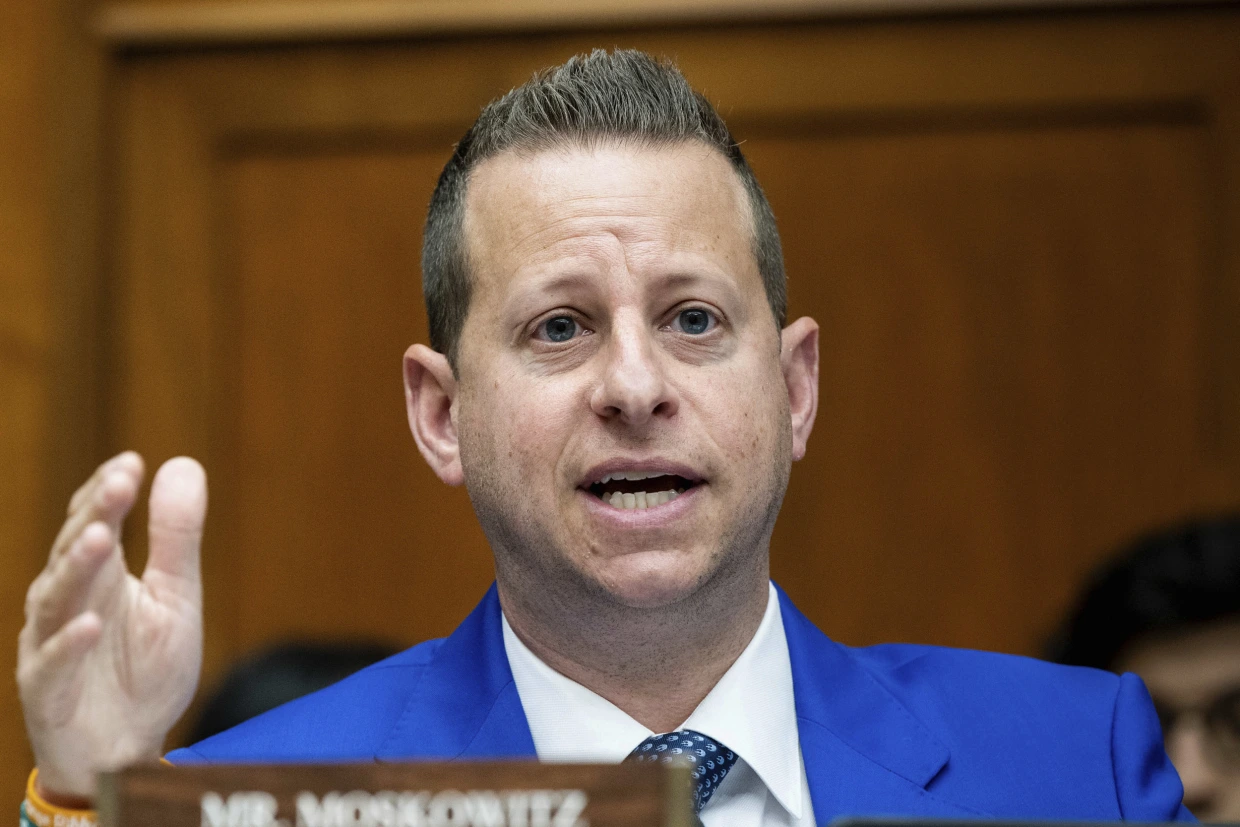
Jared Moskowitz tops 1 Primary challenger, 4 GOP foes in Q3 fundraising with $372K haul
Published

on


Democratic U.S. Rep. Jared Moskowitz doesn’t lack competition for his seat representing Florida’s 27th Congressional District, but he’s still far and away the mightiest fundraiser of the bunch.

Six candidates, including one Primary challenger — first-time candidate Oliver Larkin, who turned in an impressive first round of fundraising — are actively running to unseat him this cycle.

Their combined gains last quarter barely exceed what Moskowitz alone raised.

Between June 1 and Sept. 30, Moskowitz amassed about $372,000 through 561 contributions, roughly half of which came from Florida donors.

After spending about $163,000, he had $773,600 left heading into October. He has raised $904,500 since winning re-election in November with 53% of the vote against Republican Joe Kaufman, who is again running and leads the GOP Primary field in funding so far.

Corporate donors included the political arms of Altria, Amtrak, AT&T, General Motors, Holland & Knight, Publix, RTX and T-Mobile.

Many union and trade groups — including the Amalgamated Transit Union, American Veterinary Medical Association, Independent Community Bankers of America, International Union of Brick Layers and Allied Craftworkers, International Association of Sheet Metal Workers, National Air Traffic Controllers Association, National Beer Wholesalers Association, Internet and Television Association and SEIU — each gave four-figure sums.

So did several political committees, including PACs associated with U.S. Reps. Pete Aguilar, Katherine Clark, Nancy Pelosi, Brad Schneider and the Democratic Congressional Campaign Committee.

In terms of sheer numbers, personal checks, some as low as $10, drove Moskowitz’s gains. His biggest donors — who gave him $7,000, the maximum allowable, representing $3,500 apiece for the Primary and General elections — included Fort Lauderdale lawyer Michael Freedland, 3D modeling software executive Jon Hirschtick of Massachusetts and Colorado-based disaster consultant Alyssa Carrier.

He also got $5,000 from aerospace component manufacturing executive Brian Neff of Miami Beach, $4,000 from leadership coach Lisa Rogoff and $3,500 from Bed Bath & Beyond co-founder Leonard Feinstein and Fort Lauderdale lawyer Bernie Friedman.

Close to a third of Moskowitz’s spending — $52,400 — covered credit card payments. Another $47,000 paid for digital consulting services for Maryland-based Liftoff Campaigns.

He also spent $20,000 to repay himself for loans to the campaign and paid $7,500 to Johnson Strategies for strategic consulting and $5,200 to 1776 Inc. for printing. Both companies are based in Wilton Manors.

Other notable expenses included donations of $3,600 to the Broward Democratic Party, $2,000 to the Broward County AFL-CIO, $1,000 to the Democratic Club of Boca Raton and Delray Beach and a $2,500 payment for advertising to Florida Politics parent company Extensive Enterprises.

The rest covered credit card processing fees, bank fees, travel, food, software, insurance, supporter gifts, merchant fees, payroll expenses, email services, taxes, accounting services and postage.

Kaufman, a nonprofit executive who beat several better-funded fellow Republicans last cycle, raised more last quarter than he did by the time the 2024 Primary took place. He added almost $133,000 to his coffers in the third quarter through hundreds of personal transactions, most for two figures or less.

Notably, just 14% of the itemized contributions he received —donations for which the FEC mandates details about the giver and specific dollar values over $200 — came from Florida.

His biggest gain, a $7,000 check, came from George Daniels of Orlando-based Daniels Manufacturing Corp., which drew headlines in 2020 after it sent employees letters threatening layoffs if Joe Biden won the presidency.

Kaufman spent just $2,700. It went toward marketing, printing, postage and cell phone service costs.

He reported holding nearly $359,000 by Oct. 1, including $53,600 in self-loans and $38,600 in debts to businesses or organizations from 2011 to 2015 still listed as unreconciled.

Coming in just behind Kaufman in fundraising last quarter on the GOP side was former state Rep. George Moriatis, a lawyer who announced his candidacy for CD 23 in early March and has since collected more than $500,000, counting $110,000 in self-loans.

Last quarter, he raised $110,000 through 105 contributions, 85% of which came from Florida donors. Notable givers included Ohio self-storage executive Tom Amsdell, whose $1,000 donation increased his total giving to Moriatis to $3,500.

Loretta Amsdell, the Boca Raton-based namesake for a trust related to the Amsdell family’s U-Store-It company, chipped in $3,500.

Fort Lauderdale-based ship salvage and rescue mogul Joseph Farrell, the founder of the Mission Resolve Foundation, gave the same.

Moriatis also received $1,000 from the Lincoln Reagan Committee.

He spent $65,000, leaving $405,000 at the end of the quarter. Of that, $25,300 went to Bonita Springs-based Ace Political for campaign and finance consulting. The rest covered donation processing fees, legal services, advertising, wages, printing and email services.

Larkin, a first-time candidate who has worked as a union organizer and was part of Bernie Sanders’ 2016 presidential campaign, also broke the six-figure barrier last quarter with about $101,000 raised since he filed June 21.

He did it by pulling in well over 1,000 donations, all but 30 or so for less than $1,000.

Larkin’s biggest contributions — $7,000 a pop — came from his parents, Paul and Margot Larkin, and Sunny Isles resident Benjamin Menasha.

He also received $6,000 from Connecticut retiree Eugene Elias, $5,000 from Elias’ wife Gail, $3,500 from Pamela Huizenga — the adopted daughter of late business and sports magnate Wayne Huizenga — and $1,000 from political commentator Krystal Ball of Virginia.

Larkin spent conservatively, doling out about $19,600 for travel, lodging, phone fees, web hosting, database management, donation processing fees and a $5,400 self-reimbursement for campaign launch costs, leaving about $81,100 in his coffers.

Republicans Jared Gurfein and Raven Harrison raised $27,600 and $6,000 last quarter, respectively.

Gurfein, who filed to run July 1, spent close to half of what he raised and reported having $14,100 left by the end of Q3.

Harrison, who has been running since March, spent $24,500. This cycle alone, she reported raising $565,000 — more than half of which, $292,000, were self-loans that are refundable if unspent — and expending $337,000.

A fifth Republican candidate, Darlene Swaffar, filed a termination report in July and is out of the race.

CD 23 covers Boca Raton and West Boca in Palm Beach County, and northwest Broward County and coastal Broward south to Fort Lauderdale. Moskowitz took 51.6% of the vote in 2022 to defeat Palm Beach GOP Committeeman Joe Budd for the right to succeed then-U.S. Rep. Ted Deutch, who left office to lead the American Jewish Council.

The seat is one of 26 that the National Republican Congressional Committee is targeting for flips this cycle.

The 2026 Primary is Aug. 18, followed by the General Election on Nov. 3.


Source link

Continue Reading

Politics

Gov. DeSantis now says poorer counties will ‘eventually’ be on their own to deal without property taxes

Published

on


What once was framed as “budget dust” could eventually be gone with the wind, leaving local politicians in small towns with tough decisions in the coming years.

Gov. Ron DeSantis is reiterating his promise to give fiscally constrained counties money in his new budget proposal to replace potentially property tax revenues should they be phased out. But DeSantis is now saying those cash-strapped jurisdictions will have to do without supplementary funds down the road.

“I’m not saying it’s even going to be necessary, but I put in the budget enough money to completely, 100% reimburse any homestead property tax reduction for those fiscally constrained counties,” DeSantis said in Orlando.

“There’s some people that say you shouldn’t do that. But my view is it’s a little more difficult maybe for some of them. And now, eventually they’re going to have to figure it out.”

DeSantis rolled out the budget proposal to aid smaller counties during a cable news hit last week, but did not say there would eventually be an end to state-level generosity despite touting a “big surplus” to a national audience.

“We have 32 fiscally constrained counties. You know, Miami-Dade, Palm Beach, these are powerhouses. I’m putting in my budget the revenue to totally backfill every one of those rural counties. So they’re not going to miss a single thing,” the Governor said on “Fox & Friends.”

However, he first teased the idea in October.

“I can fund all that. I can take all 32 fiscally constrained counties, I could fund 100% of tax revenue that would be derived from a homestead Florida residence, property taxes. And it’s like budget dust for us,” DeSantis said in Panama City.

A total of 32 of Florida’s 67 counties are designated as fiscally constrained.

Typically lower in population and property value, they include Baker, Bradford, Calhoun, Columbia, DeSoto, Dixie, Franklin, Gadsden, Gilchrist, Glades, Gulf, Hamilton, Hardee, Hendry, Highlands, Holmes, Jackson, Jefferson, Lafayette, Levy, Liberty, Madison, Okeechobee, Putnam, Suwannee, Taylor, Union, Wakulla and Washington counties.

DeSantis has been leaning on lawmakers in the supermajority Republican Legislature to put a measure eliminating homestead property taxes on the ballot, even teasing a Special Session during the Summer if they don’t ratify something during the Regular Session.

That ballot measure would need 60% support should it be presented to voters.


Source link

Continue Reading

Politics

Stan McClain, Lauren Melo push for ‘Blue Ribbon’ projects to boost land preservation

Published

on


State lawmakers are considering a proposal aimed at encouraging Florida’s largest private landowners to serve as long-term stewards of both the natural and built environments, offering a framework supporters say better aligns growth, conservation and infrastructure planning.

Sen. Stan McClain and Rep. Lauren Melo have each filed bills (SB 354, HB 299) establishing “Blue Ribbon” projects, which would apply to landowners who control or own at least 10,000 or more contiguous acres. The measures would require participating landowners to conserve at least 60% of the property.

Under the bill, the plan must prescribe the development property over a 50-year planning period by meeting strict statutory requirements. Landowners would still have to earn approval from local governments based on compliance with the statutes, including development orders, and concurrency. 

“HB 299 creates a framework that secures large-scale private land conservation for the long term — without requiring state purchase or taxpayer subsidies,” Melo said.

“The legislation not only fosters responsible growth, it also expands the availability of attainable housing for Florida families. The Blue Ribbon Projects bill strikes a balance that will be good for our communities, while protecting natural spaces, wildlife corridors and critical water recharge areas.” 

The stated Blue Ribbon project goals are to protect wildlife and natural areas; limit urban sprawl; provide a range of housing options including missing middle and affordable housing; create quality communities designed to reduce vehicle trips and promote mobility options; and enhance local economic development objectives and job creation.

The proposal is born of a desire to implement smart growth strategies by ensuring growth occurs only where it can be supported. The proposal requires phased planning for water, wastewater, transportation, schools and utilities.

It also emphasizes sustainability beyond just conservation lands, by ensuring new development supports population density in compact communities that are mobility focused.

The measure also seeks to ensure the state is a good steward of taxpayer dollars, by allowing conservation lands to be secured without public dollars. 

Still in its early phases, the bill has some early detractors, such as the Sierra Club, worried the proposal constitutes a local government preemption. But Audubon Florida’s Beth Alvi has not taken a direct position and remains hopeful, telling POLITICO that Melo “has always been solutions-oriented and is a devoted advocate for her community.”

Supporters, meanwhile, argue the process actually gives local residents more say in development in or near their communities through a real remedy process for landowners or anyone who objects to the project proposal.

“These bills are about the Florida we leave behind. They secure meaningful land conservation at no cost to taxpayers, while giving our state a responsible way to plan for future growth. SB 354 and HB 299 also bring fairness and predictability to the review process and support sustainable development that pays its own way — providing the long-term certainty communities and local governments need to plan wisely,” McClain said.

The House version of the bill will be heard in its first committee, the Intergovernmental Affairs Subcommittee, Thursday at 9 a.m.


Source link

Continue Reading

Politics

First Coast manufacturing was generally flat in November, with signs of improvement

Published

on


First Coast manufacturers put the brakes on contraction for the first time in months in November, though the general industrial picture was flat.

The University of North Florida (UNF) Jacksonville Economic Monitoring Survey (JEMS) shows several sectors of the manufacturing elements expanded in November, the most upbeat turnaround on the First Coast in several months. Seven out of the 12 elements of the UNF survey showed the Purchase Managers Index (PMI) expanded last month. That’s a big change from October, when only two sectors showed expansion.

“Jacksonville’s headline PMI of 50 in November indicates that local manufacturing activity was essentially flat. This stands in contrast to the national PMI of 48.2, which shows that U.S. manufacturing continued to contract at a faster pace,” said Albert Loh, Interim Dean of the UNF Coggin College of Business who oversees the JEMS survey.

“Still, a flat PMI is relatively positive when compared with deeper national declines and highlights Jacksonville’s resilience heading toward 2026.”

UNF researchers from the JEMS project reach out to First Coast manufacturing companies each month to see where they stand on production and several other factors.

One of the key factors that showed expansion for North Florida manufacturers in October was output, which jumped from a 49 figure in October to 53 in November.

“A reading of 53 suggests a modest but meaningful pickup in business activity in the region. While not signaling a boom, it reflects resilience and indicates that local firms are navigating cost pressures, supply chain adjustments, and mixed demand with cautious optimism,” the JEMS report concluded.

New orders, another high-profile manufacturing element, also showed a substantial uptick increasing from a figure of 49 in October to 52 in November.

“New orders are a leading indicator, so this improvement points to potentially stronger production, hiring, and inventory activity ahead,” the JEMS report said.

Other factors that showed expansion in North Florida last month included output prices, average input prices, quantity of input purchased, inventory of input purchased and business activity outlook over the next year.

Key elements that are still sluggish with contraction included employment, backlogs of work, finished goods inventory and suppliers’ delivery times. New export orders were unchanged.


Source link

Continue Reading

Trending

Copyright © Miami Select.