Connect with us

Business

Japan braces for shift to right under ‘Iron Lady’ fan Takaichi
Published

on


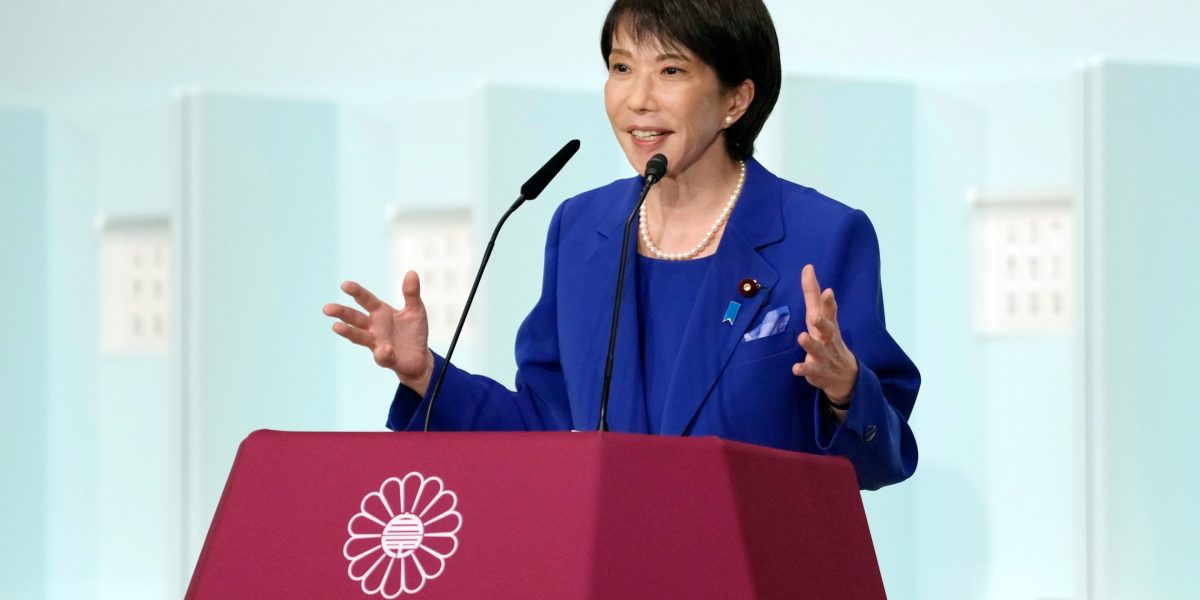
Sanae Takaichi, the pro-stimulus conservative poised to become Japan’s first female prime minister, is an energetic nationalist with a soft spot for the hard-nosed politics of Iron Lady Margaret Thatcher and the heavy metal music of Iron Maiden.

In choosing the former economic security minister as its leader, the Liberal Democratic Party is essentially betting on a swing back to the right to attract the younger voters who have flocked to smaller populist outfits, including the arch-conservative Sanseito party. 

It’s a move that could backfire if the party is seen simply reverting to the easy money and hawkish diplomacy of her mentor, former Prime Minister Shinzo Abe, without any new ideas.

Takaichi is expected to become premier later this month in a parliamentary vote. In becoming the LDP’s chief, Takaichi has already smashed a glass ceiling in a nation that has only seen male ruling party leaders. 

Her ascent to the top of the political world will send ripples through the male-dominated society that languishes near the bottom end of global gender equality rankings. But like Thatcher, the former UK prime minister whom she cites as an inspiration, her conservative views place her a long way from the stance of progressive feminism.

Her ability to build a lasting legacy as the nation’s leader will depend less on her ability to further the position of women than on her capacity to restore the fortunes of a ruling party in disarray after decades of dominance in postwar Japan. 

“From a normal woman’s perspective, she’s what you might call an idol for ‘old men,’” said Mieko Nakabayashi, politics professor at Waseda University. “She’s someone who expresses ‘old man’ opinions from a woman’s mouth and makes them happy.”

Her longevity at the head of a fickle political machine known for quickly axing its presidents will depend on how swiftly she can unite the party, win back public support and connect with those younger voters. She will also need to build consensus with opposition parties to pass legislation in a parliament where the LDP no longer has a majority.

Read more: The Party That Ruled Japan for Decades Is in Danger of Crumbling

Provided she becomes prime minister as expected, one of her first tasks will be to build ties with Donald Trump amid reports that the US president will make a stop in Japan in late October during a trip to Asia. 

Takaichi was the most forthright among the five candidates in the leadership race over the possibility of renegotiating parts of Japan’s trade deal with the US. But she toed the line following her election on Saturday, saying that an immediate renegotiation was not on the table. She still said Japan will make its opinions known through the appropriate routes should the deal not serve its interests.

But she said that might happen only if there are problems implementing the deal in its current form, a comment that suggests she is on board with the agreement for now.

On issues such as ramping up Japan’s defense spending and capabilities, containing China’s growing influence and building supply chains that align with US interests, she is likely to be a good match for Trump’s views. Still, she likely has less name recognition among US conservatives who have met her rival in the leadership contest, Shinjiro Koizumi, and who remember his father Junichiro wearing Elvis shades and serenading former President George W. Bush two decades ago.

“Takaichi has extensive experience as a politician, and since the US’s hardline stance toward China does not significantly conflict with her own views, she should be able to build a good relationship with President Trump,” said Yuichi Kodama, chief economist at Meiji Yasuda Research Institute.

For investors, the main concern will be her reputation for wanting spending to achieve growth and her penchant for central bank stimulus to goose the economy. In the latest leadership campaign, she toned down her scathing views on the Bank of Japan’s interest rate hikes from last year, when she described its raising of rates as “stupid.” But in a recent Kyodo survey she still said the BOJ should leave interest rates unchanged for now. That comment comes amid expectations the bank may raise borrowing costs again later this month.

Her spending plans are less clear. All of the candidates were expected to unleash a package of economic measures to help consumers deal with inflation in the fall, but she was the boldest in saying that extra bond issuance may be needed. In line with many in the LDP, she remains cautious on the idea of opposition demands to lower the sales tax, one of the costliest options for dealing with the cost-of-living crunch. 

Instead Takaichi has promised cash handouts and tax rebates to help households. She’s also hinted at raising the tax-free income allowance before the end of the year, a move that would resonate well with the Democratic Party for the People, another populist party that has made major inroads in the last year or two. 

While saying her spending plans will be “responsible” and that she’ll ensure the nation’s net debt load will fall over time, she said “the goal is achieving economic growth, not fiscal health,” in a sign of her expansionist spending tendencies. 

“While she always leaned toward a reflationary stance, the current economic environment has changed significantly, and curbing inflation has become the country’s mission,” said Meiji Yasuda’s Kodama. “Opposing the BOJ’s rate hikes would be contradictory, so I don’t think she can make extreme statements regarding monetary policy.”

Still, the possible outcome for markets when they open on Monday is a fall in the yen on expectations of slower central bank normalization, a rise in stocks on a weaker currency and an uptick in super-long yields on fears over longer term spending plans.

Takaichi was born on March 3, 1961 and grew up in the ancient capital of Nara, a city known for the emergence of Buddhism in Japan. Her father worked as a salesman at an equipment manufacturing company while her mother worked for the Nara police force. She studied business management at Kobe University. 

As a student, she rode a motorbike and played drums in a heavy metal band, and counts herself as a fan of British heavy-metal bands Black Sabbath and Iron Maiden, according to local media. She still occasionally picks up the sticks to hammer away on an electric drumset at home, if she squabbles with her husband, she told a local broadcaster in an interview. Her go-to song is “Burn” by Deep Purple. 

“To be honest I wish I could go out for karaoke, but I’ve been reining myself in these past years,” she said in that interview.

She studied at the Matsushita Institute of Government and Management, an organization focused on producing leaders in the world of politics and industry. 

She worked briefly as a news anchor before winning her first election in 1993 as an independent at a time when the LDP was in disarray following the bursting of Japan’s economic bubble. That election saw a multitude of opposition parties join forces to form a patchwork administration and oust the LDP for the first time since its formation. But as it has done subsequently, the LDP found a way of regrouping and taking back power, while most of the parties that ousted it have vanished.

Over her years as a politician, including her time as internal affairs minister, promoter of “Cool Japan” and as economic security minister, Takaichi has garnered a reputation as studious with an attention to fine detail. She is known to shun socializing and drinking with her peers.

“If I’m going to go out for dinner or have a drink, I’d much rather work or study something new,” she said during a campaign speech last year, adding that she often works over weekends. 

Shortly after winning the LDP election she doubled down on that message.

“I’m going to abandon the phrase ‘work-life balance,’” she said, prompting laughter from the rows of LDP lawmakers listening to her speech. “There is a mountain of things that we must accomplish together and I would like to see you work like horses.”

As a conservative darling and Abe protege, China may be wary of how she navigates a relationship that has remained tense in recent years. 

Previously, Takaichi did not mince her words when asked whether she would visit Yasukuni shrine, which honors Japan’s war dead including those who were charged as war criminals after World War II. Visits by previous prime ministers have angered neighboring countries and proven to be a flashpoint for Japan and China.

“Once the sentence is carried out, they are no longer criminals,” she said during a live TV show last week. She toned down her messaging after being elected Saturday, saying that she’ll make appropriate decisions over praying at the shrine.

She opened her campaign speech with a gripe about foreign tourists in Nara, saying she had heard of some tourists kicking the deer that roam freely in the local parks. 

That gripe seemed to tap into broader anxieties felt by the public as the number of foreign-born visitors and workers rises amid a drop in Japan’s own population. With Sanseito gaining ground in elections by capturing such concerns under a “Japanese first” message, Takaichi could be the conservative icon the LDP thinks it needs to win back right-wing voters. Among the five candidates, she consistently ranked as the most popular in recent opinion polls among the general public.

In a twist of irony for Japan’s likely first female prime minister, her conservatism may not bode well for gender equality issues. 

She opposes same-sex marriage or allowing spouses to have separate surnames, claiming it could undermine family unity. Novelist Kyoko Nakajima once called Takaichi “an honorary man” for maintaining views consistent with a traditional male-centered society, the Japan Times reported in 2021.

And while her appointment breaks a glass ceiling, it also risks becoming a glass cliff.

“Female leaders are often given some leeway for not doing things the ‘traditional’ way,” said Waseda’s Nakabayashi, who was skeptical whether Takaichi’s election represents a new era for women in Japan. “That’s why it’s often the case that women only get the leadership positions when the going gets really tough.”


Source link

Continue Reading

Business

One Trump proposal meant to prevent ‘nation of renters’ may make homeownership harder, experts say

Published

on


President Donald Trump said he is reestablishing the American dream of homeownership, but one of his most recent housing policy proposals may put the dream even more out of reach, experts say.

Speaking Wednesday at the World Economic Forum in Davos, Switzerland, Trump touted his barrage of recent housing policy executive orders, including preventing institutional investors from buying single-family homes and attempting to lower mortgage rates by directing government-controlled mortgage finance firms Fannie Mae and Freddie Mac to purchase $200 billion in mortgage-backed securities.

“It’s just not fair to the public [that] they’re not able to buy a house,” Trump said Wednesday of institutional homebuying. “And I’m calling on Congress to pass that ban into permanent law, and I think they will.” Trump has also asked Congress to cap credit-card interest rates at 10%, which he claimed Wednesday “will help millions of Americans save for a home.” 

Trump also spoke directly to Wall Street giants and institutional homebuyers at Davos, saying that “many of you are good friends of mine [and] many of you are supporters,” but “you’ve driven up housing prices by purchasing hundreds of thousands of single family homes.” 

“It’s been a great investment for them, often as much as 10% of houses on the market,” Trump said. “You know, the crazy thing is, a person can’t get depreciation on a house, but when a corporation buys it, they get depreciation.” 

One policy that went unmentioned during Trump’s Wednesday speech in Davos, and one experts say could carry potentially big risks and do little to address the root causes of high housing costs, is his proposal that would allow Americans tap their 401(k) savings for mortgage down payments, which now averages 19% of a home’s price. The current U.S. median home price is about $428,000, according to Redfin, meaning a down payment could amount to a whopping $81,000. Trump hasn’t put a dollar or percentage figure on the cap for the amount Americans could pull from their 401(k)s to use toward a down payment.

Trump’s final plan on allowing Americans to use their retirement savings for down payments would likely require congressional approval because it may involve changing the tax code. The proposal, announced Friday by Kevin Hassett, director of the National Economic Council, is Trump’s latest attempt to address growing concerns about affordability across the U.S. economy, especially in the housing market, and prevent America from becoming “a nation of renters,” as he said in his address at the World Economic Forum Wednesday.

Benefits of using 401(k) funds for a down payment

Trump’s idea has some benefits. The number of first time homebuyers has fallen to half of what it was about a decade ago, according to data from the National Association of Realtors. In addition, 22% of those who are able to buy their first home are already using either borrowed money or a gift from a friend or relative for their downpayment, according to the NAR.

While Americans can already withdraw up to $10,000 to pay for a home from individual retirement accounts (IRAs) without repaying it before age 59 ½ , this rule doesn’t apply to employer-sponsored 401(k)s, the most common retirement account, unless account holders pay a 10% penalty. 

Americans can withdraw money without a penalty from their retirement plans for some exempted purposes such as recovering from a natural disaster and some medical expenses, but still have to pay income taxes on their tax-deferred accounts. These “hardship withdrawals” increased to 4.8% of participants in Vanguard retirement plans in 2024, up from 3.6% in 2023.

Most employer-sponsored 401(k)s also allow Americans to borrow for a limited time from their retirement savings penalty-free before 59 ½, including for a home purchase, as long as they repay the amount borrowed to the account with interest.

Given the limited options for accessing retirement accounts, the president’s proposal could help Americans in need of cash to unlock liquidity for a down payment. This could be especially helpful for those who may struggle to repay an IRA loan, Robert Goldberg, a finance professor at Adelphi University in Garden City, N.Y., told Fortune.

Drawbacks of using 401(k) funds for a down payment

Still, Goldberg warned swapping out the diversified investments of a 401(k) and concentrating a large chunk of their investment into one asset is risky. While some believe home prices always go up, the housing market collapse of 2008 showed this isn’t always the case.

“Imagine home prices drop so much that the home price goes not just down to the mortgage level, but to below the mortgage level, wipes out your equity position,” he said. “You would have lost your equity, your 401(k) equity. Bad outcome.” 

Experts say Trump’s proposal also does little to address the supply side of the housing market, which has been largely frozen as homebuyers who bought in at lower interest rates prior to the pandemic have been hesitant to sell, Goldberg said. Giving more people the means to buy homes without adding more supply may inadvertently increase prices and lock more people out of the housing market, instead of making it more affordable, he argued. 

“Some people will benefit from [Trump’s plan], but overall it will just be more competition for homes,” Goldberg said. 

Yet, Trump’s proposal dealing with retirement savings is especially risky because it makes it easier for Americans to use crucial retirement savings meant for the future for non-retirement uses, said Jake Falcon, a chartered retirement planning counselor and the CEO of Falcon Wealth Advisors.

The median retirement savings for an American between the ages of 45 and 55 was $115,000 as of 2022, according to the Federal Reserve. Yet, this amount may not suffice for everyone, as some experts suggest the average person needs to have saved eight to 10 times their annual salary to retire comfortably.  

“People, generally speaking, are more than likely behind, and this will just make them further behind,” Falcon said.

Given the bleak data on American retirement savings, Falcon said the government should make dipping into a retirement account for other uses harder instead of easier.

“Allowing people to raid their 401(k) doesn’t solve the problem,” he said.


Source link

Continue Reading

Business

‘Let’s not be naive’: Ray Dalio warns the global rule-based order is already ‘gone,’ toppled by America’s debt crisis and raw power

Published

on


Bridgewater Associates founder Ray Dalio, speaking to Fortune‘s Kamal Ahmed at the World Economic Forum in Davos, Switzerland, issued a stark warning to global leaders and business executives: Stop pretending the old rules still apply. In a candid assessment of the current geopolitical landscape, Dalio argued the fate of the post-World War II global order—much debated amid President Donald Trump’s pursuit of Greenland and unsettling of the NATO alliance—is a moot point.

“Let’s not be naive and say, ‘Oh, we’re breaking the rule-based system,’” Dalio said. “It’s gone.”

The billionaire founder of the largest hedge fund in history added that as a student of financial history, he pays close attention to the economic cycles of the last 500 years and sees cycles repeat themselves over time.

“And what I learned through that exercise is the same thing happens over and over again,” he said. “And it’s like a movie for me. It’s like watching the same movie happen.”

According to Dalio, five specific forces interact to drive the movie plot forward, with the “money-debt cycle” serving as the MacGuffin that kicks things off. The roots of the current instability, Dalio explained, lie in the monetary decisions made during the past several decades. Since 1971, when the U.S. under President Richard Nixon broke the dollar’s link to gold, Dalio notes, governments have consistently chosen to “print money” rather than allow debt crises to naturally play out. This behavior occurs when debt-service payments rise faster than incomes, squeezing spending. After more than half a century of this, he argued, repeating a consistent warning in his public remarks on the subject, the world is now witnessing a “breakdown of the monetary order,” evidenced by central banks altering their reserves and buying gold.

The previous day, Dalio had said in an appearance on CNBC’s “Squawk Box,” from the sidelines of the annual meeting in Davos, fiat currencies and debt as a storehouse of wealth were “not being held by central banks in the same way” anymore. He pointed to a decoupling in which the U.S. markets have underperformed foreign markets in specific metrics, a trend visible in the changing balance sheets of global central banks.

The core of Dalio’s concern lies in the transition from trade disputes to what he terms “capital wars.” He alluded to how U.S. Treasury bonds were the bedrock of global reserves for decades, but now, Dalio said the sheer supply of debt being produced by the U.S. is colliding with a shrinking global appetite to hold it.

“There’s a supply-demand issue,” Dalio noted, adding “you can’t ignore the possibility that … maybe there’s not the same inclination to buy U.S. debt.”

This reluctance is driven by geopolitical friction. According to Dalio, in times of international conflict, “even allies do not want to hold each other’s debt,” preferring instead to move capital into hard currencies. This shift forces the issuer of the debt to monetize it, a phenomenon Dalio summarized bluntly: “We’re increasingly buying our own money. That’s… the lesson of all this.”

As Dalio was speaking on Monday, markets weathered a global selloff as they digested the revelation that President Donald Trump was demanding U.S. possession of Greenland in revenge for not getting the Nobel Peace Prize in 2025. He had texted the Prime Minister of Norway Jonas Gahr Støre in anger about this, according to confirmed reports over the weekend, even though the Nobel Prize committee is separately operated from the government of Norway. But Dalio’s Tuesday remarks came amid calmer markets, as Trump reiterated his request for Greenland but clarified he would not authorize use of force to acquire it.

This economic instability feeds directly into the collapse of political norms, Dalio told Fortune on Wednesday. He argued the multilateral world order established in 1945—characterized by institutions such as the United Nations and the World Trade Organization—was arguably a “naive system” from the start, as it relied on representation without guaranteed enforcement.

“What happens when the leading power doesn’t want to abide by the vote?” Dalio asked. “Do you really expect that there’s going to be a United Nations vote or a World Court that’s going to resolve these things?”

The result, he argued, is a definitive shift from a multilateral system to a unilateral one. Dalio posited the central question of our time has become: “Who makes the rules, who enforces the rules, and how are you going to deal with that?”

Perhaps the most chilling aspect of Dalio’s analysis is the erosion of legal authority in favor of brute force. “Power matters more” than the law, he told Fortune, noting conflicts are increasingly decided by who controls the military, the police, and the National Guard. This trend is visible not only internationally but within nations, where democracy is threatened by populism and a growing belief the system is corrupt.

When asked if this rupture should strike fear into corporate boards and CEOs who have long relied on stable global rules, Dalio responded ignoring the truth is far more dangerous.

“I think what always scares me is the lack of realism,” he said.

Dalio advised leaders to stop relying on a dissolving rule-based system and instead focus on “jurisdiction questions,” seeking out places where people are “like-minded” and mutually supportive. Whether dealing with international boundaries or domestic regulations, Dalio insists businesses must now face the hard reality the era of assured legal protection is ending.

“Will law prevail?” Dalio asked. “Internationally, everybody is having to deal with that question.”

As confidence in institutions, the law itself, and fiat-denominated debt erodes, Dalio highlighted to CNBC the quiet but significant resurgence of gold. He emphasized gold should not be viewed merely as a speculative asset but as “the second-largest reserve currency” in the world. He noted in the previous year, gold was the “biggest market to move,” and it performed far better than tech stocks as central banks diversified their holdings. JPMorgan CEO Jamie Dimon had similar remarks in an interview with Fortune at the Most Powerful Women conference in October, when he said for the first time in his life, it had become “semi-rational” to have gold in your portfolio.

However, Dalio’s outlook was not entirely defensive. He said he sees the current era as a bifurcation between the decaying monetary order and a “wonderful technological revolution,” echoing Trump’s remarks onstage earlier that day about the “economic miracle” taking place. In that regard, at least, might may end up making right.

This story was originally featured on Fortune.com


Source link

Continue Reading

Business

Jensen Huang says AI bubble fears are dwarfed by ‘largest infrastructure buildout in human history’

Published

on


Pushing back against growing skepticism regarding the sustainability of artificial intelligence spending, Nvidia CEO Jensen Huang argued against the mountain backdrop of Davos, Switzerland, that high capital expenditures are not a sign of a financial bubble, but rather evidence of “the largest infrastructure buildout in human history.”

Speaking in conversation with BlackRock CEO Larry Fink, the interim co-chair of the World Economic Forum, Huang detailed an industrial transformation that extends far beyond software code, reshaping global labor markets and driving unprecedented demand for skilled tradespeople. While much of the public debate focuses on the potential for AI to replace white-collar jobs, Huang pointed to an immediate boom in blue-collar employment required to physically construct the new computing economy.

“It’s wonderful that the jobs are related to tradecraft, and we’re going to have plumbers and electricians and construction and steel workers,” Huang said. He noted the urgency to erect “AI factories,” chip plants, and data centers has radically altered the wage landscape for manual labor. “Salaries have gone up, nearly doubled, and so we’re talking about six-figure salaries for people who are building chip factories or computer factories,” Huang said, emphasizing the industry is currently facing a “great shortage” of these workers.

Ford CEO Jim Farley has been warning for months about the labor shortage in what he calls the “essential economy,” exactly the type of jobs mentioned by Huang in Davos. Earlier this month, Farley told Fortune these 95 million jobs are the “backbone of our country,” and he was partnering with local retailer Carhartt to boost workforce development, community building, and “the tools required by the men and women who keep the American Dream alive.” 

It’s time we all reinvest in the people who make our world work with their hands,” Farley said.

In October, at Ford’s Pro Accelerate conference, Farley shared that his own son was wrestling with whether to go to college or pursue a career in the trades. The Ford CEO has estimated the shortage at 600,000 in factories and nearly the same in construction.

Huang dismisses bubble fears

Fink brought up the bubble talk for a good reason: Fear of a popping bubble gripped markets for much of the back half of 2025, with luminaries such as Amazon founder Jeff Bezos, Goldman Sachs CEO David Solomon, and, just the previous day in Davos, Microsoft CEO Satya Nadella, warning about the potential for pain. Much of this originated in the underwhelming release of OpenAI’s GPT-5 in August, but also the MIT study that found 95% of generative AI pilots were failing to generate a return on investment. “Permabears” such as Albert Edwards, global strategist at Société Générale, have talked about how there’s likely a bubble brewing—but then again, they always think that.

Huang, whose company became the face of the AI revolution when it blew past $4 trillion in market capitalization (a bar recently reached by Alphabet on the positive release of its Gemini update), tackled these fears in conversation with Fink, arguing the term misdiagnoses the situation. Critics often point to the massive sums being spent by hyperscalers and corporations as unsustainable, but Huang countered the appearance of a bubble happens because “the investments are large … and the investments are large because we have to build the infrastructure necessary for all of the layers of AI above it.”

Huang went deeper on his food metaphor, describing the AI industry as a “five-layer cake” requiring total industrial reinvention, with Nvidia’s chips a particularly crunchy part of the recipe. The bottom layer is energy, followed by chips, cloud infrastructure, and models, with applications sitting at the top. The current wave of spending is focused on the foundational layers—energy and chips—which creates tangible assets rather than speculative vapor. Far from a bubble, he described a new industry being built from the ground up.

“There are trillions of dollars of infrastructure that needs to be built out,” Huang said, noting that the world is currently only “a few 100 billion dollars into it.”

To prove the market is driven by real demand rather than speculation, Huang offered a practical “test” for the bubble theory: the rental price of computing power as seen in the price of Nvidia’s GPU chips.

“If you try to rent an Nvidia GPU these days, it’s so incredibly hard, and the spot price of GPU rentals is going up, not just the latest generation, but two-generation-old GPUs,” he said. This scarcity indicates established companies are shifting their research and development budgets—such as pharmaceutical giant Eli Lilly moving funds from wet labs to AI supercomputing—rather than simply burning venture capital.

Beyond construction and infrastructure, Huang addressed the broader anxiety regarding AI’s impact on human employment. He argued AI ultimately changes the “task” of a job rather than eliminating the “purpose” of the job. Citing radiology as an example, he noted that despite AI diffusing into every aspect of the field over the last decade, the number of radiologists has actually increased. Because AI handles the task of studying scans infinitely faster, doctors can focus on their core purpose: patient diagnosis and care, leading to higher hospital throughput and increased hiring.

Fink reframed the issue, based on Huang’s pushback. “So what I’m hearing is, we’re far from an AI bubble. The question is, are we investing enough?” Fink asked, positing that current spending levels might actually be insufficient to broaden the global economy.

Huang appeared to say: not really. “I think the the opportunity is really quite extraordinary, and everybody ought to get involved. Everybody ought to get engaged. We need more energy,” he said, adding the industry needs more land, power, trade, scale and workers. Huang said the U.S. has lost its workforce population in many ways over the last 20-30 years, “but it’s still incredibly strong,” and in Europe, pointing around him in Switzerland, he saw “an extraordinary opportunity to take advantage of.” He noted 2025 was the largest investment year in venture capital history, with $100 billion invested around the world, mostly on AI natives.”

Huang concluded by emphasizing this infrastructure buildout is global, urging developing nations and Europe to engage in “sovereign AI” by building their own domestic infrastructure. For Europe specifically, he highlighted a “once-in-a-generation opportunity” to leverage its strong industrial base to lead in “physical AI” and robotics, effectively merging the new digital intelligence with traditional manufacturing. Far from a bubble, he seemed to be saying, this is just the beginning.


Source link

Continue Reading

Trending

Copyright © Miami Select.