Connect with us

Business

Japan braces for shift to right under ‘Iron Lady’ fan Takaichi
Published

on


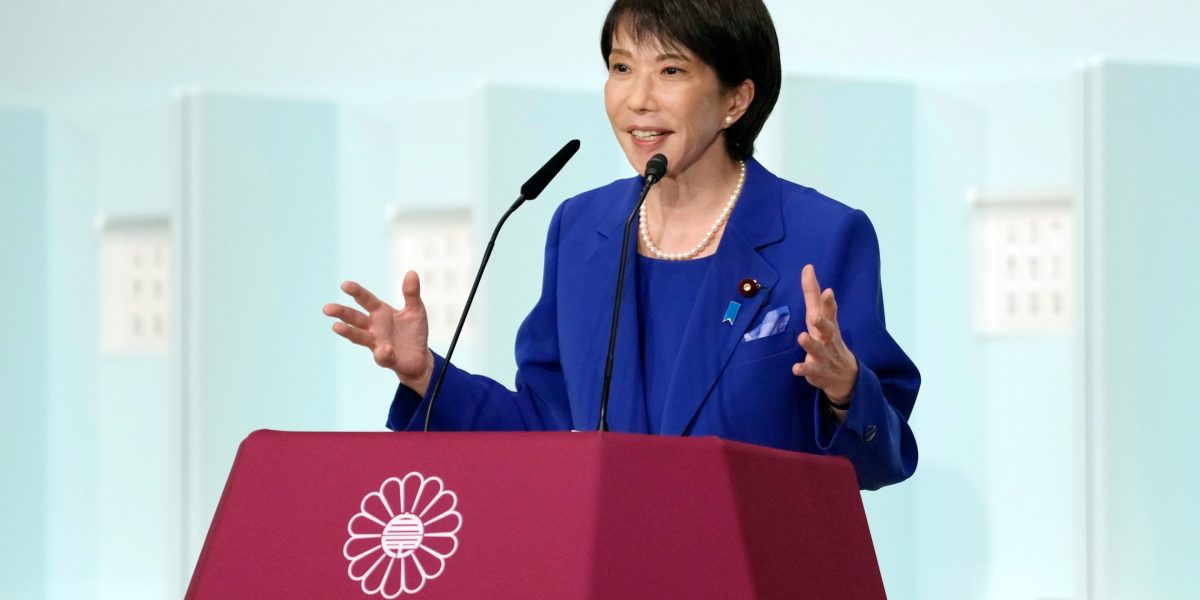
Sanae Takaichi, the pro-stimulus conservative poised to become Japan’s first female prime minister, is an energetic nationalist with a soft spot for the hard-nosed politics of Iron Lady Margaret Thatcher and the heavy metal music of Iron Maiden.

In choosing the former economic security minister as its leader, the Liberal Democratic Party is essentially betting on a swing back to the right to attract the younger voters who have flocked to smaller populist outfits, including the arch-conservative Sanseito party. 

It’s a move that could backfire if the party is seen simply reverting to the easy money and hawkish diplomacy of her mentor, former Prime Minister Shinzo Abe, without any new ideas.

Takaichi is expected to become premier later this month in a parliamentary vote. In becoming the LDP’s chief, Takaichi has already smashed a glass ceiling in a nation that has only seen male ruling party leaders. 

Her ascent to the top of the political world will send ripples through the male-dominated society that languishes near the bottom end of global gender equality rankings. But like Thatcher, the former UK prime minister whom she cites as an inspiration, her conservative views place her a long way from the stance of progressive feminism.

Her ability to build a lasting legacy as the nation’s leader will depend less on her ability to further the position of women than on her capacity to restore the fortunes of a ruling party in disarray after decades of dominance in postwar Japan. 

“From a normal woman’s perspective, she’s what you might call an idol for ‘old men,’” said Mieko Nakabayashi, politics professor at Waseda University. “She’s someone who expresses ‘old man’ opinions from a woman’s mouth and makes them happy.”

Her longevity at the head of a fickle political machine known for quickly axing its presidents will depend on how swiftly she can unite the party, win back public support and connect with those younger voters. She will also need to build consensus with opposition parties to pass legislation in a parliament where the LDP no longer has a majority.

Read more: The Party That Ruled Japan for Decades Is in Danger of Crumbling

Provided she becomes prime minister as expected, one of her first tasks will be to build ties with Donald Trump amid reports that the US president will make a stop in Japan in late October during a trip to Asia. 

Takaichi was the most forthright among the five candidates in the leadership race over the possibility of renegotiating parts of Japan’s trade deal with the US. But she toed the line following her election on Saturday, saying that an immediate renegotiation was not on the table. She still said Japan will make its opinions known through the appropriate routes should the deal not serve its interests.

But she said that might happen only if there are problems implementing the deal in its current form, a comment that suggests she is on board with the agreement for now.

On issues such as ramping up Japan’s defense spending and capabilities, containing China’s growing influence and building supply chains that align with US interests, she is likely to be a good match for Trump’s views. Still, she likely has less name recognition among US conservatives who have met her rival in the leadership contest, Shinjiro Koizumi, and who remember his father Junichiro wearing Elvis shades and serenading former President George W. Bush two decades ago.

“Takaichi has extensive experience as a politician, and since the US’s hardline stance toward China does not significantly conflict with her own views, she should be able to build a good relationship with President Trump,” said Yuichi Kodama, chief economist at Meiji Yasuda Research Institute.

For investors, the main concern will be her reputation for wanting spending to achieve growth and her penchant for central bank stimulus to goose the economy. In the latest leadership campaign, she toned down her scathing views on the Bank of Japan’s interest rate hikes from last year, when she described its raising of rates as “stupid.” But in a recent Kyodo survey she still said the BOJ should leave interest rates unchanged for now. That comment comes amid expectations the bank may raise borrowing costs again later this month.

Her spending plans are less clear. All of the candidates were expected to unleash a package of economic measures to help consumers deal with inflation in the fall, but she was the boldest in saying that extra bond issuance may be needed. In line with many in the LDP, she remains cautious on the idea of opposition demands to lower the sales tax, one of the costliest options for dealing with the cost-of-living crunch. 

Instead Takaichi has promised cash handouts and tax rebates to help households. She’s also hinted at raising the tax-free income allowance before the end of the year, a move that would resonate well with the Democratic Party for the People, another populist party that has made major inroads in the last year or two. 

While saying her spending plans will be “responsible” and that she’ll ensure the nation’s net debt load will fall over time, she said “the goal is achieving economic growth, not fiscal health,” in a sign of her expansionist spending tendencies. 

“While she always leaned toward a reflationary stance, the current economic environment has changed significantly, and curbing inflation has become the country’s mission,” said Meiji Yasuda’s Kodama. “Opposing the BOJ’s rate hikes would be contradictory, so I don’t think she can make extreme statements regarding monetary policy.”

Still, the possible outcome for markets when they open on Monday is a fall in the yen on expectations of slower central bank normalization, a rise in stocks on a weaker currency and an uptick in super-long yields on fears over longer term spending plans.

Takaichi was born on March 3, 1961 and grew up in the ancient capital of Nara, a city known for the emergence of Buddhism in Japan. Her father worked as a salesman at an equipment manufacturing company while her mother worked for the Nara police force. She studied business management at Kobe University. 

As a student, she rode a motorbike and played drums in a heavy metal band, and counts herself as a fan of British heavy-metal bands Black Sabbath and Iron Maiden, according to local media. She still occasionally picks up the sticks to hammer away on an electric drumset at home, if she squabbles with her husband, she told a local broadcaster in an interview. Her go-to song is “Burn” by Deep Purple. 

“To be honest I wish I could go out for karaoke, but I’ve been reining myself in these past years,” she said in that interview.

She studied at the Matsushita Institute of Government and Management, an organization focused on producing leaders in the world of politics and industry. 

She worked briefly as a news anchor before winning her first election in 1993 as an independent at a time when the LDP was in disarray following the bursting of Japan’s economic bubble. That election saw a multitude of opposition parties join forces to form a patchwork administration and oust the LDP for the first time since its formation. But as it has done subsequently, the LDP found a way of regrouping and taking back power, while most of the parties that ousted it have vanished.

Over her years as a politician, including her time as internal affairs minister, promoter of “Cool Japan” and as economic security minister, Takaichi has garnered a reputation as studious with an attention to fine detail. She is known to shun socializing and drinking with her peers.

“If I’m going to go out for dinner or have a drink, I’d much rather work or study something new,” she said during a campaign speech last year, adding that she often works over weekends. 

Shortly after winning the LDP election she doubled down on that message.

“I’m going to abandon the phrase ‘work-life balance,’” she said, prompting laughter from the rows of LDP lawmakers listening to her speech. “There is a mountain of things that we must accomplish together and I would like to see you work like horses.”

As a conservative darling and Abe protege, China may be wary of how she navigates a relationship that has remained tense in recent years. 

Previously, Takaichi did not mince her words when asked whether she would visit Yasukuni shrine, which honors Japan’s war dead including those who were charged as war criminals after World War II. Visits by previous prime ministers have angered neighboring countries and proven to be a flashpoint for Japan and China.

“Once the sentence is carried out, they are no longer criminals,” she said during a live TV show last week. She toned down her messaging after being elected Saturday, saying that she’ll make appropriate decisions over praying at the shrine.

She opened her campaign speech with a gripe about foreign tourists in Nara, saying she had heard of some tourists kicking the deer that roam freely in the local parks. 

That gripe seemed to tap into broader anxieties felt by the public as the number of foreign-born visitors and workers rises amid a drop in Japan’s own population. With Sanseito gaining ground in elections by capturing such concerns under a “Japanese first” message, Takaichi could be the conservative icon the LDP thinks it needs to win back right-wing voters. Among the five candidates, she consistently ranked as the most popular in recent opinion polls among the general public.

In a twist of irony for Japan’s likely first female prime minister, her conservatism may not bode well for gender equality issues. 

She opposes same-sex marriage or allowing spouses to have separate surnames, claiming it could undermine family unity. Novelist Kyoko Nakajima once called Takaichi “an honorary man” for maintaining views consistent with a traditional male-centered society, the Japan Times reported in 2021.

And while her appointment breaks a glass ceiling, it also risks becoming a glass cliff.

“Female leaders are often given some leeway for not doing things the ‘traditional’ way,” said Waseda’s Nakabayashi, who was skeptical whether Takaichi’s election represents a new era for women in Japan. “That’s why it’s often the case that women only get the leadership positions when the going gets really tough.”


Source link

Continue Reading

Business

Down Arrow Button Icon

Published

on


China has fulfilled its initial commitment to buy 12 million metric tons of soybeans from the U.S., but it’s not clear if the trade agreement announced in October can withstand President Donald Trump’s ever-shifting trade policy as American farmers are still dealing with high production costs.

Earlier this month, Trump said he would impose 25% tariffs on any country that buys from Iran, which would include China. Then last weekend he threatened to impose 10% tariffs on eight of America’s closest allies in Europe if they continue to oppose his efforts to acquire Greenland.

So the administration’s trade policy continues to change quickly, and Iowa State University agricultural economist Chad Hart said that could undermine the trade agreement with China and jeopardize the commitment by the world’s largest soybean buyer to purchase 25 million metric tons of American soybeans in each of the next three years.

“Those new tariffs — what does that mean for this agreement? Does it throw it out? Is it still binding? That’s sort of the game here now,” Hart said.

Beijing paused any purchase of U.S. soybeans last summer during its trade war with Washington but agreed to resume buying from American soybean farmers after Trump and Chinese leader Xi Jinping met in South Korea and agreed to a truce.

Treasury Secretary Scott Bessent announced the purchasing milestone China has met in an interview with Maria Bartiromo on Fox Business on Tuesday from the sidelines of a major economic forum in Davos, Switzerland, where Bessent met with his Chinese counterpart, Vice President He Lifeng. Bessent said China remains committed.

“He told me that just this week they completed their soybean purchases, and we’re looking forward to next year’s 25 million tons,” Bessent said. “They did everything they said they were going to do.”

Last fall, preliminary data from the Department of Agriculture cast doubts on whether China would live up to the agreement because it was slow to begin purchasing American soybeans and there is a lag before the purchases show up in the official numbers.

On Tuesday, the USDA data showed that China had bought more than 8 million tons of U.S. soybeans by Jan. 8, and its daily reports indicated that China placed several more orders since then, ranging from 132,000 tons to more than 300,000 tons.

China has shifted much of its soybean purchases over to Brazil and Argentina in recent years to diversify its sources and find the cheapest deals. Last year, Brazilian beans accounted for more than 70% of China’s imports, while the U.S. share was down to 21%, World Bank data shows.

Trump is planning to send roughly $12 billion in aid to U.S. farmers to help them withstand the trade war, but farmers say the aid won’t solve all their problems as they continue to deal with the soaring costs of fertilizer, seeds and labor that make it hard to turn a profit right now. Soybean farmers will get $30.88 per acre while corn farmers will receive $44.36 per acre. Another crop hit hard when China stopped buying was sorghum, and those farmers will get $48.11 per acre. The amounts are based on a USDA formula on the cost of production.

That and uncertainty about trade markets and how much farmers will receive for their crops has even some of the most optimistic farmers worried, said Cory Walters, who is an associate professor in the University of Nebraska-Lincoln’s Department of Agricultural Economics. Soybean prices jumped up above $11.50 per bushel after the agreement was announced, but the price has since fallen to about $10.56 per bushel on Tuesday. So prices are close to where they were a year ago and aren’t high enough to cover most farmers’ costs.

“Everything is changing — the land rental market, the fertilizer market, the seed market and it’s all pinching the farmer when they go to do their cash flows. The ability to make a decision is tougher now because of all the uncertainty in the market,” Walters said.

___

This story has been updated to correct that Bessent spoke on Fox Business, not Fox News.

___

Funk reported from Omaha, Nebraska. Associated Press writers Didi Tang and Fatima Hussein contributed from Washington.


Source link

Continue Reading

Business

Wall Street is talking about whether Trump’s Greenland plan will end U.S. ‘primacy’

Published

on


Investors reacted emphatically to President Trump’s insistence that he won’t back down on his plan to take over Greenland: They hate it. The S&P 500 fell 2% yesterday, even though 81% of its companies have beaten their Q4 earnings expectations so far. The dollar fell off a cliff, losing nearly 1% of its value against a basket of foreign currencies. U.S. bond prices weakened modestly. Gold, the safe-haven investment, hit yet another new record high.

The “sell America” trade is in full effect, in other words. S&P futures were up marginally this morning, suggesting that the bloodletting has been put on hold until traders hear what Trump has to say at the World Economic Forum in Davos later today. Trump offered a small ray of hope before he left for Switzerland when he told NewsNation, “We’ll probably be able to work something out.”

The drama has started a global debate about ending America’s “primacy” as the place for investors to hold assets. Increasingly, analysts and economists are talking about hedging against U.S. risk and deploying their capital in markets which are more predictable. The fact that the S&P 500 underperformed last year compared to markets in Asia and Europe is helping make the case. It’s a rerun in 2026, too. The S&P is down 0.71% year-to-date, while the Europe STOXX 600 is up 0.69% and the South Korean KOSPI is up an astonishing 14%.

“Until the US no longer ‘threatens’ with the use of tariffs … the so-called ‘primacy’ of the U.S. remains at risk of further dissolution, and with it an upending of the geopolitical alignments that have upheld markets in recent years,” Macquarie analysts Thierry Wizman and Gareth Berry wrote in a recent note to clients.

Their argument—perhaps one of the most extreme ones that Fortune has ever seen in an investment bank research note—is that when the U.S. goes through a major political convulsion a period of stagnation follows, and thus investors should begin moving their money away from America:

“A line can be traced, for example, from the failure of the U.S. in the Vietnam War and the follow-on decline in U.S, primacy, to the U.S.’s gold reserve depletion, and the subsequent end of the fixed exchange rate system under the Bretton Woods Agreement of 1944. The ‘fiat money’ era that followed was associated with a large decline in the real value of the USD, from 1971 until 1981, as well as a period of inflation and recessions across the 1970s,” they said. 

“We should worry about the USD and its relation to other currencies, too. If the reserve status of the USD does depend on the U.S. role in the world—as guarantor of security and a rules-based order—then the events of the past year, and of the past three weeks, in particular, carry the seeds of a reallocation away from the USD, and the search for alternatives, especially among reserve managers. So far, allocators have only found solace in gold, but they may eventually move toward other fiat currencies, too.”

Wall Street got a glimpse of what this might look like when the Danish retirement savings fund AkademikerPension said yesterday that it would sell its $100 million stake in U.S. bonds by the end of the week.

So far, traders are flinching at Trump’s actions. But we haven’t yet seen the kind of full-scale capital flight away from U.S. assets that might, for instance, raise inflation, interest rates or trigger a recession. But the mere fact that Wall Street is discussing it is significant.

Deutsche Bank’s George Saravelos told clients in a note at the weekend: “Europe owns Greenland, it also owns a lot of Treasuries. We spent most of last year arguing that for all its military and economic strength, the U.S. has one key weakness: it relies on others to pay its bills via large external deficits. Europe, on the other hand, is America’s largest lender: European countries own $8 trillion of US bonds and equities, almost twice as much as the rest of the world combined. In an environment where the geoeconomic stability of the western alliance is being disrupted existentially, it is not clear why Europeans would be as willing to play this part. Danish pension funds were one of the first to repatriate money and reduce their dollar exposure this time last year. With USD exposure still very elevated across Europe, developments over the last few days have potential to further encourage dollar rebalancing.”

This note was internally controversial. Deutsche Bank CEO Christian Sewing had to call U.S. Treasury Secretary Scott Bessent to disavow it.

The CEO does not stand by it but Saravelos’s colleagues may be more sympathetic. Jim Reid and his team, who religiously send an early morning email summarizing market action, did not send their email this morning. The bank told Fortune, “Deutsche Bank Research is independent in their work, therefore views expressed in individual research notes do not necessarily represent the view of the bank’s management.”

In fact, the idea that Europe might move out of U.S. assets is a commonplace inside investment banks right now. At UBS, Paul Donovan told clients earlier this week, “The implications of additional tariffs are more U.S. inflation pressures and a further erosion of the USD’s status as a reserve currency. So far, bond investors do not seem to be taking the threats too seriously.”

This morning he said that the most likely scenario wouldn’t be investors selling U.S. debt but simply refusing to buy new debt, thus reducing the flow of funds that the America is dependent on.

In a tariff war, one under-discussed weapon at Europe’s disposal is its Anti-Coercion Instrument: It has the power to ban U.S. services businesses from the E.U.

“U.S. services exports to the E.U. were $295B in 2024, equivalent to 0.9% of US GDP, suggesting the harm could be much greater if the E.U. pulled this relatively new lever at its disposal than if it responded simply with tariffs, though its economy would be hurt more too,” Pantheon Macroeconomics analysts Samuel Tombs and Oliver Allen told clients.

“In short, nobody would win from a new trade war, but the E.U. has ample scope to harm the U.S. if the Greenland situation escalates,” they said.

Here’s a snapshot of the markets ahead of the opening bell in New York this morning:

  • S&P 500 futures were up 0.19% this morning. The last session closed down 2.06%.
  • STOXX Europe 600 was down 0.4% in early trading.
  • The U.K.’s FTSE 100 was flat in early trading. 
  • Japan’s Nikkei 225 was down 0.41%.
  • China’s CSI 300 was flat. 
  • The South Korea KOSPI was up 0.49%. 
  • India’s NIFTY 50 was down 0.3%. 
  • Bitcoin was down to $89K.


Source link

Continue Reading

Business

Match Group says a ‘readiness paradox’ is crippling Gen Z in dating

Published

on


Gen Z is sometimes criticized for its proclivity toward slang or its approach to the workforce. But this generation is facing challenges very different from those of their elders. The young adults are slowing down their pursuit of the American Dream of finding “the one,” owning a home, and having kids.

But it’s not because Gen Z doesn’t want to find love, according to a report by Match Group and Harris Poll shared exclusively with Fortune. In fact, their survey results from 2,500 randomly selected U.S. adults shows 80% of Gen Z say they believe they’ll find true love, making them the most optimistic generation about finding love. Yet, only 55% of Gen Z feel like they’re actually ready for partnership. 

Therein lies the “readiness paradox,” a phenomenon that paralyzes Gen Z from taking that initial step toward a serious relationship, and subsequently toward marriage and having children. While more than half of Gen Z says they feel lonely despite having online connections, 48% of Gen Z women report feeling additional pressure to enter a relationship for “the right reason,” rather than solely to avoid loneliness. This cycle traps young people in loneliness, which is amplified by social media pressures, like the dread of “hard-launching” a relationship. 

“It makes total sense to be stuck in that paralysis of, I want this, I want a relationship, but I don’t feel ready for it, and so I don’t do it,” Chine Mmegwa, head of strategy, corporate development, and business operations at Match Group, told Fortune. “What they’re afraid of is failing. What they’re afraid of is that the other person on the other side isn’t ready.”

Match Group defines this phenomenon as a “self-reinforcing cycle” in which Gen Zers set a high bar for readiness for a relationship, then feel anxious about being alone, then crave new relationships, believe they’re not ready for it and wait longer, experience more loneliness, and then the cycle repeats. 

And some of this cycle stems from the fact that Gen Z prioritizes investing in personal growth, therapy, and defining success over other generations. Nearly 60% of Gen Z women say therapy is essential to relationship success, according to the Match Group report, and almost 50% say that setting and respecting healthy boundaries is a prime indication of being ready for a romantic relationship. And as a result, they may be more likely to delay dating. 

This report serves as a launchpad for Match Group and other dating app companies to rethink how to best serve Gen Z consumers, some of which had ditched the apps when they did have features they could relate to. But now Tinder has introduced more casual modes for Gen Zers to meet each other, like through its double-date feature and college mode where the generation can meet more people with the same relationship goals in mind.

That’s a step in the right direction for a generation that is reverting back to a desire to meet in real life.

“This is the way Gen Z wants to connect,” Match Group CEO Spencer Rascoff previously said. “They want to vibe their way through meeting people.”

Reprioritizing milestones

Unlike how some other reports about Gen Z love life have portrayed the generation, they’re not rejecting romance. Instead, they’re reshuffling life’s timeline amid economic and social strains. 

Match Group’s report shows nearly half of Gen Z say they’re not ready for relationships now, and 75% aren’t rushing into one. But, again, 80% say they believe they’ll find true love.

“They believe that when they work on themselves, their relationships become stronger,” according to the Match Group report. “And they are more likely to wait until they can put their best selves forward to give themselves the highest chance of relationship success.”

Although that may sound like worrisome news for a company trying to appeal to the latest generation, Mmegwa didn’t shy away from the challenge. 

Gen Z is “still looking to our products to solve real big issues. And they are still looking to our products and to dating to solve the things that are most important to them” she said. “It’s just a question of when and how they will use our products that [is] very different from prior generations.”

This generation also has a very different view of how happy their own parents’ and grandparents’ relationships are: Only 37% described those relationships as happy, and 34% of Gen Z women also feel working through issues from past relationships indicates readiness, according to the report.

Social media’s vicious cycle

Being highly inundated by and invested in social media has also exacerbated the readiness paradox. While 46% of Gen Z “soft-launch” relationships versus 27% overall, 81% see it as an ironclad agreement, and dread backlash from a public failure. 

It’s different from how other generations view making relationships public: “You can also hard launch and then delete the photos the next day, and it’s okay,” Mmegwa said. 

But still, for Gen Z, relationship performance pressure creates a cycle: High readiness bars lead to loneliness, which ultimately leads to them pursuing lower-stakes or casual relationships that rarely escalate into something more serious.

Instagram exacerbates the stall. While 46% of Gen Z “soft-launch” relationships versus 27% overall, 81% who hard-launch see it as an ironclad commitment, dreading public failure. Mmegwa highlighted this generational shift: “You can also hard launch and then delete the photos the next day, and it’s okay.” This “performance pressure” creates a cycle: High readiness bars lead to loneliness (over 50% feel it despite online ties), prompting low-stakes connections that rarely escalate.​

“For us, the focus is on how we bring people together and encourage them to return to in-person connections,” Hinge CEO Jackie Jantos previously told Fortune. Hinge is part of Match Group, along with Tinder, Match, and OkCupid.

How Match Group plans to address the readiness paradox

Match Group is planning to meet Gen Z where they are: They’ll keep introducing “low-pressure” tools, like Tinder’s Double Dating feature and College Mode.

“The idea here is really around helping our users have the power to control what they’re looking for in a given moment and be able to find that more easily,” Cleo Long, Tinder’s senior director of global product marketing, previously told Fortune.

Using the report as a roadmap for new product plans, future features could include features like readiness signals, Mmegwa said, and more curated matches will be important. 

“It’s no longer a speed and volume game,” she said. “It’s [about] truly making our algorithms help you know yourself better, and then help you know the person on the other side of the connection better.”


Source link

Continue Reading

Trending

Copyright © Miami Select.