Connect with us

Business

Jamie Dimon taps Jeff Bezos, Michael Dell and Ford CEO Jim Farley to advise JPMorgan’s $1.5 trillion national-security initiative

Published

on


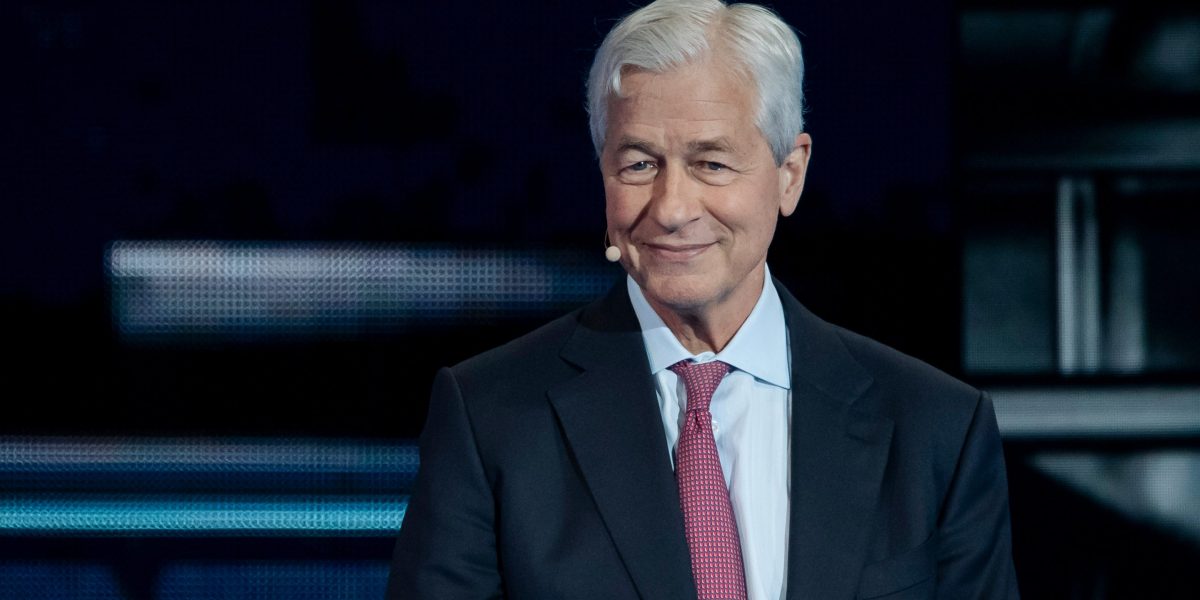
Jamie Dimon’s JPMorganChase just unveiled a list of business leaders and retired government officials that will make up a new advisory team to guide the investment bank’s $1.5 trillion national-security initiative. 

The external advisory council, announced on Monday, features prominent tech business leaders Jeff Bezos and Michael Dell as well as Ford CEO Jim Farley, alongside a number of national security and defense experts. 

JPMorganChase first announced its national-security push—coined the Security and Resilience Initiative (SRI)—in October by saying it would first invest up to $10 billion in direct equity and venture capital to companies it characterizes as paramount to U.S. national security.

Dimon also said on Monday he poached one of Warren Buffet’s personally selected investors to head the investment fund starting in January.

Both of the announcements are initial steps to realizing the company’s national-security pledge, which will span the next 10 years.

The council will be chaired by Dimon himself, and will “convene periodically” to “help spur growth and innovation in industries critical to the United States’ national security and economic resiliency,” the company said in its press release.

“We are humbled by the extraordinary group of leaders and public servants who have agreed to join our efforts as senior advisors to the SRI,” Dimon said in the Monday announcement. “With their help, we can ensure that our firm takes a holistic approach to addressing key issues facing the United States—supporting companies across all sizes and development stages through advice, financing and equity capital.”

Here is a list of the advisory council members: 

Business leaders

  1. Jeff Bezos, executive chairman and founder of Amazon and founder of Blue Origin

Bezos previously partnered with Dimon and Warren Buffett on the not-for-profit Haven health‑care venture in 2018, which was backed by Amazon, JPMorgan, and Berkshire Hathaway. Dimon has said the two “hit it off” in 1999, and Bezos even discussed hiring Dimon as Amazon’s president before Dimon chose to stay in banking.

  1. Michael Dell, CEO of Dell Technologies

Dell worked closely with Dimon and JPMorgan when the bank led the multibillion‑dollar financing for Dell’s $67 billion takeover of tech giant EMC in 2015, the largest tech deal ever at the time.

  1. Jim Farley, CEO of Ford Motor Company

Farley has publicly warned about U.S. dependence on China for chips and rare earths, arguing it is a strategic vulnerability. In a third-quarter earnings call in October, he told investors he had discussed these issues with U.S. officials as a chip shortage caused by China threatened to impact the automaker. 

  1. Alex Gorsky, former CEO of Johnson & Johnson

Gorsky, most recently the company’s former executive chairman, oversaw the company’s expansion and helped steer J&J through the Covid‑19 vaccine rollout as CEO.

  1. Phebe Novakovic, CEO of General Dynamics

Novakovic previously worked in the U.S. government in roles at the Central Intelligence Agency and the Department of Defense before moving to the private sector in 2001. After working her way up at General Dynamics, she now heads one of the Pentagon’s major defense contractors.

  1. Todd Combs, Berkshire Hathaway investment manager, CEO of GEICO

Combs is a longtime Berkshire Hathaway investment manager and CEO of Geico who left Geico this week and is leaving his Berkshire role as well to lead JPMorganChase’s SRI Strategic Investment Group and join the advisory council in early 2026. For years, he was one of Warren Buffett’s top stock pickers.

  1. Paul Ryan, Partner at Solamere Capital, former Speaker of the U.S. House of Representatives

Ryan is a partner at private-equity firm Solamere Capital and formerly served as Speaker of the U.S. House of Representatives from 2015 to 2019, where he was a key figure on fiscal and economic policy. He previously chaired both the House Budget Committee and the Ways and Means Committee, making him a central Republican figure on fiscal and economic policy and tax legislation.

National security experts

  1. Condoleezza Rice, former U.S. Secretary of State

Rice is a former U.S. Secretary of State under George W. Bush from 2005 to 2009 and, prior to that, was National Security Adviser. She played a central role in U.S. foreign policy and national‑security decision-making in the 2000s.

  1. Robert Gates, former U.S. Secretary of Defense

Gates is a former CIA director under former president George H.W. Bush from 1991 to 1993 and former U.S. Secretary of Defense, with a long career in national security and intelligence under both Republican and Democratic presidents.

  1. Chris Cavoli, retired general

Cavoli is a retired U.S. Army general who most recently served as Supreme Allied Commander Europe and Commander of U.S. European Command, overseeing NATO forces and U.S. military operations in Europe.

  1.  Ann Dunwoody, retired Commanding General of U.S. Army Material Command

Dunwoody is a retired four‑star general and former Commanding General of U.S. Army Materiel Command. She’s the first woman in U.S. history to achieve the rank of four‑star general.

  1.  Paul Nakasone, retired general and former NSA Director

Nakasone is a retired four‑star Army general who led the U.S. Cyber Command and served as director of the National Security Agency and chief of the Central Security Service from 2018 to 2024.


Source link

Continue Reading

Business

Creative workers won’t be replaced by AI, they will become ‘directors’ managing AI agents

Published

on


AI won’t automate creative jobs—but the way workers do them is about to change fundamentally. That’s according to executives from some of the world’s largest enterprise companies who spoke at the Fortune Brainstorm AI conference in San Francisco earlier this week.

“Most of us are producers today,” Nancy Xu, vice president of AI and Agentforce at Salesforce, told the audience. “Most of what we do is we take some objective and we say, ‘Okay, my goal is now to spend the next eight hours today to figure out how to chase after this customer, or increase my CSAT score, or to close this amount of revenue.”

With AI agents handling more tasks, Xu said that workers will shift “from producers to more directors.” Instead of asking, “How do I accomplish the goal?” they’ll instead focus on, “What are the goals that I want to accomplish, and then how do I delegate those goals to AI?” she said.

Creative and sales professionals are increasingly anxious about AI automation as tools like chatbots and AI image generators have proved to be good at doing many creative tasks in sectors like marketing, customer service, and graphic design. Companies are already deploying AI agents to take on tasks like handling customer questions, generating marketing content, and assisting with sales outreach. 

Pointing to a recent project with electric-vehicle maker Rivian, Elisabeth Zornes, chief customer officer at Autodesk, said that the company’s AI-powered tools enabled Rivian to test designs through digital wind tunnels rather than clay models. “It shaved off about two years of their development cycle,” Zornes said.

As AI takes on some of these lower-level tasks, Zornes said, workers can focus on more creative projects.

“With AI, the floor has been raised, but so has the ceiling,” she added. “We have an opportunity to create more, to be more imaginative.”

The uneven impact of AI

The shift to AI-augmented work may not benefit all workers equally, however.

Salesforce’s Xu said AI’s impact won’t be evenly distributed between high and low performers. “The near-term impact of AI will largely be that we’re going to take the bottom 50 percentile performers inside a role and bring them into the top 50 percentile,” she said. “If you’re in the top 10 percentile, the superstar salespeople, creatives, the impact of AI is actually much less.”

While leaders were keen to emphasize that AI will augment, rather than replace, creative workers, the shift could reshape some traditional career ladders and impact workforce development. If AI agents handle entry-level execution work, companies may need to hire fewer people, and some learning opportunities may disappear for younger workers. 

Ami Palan, senior managing director at Accenture Song, said that to successfully implement AI agents, companies may need to change the way they think about their corporate structure and workforce.

“We can build the most robust technology solution and consider it the Ferrari,” she said. “But if the culture and the organization of people are not enabled in terms of how to use that, that Ferrari is essentially stuck in traffic.”

Read more from Brainstorm AI:

Cursor developed an internal AI help desk that handles 80% of its employees’ support tickets, says the $29 billion startup’s CEO

OpenAI COO Brad Lightcap says ‘code red’ will force the company to focus, as the ChatGPT maker ramps up enterprise push

Amazon robotaxi service Zoox to start charging for rides in 2026, with ‘laser focus’ on transporting people, not deliveries, says cofounder


Source link

Continue Reading

Business

Trump says ‘starting’ land strikes over drugs in latest warning

Published

on


President Donald Trump said the US would be “starting” land strikes on drug operations in Latin America, though again declined to provide details on when and where the escalation of his military campaign would actually begin, or if countries could still do anything to avert the threatened action.

“We knocked out 96% of the drugs coming in by water, and now we’re starting by land, and by land is a lot easier, and that’s going to start happening,” Trump told reporters Friday in the Oval Office.

The US president for days has been pledging to broaden the effort, which comes after the Pentagon has launched a series of attacks on what it has called drug-smuggling boats in international waters off the coast of South America.

While Trump’s posturing has largely been seen as a pressure campaign against Venezuelan President Nicolás Maduro, he on Friday insisted the land targeting may not only impact Venezuela.

Read more: Trump Says US Eyes Land Strikes Next After Drug Boat Attacks

“It doesn’t necessarily have to be in Venezuela,” he said, adding that “people that are bringing in drugs to our country are targets.” 

Trump has justified the actions in part by framing the fight against drug smuggling as akin to combat operations. He told reporters that if overdose deaths were counted like combat deaths, it would be “like a war that would be unparalleled.”

Striking targets on land would represent a major escalation, and Maduro earlier this week said that if his nation came under foreign attack, the working class should mount a “general insurrectionary strike” and push for “an even more radical revolution.”

Join us at the Fortune Workplace Innovation Summit May 19–20, 2026, in Atlanta. The next era of workplace innovation is here—and the old playbook is being rewritten. At this exclusive, high-energy event, the world’s most innovative leaders will convene to explore how AI, humanity, and strategy converge to redefine, again, the future of work. Register now.


Source link

Continue Reading

Business

Trump names Warsh, Hassett as top Fed contenders, WSJ says

Published

on


President Donald Trump said that Kevin Hassett and Kevin Warsh are his top choices to lead the US Federal Reserve and that he expects the next chair of the central bank to consult with him on interest rates.

Trump, in an interview with the Wall Street Journal on Friday, indicated that Warsh, a former Fed governor, has climbed up the short list of contenders to challenge Hassett, the White House National Economic Council head whom many had seen as the frontrunner for the job.

“I think the two Kevins are great,” he said. “I think there are a couple of other people that are great.”

Trump previously signaled that he already made up his mind, saying Monday he had a “a pretty good idea” of who to nominate. The president last month also said he knew who he would pick for the job. The latest comments suggest that the selection process remains in flux. 

Trump met with Warsh on Wednesday. It’s not clear if Trump plans to interview other candidates for the job.

Earlier: Trump Says He’ll Meet Warsh as Fed Chair Search Nears End

The president said Warsh told him that borrowing costs should be lower. 

Later in the Oval Office, Trump said the next Fed chair should consult with him on interest rates, a move that would upend a tradition of the Fed’s independence.

“I’ve been very successful, and I think my role should be at least that of recommending — they don’t have to follow what I say,” Trump told reporters, adding he expected to make a choice “over the next few weeks.”

“I think my voice should be heard, but I’m not going to make the decision based on that,” he continued.

Trump has moved to assert control over the central bank in his second term, regularly expressing frustration that the Fed has not more aggressively reduced borrowing costs under Chair Jerome Powell.

Trump, in the Journal interview, called for aggressively lowering rates, saying they should be “1% and maybe lower than that.”

The Fed on Wednesday lowered its benchmark rate to between 3.5% and 3.75%, its third cut in as many meetings. Three central bank officials dissented from the decision and the Federal Open Market Committee remains undecided about further reductions.


Source link

Continue Reading

Trending

Copyright © Miami Select.