Connect with us

Politics

Jacksonville City Council committee votes to limit officer installations to city-owned facilities
Published

on


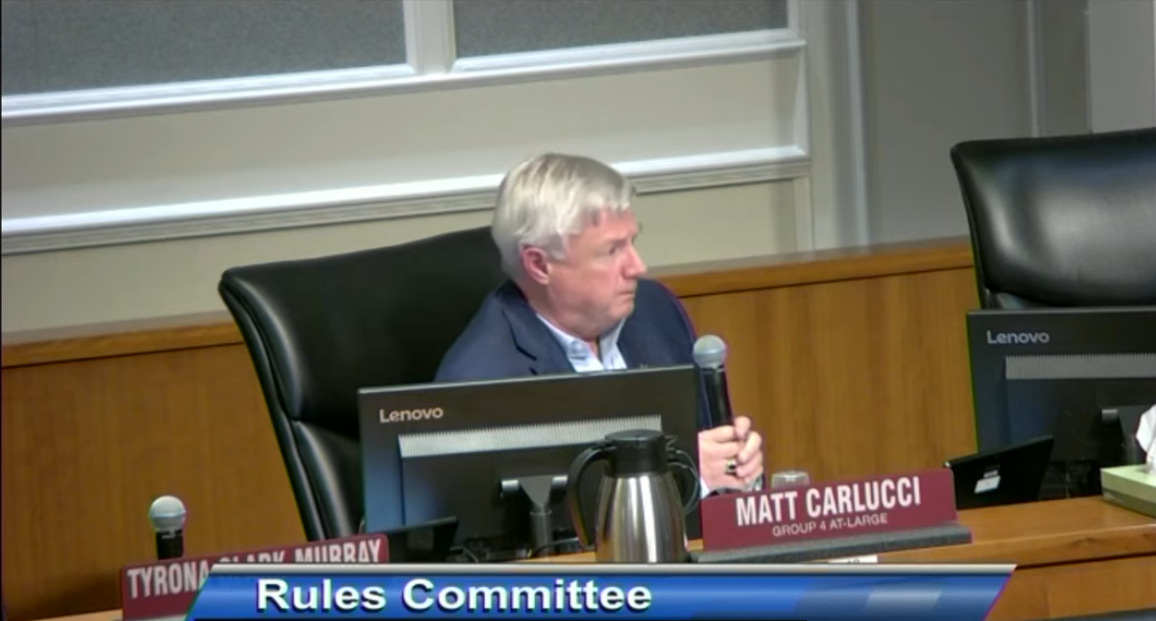
The Jacksonville City Council Rules Committee has voted in favor of legislation that would require Council officers to hold installation ceremonies in publicly owned buildings.

Matt Carlucci’s measure (2025-0869) emerged in the wake of Council President Kevin Carrico holding his own installation ceremony at a privately owned facility, which Carlucci believes could have discouraged people from attending.

Carlucci called the bill “self-explanatory” before noting that the bill came to mind when a town hall meeting was held at a “private place.”

“My concern is having it somewhere where everybody feels comfortable,” he said. “I think a city-owned venue is the right way to go.”

Republican Ron Salem noted that he had to have his at the Times-Union Center, but would have preferred to have it at the Ramallah Club.

“I have real mixed feelings about this,” said Salem, a former Council President. “I would like to give the President as much leeway as we can.”

Former President Terrance Freeman noted that he held his own installation at the city-owned Ritz, but had to fundraise more money because he was obligated to use the Ritz’s caterer. He said he was “shocked” by the cost of Carrico’s installation, which was more than $200,000.

Former President Randy White believes most future Presidents will be installed in city-owned facilities, but he doesn’t want to “hamper” future Presidents in ordinance.

Mike Gay, who has yet to be a Council President, likewise believes that Presidents should have “latitude” to hold installations where they see fit.

Ken Amaro acknowledged “merits to the bill” but also worried about “tying an individual’s hands” by putting this in law.

Carlucci said that an individual’s hands being tied is not the issue, given “the office belongs to the people.”

Amaro, Michael Boylan, Gay and Salem voted “yes.”

Freeman, White and Rules Chair Chris Miller voted “no.”

The bill likely will be voted on by the full City Council on Jan. 13.


Source link

Continue Reading

Politics

Ron DeSantis draws attention to cheaper property insurance ahead of Legislative Session

Published

on


Florida Peninsula Insurance, one of the largest property insurers in Florida, is decreasing rates by 8%, Gov. Ron DeSantis said.

Speaking at a Davie press conference, DeSantis said 83 other companies filed for rate decreases and 100 others are keeping their rates flat.

“As of January, the 30-day average request by companies for home rates are down 2.3%,” DeSantis said. “We’re one of the probably the only states in the country where you’re seeing a decrease.”

DeSantis and state administrators held a presser to highlight progress that Florida has made lowering property insurance. DeSantis’ remarks come just before the start of the 2026 Legislative Session, where DeSantis is pushing lawmakers to put a constitutional amendment on the ballot to repeal property taxes — which he says hurts Floridians worse in the pocketbook than property insurance.

A study by the Florida League of Cities warned that eliminating property taxes would hurt local governments’ essential services.

Insurance Commissioner Michael Yaworsky and DeSantis both credited recent state reforms in helping stabilize Florida’s property insurance costs. Some of the changes put in place make it more difficult for homeowners to sue property insurance carriers to get coverage. 

“We had 8% of homeowners’ claims nationwide, but that accounted for almost 80% of litigation expenses nationwide right here in Florida,” DeSantis said.

Yaworsky said he is hopeful lawmakers won’t repeal some of the tort reforms in the 2026 Legislative Session.

DeSantis said as carriers save money from fewer lawsuits to fight, they are passing the savings back to consumers. 

In addition to Peninsula, Security First Insurance, which covers 62,000 homes, also posted an 8% average decrease, the Governor said.

Meanwhile, the top five auto insurers averaged 6.5% premium decreases, DeSantis said.

Over 12 months, 42 auto insurance companies signaled rate decreases, with 32 of those companies filing the decrease notice within the past six months, DeSantis said.

Progressive Insurance previously agreed to give $1 billion in rebates to customers that are expected to go through by Thursday, DeSantis added.

“You talk to every single one of these companies, the only reason this is happening is because of the market reforms,” DeSantis. “And honestly. they’re kind of forced to do this, right? Because it’s a competitive market.”


Source link

Continue Reading

Politics

Why Orange County school leaders should look to Wichita

Published

on


It may be a memorable line in the White Stripes’ iconic anthem, “Seven Nation Army.” But the phrase “I’m goin’ to Wichita” hardly has the same luster or appeal as the oft-heard exclamation, “We’re going to Disney World!”

Still, if members of the Orange County School Board want to do right by their K-12 students growing up in the shadow of the Magic Kingdom, they should pack their bags and pay a visit to homely Wichita. Soon.

Wichita, you see, is home to one of the most interesting innovations in K-12 education to come along in years. And it’s exactly the kind of innovation the Orange County School Board ought to consider before proceeding with plans to close seven public schools this Fall.

Several years ago, some forward-looking Wichita leaders had an interesting thought: “What if we converted our old historic train station into a co-learning space that could serve all sorts of K-12 students in our city?”

The idea took hold. Soon, Wichita’s Union Station was bustling with schoolchildren eager to learn from a variety of educators.

Wichita’s Learning Lab has four anchor programs, each providing a distinctive educational experience in a dedicated learning space. Two of these anchors are run by public school educators; one is a private school startup, and the fourth is a homeschooling co-op.

Complementing these Learning Lab fixtures are a variety of “a la carte” offerings that occupy flexible workshop spaces staffed by community partners. Among the specialty programs offered: printmaking, forensic science, ballet, Spanish, American Sign Language, sports journalism, college prep, and musical theatre.

If all this sounds magical — like something out of “The Wizard of Oz” — the truth is co-locational learning arrangements may have even greater potential in Florida than in Kansas. Florida’s robust school choice scholarship programs already blur the lines between public, private, and home schooling. For example, two-thirds of Florida’s 67 public School Districts now offer “a la carte” courses for scholarship students primarily educated elsewhere.

Co-locational learning arrangements like Wichita’s Learning Lab could also help solve a thorny problem facing School Districts statewide: what to do with excess classrooms when there aren’t enough public school students to fill them.

The Orange County School Board’s current impulse is simple: “Shut down some schools.” That’s why seven are now on the chopping block. But closing neighborhood schools is rarely popular, especially with families who don’t want their children bused far from home.

With the growing popularity of microschools, hybrid programs, specialty courses, and other innovations, School Boards increasingly need to borrow a page from Wichita. They need to ask, “Why don’t we invite community partners to rent space in our schools and offer programs that serve students beyond our own public schoolers?”

Renting space to K-12 partners would help districts’ bottom lines. Co-locational education makes far more sense than closing schools needlessly or converting them into something else entirely. After all, school buildings were designed for K-12 students — right down to the child-sized toilets.

So, as hordes of visitors stream into Orlando to fulfill dreams of going to Disney World, members of the Orange County School Board should be planning a trip in the opposite direction. They should be getting out of Dodge to check out the Learning Lab just down the road from Dodge City — in the luster-lacking city the White Stripes sang about: Wichita.

___

William Mattox is the senior director of the Marshall Center for Education Freedom at The James Madison Institute.


Source link

Continue Reading

Politics

David Jolly calls out James Fishback for ‘racist’ rhetoric against Byron Donalds

Published

on


Democratic gubernatorial candidate David Jolly is slamming “racist” rhetoric employed by Republican candidate James Fishback used to criticize a Republican opponent, Byron Donalds.

“James Fishback is a formidable Republican candidate for Governor. His undisguised racist comments describing a Black candidate’s vision as ‘Section 8 ghetto’ and referring to Byron Donalds as ‘By’rone’ and a ‘slave’ are deliberate, offensive and beneath this state,” Jolly said.

Fishback has repeatedly called Donalds a “slave” to donors, a label first employed when he announced his own campaign for Governor in November. He recently used the term “By’rone” and referenced a “Section 8 ghetto” while reposting a far-right account on X.

Donalds, one of five Black Republicans currently serving in Congress, would be Florida’s first Black Governor, if elected.

Jolly, a former Republican Congressman turned Democratic candidate, said Fishback’s rhetoric falls beyond the pale and should not be tolerated by any mainstream political leader.

“Florida’s political leadership of all partisan persuasions — those elected and those running — should denounce, deplatform, and dismiss James Fishback,” Jolly said.

“Calling out racism isn’t divisive, but tolerating it is. I’ve been a Republican, an independent, and today I’m a proud Florida Democrat. I know my former colleagues continue to wrestle with extracting from their party the darkest voices of American politics. It shouldn’t be so.”

Of note, Jolly and Donalds, who launched his campaign in March, have clashed regularly online. Shortly after Jolly launched his own campaign for Governor in June, Donalds’ campaign cut an attack ad criticizing Jolly’s positions on gun rights.

But the public differences between Jolly and Donalds thus far have surrounded policy.

“Byron Donalds and I don’t agree much on policy these days, but he’s a worthy candidate offering his vision for Florida. While I believe his views are controversial, his candidacy is not. Our campaign is built on a simple value: Everyone is welcome in Florida, and everyone deserves to be treated with dignity and respect. We put that value into action by how we conduct ourselves in this race and in governing,” Jolly said.

“As we approach Dr. (Martin Luther) King’s birthday next week, Floridians are looking for leaders who unite people and solve big problems. I’m ready to lead that conversation. I’m asking other candidates running for Governor to join me, particularly Byron Donalds, Paul Renner and Jerry Demings. Let’s unite the state around our shared values and return to a contest of ideas.”

Donalds has largely ignored Fishback’s incendiary rhetoric. Fishback, the CEO of Azoria, has consistently polled in single digits thus far against Donalds. A recent poll from Fabrizio, Lee & Associated, conducted for Donalds’ campaign, showed in the current field of candidates, Donalds boasts 47% support among likely Republican Primary voters compared to Fishback’s 5%.


Source link

Continue Reading

Trending

Copyright © Miami Select.