Connect with us

Politics

Jacksonville City Council committee votes to limit officer installations to city-owned facilities
Published

on


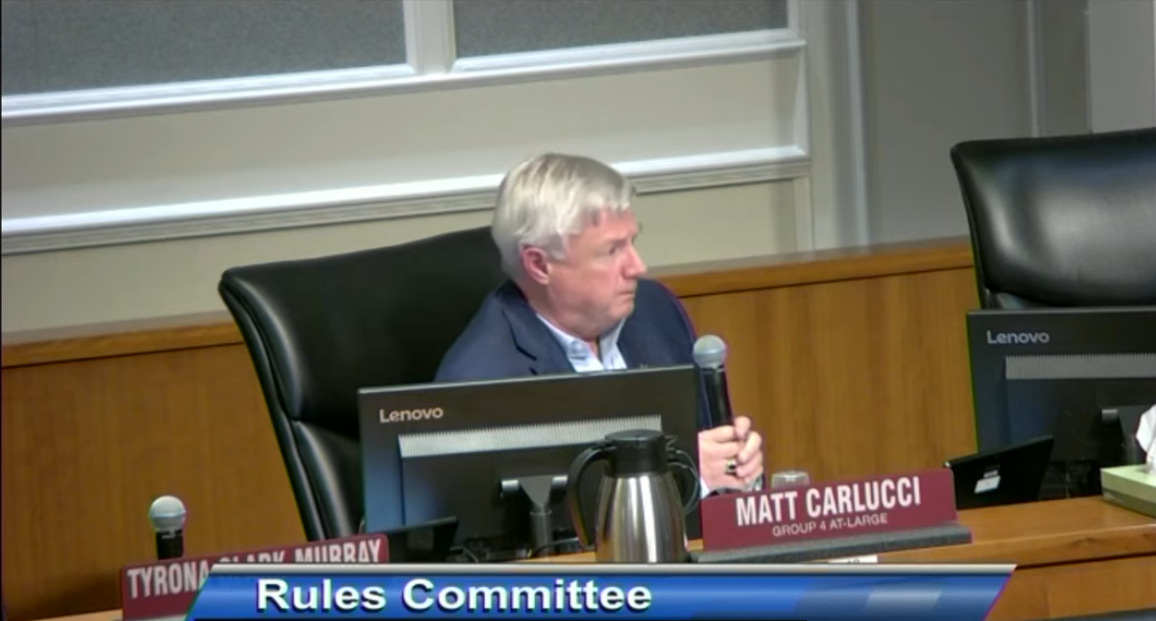
The Jacksonville City Council Rules Committee has voted in favor of legislation that would require Council officers to hold installation ceremonies in publicly owned buildings.

Matt Carlucci’s measure (2025-0869) emerged in the wake of Council President Kevin Carrico holding his own installation ceremony at a privately owned facility, which Carlucci believes could have discouraged people from attending.

Carlucci called the bill “self-explanatory” before noting that the bill came to mind when a town hall meeting was held at a “private place.”

“My concern is having it somewhere where everybody feels comfortable,” he said. “I think a city-owned venue is the right way to go.”

Republican Ron Salem noted that he had to have his at the Times-Union Center, but would have preferred to have it at the Ramallah Club.

“I have real mixed feelings about this,” said Salem, a former Council President. “I would like to give the President as much leeway as we can.”

Former President Terrance Freeman noted that he held his own installation at the city-owned Ritz, but had to fundraise more money because he was obligated to use the Ritz’s caterer. He said he was “shocked” by the cost of Carrico’s installation, which was more than $200,000.

Former President Randy White believes most future Presidents will be installed in city-owned facilities, but he doesn’t want to “hamper” future Presidents in ordinance.

Mike Gay, who has yet to be a Council President, likewise believes that Presidents should have “latitude” to hold installations where they see fit.

Ken Amaro acknowledged “merits to the bill” but also worried about “tying an individual’s hands” by putting this in law.

Carlucci said that an individual’s hands being tied is not the issue, given “the office belongs to the people.”

Amaro, Michael Boylan, Gay and Salem voted “yes.”

Freeman, White and Rules Chair Chris Miller voted “no.”

The bill likely will be voted on by the full City Council on Jan. 13.


Source link

Continue Reading

Politics

Meg Weinberger focuses on animals, no-fault repeal, Donald Trump airport

Published

on


West Palm Beach Republican Rep. Meg Weinberger is heading into the 2026 Session with an ambitious slate of bills with varying aims.

All focus on issues close to her heart, impactful for her district, or both.

Atop the list is HB 921, which would impose a “duty to report” instances of animal cruelty by treatment providers.

Under the bill and its upper-chamber analog (SB 468) by Port Orange Republican Sen. Tom Wright, veterinarians, vet technicians and related provider employees would have to report suspected past or ongoing animal cruelty to law enforcement or certified animal control officers. Failure to do so could lead to professional discipline.

Those who report in good faith would be shielded from liability, retaliation or disciplinary action.

Weinberger, who owns and leads an animal rescue nonprofit, said the measure is a response to a disturbing case in Brevard County, where a vet tech was arrested last year on multiple animal cruelty counts.

Weinberger said Sheriff Wayne Ivey asked her to run the bill, of which Merritt Island Republican Rep. Tyler Sirois is a co-prime sponsor. Last year, she passed legislation steepening penalties for animal abusers and creating an online registry of them.

“Animal cruelty is a public safety concern,” she said.

A related bill Weinberger is filing would fortify consumer protections in dealings with dog breeding and puppy mill companies by adding to Florida’s Pet Lemon Law, particularly in cases involving sick or misrepresented animals. Miami Republican Sen. Ileana Garcia is carrying its companion (SB 1356).

The bill would, among other things, require pet sale financing agreements to be terminated at no cost if an animal is returned, remove a current cap limiting veterinary reimbursements to the purchase price, tighten disclosure and documentation requirements, and allow buyers to recover damages, court costs and attorneys fees through civil action.

It would also create new civil penalties for deceptive or unfair business practices in pet sales, responding to the growing use of financing arrangements and persistent complaints about unhealthy animals being sold.

Weinberger said she and Garcia collaborated with Gov. Ron DeSantis’ Office on the legislation, which they may update with additional language to better regulate animal shelters. Right now, there isn’t a single, comprehensive statewide code that spells out detailed housing and care standards for animal shelters.

The changes the legislation would contemplate, Weinberger said, would include standards for animal containment, food, water, temperature and general care.

“There’s no guidelines now,” she said, adding that the bill would institute “a lot of what would be common sense to me or you and prevent animals from living in conditions that no living creature should suffer.”

Weinberger is also reviving her effort to repeal Florida’s no-fault auto insurance policy and replace it with a fault-based model. Her bill to do so last year advanced through two of three House committees before stalling out due, at least in part, to its Senate companion gaining no traction.

The legislation (SB 522, HB 769) she and Fort Pierce Republican Sen. Erin Grall refiled for this year has the same objective. It would overhaul dozens of statutes to institute a mandatory bodily injury and property damage liability framework, significantly increasing required coverage levels beginning in 2027.

Overall, it represents a wholesale restructuring of Florida’s auto insurance system away from no-fault coverage, rewriting dozens of statutes to conform to the new framework, adjusting insurance requirements, and strengthening financial responsibility and fraud enforcement provisions.

“Insurance isn’t my field, but I’ve read a lot about it,” Weinberger said. “It hasn’t changed since the ’70s. What are you going to do with $10,000 if you get into a car accident? That doesn’t cover anything nowadays, sadly. So, this is common sense, but I don’t know if it’s going to go anywhere.”

Another proposal (SB 706, HB 919) Weinberger is sponsoring with Melbourne Republican Sen. Debbie Mayfield and St. Augustine Republican Rep. Kim Kendall is in keeping with her nickname “MAGA Meg” by renaming Palm Beach International Airport as “Donald J. Trump International Airport.”

The measure would also define “major commercial service airports” in state statutes and preempt the naming of those airports to the state, removing local authority to rename them.

Trump, who resides at Mar-a-Lago in Palm Beach, lives “about five miles” from the hub, Weinberger said, and he deserves an honor many other Presidents have enjoyed.

“I think it’s only appropriate,” she said. “It’s an honor to recognize President Trump. He definitely has left a lasting impact on our country, and I truly believe he made promises, and he’s kept his promises. I feel like this is a tribute to his leadership, his legacy. You know how much he loves our country, and it’s his hometown.”

It would break with precedent, however. While airports have been renamed after U.S. Presidents while they were still alive — including Ronald Reagan, George H.W. Bush and Bill Clinton — there has never been a case where a major airport was rechristened to honor a sitting President.

It has happened outside of America, however, like in Nigeria, which renamed an airport in Minna after President Bola Ahmed Tinubu in 2024.

A fifth priority bill for Weinberger (HB 575) addresses the perennial issue of single-use, nonbiodegradable cups, to-go boxes and similar products that many coastal localities have banned in recent years.

The measure and its Senate twin (SB 240) by Garcia would preempt regulation of those “auxiliary containers” to the state, barring local governments from adopting new bans, restrictions or taxes.

Local restrictions enacted before Jan. 1, 2026, or that limit the use, sale or distribution of single-use plastic containers on public property would be exempt.

HB 575, if approved, would direct the Department of Environmental Protection (DEP) to develop a uniform, statewide ordinance governing nonrecyclable containers, which local governments could then adopt and enforce.

DEP would have to begin stakeholder engagement and public workshops on the issue by Oct. 1, 2026, with the new rules due within a year of that time.

“We don’t want to negatively impact cities that have been doing a good job on this,” she said. “But cities like Miami and many other areas have had issues with cleaning up their beaches, and unfortunately, I think it’ll be a problem until the state addresses the issue.”

The 2026 Legislative Session begins Tuesday.


Source link

Continue Reading

Politics

Florida TaxWatch to-do list prioritizes oversight, quality-of-life issues

Published

on


One of Florida’s major government watchdog groups has issued its priority list heading into the Legislative Session Tuesday.

Florida TaxWatch officials issued a top 10 list of priorities they’d like to see accomplished before the Regular Session ends March 13. TaxWatch President and CEO Jeff Kottkamp said Florida’s economic standing is superior to many states in America, and with the right commitment from lawmakers, that should continue.

“Florida continues to be the most envied of states in the nation due to our economic vitality, business-friendly incentives, high quality education, and health care priorities, truly making the Sunshine State the best place in the country to live, work, vacation, and raise a family,” Kottkamp said in a news release.

“That is why, as the ‘eyes and ears’ of taxpayers, Florida TaxWatch has once again identified these important taxpayer priorities and will be closely monitoring how elected officials allocate precious taxpayer dollars to meet the needs of all Floridians.”

The TaxWatch legislative priority list includes:

— A fair and equitable system of taxation which centers on, at the very minimum, reducing the property tax burden on Florida homeowners with increased tax relief. TaxWatch is advocating equitable distribution of tourist development taxes and reducing taxes on communication services in order to expand growth of broadband services.

— TaxWatch is also pushing for increased transparency, accountability and efficiency in all levels of Florida government. The watchdog organization is advocating the implementation of a Florida Government Efficiency Act which would require an annual budget from the Governor’s Office that includes cost-saving items along with efficiency stipulations that includes inspectors general, state agencies, and outside organizations such as TaxWatch.

— Health care policies should enhance the lifespan of Floridians by improving access, quality and affordability among all those who live in the state. The TaxWatch Institute for Quality Health and Aging has proposed multiple solutions to improve health care in the state.

— TaxWatch is also advocating more legislation to protect the state’s water system and other environmental elements in Florida. One of the key elements in that objective for TaxWatch is the proposal to create a five-year water projects work program. The group is also advocating conversions of septic systems to public sewer systems.

— Reducing the cost of property insurance while increasing the resilience of infrastructure throughout the state is another area TaxWatch officials say needs serious attention by lawmakers. The organization is supporting increased competition among insurance carriers while, at the same time, reducing the size of Citizens Property Insurance Corp., the state-established firm that provides insurance policies for Florida homeowners who can’t get coverage with for-profit companies.

— TaxWatch is also encouraging legislators to stop “municipal utility revenue sweeps,” which is a process of public utilities transferring money from their general funds to other government services. TaxWatch specifically is endorsing legislation (HB 773) that would reduce those so-called “sweeps” to 10% of utility revenue. Beyond that, a referendum would require approval by voters.

— The group also wants to see “growth of a robust manufacturing industry.” TaxWatch is endorsing bills in both the House (HB 483) and Senate (SB 528) that propose the creation of a chief manufacturing officer for the state that would coordinate plans to increase manufacturing projects across the state. That could also include the establishment of a Florida Manufacturer’s Workforce Development Grant program that would help incentivize projects that would include new technologies and cybersecurity infrastructure.

— Parents would also get increased help under the TaxWatch legislative agenda, as the group is advocating increased access to quality child care. TaxWatch has already prepared a brief outlining how to increase access and how that access reduces economic inequality.

— Along the lines of enhancing the well-being of children, TaxWatch is advocating increased programs that teach children how to swim in Florida. The Swimming Lessons Voucher Program already exists in the state, but a revision to that program in both the House (HB 85) and Senate (SB 428) would expand the age of children of families who can get the vouchers.

— And TaxWatch is also pushing the state to make the Florida employees health insurance trust fund solvent. A TaxWatch report shows that despite an estimated $652.7 million balance for Fiscal Year 2024-25, the state trust fund is projected to see operating losses in the next half-decade.


Source link

Continue Reading

Politics

AARP Florida signals legislative priorities to protect seniors

Published

on


From keeping seniors safe in emergencies to protecting them from scammers, AARP Florida released its 2026 Legislative Priorities.

“AARP’s mission in the legislative process is clear: provide data-driven insights, champion innovative policy solutions, and ensure the voices of older Floridians are heard,” said AARP Florida State Director Jeff Johnson. “We’re committed to working hand-in-hand with lawmakers to make Florida a place where people of all ages can thrive.”

As the Regular Session convenes Tuesday, the AARP said its agenda fits into four key areas — affordable housing, “health security” to improve Home and Community-Based Services and enhance nursing home quality, expand consumer protections to protect seniors from fraud and abuse, as well as providing more accessible retirement saving opportunities, the organization said in a press release.

AARP Florida said it wants to improve staffing and training and stronger oversight in nursing homes. 

Florida’s 2.7 million family caregivers need more support — including respite care — as they care for aging family members, AARP Florida said.

Seniors also need more telehealth and digital tools, but that needs to come with training and infrastructure to help people access them, AARP Florida said.

The AARP Florida also wants to expand access to Home and Community-Based Services by increasing state investment through Medicaid and other funding streams,” the organization said, adding it wants to “prioritize services that allow older adults to age in place with dignity and independence.”

Strengthening consumer protections, the AARP Florida wants better “interagency and interorganizational coordination, data sharing and reporting to protect vulnerable adults from abuse, neglect and exploitation,” the press release said.

To keep seniors safe from scams, AARP Florida is also asking lawmakers for stronger law enforcement and increased education to warn seniors about exploitative schemes targeting the elderly.

When it comes to housing, the AARP Florida backs zoning reforms, inclusive development and eviction protections to help seniors find affordable housing, the organization said. In addition, AARP Florida is urging lawmakers to ensure seniors and people with disabilities aren’t overlooked in emergency planning so they can access shelters and post-emergency assistance.

Johnson said volunteer advocates will help lobby lawmakers as AARP Florida seeks to support Floridians ages 50 and up.

“Our volunteers will once again join us at the Capitol during this Legislative Session. Their passion and real-life experiences help lawmakers understand how legislation impacts older adults,” Johnson said. “Over the years, their advocacy has championed meaningful changes for Floridians.”


Source link

Continue Reading

Trending

Copyright © Miami Select.