Connect with us

Politics

It’s a ‘judgment call’ whether Florida redraws its congressional map
Published

on


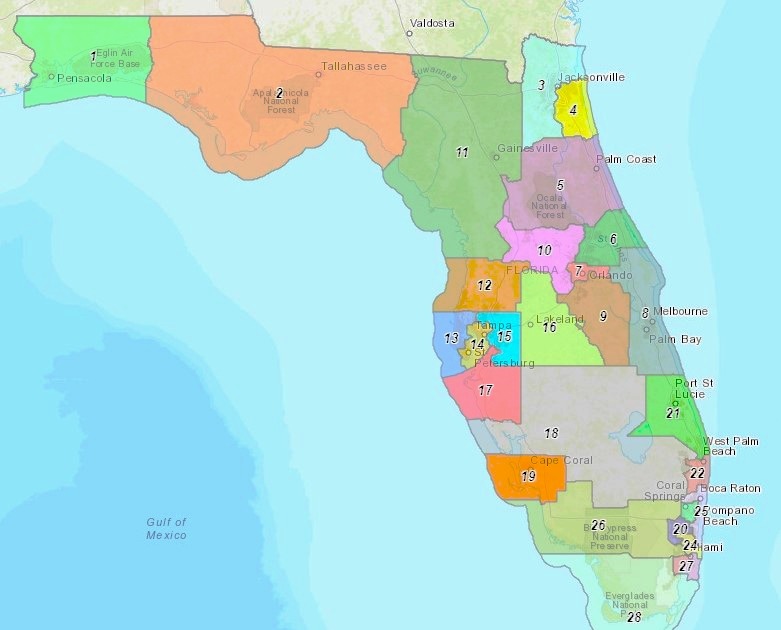
A pending ruling by the U.S. Supreme Court regarding the 1965 Voting Rights Act could trigger the Florida Legislature to conduct a mid-decade congressional redistricting effort, but it won’t require them to do so.

That was the opinion of Tallahassee election attorney Andy Bardos, who spoke Wednesday before a Florida House select committee charged with considering congressional redistricting, the second “educational and informative meeting” in the past week that did not allow public comment.

Denying that redistricting would have anything to do with partisan advantage, Gov. Ron DeSantis has maintained that Florida will be “forced to” redistrict once the high court rules in a case called Louisiana v. Callais, which could redefine Section 2 of the Voting Rights Act or declare it unconstitutional. The Justices have twice heard the case and are expected to rule sometime before next July.

“In terms of binding effect, it has binding effect on Louisiana,” Bardos told lawmakers. “Whether Florida chooses after Callais to keep its maps in place, await either the next cycle, or await litigation, or redraw its districts, that will be a judgment call made when we see the Callais decision.”

Bardos and committee Chair Mike Redondo, a Miami Republican, confirmed during the hearing that if the Legislature does in fact redo the congressional map sometime next year, it would do so based on U.S. census and voter information data they used previously when it did the decennial redistricting in 2022.

Court rulings

What has changed since then is the Florida Supreme Court’s ruling in July upholding the state’s 2022 congressional map, which had been legally challenged by voting rights groups such as Black Voters Matter after it was approved by the Legislature.

Those groups argued the map had violated the 2010 Fair Districts amendments when it redrew Florida’s 5th Congressional District. That seat stretched for more than 200 miles along the Florida-Georgia border to encompass Black populations in Florida’s old plantation belt from Gadsden to Duval counties.

One of those protections in the Fair Districts amendments prohibits lawmakers from drawing districts that “diminish (racial and language minorities’) ability to elect representatives of their choice.” The plaintiffs had argued that eliminating a district in which Black voters were electing their preferred candidate violated that provision.

The Florida Supreme Court ruled that the old District 5 seat was likely an illegal race-based gerrymander that failed to meet the equal-protection standards under the U.S. Constitution. “In the process of deciding that, the court articulated legal principles that had never before been set forth by a court in that way,” Bardos said.

The Fair District amendments also state that “no apportionment plan or individual district shall be drawn with the intent to favor or disfavor a political party or an incumbent,” which seemingly would contradict the stated goal of President Donald Trump, who said explicitly in July that he wanted Texas to create more House seats favorable to his party for the 2026 Midterm Elections. DeSantis said publicly weeks later that he thought Florida should do so, as well.

Bardos went on to tell Rep. Kevin Chambliss, a Homestead Democrat, that the Florida Supreme Court ruling that the 2022 congressional map was constitutional “raises questions now about how does this articulation of additional principles effect other parts of the state which the court wasn’t focused on.”

This was the last meeting scheduled by the select committee until the 2026 Legislative Session begins on Jan. 13. However, both DeSantis and Senate President Ben Albritton have said they would prefer the Legislature wait to address the issue again in a Special Session after the U.S. Supreme Court weighs in on the Louisiana v. Callais case — which, as Bardos said Wednesday, might not be for another six months.

No public comment allowed

Opponents of the proposed redistricting expressed outrage that the public wasn’t given time to speak during the hearing.

“The people of Florida deserve better than a rush job behind closed doors,” said Jessica Lowe-Minor, President of the League of Women Voters of Florida. “There’s no compelling reason to do redistricting at all right now, and it certainly shouldn’t be done when the public doesn’t have sufficient opportunities to engage and provide input.”

“When lawmakers show up in Tallahassee, they should be fighting for the hardworking people who sent them there,” added Amina Spahić, political director with Florida For All. “But, instead, we see them catering to the powerful interests and mega-donors who bankroll their campaigns.”

Noting that some of his constituents drove up from South Florida before learning that they would not be able to speak during Wednesday’s hearing, Chambliss asked Redondo if he could provide notice earlier if he planned to disallow public comment during future committee meetings.

Redondo responded that both hearings held so far involved only presentations, which he said typically do not allow for public comment. “When there’s some sort of legislative action being considered, that’s typically when we see public comment in normal meetings. But we’ll certainly try to notice the meetings as reasonably early as possible,” he said.

Republicans hold a 20-8 lead over Democrats in the state’s congressional delegation. Republican National Committee Chair and Sarasota Sen. Joe Gruters reposted an analysis of the situation around the country on Tuesday.

That analysis predicts that Florida Republicans would gain five seats if and when they go through with redistricting and voters follow through as the GOP expects them to in November 2026.

___

Reporting by Mitch Perry. Florida Phoenix is part of States Newsroom, a nonprofit news network supported by grants and a coalition of donors as a 501c(3) public charity. Florida Phoenix maintains editorial independence. Contact Editor Michael Moline for questions: [email protected].


Source link

Continue Reading

Politics

Jimmy Patronis backs bill to loosen Clean Water Act regulations

Published

on


U.S. Rep. Jimmy Patronis is on board with a movement to reduce the impacts of the Clean Water Act and ease some restrictions on development.

Patronis, a Republican in Florida’s 1st Congressional District in the Panhandle, voted with many of his colleagues in favor of the Promoting Efficient Review for Modern Infrastructure Today (PERMIT Act HR 3893). Many Republicans say the proposed measure is designed to “reduce red tape.”

The proposal “eliminated duplicative and costly Clean Water Act permit requirements that do not improve environmental safety,” according to a House GOP statement.

The PERMIT Act, drafted by U.S. Rep. Mike Collins, a Georgia Republican, would also provide amendments to the Federal Water Pollution Control Act.

Patronis voted in favor of the measure, saying it’s long overdue.

“I am honored to support the passage of the PERMIT Act that will streamline … permitting, while ensuring the environment is protected,” Patronis said. “We must keep the government out of our backyards and restore power to the states.”

The measure has yet to go to the full floor of the U.S. Senate for consideration.

But the bill, according to supporters, reduces costly project delays and unnecessary litigation. It provides certainty to infrastructure builders, farmers, water utilities and small businesses, according to wording in the measure.

The bill would limit the scope of the Clean Water Act, which was originally approved by Congress in 1972. When it comes to permitting under the Clean Water Act, the new measure Patronis supports would exclude waste treatment systems, prior converted cropland, groundwater, or features that are determined to be excluded by the U.S. Army Corps Engineers.

While conservatives in Congress support the PERMIT Act, the measure has drawn criticism from environmental activist organizations.

The Hydropower Reform Coalition assailed the proposal for what it says undercuts long-standing environmental protections for many of America’s waterways.

“This prevents states from considering upstream, downstream, or cumulative impacts of projects like dams, pipelines, or large-scale developments,” a Coalition analysis said. “Enforcement authority would rest only with federal permitting agencies, leaving states unable to enforce the very conditions they might place on a project.”


Source link

Continue Reading

Politics

Robin Pegeuro nets CD 27 endorsement from Joe Geller

Published

on


Former prosecutor Robin Peguero just landed an endorsement from Miami-Dade County School Board member Joe Geller as Peguero seeks to supplant Republican U.S. Rep. María Elvira Salazar.

Geller, who previously served in the Florida House, as Mayor of North Bay and as Chair of the Miami-Dade Democratic Party, said in a statement that Peguero “will fight for you and me in Congress.”

“Robin will fight for lower costs and affordable healthcare and housing. He’ll fight to defend the rule of law and our democracy. He’ll fight to give all our families a fair shot at the American Dream,” Geller said.

“Robin will take back this seat in Congress — and I’m proud to endorse him.”

The nod from Geller joins others from Key Biscayne Council member Franklin Caplan, Coral Gables Commissioner Melissa Castro, Cutler Bay Council member B.J. Duncan, former U.S. Rep. Donna Shalala, former state Reps. Annie Betancourt and J.C. Planas, and ex-Key Biscayne Mayor Mike Davey, who withdrew from the race for Florida’s 27th Congressional District and immediately endorsed Peguero in August.

Peguero also carries support from CHC Bold PAC, the campaign apparatus of the Congressional Hispanic Caucus, which prioritizes increasing Latino representation in Congress.

A former federal homicide prosecutor born to immigrant parents from the Dominican Republic and Ecuador, Peguero’s government bona fides include a stint as an investigator for the congressional Jan. 6 Committee and work as Chief of Staff to U.S. Rep. Glenn Ivey, a Maryland Democrat.

Today, he works as a novelist and professor at St. Thomas University College of Law.

Peguero will face at least two CD 27 Primary opponents: accountant Alexander Fornino and entrepreneur Richard Lamondin.

Through the last reporting period that ended Sept. 30, Peguero raised $330,000, while Lamondin amassed $453,000 and Fornino collected $25,000.

Salazar, meanwhile, has amassed $681,000 since winning re-election to a third term last year by 21 percentage points. She also has more than $1.64 million in reserve, Federal Election Commission records show.

CD 27 — one of three Florida districts that the Democratic Congressional Campaign Committee has highlighted as “in play” — covers Miami, Coral Gables, Cutler Bay, Key Biscayne, Pinecrest, North Bay Village, South Miami, West Miami and several unincorporated areas.


Source link

Continue Reading

Politics

Gov. DeSantis appoints Toni Zetzsche, reups Marilyn Pearson-Adams and Gino Collura on PHSC Board

Published

on


Her doggedness over the DOGE data earned Pearson-Adams another nod from DeSantis.

Gov. Ron DeSantis has reappointed Marilyn Pearson-Adams and Gino Collura to the Pasco-Hernando State College District Board of Trustees, while also appointing Toni Zetzsche to fill another seat.

The appointments come at a time of turnover. Former Board President Jesse Pisors resigned earlier this year after the college experienced negative growth, ranking second to last in the state for student retention. Eric Hall succeeded Pisors.

Trustees establish Board rules and policies for the college and oversee its governance in accordance with state statutes and State Board of Education rules. But Pisors withheld the data from them for around a year, according to an article by WUSF. The data was gathered by the Department of Government Efficiency (DOGE) established by DeSantis.

Pearson-Adams is a longtime Trustee and a former Chair and Vice Chair. She chaired the Board during the data controversy, but was succeeded by Nicole Newlon for the 2025-26 school year in July. Pearson-Adams’s doggedness over the DOGE data earned her another nod from DeSantis.

Pearson-Adams is the owner and broker of Century 21 Alliance Realty in Spring Hill, is a member of the National Association of Realtors, Florida Realtors and the Hernando County Association of Realtors, and was inducted into the National Association of Realtors Hall of Fame in 2020. She attended El Camino Junior College.

Collura is the founder of Big Guava Management, serves on the board of Prison Rehabilitative Industries and Diversified Enterprises Inc., and is an advisory board member for the University of South Florida College of Education, the Saint Leo University College of Arts and Sciences and Heroes Adapt Inc. He earned his bachelor’s degree, master’s degree in international relations and doctorate in neuroanthropology from the University of South Florida.

Zetzsche is the chief communications and community engagement officer for Pasco County Schools. She is a member of the Greater Tampa Bay Chamber of Commerce, the Council for Exceptional Children and the Pasco County Commission on the Status of Women. She earned a bachelor’s degree in criminal justice from the University of South Florida, a master’s degree in elementary education from Roosevelt University and a doctorate in educational leadership from Capella University.

The appointments are subject to confirmation by the Florida Senate.


Source link

Continue Reading

Trending

Copyright © Miami Select.