Italy, whose sovereign assets from bonds to banks have so often been the subject of market crises in recent years, is currently enjoying a windfall as the central bank’s vast gold reserves track record-high prices.
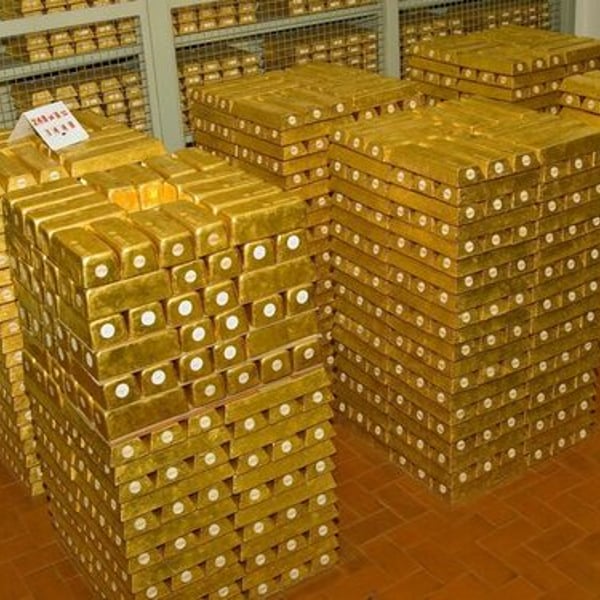
A secure room inside the Bank of Italy’s gold vault is filled with stacked gold bars stored along the corridor and behind metal security cages in an undated handout picture, in Rome, Italy – The Bank of Italy/Handout via REUTERS
The country’s bullion stockpile reflects decades of determined safeguarding after it rebuilt reserves plundered by the Nazis in the 1940s, and a stance that has seen it resist calls to sell through repeated crises and as its national debt soared.
The Bank of Italy now sits on the world’s third-largest national gold stockpile, behind only the US and Germany. Its 2,452 metric tons of gold are worth an estimated $300 billion at current prices, roughly 13% of 2024 national output, Reuters calculations show.
Italy’s love affair with bullion goes back millennia, with the Etruscans mastering the technique of fusing gold beads well before ancient Rome. Under Julius Caesar, the aureus gold coin became the monetary cornerstone of the Roman Empire, and centuries later, the fiorino became as influential in medieval Europe as the dollar is today.
The country’s more recent gold policy was shaped by its wartime experience, when Nazi forces aided by Italy’s own fascist regime seized 120 tons of its reserves. By the war’s end, these had dwindled to around 20 tons.
During its post-war “economic miracle”, Italy became an export-driven economy and saw a surge in foreign currency inflows, notably US dollars. Some of these, according to the Bank of Italy’s website, were converted into gold. Its holdings had climbed to 1,400 tons by 1960, including three-quarters of the seized bullion which it was able to recover in 1958.
The oil shocks of the 1970s ushered in further global uncertainty, which in Italy meant social unrest and frequent government changes seen as risky by investors. “The extreme monetary instability led the central banks of Western countries to buy gold, the ultimate symbol of financial solidity,” Stefano Caselli, dean of the SDA Bocconi School of Management in Milan, told Reuters.
To offset budget holes left by capital flight, Rome used 41,300 ingots from its gold reserves as collateral for a $2 billion loan from Germany’s Bundesbank in 1976. But unlike Britain or Spain, Italy has refused to sell off gold during financial downturns, retaining its reserves even through the 2008 debt crisis.
“Gold is like the family silverware, it’s like grandpa’s precious watch, it’s the last resort in times of crisis, any crisis that undermines international confidence in the country,” Salvatore Rossi, former deputy governor of the Bank of Italy, wrote in his 2018 book ‘Oro’ (Gold).
With gold still viewed as a safeguard of last resort by many Western nations, central banks worldwide are again stockpiling amid a reshaping of the global order. “That historical decision of the Bank of Italy feels strikingly modern,” said Caselli. “Because we are back there again.”
The Bank of Italy currently holds approximately 871,713 gold coins weighing some 4.1 tons in its vaults, dubbed the ‘sacristy’ after the room in a church where sacred items are kept. Gold accounted for nearly 75% of Italy’s official reserves at the end of last year, a significantly higher ratio than the 66.5% of the euro zone, according to World Gold Council data.
Around 1,100 tons are stored in the vault beneath the Bank of Italy’s headquarters at Palazzo Koch, a short walk from the Colosseum. A similar portion is held in the US, while smaller amounts are kept in Britain and Switzerland. Italy also remains one of the world’s top exporters of gold jewellery, with production concentrated in Alessandria, Arezzo, and Vicenza. Luxury brands like Bulgari, Buccellati and Damiani enjoy global acclaim.
Calls to sell gold to reduce Italy’s public debt, now over 3 trillion euros ($3.49 trillion) and seen at 137.4% of GDP next year, continue to surface but have not yet succeeded. “Selling even half of the gold holding would not solve Italy’s debt problem anyway,” said Giacomo Chiorino, head of market analysis at Banca Patrimoni Sella & C.
Some argue that selling ingots could unlock funding for essential public services to benefit citizens instead of sitting idly in vaults. Nonetheless, the Bank of Italy shows no intention of selling. It had no comment on its gold policy for this article.
“At a time when the world is being redrawn, market prices have reached unprecedented multiples and (digital assets such as) stablecoins and cryptocurrency are gaining ground, central banks currently hold the hottest asset,” Bocconi’s Caselli said. “They are right not to sell.”
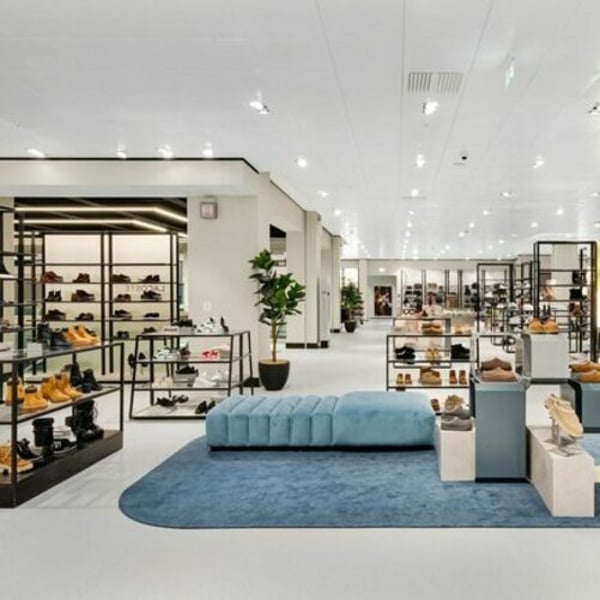
The newest ‘next-generation’ Frasers department store has opened at Queensgate Peterborough in the heart of the city.
Frasers Group
Spanning 60,000 sq ft across two floors, it brings together Frasers Group brands including Flannels, Sports Direct, USC, and Jack Wills under one roof.
The new destination “offers an elevated retail experience, providing access to the world’s most aspirational premium, lifestyle and sports brands”, across women’s, men’s, and kidswear, Frasers Group said.
It includes a dedicated 5,000 sq ft Flannels store, providing the Queensgate catchment “with the best in luxury and contemporary fashion, footwear, and accessories”.
This includes an extensive range of globally-recognised labels including Boss, Coach, Levi’s, Biba, Tommy Hilifger, Barbour, alongside sports brands under its Sports Direct banner, including Adidas, Nike, The North Face, Under Armour, New Balance, Everlast, Slazenger, Karrimor and USA Pro.
Ed Ginn, director of Investment Management for Queensgate operator Invesco Real Estate, said: “Frasers Group’s opening is the start of an exciting new chapter, and marks significant progress in our efforts to maintain Queensgate as a leading retail and leisure destination in the region and in the UK more widely.
“[The Frasers] addition… to the centre raises the bar for potential investment from brands to further enhance the shopping experience, as we continue to evolve Queensgate in a way that provides our catchment with everything they could need or want, in one place.”
Businessman Gerald Ratner has launched a surprise bid to buy the UK arm of the jewellery empire he famously trashed more than three decades ago after calling some products of his signature brand Ratners ‘total crap’.
Image: Ernest Jones
The businessman is seeking to acquire the British H Samuel and Ernest Jones chains from US-listed Signet Jewellers and install himself as chairman after he lost control of the businesses in the early 1990s, reported The Daily Telegraph.
Ratner has appealed to shareholders of the company as part of a bid to purchase the loss-making UK arm, which he said he has been “pursuing since the summer”.
The brands were once part of Ratners Group, the firm that he was forced to exit after he jokingly declared a few of its cheaper products were “total crap” in a speech at the Institute of Directors 30 years ago.
Ratner also remarked that some of the firm’s earrings were “cheaper than a prawn sandwich at Marks & Spencer – but I have to say, the sandwich will probably last longer than the earrings”.
The ensuing negative reaction from consumers and the wider business community gave rise to the phrase ‘to do a Ratner’ or destroy a valid business.
Ratner said he was attempting to acquire the UK division of Signet – which was formerly Ratners Group before it was rebranded – because he claimed its American owners were “doing everything wrong”.
The newspaper said that to launch his bid, Ratner has been in touch with Signet’s CEO. He’s understood to be backed by a consortium of primarily-British investors and has said they have the funds lined up.
He’s now launching an appeal directly to the company’s shareholders, who Ratner hopes should question why the US owners do not sell the loss-making division.
He told The Telegraph: “The reason we’re putting pressure on the shareholders is simply because of the fact that they’re doing so badly in the UK, they’re closing shops all the time and last year they sold their best shops.
“So we took the view that they’re not really interested in the UK. We approached them thinking that it’s in the interests of shareholders to just get rid of it.”
Signet is worth more than $3.7 billion (£2.8 billion) with a successful US operation but a loss-making UK division.
Frasers Group is reportedly considering a bid for failed business SilkFred as it continues to focus on acquiring brands that it sees as having growth potential or some unique properties in their business model that it can use in its wider operations.
SilkFred
SilkFred entered administration in October (although it was only officially announced last month) with Quantuma handling the process. The 15-year-old fashion company specialised in connecting womenswear designers and labels with consumers. Its particularly focus was occasionwear and unique pieces from indie brands.
News of Frasers’ (as-yet-unconfirmed) interest is hardly surprising. It continues to be one of the most acquisitive businesses in UK fashion. Only recently it has acquired both Braehead and Swindon Designer Outlet shopping destinations, a majority stake in luxury LA store The Webster, as well as adding to its already large ASOS stake (its 26% holding makes that company’s second-biggest shareholder).
The company hasn’t commented about SilkFred, although it would fit into its strategy of targeting younger consumers at a variety of price levels.
As mentioned, SilkFred went into administration this autumn, although here had been rumours of it struggling or a while.
Its most recent results covered 2023 and showed losses widening as sales fell as much as 46% to just £11.18 million.
Frasers, by contrast, is a giant of the retail sector with its half-year results up to the end of October showing revenue of £2.58 billion and retail trading profit of £411.4 million.







 Politics8 years ago