Connect with us

Fashion

Is there a price tag for the Louvre’s stolen jewels?

Published

on


By

Bloomberg

Published


October 22, 2025

French authorities have described it as priceless. But the last time the diamond-encrusted bow, which once belonged to Empress Eugenie, was sold, it reached a reported €6.72 million ($7.8 million). What it’s worth now, three days after it was stolen as part of a raid on the Louvre Museum in Paris is much more difficult to establish.

Unless stolen to order, the plunder of royal necklaces, tiaras and earrings, is in art-market parlance already “burned”- at least in its last-known state. The Ocean’s Eleven-style robbery has been widely publicised so the pieces can’t be sold, or worn, in public. And black markets carry deep discounts. Selling the jewels separately may be more discrete but also won’t be straightforward.

The alternative is that the exquisite jewels- diamonds, emeralds, sapphires- and gold could be broken up and melted down. Officially, the eight items are worth €88 million but not if the roughly 9,000 small and large stones gems are sold separately, according to Paris Prosecutor Laure Beccuau.

It’s usually the precision of the heist that captures filmmakers’ attention. But the next act- moving the high-profile loot- is just as perilous.

“Often the thieves realise that the risk is too great,” said Charlotte Chambers-Farah, a client manager at the London-based Art Loss Register. “They haven’t managed to move the goods within six months to a year, the burden becomes too heavy.”

The gems are likely to hold the most value but often have identifiers like the size and weight of the stone. To get around this, the stones could be dismantled, recut and reassembled to make them nearly unrecognisable, according to Chambers-Farah. 

Tobias Kormind, managing director of jeweller 77 Diamonds, estimated that the stolen gemstones could be worth about £10 million ($13.4 million), with much of the value derived from four large diamonds set in one of the brooches that was stolen. 

“It might be somebody now pays a tenth of the market value, takes it, and if they can afford it they hold it for ten years, and then slowly start breaking it up,” he said. “If in two years time someone comes in with a stone that needs to be recut, it’s not unusual, and they go through one person and another person, and then there’s somebody relatively credible who goes to a third.”

Melted down gold is almost impossible to identify and the price has risen almost 60% this year to near-record levels. Unlike the solid gold toilet stolen from Blenheim Palace in 2019, the jewellery wouldn’t contain enough metal to make it the focus of the robbery. 

Politicians, French police, and Louvre’s security staff have been strongly criticised for not stopping the heist. The lax outdoors surveillance, that allowed a furniture hoist to park up outside the museum unnoticed, could have made it a more attractive target than the closely-guarded jewellery stores at the Place Vendôme.

“We see a shift in the last 10 years, when museums are targeted no longer for paintings but much more for precious metals or diamonds,” said Arthur Brand, an art crime detective. Most art thieves would expect to get about a third of the value of the item when reselling, but it’s hard to determine how big the market would be for these high-profile jewels.

Selling the treasure for parts would unlock the value of the haul but would immediately destroy the historical meaning. French police will be racing to try to recover the jewellery before this happens.

Last month, a 3,000-year-old gold bracelet that was stolen from the Egyptian Museum in Cairo was melted down, according to the country’s interior ministry. 

Although deemed “priceless jewels” by French Justice Minister Gerald Darmanin, many of the pieces bore actual price tags before arriving in the vitrines of the Paris museum.

Empress Eugenie’s large corsage bow, stolen on Sunday, was purchased in 2008 with help from the Friends of the Louvre donor group for a reported €6.72 million. It had been set for auction at Christie’s in New York when the museum stepped in with the private purchase. The brooch had ceased to be part of the French crown jewels 121 years earlier when it was sold at a public auction to a jeweller for 42,200 French Francs or €85,000 at the time. An emerald necklace and earrings belonging to Empress Marie-Louise were acquired by the Louvre in 2004 from Baron Elie de Rothschild, according to the museum’s records, which didn’t include a price. His late wife had owned them, according to the records, which show they earlier passed through the jewellers Van Cleef and Arpels.

A Tiara of Empress Eugenie was sold in 1992 at a Sotheby’s auction in Geneva for more than $1 million and then donated by the donor group to the Louvre, museum and auction house records show. The stolen haul also included a tiara, a sapphire necklace, and matching earrings from the collection of Queens Marie-Amelie and Hortense, all acquired by the Louvre in 1985, according to museum records. The oldest acquisition, a reliquary brooch entered the collection in 1887.  

Rob van Beurden, an Antwerp-based diamond expert with 45 years experience in the industry, said that while it would be possible to recut the gems, he thinks it’s much more likely that they have been stolen to order.

“They always say that wherever a diamond is stolen, be it in Paris, in Prague, or in Madrid, chances are fair that it will end up in Antwerp,” he said. “But I don’t think anyone would be interested in burning their fingers on something this hot.”

“If they’re not stolen on assignment, then they will end up most likely somewhere in Antwerp, and God forbid it’ll be for the scrap value,” he said. “If ever they were to be sold just for the material, for the scrap value or for the diamonds, then it’s very little money.”

There have been questions raised about the professionalism of the gang. While making off with the necklaces and other items, the thieves left the 140-carat “Régent” diamond untouched and dropped a crown with more than 1,000 diamonds.

It’s not unheard of for stolen pieces to end up being later abandoned in a public place or reappear decades later.

In 2018,  thieves took two crowns and an orb belonging to the Swedish monarchy which were later found on top of a trash can in a Stockholm suburb. A collection of antique gold snuff boxes stolen from a stately home in Leeds, England, was found four decades later, intact. 

Sometimes items are stolen and used as leverage by a gang to get a member in prison a shorter sentence. The thieves realize they can’t sell the loot but still try to use it to gain advantage, according to Julian Radcliffe, founder of the Art Loss Register.

President Emmanuel Macron said that getting the crown jewels back in one piece is the outcome he’s hoping for. “We will recover the artworks, and the perpetrators will be brought to justice,” he said in a post on X earlier this week.


Source link

Continue Reading

Fashion

More arrivals for Outlet Shopping at The O2 that’s on track for ‘stellar’ 2025

Published

on


Published


December 8, 2025

What’s been a good year for Outlet Shopping at The O2 has just got better. The centre, linked closely to the O2 entertainment arena in the Greenwich Peninsular, southeast London, has opened two more new stores — fashion retailer TM Lewin and jewellery brand Lovisa — while also adding a recently-upsized unit for sportswear brand New Balance.

Image: TM Lewin

It all adds up to “growing momentum” for an outlet shopping destination that’s “on track for a stellar end to 2025” having enjoyed a 23% uplift in sales throughout November vs 2024, and footfall up 24% across the whole scheme, it said.

British heritage brand TM Lewin’s 1,827 sq ft store becomes the retailer’s only outlet location after returning to physical retail earlier this year. The space offers the brand’s range of shirts, suits, and accessories.

Dan Ferris, managing director at TM Lewin, said: “Our re-entry into physical retail has been a big move for us this year, and we have carefully selected locations where we believe our stores can get the best experience, regular customers, and be part of a community.”

Also making its outlet debut, Lovisa will open a 1,722 sq ft unit, adjacent to fashion retailers Dune London and Kurt Geiger, becoming the destination’s second dedicated jewellery retailer. It’s arrival supports the venue as a draw for accessories with demand “up 38% over November vs the same period in 2024”.

The store will offer its full range of necklaces, earrings and rings as well as its piercing facilities.

Long-standing tenant New Balance is also set to reinvest at the outlet, upsizing into a new 3,129 sq ft unit. The space will sport the brand’s new store concept, with additional space for wider stock collections.

Louisa Dalgleish, leasing director at Outlet Shopping at The O2, added: “As a destination already full of leading retail, the fact that we continue to attract such strong brands for their outlet debuts speaks volumes about our sustained momentum. Our success is a direct result of our collaborative landlord approach and the strength of our tenant mix, and our positive results throughout November are a clear indication that things show no sign of slowing down, with us remaining firmly front of mind for new entries into the outlet market.”

Copyright © 2025 FashionNetwork.com All rights reserved.


Source link

Continue Reading

Fashion

Central bank body BIS raises concerns of gold and stocks double bubble

Published

on


By

Reuters

Published


December 8, 2025

The combination of gold and share prices soaring in unison is a phenomenon not seen in at least half a century and raises questions of a potential bubble in both, global central bank umbrella body, the Bank for International Settlements, says.

Gold seized included coins, bars, and jewellery (photo for illustrative purposes only) – REUTERS/ Ajay Verma/File Photo/File Photo

While equity markets continue to be driven by AI and tech gains, gold’s 60% surge this year is set to be its biggest since 1979, fuelling debate about whether its traditional role as a safe-haven asset has changed. “Gold has behaved very differently this year compared to its usual pattern,” Hyun Song Shin, economic adviser and head of the Monetary and Economic Department at the BIS said as it released its ⁠final report of the year on Monday. “The interesting phenomenon this time has been that gold has become much more like a speculative asset.”

Dubbed the central bank to the world’s central banks, the BIS has given regular warnings ⁠about potential stock market bubbles in recent years, but its concern around the co-movement with gold is two-fold. Where would investors shelter if stocks and gold both crash. And what could it mean for central banks and other reserve managers given some have been heavy buyers of gold.

The BIS’ analysis concluded that this year has been the first time gold and the ‍S&P 500 have ‌jointly exhibited “explosive behaviour” in the last 50 years. Not only is gold up 60% this year, it is up more than 150% since ⁠2022 when the post-Covid pandemic surge in inflation ‌began to impact markets, alongside Russia’s invasion of Ukraine and subsequent Western sanctions on Moscow.

Another possible bubble warning sign is ‌that retail investors have also been piling in. Gold exchange-traded fund (ETF) prices have been consistently trading at a premium relative to their net asset value (NAV) this year, signalling “strong buying pressure coupled with impediments to arbitrage,” the BIS said.

Central banks’ purchases have “clearly set a very firm tone in the price of gold,” Shin added. “Whenever you have prices actually doing quite well, you will see other investors jumping in, and certainly ‍retail investors have also taken part (in the rally), and not just in gold”.

The BIS gave a broader warning too about the “growing fragility” of the risk-on environment amid the concerns about artificial intelligence (AI) valuations and the recent 20% dives in cryptocurrencies like bitcoin. The European Central Bank and ‌Bank of England have both raised ⁠their ​own AI bubble concerns in recent weeks and the risk of an abrupt burst if investors’ rosy expectations ⁠are not met.

Shin ​said the profits being made by the AI firms- now spending enormous amounts on data centres- was an important difference between now and the “dotcom bubble” of the early 2000s when firms weren’t making money. The “fundamental question,” however, is whether those expenditures will be seen as being justified ​in the long run, Shin said, adding that the other key determinant for markets will be how the global economy holds up next year. “So far, activity has been surprisingly resilient,” Shin said.

The BIS is also watching where ⁠the dollar goes from here. This year it is headed for its ⁠biggest annual drop since the Lehman Brothers collapse in 2007. “After the April episode (when US President Donald Trump announced sweeping trade tariff plans), the dollar has been relatively stable,” Shin said. “I think the hedging behaviour of non-US investors is going to be a very, very important input into how markets will co-move from here.”

© Thomson Reuters 2025 All rights reserved.


Source link

Continue Reading

Fashion

Ex-Levi Americas president buys Dr Martens shares

Published

on


Published


December 8, 2025

Share purchases in key companies are always interesting but we wouldn’t normally mention anyone buying a relatively small amount of shares, especially not an amount adding out to ‘only’ £75,000.

Image: Dr Martens

But given that the company concerned saw fit to announce the purchase itself and given that the company is in the middle of a major turnaround, it’s of more interest than it might usually be.

Dr Martens announced on Monday that Robert Hanson, who joined the board as an independent non-executive director in March, has purchased 96,000 shares in Dr Martens – worth over £75,000.

Share purchases by insiders are particularly significant given that those insiders tend to have the best view of how the company is faring with its turnaround and an individual committing a significant sum of their own money is particularly interesting.

Hanson currently serves as CEO of The Duckhorn Portfolio. His previous roles include EVP and president of Constellation Brands’ Wine & Spirits, president of Americas at Levi’s as well as CEO roles at American Eagle Outfitters and John Hardy. 

He purchased 96,000 ordinary shares at a price of £0.7886 per share. The buy suggests he believes that the shares, which are much lower than their all-time high of £5+, represent good value and should rise. 

Dr Martens is currently working through a recovery from a major period of weakness and it seems to be yielding results. Its first half update in November showed progress, with America recovering in particular even though EMEA still showed weakness.

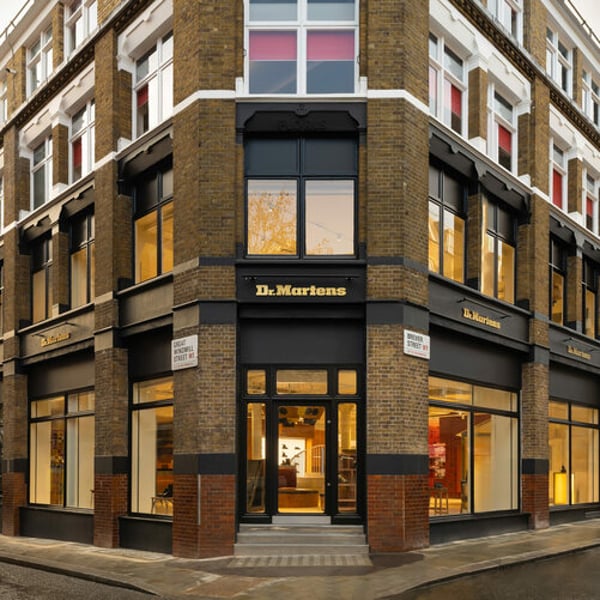
A week later, it also announced the opening of its new Soho, London flagship and that’s a key development. The store “represents the most elevated expression of the… brand to date”. The first-ever ‘beacon’ store is on Brewer Street with its two floors spanning 3,400 sq ft to make it the brand’s biggest UK flagship – “built to bring the people and product of Dr Martens together”.

Copyright © 2025 FashionNetwork.com All rights reserved.


Source link

Continue Reading

Trending

Copyright © Miami Select.