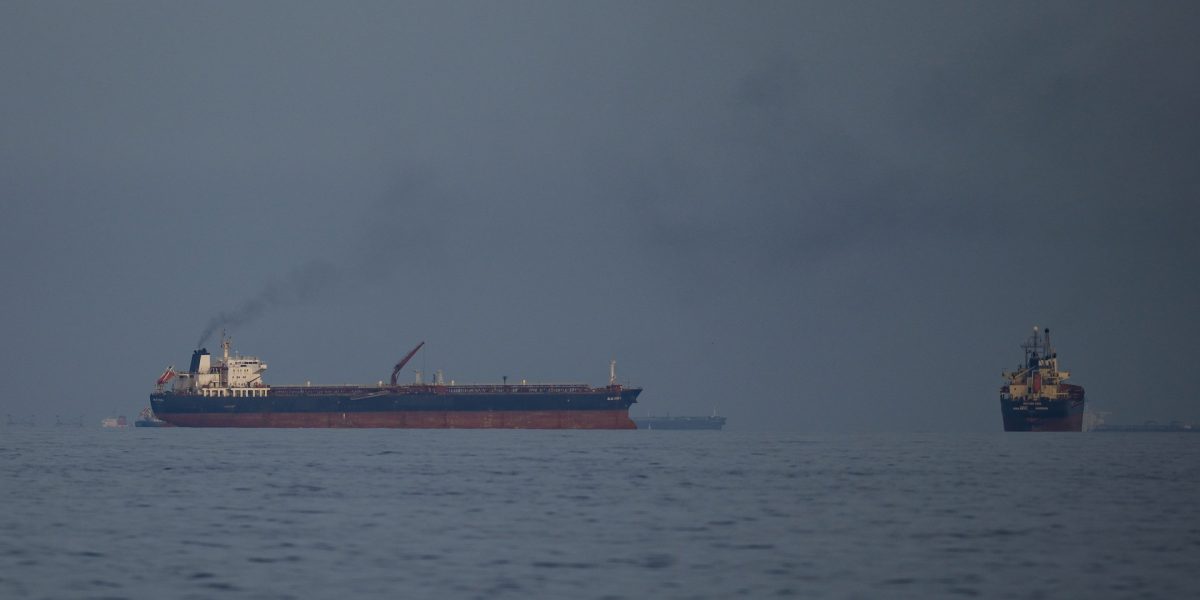
U.S. Energy Secretary Chris Wright told NBC he has been “in dialogue” with some of the countries, and said he expected China “will be a constructive partner” in reopening the strait through which one-fifth of global oil exports normally pass.
Iran’s Foreign Minister Abbas Araghchi told CBS that Tehran has been “approached by a number of countries” seeking safe passage for their vessels, “and this is up to our military to decide.” He said a group of vessels from “different countries” had been allowed to pass, without providing details.
Iran has said the strait is open to all except the United States and its allies.
“We don’t see any reason why we should talk with Americans” about finding a way to end the war, Araghchi added, noting that Israel and the U.S. started the fighting with coordinated attacks on Feb. 28 during indirect U.S.-Iran talks. The talks focused on Iran’s nuclear program, and Araghchi said Tehran had “no plan to recover” enriched uranium that is under rubble following U.S. and Israeli attacks last year.
Countries cautious on Trump’s call
“We are intensively looking with our allies at what can be done, because it’s so important that we get the strait reopened,” U.K. Energy Secretary Ed Miliband told Sky News, adding that ending the war is the “best and surest” way to do it.
South Korea’s Foreign Ministry said it “takes note” of Trump’s call and that it “will closely coordinate and carefully review” the situation with the U.S.
Expectations are high that Trump will ask Japan directly when Prime Minister Sanae Takaichi meets him on Thursday at the White House.
A spokesperson for China’s embassy to the U.S., Liu Pengyu, said “all parties have the responsibility to ensure stable and unimpeded energy supply” and that China would “strengthen communication with relevant parties” for de-escalation.
France previously said it is working with countries — President Emmanuel Macron mentioned partners in Europe, India and Asia — on a possible international mission to escort ships through the strait but has stressed it must be when “the circumstances permit,” when fighting has subsided.
Meanwhile, emergency oil stocks “will soon start flowing to global markets,” the International Energy Agency said Sunday, describing the collective action to lower prices “by far the largest ever.”
It updated last week’s announcement of 400 million barrels to nearly 412 million. Asian member countries plan to release stocks “immediately,” and reserves from Europe and the Americas will be released “from the end of March.”
More missile and drone attacks are reported
Gulf Arab states reported new missile and drone attacks a day after Iran called for the evacuation of three major ports in the United Arab Emirates — the first time it has threatened a neighboring country’s non-U.S. assets. Bahrain, Saudi Arabia and the UAE said they were working to intercept projectiles.
Iran has accused the U.S. of launching Friday’s strikes on Kharg Island, home to Iran’s primary oil terminal, from the UAE, without providing evidence.
U.S. Central Command said it had no response to Iran’s claim, and Anwar Gargash, a diplomatic adviser to the UAE president, rejected it. Gulf countries that host U.S. bases have denied allowing their land or airspace to be used for military operations against Iran.
Iran has threatened to attack the region’s U.S.-linked “oil, economic and energy infrastructures” if the Islamic Republic’s oil infrastructure is hit.
Iran has fired hundreds of missiles and drones at the UAE, Bahrain, Saudi Arabia, Qatar and Oman during the war, causing significant damage and rattling economies even as most are intercepted. Tehran says it targets U.S. assets, even as Iranian strikes are reported at civilian sites such as airports and oil fields.
War’s toll mounts across the region
Iranian strikes have killed at least a dozen civilians in Gulf countries, most of them migrant workers.
In Iran, the International Committee for the Red Cross said more than 1,300 people have been killed. Iran’s Health Ministry said 223 women and 202 children are among the dead, according to Mizan, the judiciary’s official news agency.
Iran’s government on Sunday showed journalists buildings damaged by strikes in Tehran on Friday. A police station was hit and surrounding buildings were damaged. Some apartments’ outer walls had been stripped away.
“God had mercy on all of us,” said Elham Movagghari, a resident.
In Israel, 12 people have been killed by Iranian missile fire and more have been injured, including three on Sunday. At least 13 U.S. military members have been killed, six in a plane crash in Iraq last week.
At least 820 people have been killed in Lebanon, according to its Health Ministry, since Iran-backed Hezbollah started hitting Israel and Israel responded with strikes and sent additional troops into southern Lebanon. In just 10 days, more than 800,000 people — nearly one out of every seven residents of Lebanon — have been displaced.
More Iranian missile strikes hit Israel
Israel said it continued to strike Iran. Iran fired missiles toward Israel.
Several strikes hit central Israel and the Tel Aviv area, where they caused damage at 23 sites and sparked a small fire. Magen David Adom, Israel’s rescue service, released video showing a large crater in a street and shrapnel damage to an apartment building.
Multisite impacts have become a hallmark of the war, as Israel’s military says Iran is firing cluster bombs that can evade some air defenses and scatter submunitions across multiple locations.