Connect with us

Business

Iran edges closer to a revolution that would reshape the world

Published

on


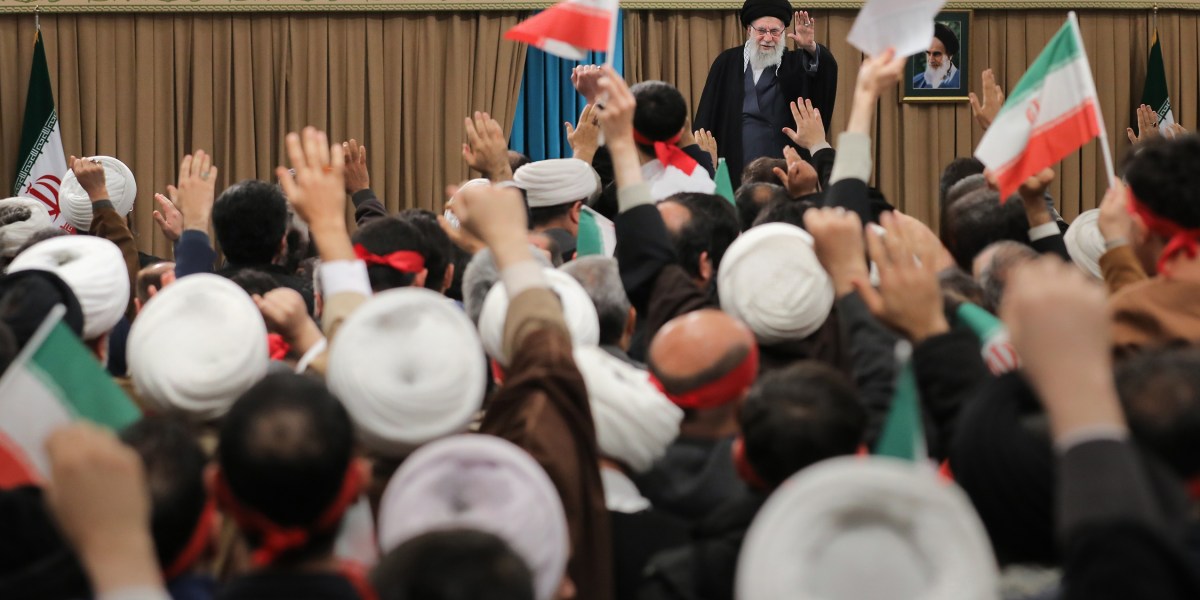
As protesters pour into the streets of Iran night after night, leaders across the region and around the world are grappling with the possibility that the Islamic Republic could be overthrown — a seminal event that would transform global geopolitics and energy markets.

The regime of Supreme Leader Ayatollah Ali Khamenei has weathered bouts of protests many times, but demonstrations that began two weeks ago are spreading — by some accounts, hundreds of thousands of people defied authorities’ threats and a brutal crackdown to take to the streets over the weekend, from the capital Tehran to dozens of other cities across the nation of 90 million. They are being cheered on by President Donald Trump, fresh off the capture of Venezuela’s Nicolas Maduro, and the US leader has in recent days repeatedly threatened to strike Iran, suggesting that America is back in the regime change business.

World leaders and investors are watching closely. US commanders have briefed Trump on options for military strikes, according to a White House official. Brent crude surged more than 5% on Thursday and Friday to over $63 a barrel as investors priced in the possibility of supply disruptions in OPEC’s fourth-biggest producer.

“This is the biggest moment in Iran since 1979,” said William Usher, a former senior Middle East analyst at the Central Intelligence Agency, referring to the revolution that birthed the Islamic Republic, upended the balance of power in the region and led to decades of rancor between Tehran and the US and its allies. “The regime is in a very tough spot right now and the primary driver is the economy. I think they have a narrowing window to reassert control and a diminished toolset to do it.”

More than 500 protesters have been killed in the past two weeks, according to the AP, citing the US-based Human Rights Activists News Agency, and more than 10,000 have been arrested in demonstrations triggered by a currency crisis and economic collapse, but now also focused on the regime.

Authorities have tried to block the internet and telephone networks since Thursday, as they seek to quell Iranians’ growing outrage over government corruption, economic mismanagement and repression. Foreign airlines have canceled flights to the country.

Trump’s repeated warnings to Iran that the US will strike if it kills peaceful protesters come as the president escalates his assault on the post-World War II global order in a stunning assertion of American power that’s included claiming Venezuela’s oil after seizing Maduro, and threatening to take over Greenland from NATO ally Denmark.

Israel, which battered Iran during a US-assisted 12-day air war in June, is liaising closely with European governments about the situation on the ground, according to a senior European official, who asked not to be named discussing private talks. 

If the regime does fall, it would be a blow to Russian President Vladimir Putin, who would lose another foreign ally after Maduro this month and the overthrow of Syria’s Bashar al-Assad just over a year ago, the official added.

The stakes for oil traders are significant. But it’s unclear if Khuzestan, the main oil-pumping province, has seen unrest and so far there are no signs of reduced crude exports. On Saturday, Reza Pahlavi, the son of the former shah who’s exiled in the US and positioning himself as an opposition leader, urged petroleum workers to strike. Oil strikes in 1978 were one of the death knells of his father’s monarchy because of how they immediately hit the economy.

The market’s “focus has now shifted to Iran,” said Arne Lohmann Rasmussen, chief analyst at A/S Global Risk Management, which helps clients manage volatility in energy markets. “There is also growing concern in the market that the US, with Trump at the helm, could exploit the chaos to attempt to overthrow the regime, as we have seen in Venezuela.”

The White House is on a high after the tactical success of the operation against Maduro, as well as Trump’s decision to bomb Iranian nuclear facilities at the end of the 12-day war. American officials are also increasing pressure on Denmark to cede control of Greenland, signaling the administration has the appetite for more forays abroad.

Read More: Trump’s Ousting of Maduro Shows His New World Order Is Here

Trump may well be tempted, for all the risks, to try to topple a government that’s been an archenemy to the US and Israel for over 45 years. 

“The balance of power would change dramatically,” Mark Mobius, the veteran emerging markets investor, said of the downfall of the Islamic Republic. “The best outcome would be a complete change in the government. The worst outcome would be continued internal conflict and a continuing rule by the current regime.”

Trump at times ran against American adventurism in the region, where the ousting of longtime US enemy Saddam Hussein in Iraq unleashed a generation of chaos and terrorism, costing hundreds of thousands of lives and trillions of dollars.

It’s just that kind of potential power vacuum that’s worrying Arab leaders in the Gulf Cooperation Council, according to regional officials. While the group — which includes Saudi Arabia, the United Arab Emirates and Qatar — has often viewed Iran as an adversary, its members have sought to improve ties in recent years to ensure Tehran doesn’t lash out against any Israeli or US military action by attacking them. The specter of the Arab Spring, where dictators fell across the region only for chaos to follow, looms large.

Iran has warned that if it’s attacked, American assets in the region — where it has deep commercial ties and tens of thousands of troops stationed — and Israel will be “legitimate targets for us.”

Read More: How Sanctions and a Currency Crash Fueled Iran Unrest

The Islamic Republic has been severely weakened in the past two years, thanks to its stagnating economy, rampant inflation and Israel striking both it and its proxies. But it retains a large and sophisticated arsenal of ballistic missiles able to hit targets across the Middle East, from military bases to oil installations, and the regime still has the backing of the country’s myriad security forces, including the all-important Islamic Revolutionary Guard Corps.

For the GCC and the likes of Turkey and Pakistan, the worst outcome would be chaos in Iran, said Ellie Geranmayeh, deputy program director for the Middle East and North Africa at the European Council on Foreign Relations. It’s an eventuality made more possible by the sheer diversity of Iranian protesters, who include everyone from urban, secular elites to religious conservatives and lack a unifying leader.

“With the GCC reconciliation of the past few years with Tehran, there’s a sense of better the devil you know rather than complete chaos or an unknown power structure that is alien to them,” said Geranmayeh.

US and Israeli strikes might even strengthen the government and reduce the appeal of the protest movement. In June, there was a surge in nationalism as the Jewish state and Washington rained down bombs.

The Islamic Republic probably won’t survive in its current form by the end of 2026, according to Dina Esfandiary, a Middle East analyst at Bloomberg Economics. The most likely scenario, she said, is a leadership reshuffle that largely preserves the system or a coup by the IRGC, which could mean greater social freedom — the organization is run by generals rather than clerics — but less political liberty and a more militaristic foreign policy.

The chances of a revolution are still fairly low, she said.

“A collapse appears unlikely for now,” she said. “Iranians are frightened of chaos, having seen it wreak havoc in neighboring Iraq and Syria. More importantly, the government is cracking down hard.”

On Sunday, President Masoud Pezeshkian, a former heart surgeon and a moderate relative to others at the top of the Iranian government, struck a conciliatory note, offering condolences to families affected by the “tragic consequences.”

“Let’s sit down together, hand in hand, and solve the problems,” he said on state TV.

It’s unlikely many protesters will believe him. The supreme leader, a much more powerful figure, as well as members of the security forces, are increasingly bellicose, floating the death penalty and making clear they’re prepared to respond as they always have — with brutal force.

“I don’t think a collapse of the regime would be pretty,” said Usher, the former CIA analyst. “Short-term, I could imagine some fracturing of the country as ethnic minority groups and some provinces pursue autonomy from Tehran. The IRGC will fight vigorously to save the regime so I think there’d be strong possibility for large-scale violence.”


Source link

Continue Reading

Business

Anthropic debuts Claude for Healthcare, partners with HealthEx for patient electronic health records

Published

on


AI lab Anthropic is making a major push into healthcare with the launch of Claude for Healthcare and an expansion of its life sciences offerings.

The announcement, timed to coincide with the start of the JPMorgan Healthcare Conference in San Francisco this week, comes just days after OpenAI unveiled ChatGPT for Health. That’s no coincidence and reflects the growing competition among leading AI labs to build specialized products for lucrative industries like healthcare, finance, and coding.

The Claude for Healthcare announcements include a partnership with HealthEx, a startup that allows patients to see all of their electronic medical records in a single place and control access to that data. The partnership includes a way for users to connect their personal medical records to Anthropic’s Claude in order to use the chatbot to answer health-related questions.

“HealthEx lets people bring their health records into a conversation with Claude and ask important questions in everyday language—What does this lab result mean? What should I bring up with my doctor? How has this number changed over time?—and get answers grounded in their own health history,” Amol Avasare, product lead at Anthropic, said.

The announcements also include a similar set of connectors for Function Health, a company that helps patients schedule lab tests and interpret the results, as well as integrations with Apple Health and Android Health Connect that will be rolling out to beta testers next week. For now, the connectors to HealthEx and Function Health are available to Claude Pro and Max subscribers in the U.S.

Health-related queries are among the leading consumer use cases of AI chatbots. But so far, Anthropic has been less focused on serving the general consumer market than its rival OpenAI, which boasts more than 800 million weekly users. Anthropic is thought to have far fewer consumer users and has instead concentrated on specialized use cases, such as software coding, that more naturally appeal to enterprise customers. It has pulled ahead of OpenAI in enterprise marketshare according to several recent surveys. It has also recently been creating more tailored versions of Claude to serve other industry or professional verticals, such as Claude for Financial Services and Claude for Life Sciences.

Anthropic has said it is interested in serving consumers as well as large organizations, and today’s announcements were aimed at both consumers and enterprise customers, such as hospitals, insurers, and pharmaceutical companies.

New offerings for healthcare providers, insurers, and pharma

The company said it was adding connectors to industry-standard databases including the Centers for Medicare & Medicaid Services Coverage Database, the International Classification of Diseases (ICD-10), the National Provider Identifier Registry, and PubMed.

These connectors are designed to help healthcare providers with tasks like speeding up prior authorization requests, supporting claims appeals, coordinating care, and triaging patient messages.

For life sciences companies, Anthropic is expanding beyond its initial focus on preclinical research to support clinical trial operations and regulatory work. New connectors include Medidata for clinical trial data and ClinicalTrials.gov. It is also launching connectors to bioRxiv and medRxiv—which are repositories for medical and biological research papers, usually before their findings have been peer reviewed; Open Targets, a database of identified drug targets; and ChEMBL, a database of bioactive compounds that could be used to make drugs.

The company is working with major healthcare and pharmaceutical companies including AstraZeneca, Sanofi, Genmab, Banner Health, Flatiron Health, and Veeva, among others. In a video clip Anthropic provided to reporters, it showed how Claude can now help a pharmaceutical company design a protocol for a Phase II clinical trial of a hypothetical drug designed to treat Parkinson’s Disease. It reduced the time it takes to draft the protocol design from many days to just about an hour.

Letting Claude use medical records to answer patient queries

Among the centerpieces of the new consumer health offerings is the partnership with HealthEx, which can help patients consolidate medical records from more than 50,000 health systems.

Fortune talked with executives from both companies exclusively about the new offering.

“Personal health records today are scattered across providers, and it can be difficult to get a complete view,” Avasare told Fortune. “HealthEx built a way to use Claude to unify those records with user consent and strong controls. Users decide what to share and can revoke access at any time, and their health data is never used for model training.”

HealthEx cofounders Priyanka Agarwal, now the company’s CEO, and Anand Raghavan, its CTO.

Photo courtesy of HealthEx

Users enable the HealthEx connector inside Claude, verify their identity, and connect their patient portal logins. HealthEx then unifies records across providers. When users ask Claude health-related questions, Claude uses Model Context Protocol (MCP)—an open standard Anthropic developed for connecting AI to external data sources—to securely retrieve relevant portions of the record for each specific question.

To enhance data privacy, Claude requests only the categories of information most likely to be relevant to a question—such as medications, allergies, recent lab reports, or doctor notes—rather than pulling an entire medical record. If relevance isn’t obvious, Claude can prompt users to broaden the scope, asking if they want to look further back in their history, Avasare said.

Priyanka Agarwal, cofounder and CEO of HealthEx, said the partnership addresses a fundamental problem in American healthcare: making it easier for consumers to access and understand their own health data.

“We’re giving every American a safe, private way for them to use their health data with AI,” Agarwal told Fortune. “We know that AI based on personal context is going to be more effective at providing support.” She said that by connecting medical records to HealthEx and HealthEx to Claude, users will get “responses [that] are grounded in your health history, not generic advice.”

According to Anthropic, the healthcare and life sciences announcements are possible because of recent improvements to Claude’s underlying capabilities. When tested on simulations of real-world medical and scientific tasks, Claude Opus 4.5, Anthropic’s latest model, substantially outperforms earlier releases. The company also said Opus 4.5 with extended thinking shows improvements in producing correct answers on honesty evaluations, reflecting progress on reducing factual hallucinations.


Source link

Continue Reading

Business

Buddhist monks are walking barefoot from Texas to DC with their dog, drawing crowds across the South

Published

on


A group of Buddhist monks and their rescue dog are striding single file down country roads and highways across the South, captivating Americans nationwide and inspiring droves of locals to greet them along their route.

In their flowing saffron and ocher robes, the men are walking for peace. It’s a meditative tradition more common in South Asian countries, and it’s resonating now in the U.S., seemingly as a welcome respite from the conflict, trauma and politics dividing the nation.

Their journey began Oct. 26, 2025, at a Vietnamese Buddhist temple in Texas, and is scheduled to end in mid-February in Washington, D.C., where they will ask Congress to recognize Buddha’s day of birth and enlightenment as a federal holiday. Beyond promoting peace, their highest priority is connecting with people along the way.

“My hope is, when this walk ends, the people we met will continue practicing mindfulness and find peace,” said the Venerable Bhikkhu Pannakara, the group’s soft-spoken leader who is making the trek barefoot. He teaches about mindfulness, forgiveness and healing at every stop.

Preferring to sleep each night in tents pitched outdoors, the monks have been surprised to see their message transcend ideologies, drawing huge crowds into churchyards, city halls and town squares across six states. Documenting their journey on social media, they — and their dog, Aloka — have racked up millions of followers online. On Saturday, thousands thronged in Columbia, South Carolina, where the monks chanted on the steps of the State House and received a proclamation from the city’s mayor, Daniel Rickenmann.

The physical toll of the monks long walk

At their stop Thursday in Saluda, South Carolina, Audrie Pearce joined the crowd lining Main Street. She had driven four hours from her village of Little River, and teared up as Pannakara handed her a flower.

“There’s something traumatic and heart-wrenching happening in our country every day,” said Pearce, who describes herself as spiritual, but not religious. “I looked into their eyes and I saw peace. They’re putting their bodies through such physical torture and yet they radiate peace.”

Hailing from Theravada Buddhist monasteries across the globe, the 19 monks began their 2,300 mile (3,700 kilometer) trek at the Huong Dao Vipassana Bhavana Center in Fort Worth.

Their journey has not been without peril. On Nov. 19, as the monks were walking along U.S. Highway 90 near Dayton, Texas, their escort vehicle was hit by a distracted truck driver, injuring two monks. One of them lost his leg, reducing the group to 18.

This is Pannakara’s first trek in the U.S., but he’s walked across several South Asian countries, including a 112-day journey across India in 2022 where he first encountered Aloka, an Indian Pariah dog whose name means divine light in Sanskrit.

Then a stray, the dog followed him and other monks from Kolkata in eastern India all the way to the Nepal border. At one point, he fell critically ill and Pannakara scooped him up in his arms and cared for him until he recovered. Now, Aloka inspires him to keep going when he feels like giving up.

“I named him light because I want him to find the light of wisdom,” Pannakara said.

The monk’s feet are now heavily bandaged because he’s stepped on rocks, nails and glass along the way. His practice of mindfulness keeps him joyful despite the pain from these injuries, he said.

Still, traversing the southeast United States has presented unique challenges, and pounding pavement day after day has been brutal.

“In India, we can do shortcuts through paddy fields and farms, but we can’t do that here because there are a lot of private properties,” Pannakara said. “But what’s made it beautiful is how people have welcomed and hosted us in spite of not knowing who we are and what we believe.”

Churches, families and towns host the monks along their path

In Opelika, Alabama, the Rev. Patrick Hitchman-Craig hosted the monks on Christmas night at his United Methodist congregation.

He expected to see a small crowd, but about 1,000 people showed up, creating the feel of a block party. The monks seemed like the Magi, he said, appearing on Christ’s birthday.

“Anyone who is working for peace in the world in a way that is public and sacrificial is standing close to the heart of Jesus, whether or not they share our tradition,” said Hitchman-Craig. “I was blown away by the number of people and the diversity of who showed up.”

After their night on the church lawn, the monks arrived the next afternoon at the Collins Farm in Cusseta, Alabama. Judy Collins Allen, whose father and brother run the farm, said about 200 people came to meet the monks — the biggest gathering she’s ever witnessed there.

“There was a calm, warmth and sense of community among people who had not met each other before and that was so special,” she said.

Monks say peace walks are not a conversion tool

Long Si Dong, a spokesperson for the Fort Worth temple, said the monks, when they arrive in Washington, plan to seek recognition of Vesak, the day which marks the birth and enlightenment of the Buddha, as a national holiday.

“Doing so would acknowledge Vesak as a day of reflection, compassion and unity for all people regardless of faith,” he said.

But Pannakara emphasized that their main goal is to help people achieve peace in their lives. The trek is also a separate endeavor from a $200 million campaign to build towering monuments on the temple’s 14-acre property to house the Buddha’s teachings engraved in stone, according to Dong.

The monks practice and teach Vipassana meditation, an ancient Indian technique taught by the Buddha himself as core for attaining enlightenment. It focuses on the mind-body connection — observing breath and physical sensations to understand reality, impermanence and suffering. Some of the monks, including Pannakara, walk barefoot to feel the ground directly and be present in the moment.

Pannakara has told the gathered crowds that they don’t aim to convert people to Buddhism.

Brooke Schedneck, professor of religion at Rhodes College in Memphis, Tennessee, said the tradition of a peace walk in Theravada Buddhism began in the 1990s when the Venerable Maha Ghosananda, a Cambodian monk, led marches across war-torn areas riddled with landmines to foster national healing after civil war and genocide in his country.

“These walks really inspire people and inspire faith,” Schedneck said. “The core intention is to have others watch and be inspired, not so much through words, but through how they are willing to make this sacrifice by walking and being visible.”

On Thursday, Becki Gable drove nearly 400 miles (about 640 kilometers) from Cullman, Alabama, to catch up with them in Saluda. Raised Methodist, Gable said she wanted some release from the pain of losing her daughter and parents.

“I just felt in my heart that this would help me have peace,” she said. “Maybe I could move a little bit forward in my life.”

Gable says she has already taken one of Pannakara’s teachings to heart. She’s promised herself that each morning, as soon as she awakes, she’d take a piece of paper and write five words on it, just as the monk prescribed.

“Today is my peaceful day.”


Source link

Continue Reading

Business

What global executives need to ask about China in 2026

Published

on


2025 was a turbulent year for China. The country began the year battling geopolitical headwinds and weak domestic demand. By April, new tariffs and trade frictions triggered some of the most significant trade actions in decades.

Yet by November, the story had changed. China’s annual trade surplus passed $1 trillion, a record high. GDP growth remained steady at around 5%. The country seems to have shrugged off concerns of “deglobalization.”

What does 2026, the Year of the Horse, pose for China? The headlines may focus on Trump tariffs or real estate woes, but there are more subtle trends happening that will define China’s economic trajectory. China presents new challenges for international business, particularly from confident local competitors, but there are still opportunities for disciplined global executives. Five key questions will matter as the world’s second-largest economy navigates a fast-changing global economy.

How will tariff uncertainty shape your China strategy?

China has long dominated global manufacturing, thanks to its cost competitiveness and integrated supply chains. That strength remains intact despite higher U.S. tariffs in 2025, which have now stabilized at around 50%. The tariffs barely dented China’s trade: The country’s share of global goods exports held steady at around 14%, four times greater than India and Vietnam combined.

The reason is that China has already broadened its trade partners. Goods exports to the U.S. represent just 2-3% of China’s GDP, and over half of China’s goods exports now go to Global South economies including ASEAN, Latin America, the Middle East, and Africa.

China also exports more knowledge-intensive goods, such as electronics and automobiles, and fewer labor-intensive goods, like furniture and toys.

Beijing’s bought itself some time, but 2026 will be the test of how resilient China’s export economy truly is. Trade patterns will continue to shift, with one analysis by the McKinsey Global Institute suggesting that as much as 30% of global trade could be shift corridors by 2035. The trade map is being redrawn in real time.

Multinational companies with a presence in China need supply chain flexibility, so that can rewire their operations as quickly as China’s companies can.

Where are Chinese consumers spending, and what does that mean for global brands?

Before the pandemic, Chinese consumers drove near-double-digit retail growth each year. Yet in 2025, consumer confidence hit historic lows, youth unemployment hovered around 15%, and real estate remained stagnant. Yet retail spending grew around 4-5% in the first three quarters of 2025 year-on-year.

Chinese consumers continue to spend—just on different things. Tourism spending rose 12% in the first three quarters of 2025, while box office revenue jumped 22%. Government subsidies supported double-digit growth in spending on electric vehicles and home appliances. Discretionary spending, however, struggled.

The opportunity for executives lies in tapping China’s sizable household savings. Consumers are waiting for something worth buying, and so the challenge will be to offer products and services that Chinese shoppers think are genuinely worth pursuing. Competing on price alone won’t work; only a compelling value proposition will unlock these locked savings.

Can your business survive and thrive in China’s hyper-competitive market?

China is struggling with deflationary pressure, even as the West fights inflation. 2025 accelerated what the Chinese call “involution”, an intense competition that erodes margins across the industry. Roughly 30% of large industrial firms reported losses, up from 20% before the pandemic.

But the period of “overcapacity” may be easing. Fixed asset investment slowed, and then shrank, reflecting weaker spending in some sectors. Rather than being a concern, lower investment may signal that companies are pulling back from excessive expansion, correcting years of overinvestment that flooded markets and destroyed pricing power. That adjustment, if reinforced by appropriate reforms, could eventually stabilize margins.

Companies must now differentiate through technology, branding and services, and not just price. Importantly, success in China will lead to a competitive advantage anywhere else in the world. Otherwise, competition with Chinese players can be brutally unforgiving—not just on their home turf, but increasingly overseas as well.

Are you ready to face Chinese competitors abroad?

China has attracted foreign capital for decades. But last year, China turned into growing source of investment. Foreign direct investment announcements into China between 2022 and 2025 fell by roughly two thirds, compared to between 2015 and 2019 on an annualized basis. Outbound Chinese FDI announcements held steady at around $100 billion annually, but it’s broadened beyond the traditional destination of emerging Asia to newer markets like Latin America, the Middle East and Europe.

Chinese companies are also becoming global cultural exporters. Pop Mart’s Labubu figurines, the blockbuster Black Myth: Wukong, and Chinese EV brands have all captured global audiences. This reflects a growing form of commercial “soft power,” as Chinese culture, lifestyle trends and consumer brands penetrate markets.

In 2026, expect to face Chinese competitors on your home turf. Global South markets, and their younger and increasingly affluent populations, are becoming more important to Chinese companies, but Western economies still present an opportunity for Chinese brands that are competitively priced and culturally relevant. It’s not a question of whether Chinese companies are coming; it’s whether you’re ready to match their speed, cost, and efficiency.

Will Chinese AI reshape productivity, in China and beyond?

Before 2025, Silicon Valley looked like it had an insurmountable lead over China in AI. Then came perhaps the biggest China story of the year: DeepSeek’s open-source AI model that rocked markets and intensified AI competition in China, the U.S., and around the world.

China is now an AI leader, even amid tough U.S. export controls and a moribund venture capital sector. Major tech firms like Alibaba rolled out models competing with the best from the U.S., while a swarm of “little dragons”—smaller, agile AI startups—released their own innovative models. Chinese AI now perform strongly on LLM leaderboards

China’s innovation engine—rapid iteration, cost-efficient scaling, substantial engineering talent, and collaborative open-source development—explains how the country was able to take the lead on AI.

But business impact is more important than technical performance. Will this AI capability translate into meaningful productivity gains?

McKinsey Global Institute analysis finds Chinese companies rank in the top ten in 16 of 18 sectors that can drive up to one-third of GDP growth by 2040, with AI playing an important enabling role across many of them.

More meaningful signals may emerge next year, as China continues to invest in AI use-cases across its manufacturing sector. A new “DeepSeek moment,” perhaps in industry, might be a sure bet for 2026.

Looking ahead

2026 begins with sharper risks for China: Geopolitical uncertainty, a struggling real estate sector, strained public finances, and elevated youth unemployment. Yet what draws companies to China—scale, innovation, and global influence— remain as compelling as ever.

The companies that will win in China next year won’t be those with the best macroeconomic forecasts, but rather those that can win on the ground: building resilient supply chains, differentiating themselves from the competition, and harnessing the country’s innovation.

For global businesses prepared to operate with this level of discipline, China can still be a lucrative market in the Year of the Horse.


Source link

Continue Reading

Trending

Copyright © Miami Select.