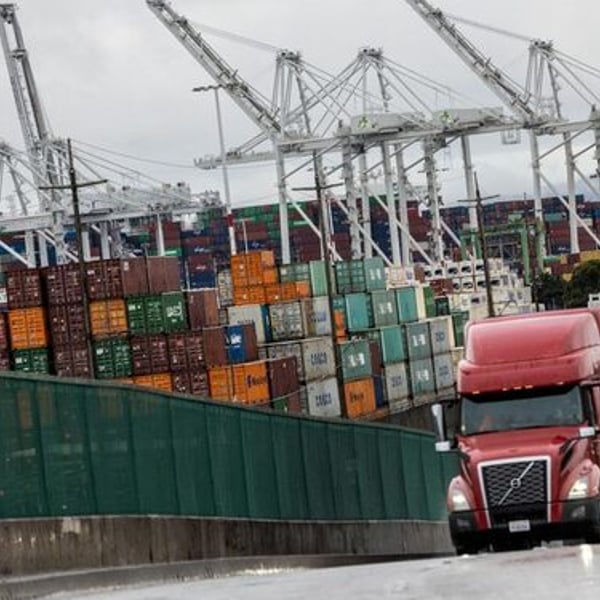
Global investors are heading into U.S. President Donald Trump‘s Wednesday deadline for trade tariffs palpably unexcited and prepared for a range of benign scenarios that they believe are already priced in.
Reuters
Just days before the end of a 90-day pause he announced on his April 2 “Liberation Day” tariffs, Trump said the first batch of letters outlining the tariff levels they would face on exports to the United States would be sent to 12 countries on Monday.
Investors who have been tracking this date for months expect more details to emerge in the coming days and protracted uncertainty too, anticipating Trump will not be able to complete deals with all of America’s trading partners in the coming week.
And they are not overly concerned.
“The market has gotten much more comfortable, more sanguine, when it comes to tariff news,” said Jeff Blazek, co-chief investment officer of multi-asset at Neuberger Berman in New York.
“The markets think that there is enough ‘squishiness’ in the deadlines – absent any major surprise – to not be too unsettled by more tariff news and believe that the worst-case scenarios are off the table now.”
Both the tariff levels and effective dates have become moving targets. Trump said on Friday that tariffs ranging up to 70% could go into effect on August 1, levels far higher than the 10%-50% range he announced in April.
So far, the U.S. administration has a limited deal with Britain and an in-principle agreement with Vietnam.
Deals that had been anticipated with India and Japan have failed to materialize, and there have been setbacks in talks with the European Union.
World stocks are meanwhile at record highs, up 11% since April 2. They fell 14% in three trading sessions after that announcement but have since rallied 24%.
“If Liberation Day was the earthquake, the tariff letters will be the aftershocks. They won’t quite have the same impact on markets even if they are higher than the earlier 10%,” said Rong Ren Goh, a portfolio manager in the fixed income team at Eastspring Investments in Singapore.
“This financial system is so inundated with liquidity that it is hard to cash up or delever at the risk of lagging the markets, with April serving as a painful reminder for many who derisked and were then forced to chase the relentless recovery in the subsequent weeks.”
Investors have also been distracted by weeks of wrangling in Congress over Trump’s massive tax and spending package, which he signed into law on Friday.
Stock markets have celebrated the passage of the bill, which makes Trump’s 2017 tax cuts permanent, while bond investors are wary the measures could add more than $3 trillion to the nation’s $36.2 trillion debt.
The S&P 500 and Nasdaq indexes closed at record highs on Friday, notching a third week of gains. Europe’s STOXX 600 benchmark is up 9% in three months.
But the risks of tariff-related inflation have weighed on U.S.
Treasuries and the dollar, and jostled expectations for Federal Reserve policy. Rate futures show traders no longer expect a Fed rate cut this month and are pricing in a total of just two quarter-point reductions by year-end.
The dollar has suffered a knock to its haven reputation from the dithering on tariffs. The dollar index, which reflects the U.S. currency’s performance against a basket of six others, has had its worst first half of the year since 1973, declining some 11%. It has fallen by 6.6% since April 2 alone.
“The markets are discounting a return to tariff levels of 35%, 40% or higher, and anticipating an across-the-board level of 10% or so,” said John Pantekidis, chief investment officer at TwinFocus in Boston.
Pantekidis is cautiously optimistic about the outlook for U.S. stocks this year, but the one variable he is watching closely is interest rate levels.
For now he expects to see interest rates dip in the second half, “but if the bond market worries about the impact of the bill and rates go up, that’s a different scenario.”
The demerger of Unilever‘s ice cream division, to be named ‘The Magnum Ice Cream Company,’ which had been delayed in recent months by the US government shutdown, will finally go ahead on Saturday, the British group announced.
Reuters
Unilever said in a statement on Friday that the admission of the new entity’s shares to listing and trading in Amsterdam, London, and New York, as well as the commencement of trading… is expected to take place on Monday, December 8.
The longest federal government shutdown in US history, from October 1 to November 12, fully or partially affected many parts of the federal government, including the securities regulator, after weeks without an agreement between Donald Trump‘s Republicans and the Democratic opposition.
Unilever, which had previously aimed to complete the demerger by mid-November, warned in October that the US securities regulator (SEC) was “not in a position to declare effective” the registration of the new company’s shares. However, the group said it was “determined to implement in 2025” the separation of a division that also includes the Ben & Jerry’s and Cornetto brands, and which will have its primary listing in Amsterdam.
“The registration statement” for the shares in the US “became effective on Thursday, December 4,” Unilever said in its statement. Known for Dove soaps, Axe deodorants and Knorr soups, the group reported a slight decline in third-quarter sales at the end of October, but beat market expectations.
Under pressure from investors, including the activist fund Trian of US billionaire Nelson Peltz, to improve performance, the group last year unveiled a strategic plan to focus on 30 power brands. It then announced the demerger of its ice cream division and, to boost margins, launched a cost-saving plan involving 7,500 job cuts, nearly 6% of the workforce. Unilever’s shares on the London Stock Exchange were steady on Friday shortly after the market opened, at 4,429 pence.
This article is an automatic translation. Click here to read the original article.
Burberry has named a new chief operating and supply chain officer as well as a new chief customer officer. They’re both key roles at the recovering luxury giant and both are being promoted from within.
Matteo Calonaci becomes chief operating and supply chain officer, moving from his role as senior vice-president of strategy and transformation at the firm.
In his new role, he’ll be oversee supply chain and planning, strategy and transformation, and data and analytics. He succeeds Klaus Bierbrauer, who’s currently Burberry supply chain and industrial officer. Bierbrauer will be leaving the company following its winter show and a transition period.
Matteo Calonaci – Burberry
Meanwhile, Johnattan Leon steps up as chief customer officer. He’s currently currently Burberry’s senior vice-president of commercial and chief of staff. In his new role he’ll be leading Burberry’s customer, client engagement, customer service and retail excellence teams, while also overseeing its digital, outlet and commercial operations.
Both Calonaci and Leon will join the executive committee, reporting to Company CEO Joshua Schulman.
JohnattanLeon – Burberry
Schulman said of the two execs that the appointments “reflect the exceptional talent and leadership we have at Burberry. Both Matteo and Johnattan have been instrumental in strengthening our focus on executional excellence and elevating our customer experience. Their deep understanding of our business, our people, and our customers gives me full confidence that their leadership will help drive [our strategy] Burberry Forward”.
Traditional and occasion wear designer Puneet Gupta has stepped into the world of fine jewellery with the launch of ‘Deco Luméaura,’ a collection designed to blend heritage and contemporary aesthetics while taking inspiration from the dramatic landscapes of Ladakh.
Hints of Ladakh’s heritage can be seen in this sculptural evening bag – Puneet Gupta
“For me, Deco Luméaura is an exploration of transformation- of material, of story, of self,” said Puneet Gupta in a press release. “True luxury isn’t perfect; it is intentional. Every piece is crafted to be lived with and passed on.”
The jewellery collection features cocktail rings, bangles, chokers, necklaces, and statement evening bags made in recycled brass and finished with 24 carat gold. The stones used have been kept natural to highlight their imperfect and unique forms and each piece in the collection has been hammered, polished, and engraved by hand.
An eclectic mix of jewels from the collection – Puneet Gupta
Designed to function as wearable art pieces, the colourful jewellery echoes the geometry of Art Deco while incorporating distinctly South Asian imagery such as camels, butterflies, and tassels. Gupta divides his time between his stores in Hyderabad and Delhi and aims to bring Indian artistry to a global audience while crafting a dialogue between designer and artisan.