
Business
Investors are betting big on ‘prediction markets’ Kalshi and Polymarket—will the gamble pay off?
Over Labor Day weekend, social media lit up with observations that President Trump had not been seen in public for several days. Soon, rumors swirled about Trump’s health—and ghoulish hashtags even claimed he had died. Yes, it was just another weekend in the online rumor mill, but this round of speculation came with a novel twist: a flurry of bets about the president’s health on so-called prediction market sites. On Kalshi, the odds of Vice President JD Vance taking office by the end of the year shot up to 15%. For Kalshi customers, a wager of $15 would mean a payout of $100 if Vance took office.
Trump’s alleged disappearance, of course, proved a false alarm. By Tuesday, the internet had moved on to other diversions—but not before pundits blasted Kalshi and its prediction markets rival Polymarket for running “assassination markets,” where the public could (indirectly) wager on the death of a public figure.
Those accusations may have been overblown—not least because one of Trump’s sons invests in and advises both Kalshi and Polymarket. But the episode showed how prediction markets, long the province of a niche clique of academics, have suddenly become a mainstay of politics and the news cycle.
They are also on the cusp of becoming big business.
Kalshi and Polymarket have been around for seven and five years respectively, but their big breakout came during last year’s U.S. presidential election campaign. Over the course of several months, millions of people convened on the platforms to wager more than $3 billion on the outcome, resulting in forecast that proved far more accurate than the most highly regarded polls. For the startups’ founders, this proved their thesis: that the platforms’ blend of crowdsourced wisdom and financial self-interest offers an unprecedented window into future events.
Right now on Kalshi and Polymarket, those future events include profound geopolitical and economic questions, like whether China will invade Taiwan by the end of 2025 (6% as of mid-September) or how many rate cuts the Fed will implement by end of year (14% for two cuts). There are also plenty of more frivolous wagers, like whether Taylor Swift will get pregnant in 2025 (15%).
To their backers, these wagers (“events contracts” in prediction markets parlance) represent a promising new industry—and a potentially powerful tool that investors could use to hedge their portfolios, or that businesses could use to predict consumer demand. Sequoia venture capitalist Alfred Lin describes the markets to Fortune as “basically truth machines.”
Seizing on a favorable environment for fintech experimentation, Lin and others have poured hundreds of millions of dollars into Kalshi and Polymarket (each of which now enjoy $1-billion-plus “unicorn” valuations) and a handful of smaller platforms; public companies like Robinhood are also jostling for a piece of the action. Right now, monthly wagers on Polymarket and Kalshi are totaling well over $1 billion, while analytics firm Similarweb says the sites attracted over 35 million visitors this summer.
Still, the emerging sector is fraught with risks. While their supporters envision prediction markets as nimble tools for peering into the future, many others—including, it seems, most of the people actually using them—see them as just another way to gamble. If the markets come to be seen primarily as just another casino, they are likely to lose the moral and intellectual high ground their boosters have touted. That’s not to mention the challenge of the brutal competition and legal jeopardy that would go with operating in the tightly regulated gaming industry.
There’s also the public unease around platforms that permit wagers on war or the health of politicians in a time of general social upheaval—an unease intensified by the murder of conservative activist Charlie Kirk. And some question whether the two leading prediction market companies can be trusted to run their startups responsibly. In the past year, the founders of both Kalshi and Polymarket have engaged in eyebrow-raising antics that could give pause to investors and regulators alike.
The biggest risk hanging over the industry, though, is a basic business question: Can sites like Kalshi and Polymarket generate sustained interest—and revenue—outside of the once-in-four-years presidential contest?
Prior to election night, nearly $211 million of prediction market bets came flooding in. The following day, gleeful winners lined up to collect—pleased to have anticipated the triumph of the Democratic incumbent, Woodrow Wilson.
That was in 1916, a year that would prove to be the high-water mark of U.S. prediction markets for over a century. When these markets surged back to prominence in last year’s Trump-Harris contest, they were clothed in Kalshi and Polymarket’s digital wrapper. But the underlying mechanics are very much the same as in Wilson’s era.
You can think of prediction markets as wagers that are fluid. Unlike casinos or conventional betting sites, where bettors place a fixed wager against the house, participants on Kalshi and Polymarket bet against one another and can close out their “event contract” anytime. Like stock exchanges, prediction markets serve as a matching service between buyer and seller.
For instance, a contract for a heavily favored election candidate might cost 80¢, which locks in a $1 payout if the candidate wins. The opposing bettor buys a 20¢ ticket that pays $1 if the other candidate wins. But if the favored candidate suffers a major scandal, the value of that contract might drop to 40¢—leaving the owner to decide whether to sell it to another bettor or hold it till the election results come in.
While this is a form of gambling, proponents argue that any negative social effects are outweighed by the powerful signals the contracts can provide to markets about everything from weather in harvest season to whether a given politician will be elected. In practice, the closer to $1 the value of the event contract comes, the greater the likelihood of the event coming to pass. As the Trump election results demonstrated, the markets can be uncannily accurate—and the more people participate, the more accurate they theoretically become.
According to Kalshi cofounder Tarek Mansour, that accuracy is the result of two interlocking factors. “They’re a market-based mechanism, so you get the wisdom of the crowds,” he explains. “Number two, skin in the game. When people have real money on the line, they don’t lie.
Why did something so useful fall out of favor in the first place? The best answer is that prediction markets got swept up in broader Progressive Era campaigns against gambling, just as the rise of scientific polling pioneered by George Gallup provided a useful alternative. (Ironically, the anti-gambling crusades of that era often spared horse racing, since, in the eyes of the moralists, it enjoyed an association with rural American virtue—while also teaching young, military-age men to size up horseflesh.)
Robin Hanson, a George Mason University professor, sees the debate over prediction markets as part of a longtime push and pull between those who view tools for speculation as a moral threat, and those who see them as useful. “Moralizing about betting markets goes up and down in cycles,” Hanson observes. “Pretty much all financial markets were illegal at some point, including stocks and life insurance.”
In this view, prediction markets are taking their place next to products like options and futures contracts, which regulators long frowned on as overly speculative, but are now viewed as important market signals.
Lin of Sequoia is a Kalshi board member who studied prediction markets in college, and he believes they offer a superior way to hedge against uncertainty, allowing investors to fortify themselves against, for example, adverse interest rate movements. “Right now, the way to do that is to look for interest-sensitive stocks and either buy or short them,” says Lin. “There needs to be a better way.”
Mansour says first-hand experience led him to the same conclusion; he once worked on the “exotics” desk of Goldman Sachs, where he built baskets of stocks to help customers take positions on events like Brexit.
This push to open prediction markets follows decades of the U.S. banning them—though not entirely. In 1998, the Commodity Futures Trading Commission (CFTC) permitted an entity called the Iowa Electronic Markets to run betting platforms in which a small group of academics could wager very small amounts. The agency then gave permission in 2014 to a successor group, PredictIt, to operate a somewhat broader version.
In the past two years, the legal chains holding back prediction markets have largely vanished. But the current era of these markets is being shaped by startup founders with a penchant for bending the rules.
“Bruh!” Shayne Coplan’s curly head yells on my iPhone screen shortly before last year’s election. It’s clear Coplan is sore over a Fortune story that revealed that many of the wagers on Polymarket had come from fishy trades.
That revelation didn’t dim the general enthusiasm around Polymarket, and in the subsequent months, I repeatedly propose Zoom or in-person meetings so Coplan can tell me the full story. Nope: Coplan prefers to do it his way, with direct messages and ambush video calls over Signal, where he has chosen the Beatles’ Revolver cover as his avatar.
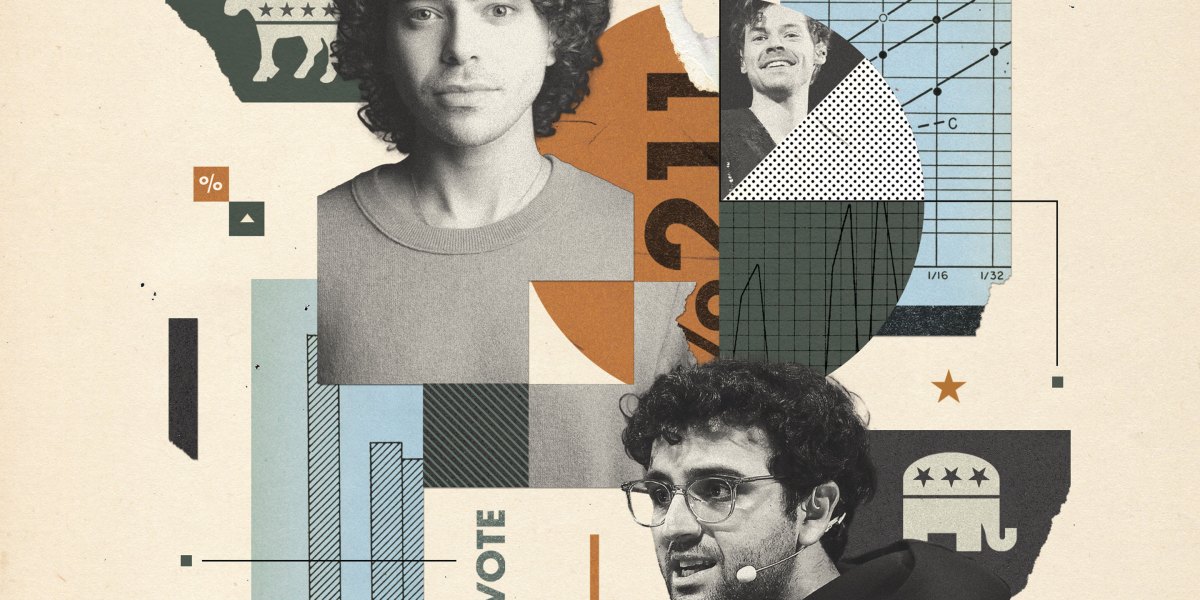
The 27-year-old Coplan, a New York City kid who got deep into cryptocurrency in high school, started Polymarket in 2020 after dropping out of NYU. One of his backers, Rob Hadick of Dragonfly Capital, describes him as brilliant, with a deep, all-consuming passion for probabilities. Recent accounts and photos of Coplan reflect a founder with a cooler-than-thou affect possessed of deep confidence—or perhaps overconfidence. Recalling encounters with him, two crypto executives told Fortune of Coplan comparing himself to Apple founder Steve Jobs.
Coplan has also brought his swagger to the way he operates his company. In 2022, Polymarket was hit with a CFTC consent decree barring it from operating in the U.S. Despite this, there’s ample evidence that the site turned a blind eye to Americans who placed bets by using a VPN to mask their location. (Polymarket disputes this characterization.) It’s quite possible that this conduct—or Polymarket’s decision to pay U.S. influencers to promote the site—explained the Justice Department’s decision shortly after the election to raid Coplan’s apartment and seize his smartphone and other devices.
The sensible response to a federal raid is to let your lawyers do the talking. Coplan chose another strategy. Days later, he took to X to tweet “New phone who dis?” The gesture amounted to taunting the prosecutors but would ultimately do him no harm; months later, the Feds dropped the investigation without filing charges.
If Coplan relishes being the enfant terrible of prediction markets, Kalshi’s cofounders have taken a different tack. Mansour and cofounder Luana Lopes Lara are eager to talk up their track record of compliance. This included staying well clear of the U.S. market until September 2024, when Kalshi prevailed in a lawsuit against the CFTC, with a federal judge ruling the agency lacked jurisdiction over events contracts unless they concerned “assassination,” “terrorism,” or “gaming.”
Mansour, 29, is slightly disheveled and shares little in common with Coplan save for a fixation with probabilities. Born in California, the Kalshi CEO returned with his parents to a Christian village in Lebanon as a young child. “We went through a few periods of war or terrorism. It was an anxiety-inducing period,” recalls Mansour, adding that he responded to the turmoil by becoming obsessed with math, and then with getting into MIT. Today, he posts his 5.0 GPA from the university on his LinkedIn page.
His cofounder has a different story and mien. Lopes Lara, also 29 and an MIT grad, was born and raised in Brazil and became a professional ballerina before abruptly pivoting to mathematics. Polished and easy in conversation, she recalled moments when prediction markets directly intersected with her own life.
The question “will Kalshi or Polymarket win the most market share?” would be great fodder for a crowdsourced answer.
“The Kalshi markets started predicting that [COVID] was going to pick up again around Thanksgiving a couple years ago, and we made our own return-to-office decisions thinking about this,” she recalls. The prediction proved correct, she adds: “It was very cool to see and follow it, since you could predict what was going to happen in the news a week later.” Lopes Lara also remembers taking a keen interest in a more trivial wager over whether the band One Direction would reunite, and realizing to her deep disappointment that they wouldn’t.
The Kalshi cofounders run a tight ship, with Mansour serving as the public face of the company while Lopes Lara runs internal operations. The team closely vets new events contracts and has added rules to address unanticipated or controversial outcomes. Those include the “will Trump leave office” contract: Under Kalshi rules, that contract will pay out only partially in the event the president dies, rather than paying out “yes” bettors in full.
Polymarket has no such provision for its “will Trump leave office” contract. It has also listed other bets that ended in controversy—among them, a recent wager over whether the president of Ukraine would wear a suit at a White House visit. When Volodymyr Zelensky turned up in black raiment that media outlets described as a suit, Polymarket nonetheless chose to pay those who bought “no” contracts. That decision followed a shadowy dispute-resolution process involving a vote among holders of an obscure cryptocurrency—hardly the kind of adjudication that mollifies critics or customers.
Coplan’s site has given rise to other controversies, including its decision in January to list contracts on when the catastrophic fires around Los Angeles would be contained—wagers that detractors blasted as “arson markets.” The site, which relies on crypto-based contracts, has also drawn flak for being a locus of “wash trading,” identified by blockchain forensics firms, which involves transactions in which one person takes both sides. While wash trading is common on many crypto sites as a way for traders to artificially bump up a coin’s liquidity or feign momentum, its presence makes it hard to ascertain the true volume of wagering on Polymarket. (“Polymarket’s Terms of Use expressly prohibit market manipulation,” a company spokesperson said in response to an earlier Fortune article that examined the issue.)
Kalshi has had fewer legal and ethical stumbles than Polymarket, but the startup hasn’t always modeled good corporate behavior. Most notably: The site responded to news of the FBI’s raid on Coplan’s house with a dirty-tricks campaign that paid at least four influencers to post social media comments highlighting the episode. Among other moves, Kalshi asked the former NFL star Antonio Brown to tweet news of the incident along with the comment “this nigga seems guilty,” which Brown promptly did. Soon after, tech news site Pirate Wires published direct messages linking Kalshi employees to the campaign.
At the time, Kalshi declined to condemn the behavior or discipline the employee responsible. When asked about the episode in a recent interview, Lopes Lara expressed regret, saying the person responsible had not informed her or Mansour about the plan. “Everyone makes mistakes,” she said. “That was a mistake; it was over the line. It’s not something we identify with or would do again.”
While Polymarket and Kalshi have skirmished and pushed boundaries, investors have only grown more enthusiastic. This June, Polymarket finalized a $200 million investment led by Peter Thiel’s Founders Fund, valuing the startup at $1 billion. Meanwhile, Kalshi the same month raised $185 million from Sequoia, Paradigm, and others, at a $2 billion valuation. In September, an anonymously sourced report on tech website The Information claimed both companies were raising more money at significantly higher valuations.
That investor enthusiasm coincides with buzz among news outlets and on social media. But that doesn’t mean the platforms are a sure bet as a business.
Polymarket and Kalshi both peaked on Election Day, when Mansour recalls his site eclipsing even Pornhub (the internet’s most popular destination most days). Since then, no wager listed on either site has come close to re-creating the billions of dollars of bets generated by the Trump-Harris contest. Daily app downloads last October topped 100,000 for Kalshi and 50,000 for Polymarket, according to the companies; the respective figures this June were closer to 6,500 and 650, according to Apptopia.
For now, it’s hard to do a head-to-head comparison between the two companies. Kalshi leads in app download figures. Web traffic tells a different story: Similarweb says Polymarket received 31.7 million visitors between June and August while Kalshi received 4.5 million. But Polymarket’s wash-trading phenomenon is very likely inflating its traffic volumes, while Kalshi’s app advantage can be discounted by the fact it has been the only one of the two allowed to operate in the U.S.
For Kalshi, victory in last year’s CFTC case has served as a regulatory moat to give it a competitive edge. For months, the company also appeared to have an additional political ace up its sleeve in Washington, D.C., in the form of Donald Trump Jr., who became a paid advisor in January. Kalshi’s advantages have quickly eroded, however. Polymarket recently acquired a company that will soon enable it to operate in the U.S. without violating its ongoing consent decree. And Don Jr. revealed in August that his venture capital firm, 1789 Capital, had invested in Polymarket, and that he has joined that startup’s advisory board as well.
Prediction markets may also not be a two-horse race for much longer. New competitors include startups like Railbird and one called The Clearing Company—started by former Polymarket executives. Trading giant Robinhood has also jumped into the sector, offering a series of wagers on high-profile sporting events via third-party partners, including but not limited to Kalshi.
There’s also uncertainty around how these firms plan to make money. The most obvious model is by charging commissions: Kalshi charges around 1% on bets by customers, who are currently wagering an average of $19 million per day. For now, Polymarket is charging no fees, though Hadick, the venture investor, says the site could easily earn several hundred million dollars a year if it did so. Both sites are also signing partnerships with media and AI companies that could yield revenue in the form of data licensing or research fees. Crypto could be another revenue stream: Polymarket is rumored to be launching a digital token, and Kalshi is rushing to embrace blockchain.
All of this, though, will depend on the companies creating a critical mass of liquidity for prediction markets—and a growing reputation for accurate predictions—by persuading everyday people to use them. According to Lin of Sequoia, these tools will follow the same trajectory as any other new technology, spreading from early adopters to the broader public as they become more familiar.
Kalshi’s most popular bets since last year’s election night offer a glimpse of how that adoption might occur. Recent buzzy contracts include wagers on the New York City mayoral race and two sporting events. But Kalshi bettors also rushed to place wagers on Trump’s Liberation Day tariffs, and on the resignation of the notorious “kiss cam” Astronomer CEO.
For now, it appears both sites are devoting most of their promotional efforts to sports-related wagers. While that opportunity appears to be low-hanging fruit—Kalshi’s biggest non-election success came in the form of more than $500 million in bets on March Madness—it also may be short-lived. Ordinarily, the sports wagers would be a clear violation of state regulations on gaming, which govern casinos and betting sites like DraftKings. Kalshi and Polymarket are relying on somewhat convoluted legal reasoning that “events contracts” are different from gambling. While Kalshi prevailed in one court ruling, it is not hard to imagine another court finding otherwise—and several lawsuits are proceeding through state courts.
Ultimately, questions like “Will Kalshi or Polymarket win the most market share?” or “Will an appeals court ban sports betting on prediction markets?” would be great fodder for a crowdsourced answer from a large group of people with skin in the game. For now, at least, those are two bets you won’t find on Kalshi or Polymarket.
The bets drawing wagerers to prediction markets
Politics made Kalshi and Polymarket famous, but other topics are attracting big money
$130.5 million
2025 NBA Finals: Oklahoma City or Indiana?
$88.5 million
Sept. 2025 Fed rate decision: How big a cut?
$504.2 million
March Madness, 2025: Picking NCAA hoops winners.
$218.8 million*
Daily temperatures in multiple cities
$67.8 million*
Rotten Tomatoes scores: Ratings on the review site.
Recent bets on Kalshi. *Money wagered cumulatively in long-running betting series (as of 9/17/25)
This article appears in the October/November issue of Fortune with the headline “Wanna bet? Why investors are gambling on Kalshi and Polymarket.”