Connect with us

Business

Investor who manages $900 million in assets says there’s one investing hack everyone should know: ‘I wish they would teach it more in high school’

Published

on


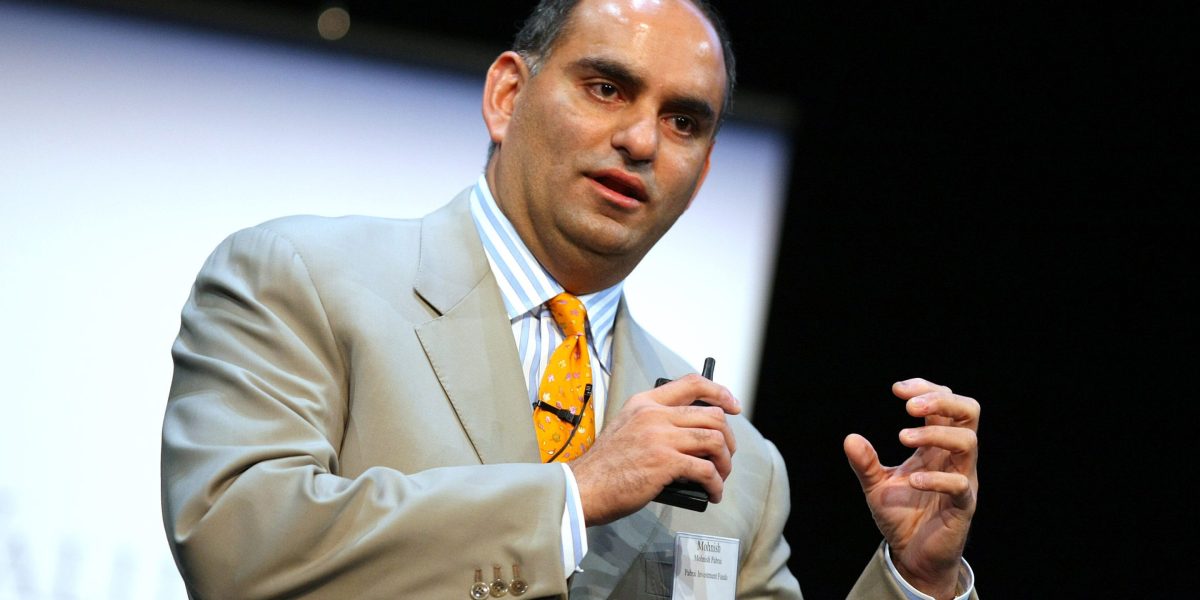
Mohnish Pabrai, a prominent value investor who manages approximately $900 million in assets through his Pabrai Investment Funds, has identified a simple mathematical concept he believes should be fundamental education for every investor: the Rule of 72.

During a recent appearance on The Diary of a CEO, a popular business podcast hosted by British entrepreneur Steven Bartlett, Pabrai emphasized the importance of this financial principle. The Rule of 72 is a simple way to help you calculate how long it takes money to double at a given interest rate.

“It’s a kind of a mathematical hack,” Pabrai said during the interview. “The rule of 72 is a very important rule, and I wish they would teach it more in high schools and elementary school.”

The formula works by dividing 72 by the expected annual return percentage. For example, at a 7% return, money doubles in approximately 10 years (72 ÷ 7 = 10.3). At 10% returns, doubling occurs in roughly seven years, while 15% returns cut the doubling time to about five years.

“It’s very important to know how long money takes to double, because then we can start doing a lot of math in our heads,” Pabrai said.

This mental calculation ability allows investors to quickly assess the long-term potential of different investment opportunities without complex financial calculators.

The power of compound interest

To illustrate the power of compound interest, Pabrai shared a compelling historical example during the interview. In 1623, Native American Indians sold Manhattan to Dutch settlers for $23. Yes, you read that right.

“If the Indians had invested at 7% a year for the last 400 years, they would have more money than owning the land,” he explained. Using the Rule of 72, that $23 would have doubled every 10.3 years at 7% returns. Over 400 years, this would have resulted in approximately $23 trillion—significantly more than the value of Manhattan real estate today, which is estimated to be in the ballpark of $2.2 trillion.

The example becomes even more striking when scaled down: “If you gave them 2.3 cents, 100 years later, they’d have $23, and now it would be the 23 trillion,” Pabrai noted, adding “if the runway is long enough, the starting capital doesn’t matter.”

Beyond the mathematical concept, Pabrai offered practical advice for everyday investors during the interview. He emphasized three fundamental principles: “spend less than you earn,” start investing young to maximize the compounding runway, and focus on broad market indices rather than individual stock picking.

“You could open an account at Fidelity or Interactive Brokers or Robin Hood, any of these places,” he said. “You could just ask them to give to buy you the S&P 500 index, for example, and they will get you invested in that.”

Pabrai said if you start investing at age 18, an initial $5,000 investment with a 10% return would result in approximately $500,000 by age 68, thanks to the money doubling seven times over the 50-year period.

“You can start seeing that over a lifetime, you’re going to be having too much money,” he noted.

The investment guru

Pabrai’s advocacy for this simple mathematical tool demonstrates how foundational financial concepts, when properly understood and applied, can transform investment outcomes. His message is clear: The path to wealth isn’t through complex strategies or market timing, but through understanding the fundamental mathematics of compound growth and having the patience to let it work over time. Plus, the simplicity of the rule—valuable for quick mental calculations—helps investors appreciate why maintaining consistent returns matters more than chasing spectacular short-term gains.

Pabrai brings considerable credibility to his investment recommendations. Born in Mumbai in 1964, he moved to the United States to attend Clemson University before launching his entrepreneurial career. After founding and successfully selling his IT consulting company TransTech for $20 million in 2000, Pabrai transitioned into investing, launching his investment funds in 1999.

Pabrai has built an impressive track record over more than two decades. His funds achieved cumulative returns of 517% net to investors versus 43% for the S&P 500 from 2000 to 2013, representing outperformance of 474 percentage points. Since inception, his funds have delivered annualized returns of approximately 25%, though recent years have shown more mixed performance relative to benchmarks.

Pabrai’s investment philosophy closely mirrors that of Warren Buffett, whom he famously paid $650,100 to have lunch with in 2007 alongside fellow investor Guy Spier.

You can watch Pabrai’s full Diary of a CEO interview below:

For this story, Fortune used generative AI to help with an initial draft. An editor verified the accuracy of the information before publishing.


Source link

Continue Reading

Business

TV producer behind ‘I Married a Murderer’ makes FBI Most Wanted list on claim she got a $14.7 million bank loan as a fake heiress

Published

on


The former head of a California company that produced true crime TV shows has been added to the FBI’s Most Wanted list, years after being charged with portraying herself as an heiress to get millions of dollars from lenders.

Mary Carole McDonnell, 73, is believed to be in Dubai, United Arab Emirates, the FBI said on Dec. 5.

McDonnell is the former chief executive at Bellum Entertainment LLC, based in Burbank, California, which produced shows such as “It Takes a Killer” and “I Married a Murderer.”

Bellum was having financial problems in 2017. McDonnell was able to get a $14.7 million loan from a bank after falsely claiming she was related to the founders of McDonnell Douglas, a leading aviation and aerospace company, and had $28 million in a trust account, according to court documents.

“It is alleged that McDonnell also defrauded additional financial institutions in a similar fashion, with an estimated loss of over $15 million,” the FBI said.

A grand jury indicted McDonnell in 2018 on charges of fraud and identity theft. She has not been found. The case is filed in federal court in Santa Ana, California.

Join us at the Fortune Workplace Innovation Summit May 19–20, 2026, in Atlanta. The next era of workplace innovation is here—and the old playbook is being rewritten. At this exclusive, high-energy event, the world’s most innovative leaders will convene to explore how AI, humanity, and strategy converge to redefine, again, the future of work. Register now.


Source link

Continue Reading

Business

The Fed delivers a rare ‘hawkish cut’ as Powell tries to steady a softening job market

Published

on


The Federal Reserve cut rates for a third straight meeting on Wednesday in what analysts call a “hawkish” move: an attempt to support a softening labor market while signaling reluctance to keep cutting.

The move was widely anticipated, but the tone was not. Officials paired it with with firmer language about the “extent and timing” of additional adjustments, phrasing that, in what economists call Fed-speak, raises the bar for further cuts and underscores the committee’s unease about inflation, which the statement noted has “moved up” and “remains somewhat elevated.”

The decision also exposed the widening fractures inside the central bank toward the end of Chair Jerome Powell’s term. Three officials dissented, but in opposite directions: Stephen Miran pushed for a larger 50-basis-point cut, while Austan Goolsbee and Jeffrey Schmid argued the Fed should hold rates steady. It’s the rare meeting where hawks and doves both object, a scenario analysts had warned was increasingly probable as disagreements sharpened over how quickly the labor market is cooling, and how much restraint inflation still requires.

The December meeting also carries unusual weight because it may be the final one in which Powell still has his authority as Fed chair. His term expires in May, but President Donald Trump has already vowed to announce a successor early in 2026, effectively creating a “shadow chair” before Powell leaves. 

“Feels like in a way the last Powell Fed meeting,” Bloomberg’s Conor Sen wrote on X. Powell is slated to speak at the conference shortly after the announcement. 

Labor market concerns drove the cut

Wednesday’s decision was justified primarily by weakening conditions in the job market. Hiring has slowed markedly since the summer, while unemployment has ticked up and businesses across industries have begun signaling greater caution, even though the layoffs themselves have not yet surged in the official data.

Private-sector signals have flashed more urgency. ADP’s November report showed employers shedding a net 32,000 jobs, the sharpest decline in more than two years. Nearly all of those losses came from small businesses, which cut 120,000 positions, while medium and large firms kept adding workers. Economists view that pattern as a warning sign: small businesses are the most sensitive to rising costs and weakening demand, and they often pivot first when conditions deteriorate. 

The government’s long-delayed JOLTS report, released Tuesday, added another layer. Job openings in October rose modestly, but remained far below last year’s levels; the quit rate fell to 1.8%, the lowest since early 2021; and hiring remained stuck at 3.2%, consistent with what economists and Powell himself have called a “low hire, low fire” labor market. Companies aren’t slashing staff outright—but they aren’t expanding either. That’s enough to worry economists.

“Low hiring on its own is bad news,” top economist and Fed-watcher Claudia Sahm told Fortune. “It puts upward pressure on unemployment, and that’s the dynamic the Fed is trying to get ahead of.”

A deliberately cautious message

The Fed sought to balance labor-market concerns with the political sensitivity of cutting rates while inflation is still elevated.

Fed officials will want more flexibility than signalling the cutting cycle is open-ended. Unemployment remains low by historical standards; consumption has been resilient among high-income households; and financial markets have surged on expectations of easier policy next year. Powell has warned markets over-read his intentions this year.

Still, Powell cannot declare victory or signal a pause with confidence. The November jobs report arrives just days after the meeting, and he will want flexibility in case that comes out worse than expected, so he doesn’t look “flat-footed,” Sahm said. 

The limits of preemption

For the Fed, the goal is to smooth out the cycle—to cut early enough to prevent a deeper downturn without abandoning the fight against inflation, still sticky at 2.8%, higher than the Fed’s preferred rate of 2%. Sahm, who helped design the Fed’s framework for interpreting labor-market inflection points, argues timing is crucial.

“If the Fed waits to cut until they see clear deterioration, they’ve waited too long,” she said. Initial jobless claims remain low, she noted, but they are not predictive. As a lagging indicator, they tend to spike only after a recession has begun.

The central bank’s challenge now is to navigate between those competing risks while markets, the White House, and Congress push for clarity the Fed cannot yet provide.

If the Fed has to continue easing into early 2026, Sahm argues, it will not be a bullish signal.

“If they end up doing a lot more cuts,” she said, “then something has gone wrong.”


Source link

Continue Reading

Business

Actress Natasha Lyonne is helping to shape the future of AI

Published

on


The actress, director, and wild-style futurist Natasha Lyonne is fascinated by technology. She speaks of the beauty and power of interstellar travel and muses about living long enough to walk a Hollywood red carpet as a reanimated cyborg.

But she also has a grave concern, she explained to Fortune’s Brainstorm AI audience on Monday in San Francisco: With all this boundless possibility, why is AI focused on replacing screenwriters instead of, say, figuring out a solution to fixing plastic bottles polluting the oceans? “I don’t think that’s an accident,”  said Lyonne, 46. “It’s about cutting costs.”

What the co-founder of the media production company Animal Pictures would like to see is people paid for their expertise, work, and creative ideas, and the democratization of filmmaking so more people can engage in a business that has traditionally had sky-high barriers to entry.

Her rallying cry to C-suites and AI leaders—delivered in her signature wry, New York City accent—is to think really hard about what it means to be human in this age where AI is all the rage, and act accordingly. “We are the ones who are deciding what this use is going to be and how we choose to use it,” Lyonne said. “I really want this to mean a seat at the table for more people to do even more extraordinary things.”

Lyonne, who was named one of TIME’s 100 Most Influential People in AI 2025, joked that she anointed herself CEO of Animal Pictures and updated her LinkedIn with the title because it “seemed like a vibe.” So Lyonne now technically shares the title with others in the C-suite, and she observes a widening divide between senior executives of the world who are deciding how AI will be implemented in companies, and the employees who could see their jobs and opportunities dry up. Even though this moment in AI development includes outside factors like competition with China and meeting Wall Street’s expectations, she argues that the industry must remember that there are serious decisions to be made that history will remember. 

Lyonne, who has been in the film business since she was a child actor, pointed out that it takes enormous human legwork—from casts, crews, and everyone from drivers to the creatives who bring ideas onto screens—to keep film and television plodding forward. AI companies that scrape content without permission or payment are neglecting that entire ecosystem, she said. “So I don’t think it’s super-Kosher copacetic to just kind of rob freely under the auspices of acceleration or China, right?”

The Russian Doll and Poker Face star is also a co-founder of Asteria Film Co., a generative AI film and animation studio. Asteria describes itself as being powered by the “first clean AI model”—the “clean” referring to AI that has been trained on models with creative work that is licensed or cleared, rather than content used without payment or permission.  She is also directing an upcoming film called Uncanny Valley using an AI video model called Marey that was created based on copy-right cleared, licensed data. The film reportedly doesn’t include AI actors, but it will blend generative AI filmmaking techniques with traditional human-led filmmaking.

As a child, she said, she studied Talmudic texts and interpretations in Aramaic—the ancient language used in Talmudic writings. The complexity in exploring layers of meaning and iterations of theory now informs her approach to AI in filmmaking., she said.

Lyonne said she dropped out of New York University to pursue a self-taught education in film at the indie movie theater The Film Forum. When asked what advice she’d give her younger teenage self, Lyonne suggested mastery of the kind that takes 10,000 hours of work to develop. “Really, really learn these tools,” she said. “It’s really about technique, and that takes a long time… that’s how you learn how to write and all that.”

The beauty of mastering a skill and knowing how to think and create is that then you can break those rules, said Lyonne. “I’m not so much interested in raging against the machine,” she said. “I’m interested in building new houses, new seats at the table.”


Source link

Continue Reading

Trending

Copyright © Miami Select.