Connect with us

Business

Inside the ultra-private one-room hotels redefining luxury travel
Published

on


After the mangosteen daiquiri misted tableside with lime oil, the cheesy garlic naan, the broccoli salad with pistachios and mint, the pink peppered pineapple soda, the tandoori half-chicken with tingling green chutney, the crock of thick, savory, buttery black dal—after all that, served in the celadon-green Permit Room in Notting Hill, no, I did not need dessert. 

Enter the brownie to end all brownies. It came cloaked in malai, the Indian version of clotted cream, and pulverized jaggery. My spoon slipped through, revealing an interior so moist and black, it looked like you could grow tomatoes in it.

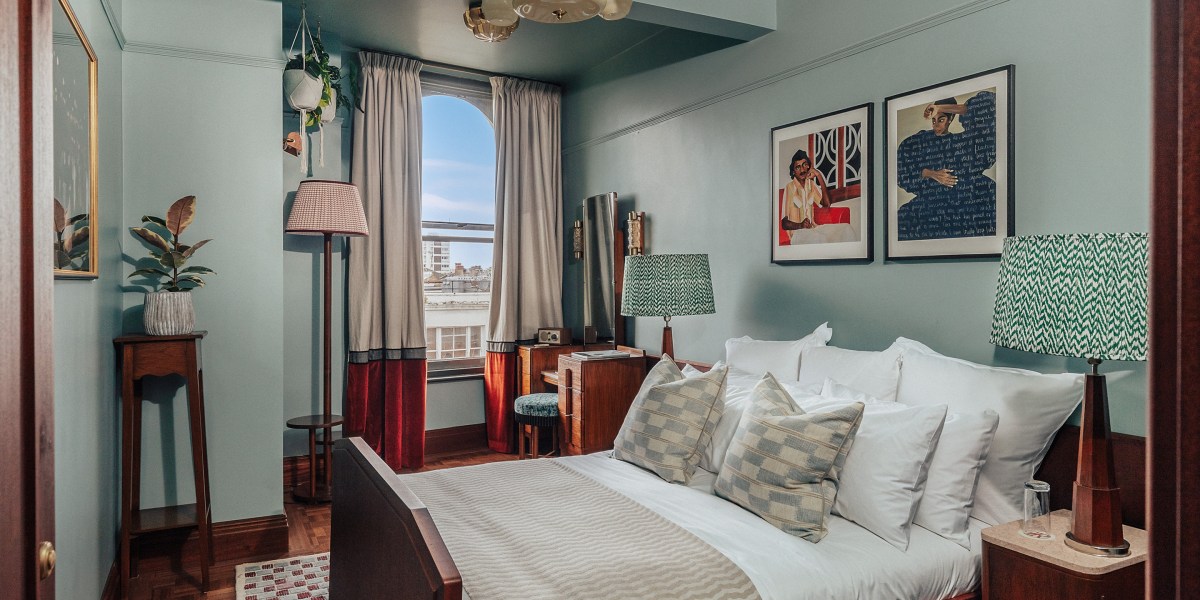
Dessert was not, however, the sweetest thing about this epic meal at the Permit Room, a branch of the London-based Dishoom empire. The sweetest part was the fact that the only thing separating me from postprandial relaxation in a waffle-knit robe was a viridian stairwell up to the Lodgings—a one-room hotel I had all to myself.

The two-bedroom, two-bathroom flat, splashed with exuberant fabrics and Art Deco lighting, has arched windows that look out on the neighborhood’s famous Portobello Road Market, where tourists and locals skitter between stalls hawking silver teapots, first-edition books, and vintage Burberry trench coats. And there were plenty of treasures to find in the Lodgings, too, including a smart vinyl collection and a veritable museum of modern South Asian art curated by the L.A. gallerist Rajiv Menon.

The Lodgings at the Permit Room take bed and breakfast seriously.

TARAN WILKHU/COURTESY OF THE PERMIT ROOM/DISHOOM

The founders of Dishoom, cousins Shamil and Kavi Thakrar, had been thinking about this hotel concept for a while. “We’ve always adored those stays in Bombay with friends or family, someone pressing food into our hands, and a sense of being properly looked after,” says Kavi. “We wondered, what if we could bottle that feeling of warmth and hospitality, and bring it here?”

The cousins have hosted millions for meals at their four Permit Rooms and 11 Dishoom restaurants, but the opening of the Lodgings in July (at £700 per night) marks the first time they’ve had guests stay overnight.

They’ve hit upon a new mood in the luxury hotel arms race: sumptuous hideouts that combine the privacy of an exclusive-use rental with the amenities of a full-service property. The most rarefied stay, it turns out, is the one where you’re the only guest. 

André Terrail’s grandmother once lived in the elegant apartment above La Tour d’Argent.

MATTHIEU SALVAING/COURTESY OF LA TOUR D’ARGENT

You won’t find these rooms on Expedia. Bookings are typically via email or an old-fashioned phone call. At the 1RoomHotel in Detroit, in a historic building in Corktown—it boasts an infrared sauna, Soho Home furnishings, and a 1,000-square-foot terrace—hotelier Doug Schwartz works mostly by referral. “We only do one booking a week, 50 guests a year,” he says. “So we really try to cater to that person.” That could mean their favorite cocktail prestocked in the minibar, or a tour around Motor City in the house car, a restored 1972 Ford Bronco. “At a hotel with a hundred rooms,” he said, “all that stuff gets lost in translation.”

While these properties are not all above restaurants, most target food-destination travelers looking to extend their experience from dining room to bedroom. From Chicago (the minimalist Loft at Michelin twostar Oriole) to Tasmania (the Ogee Guesthouse, neighboring the perpetually packed wine bar of the same name), access to a hard-to-get reservation is a motivating amenity in its own right. 

The Permit Room has a line of hopeful diners snaking out the front door the entire day. But as the only overnight guest, I had a table waiting for me whenever I felt like eating, or I could order up room service from my living room’s baby-blue landline telephone. Before going to bed, I marked my breakfast order on the doorknob hanger menu, and awoke to fragrant masala chai, an immunity-boosting ginger shot, brioche French toast, and yogurt speckled with what looked like $100 worth of vanilla bean. The minibar fridge was stocked with Dishoom’s superb mango lassi.

The Lodgings at the Permit Room take bed and breakfast seriously.

TARAN WILKHU/COURTESY OF THE PERMIT ROOM/DISHOOM

In Paris, those who can’t get into the famous La Tour d’Argent might consider its Augusta Apartment (€1,800 per night). André Terrail, whose family has owned the Left Bank restaurant for 114 years, converted it in 2023 from the old private dining room. Why let the magic of a La Tour tasting fizzle after paying the bill, when it might continue with a nightcap overlooking an illuminated Notre Dame and slumber in a bespoke Maison Tréca bed? Terrail’s grandfather also managed the iconic Hotel George V (now the Four Seasons) in the early 20th century, so “it sounded logical that we would extend back into a hotel-like experience,” he said.

But it was Terrail’s grandmother, Augusta Burdel, who inspired the design. A patroness of the arts and woman-abouttown, she lived in the apartment 50 years ago, and probably would have appreciated the custom-built Scandinavian sauna and peacock-blue kitchen, as well as the ivory wainscoting and herringbone wood floors. Guests have the run of the place and can hire a barman to mix martinis in residence or unwind on the restaurant’s rooftop terrace after the venue closes for the night. 

“The apartment is a little bit like going to Disneyland [mixed] with the Terrail and La Tour d’Argent story,” Terrail says. “I think we are having tons of fun with it.


Five unique boutiques

If you love the pomp of a grand hotel but crave quiet and a personal touch, these exquisite one-roomers are for you.

The Lodgings at The Permit Room, London

The cousins behind Dishoom, the wildly popular Indian restaurant chain, bring some bona fide Bombay hospitality to Portobello Road. 

La Tour D’Argent’s Augusta Apartment, Paris

André Terrail, the restaurant’s third-generation owner, has modernized what was once his grandmother’s apartment with colorful flair.

The 1RoomHotel, Detroit

The 50 guests a year who snag a booking here can enjoy an infrared sauna, a spacious terrace, and the opportunity to tool around in a 1972 Ford Bronco.

The Loft at Oriole, Chicago

A stay above the two-Michelin-star restaurant includes a reservation at Oriole’s Kitchen Table for “a front-row dining experience” with chef Noah Sandoval. 

Ogee Guesthouse, Tasmania

Matt and Monique Breen’s two-bedroom apartment—steps from their renowned restaurant, Ogee— offers a listening room with records from their own collection.

This article appears in the October/November 2025 issue of Fortune with the headline “Be our (only) guest.”

Fortune Global Forum returns Oct. 26–27, 2025 in Riyadh. CEOs and global leaders will gather for a dynamic, invitation-only event shaping the future of business. Apply for an invitation.


Source link

Continue Reading

Business

Nvidia’s CEO says AI adoption will be gradual, but we still may all end up making robot clothing

Published

on


Nvidia CEO Jensen Huang doesn’t foresee a sudden spike of AI-related layoffs, but that doesn’t mean the technology won’t drastically change the job market—or even create new roles like robot tailors.

The jobs that will be the most resistant to AI’s creeping effect will be those that consist of more than just routine tasks, Huang said during an interview with podcast host Joe Rogan this week. 

“If your job is just to chop vegetables, Cuisinart’s gonna replace you,” Huang said.

On the other hand, some jobs, such as radiologists, may be safe because their role isn’t just about taking scans, but rather interpreting those images to diagnose people.

“The image studying is simply a task in service of diagnosing the disease,” he said.

Huang allowed that some jobs will indeed go away, although he stopped short of using the drastic language from others like Geoffrey Hinton a.k.a. “the Godfather of AI” and Anthropic CEO Dario Amodei, both of whom have previously predicted massive unemployment thanks to the improvement of AI tools.

Yet, the potential, AI-dominated job market Huang imagines may also add some new jobs, he theorized. This includes the possibility that there will be a newfound demand for technicians to help build and maintain future AI assistants, Huang said, but also other industries that are harder to imagine.

“You’re gonna have robot apparel, so a whole industry of—isn’t that right? Because I want my robot to look different than your robot,” Huang said. “So you’re gonna have a whole apparel industry for robots.”

The idea of AI-powered robots dominating jobs once held by humans may sound like science fiction, and yet some of the world’s most important tech companies are already trying to make it a reality. 

Tesla CEO Elon Musk has made the company’s Optimus robot a central tenet of its future business strategy. Just last month, Musk predicted money will no longer exist in the future and work will be optional within the next 10 to 20 years thanks to a fully fledged robotic workforce. 

AI is also advancing so rapidly that it already has the potential to replace millions of jobs. AI can adequately complete work equating to about 12% of U.S. jobs, according to a Massachusetts Institute of Technology (MIT) report from last month. This represents about 151 million workers representing more than $1 trillion in pay, which is on the hook thanks to potential AI disruption, according to the study.

Even Huang’s potentially new job of AI robot clothesmaker may not last. When asked by Rogan whether robots could eventually make apparel for other robots, Huang replied: “Eventually. And then there’ll be something else.”


Source link

Continue Reading

Business

The ‘Mister Rogers’ of Corporate America shows Gen Z how to handle toxic bosses

Published

on


After two decades of climbing the corporate ladder at companies ranging from ABC, ESPN, and Charter Communications (commonly known as Spectrum), Timm Chiusano quit it all to become a content creator. 

He wasn’t just walking away from high titles, but a high salary, too. In his peak years, Chiusano made $600,000 to $800,000 annually. But in June of 2024, after giving a 12-week notice, he “responsibility fired himself” from his corporate job as VP of production and creative services at Charter.

He did it all to help others navigate the challenges of a workplace, and appreciate the most mundane parts of life on TikTok.

@timmchiusano

most people are posting their 2024 recaps; these are a few of my favorite moments from the year that was, but i need to start reintroducing myself too i dont have a college degree, no one in my life knew that until i was 35 when i eventually got my foot in the door in my early 20’s after a few years of substitute teaching and part time jobs, i thought for sure i had found the career path of my dreams in live sports production i didn’t think i had a chance of surviving that first college football season but i busted my ass, stuck around and got promoted 5 times in 5 years then i met a girl in Las Vegas, got married in 7 months, and freaked out about my career that had me travelling 36 weeks a year i had to find a more stable “desk job”, i was scared shitless that i was pigeonholed and the travel would eventually destroy my marriage i crafted a narative for espn arguing they needed me on their marketing team because of my unique perspective coming from the production side i got rejected, but kept trying and a year i got that job the 7 years with espn were incredible, but also exhausting and raised all kinds of questions about corporate america, toxic situations, and capitalism in general why was i borderline heart attack stressed so often when i could see that my ideas were literally generating 2,000 times the money that i was getting paid? in 2012 i had a kid and in 2013 i got the biggest job of my career to reinvent how to produce 20,000 commercials a year for small business it took 12 rounds of interviews, a drug test i somehow passed, and a background check that finally made me tell my wife of 8 years that i didnt have a college degree they brought me in the thursday before my first day and told me what i told grace in that clip the next decade was an insane blur; i saw everything one would ever see in their career from the perspective of an executive at a fortune 100 i started making tiktoks, kinda blacked out at some point in 2019 and responsibly fired myself in 2024 to see what i might be capable of on my own with all the skills i picked up along my career journey now the mission is pay what i know forward, and see if i can become the mr rogers of corporate america cc: @grace beverley @Ryan Holiday @Subway Oracle

♬ original sound – timm chiusano

What started as short-video vlogs on just about anything in 2020 (reviews on protein bars, sushi, and sneakers) later transitioned to videos on growing up, and dealing with life’s challenges, like coming to terms when you have a toxic boss. Today, his platform on TikTok has over 1 million followers

With the help of going viral from his “loop” format where videos end and seamlessly circle back to the beginning, he began making more videos as a side-hustle on top of his day-to-day tasks in the office.

“How can I get people to be smarter and more comfortable about their careers in ways that are gonna help on a day-to-day basis?” Chiusano told Fortune.

Today, he could go by many titles: former vice president at a Fortune 100 company, motivational speaker, dad, content creator, or as he labels himself, the Mister Rogers of Corporate America. 

Just as the late public television icon helped kids navigate the complexities of childhood, Chiusano wants to help young adults think about how to approach their careers and their potential to make an impact. 

“Mister Rogers is the greatest of all time in his space. I will never get to that level of impact. But it’s an easy way to describe what I’m trying to do, and it consistently gives me a goal to strive for,” he said. “There are some parallels here with the quirkiness.”

Firing himself after 25 years in the corporate world

Even with years in corporate, Chiusano doesn’t resemble the look of a typical buttoned-up executive. Today, he has more of a relaxed Brooklyn dad attire, with a sleeve of tattoos and a confidence to blend in with any trendy middle aged man in Soho. During our interview, he showed off one of the first tattoos he got: two businessmen shaking hands, a reference to Radiohead’s OK Computer album.

“This is a dope ass Monday in your 40s,” began one of his videos.

It consisted of Chiusano doing everyday things such as eating leftovers, going to the gym, training for the NYC marathon, taking out the trash, dropping his daughter off at school, a rehearsal for a Ted Talk, eating lunch with his wife, and brand deal meetings. Though the content sounds pretty normal, that’s the point. 

“The reason why I fired myself in the first place was to be here,” he says in the video while picking his daughter up from school.

Today, Chiusano spends his days making content on navigating workplace culture, public speaking, brand deals, brand partnerships, executive coaching, writing a book, and the most important job: being a dad to his 13-year-old daughter Evelyn.

“I’m basically flat [in salary] to where I was, and this is everything I could ever want in the world,” he said. “The ability to send my kid to the school she’s been going to, eat sushi takeout almost as much as I’d like, and do nice things for my wife.”

In fact, when sitting inside one of his favorite New York City spots, Lure Fishbar, he keeps getting stopped by regulars who know him by name. He points out that one of his favorite interviews he filmed here was with legendary filmmaker Ken Burns.

Advice to Gen Z

In a time where Gen Z has been steering to more unconventional paths, like content creation or skill trades rather than just a 9-to-5 office job, Chiusano opens up a lens to what life looks like when deciding to be present rather than always looking for what’s next—a mistake he said he made in his 20s. 

Instead, he wants to teach the younger generation to build skills for as long as you can, but “if you are unhappy, that’s a very different conversation.”

“I think some people will make themselves more unhappy because they feel like that’s what’s expected of a situation,” he said.

“I would love to be able to empower your generation more, to be like somebody’s gonna have to be the head of HR at that super random company to put cool standards and practices in place for better work-life balance for the employees.” 


Source link

Continue Reading

Business

Mark Zuckerberg says the ‘most important thing’ he built at Harvard was a prank website

Published

on


For Mark Zuckerberg, the most significant creation from his two years at Harvard University wasn’t the precursor to a global social network, but a prank website that nearly got him expelled.

The Meta CEO said in a 2017 commencement address at his alma mater that the controversial site, Facemash, was “the most important thing I built in my time here” for one simple reason: it led him to his wife, Priscilla Chan.

“Without Facemash I wouldn’t have met Priscilla, and she’s the most important person in my life,” Zuckerberg said during the speech.

In 2003, Zuckerberg, then a sophomore, created Facemash by hacking into Harvard’s online student directories and using the photos to create a site where users could rank students’ attractiveness. The site went viral, but it was quickly shut down by the university. Zuckerberg was called before Harvard’s Administrative Board, facing accusations of breaching security, violating copyrights, and infringing on individual privacy.

“Everyone thought I was going to get kicked out,” Zuckerberg recalled in his speech. “My parents came to help me pack. My friends threw me a going-away party.”

It was at this party, thrown by friends who believed his expulsion was imminent, where he met Chan, another Harvard undergraduate. “We met in line for the bathroom in the Pfoho Belltower, and in what must be one of the all time romantic lines, I said: ‘I’m going to get kicked out in three days, so we need to go on a date quickly,’” Zuckerberg said.

Chan, who described her now-husband to The New Yorker as “this nerdy guy who was just a little bit out there,” went on the date with him. Zuckerberg did not get expelled from Harvard after all, but he did famously drop out the following year to focus on building Facebook.

While the 2010 film The Social Network portrayed Facemash as a critical stepping stone to the creation of Facebook, Zuckerberg himself has downplayed its technical or conceptual importance.

“And, you know, that movie made it seem like Facemash was so important to creating Facebook. It wasn’t,” he said during his commencement speech. But he did confirm that the series of events it set in motion—the administrative hearing, the “going-away” party, the line for the bathroom—ultimately connected him with the mother of his three children.

Chan, for her part, went on to graduate from Harvard in 2007, taught science, and then attended medical school at the University of California, San Francisco, becoming a pediatrician.

She and Zuckerberg got married in 2012, and in 2015, they co-founded the Chan Zuckerberg Initiative, a philanthropic organization focused on leveraging technology to address major world challenges in health, education, and science. Chan serves as co-CEO of the initiative, which has pledged to give away 99% of the couple’s shares in Meta Platforms to fund its work.

You can watch the entirety of Zuckerberg’s Harvard commencement speech below:

For this story, Fortune journalists used generative AI as a research tool. An editor verified the accuracy of the information before publishing. 


Source link

Continue Reading

Trending

Copyright © Miami Select.