Business
Inside the debt-heavy sand trap of Trump’s U.K. golf course finances
Published
3 months agoon
By
Jace Porter
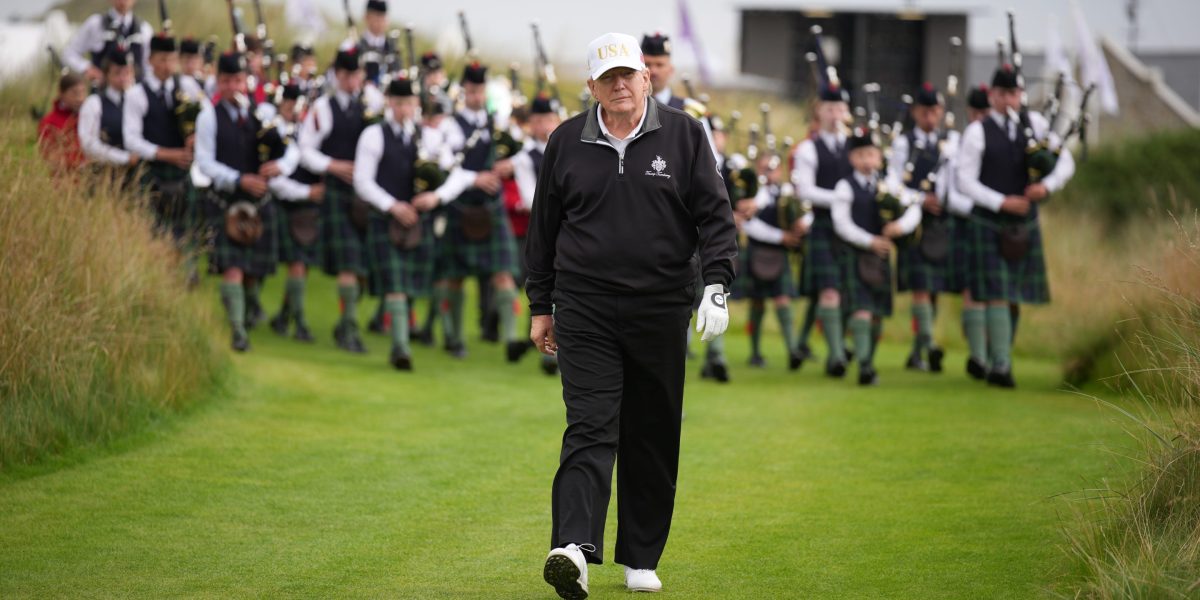
When President Donald Trump went to Scotland in July, he did so not only as commander-in-chief but as the controversial proprietor of some of Britain’s most scrutinized golf resorts. His three-day stop at Trump Turnberry, a hotel and golf resort that is one of the president’s two properties in the country, drew attention when U.K. Prime Minister Keir Starmer joined him to discuss a trade deal between the nations and the ongoing wars in Ukraine and Gaza. He was followed by European Commission President Ursula von der Leyen, who announced the framework of a trade deal with the E.U. from the luxurious property.
Trump hosting Starmer at Turnberry broke with diplomatic tradition. American presidents are usually invited to foreign countries by their leaders and hosted at diplomatic residences. But it follows his pattern of abandoning presidential norms, especially when it comes to his family business. According to Michael Cohen, former vice president of the Trump Organization and Trump attorney, the president’s habit of hosting at his properties plays into having a home court advantage. Not only is Trump most comfortable at his properties, where everyone around him is “at his beck and call,” but it also offers Trump the opportunity to show off his brand’s visible presence, Cohen told Fortune.
“The name Trump is plastered everywhere, whether it’s inside of an elevator, whether it’s on a wall with photos of him, whether it’s pulling up to the facility where it says Trump Turnberry. The same holds true, whether it’s Doral, whether it’s Aberdeen, whether it’s Bedminster, Briarcliff, it makes no difference,” he said. “So there’s definitely a power play. It’s an impressive place, and so anybody pulling up sees the value of the property.”
Both of Trump’s Scottish resorts—Turnberry and Trump International Scotland near Aberdeen—are run by Eric Trump and held in a trust managed by the president’s children.
“There is an old expression that land can neither be created nor destroyed, and it’s what made kingdoms, kingdoms. Donald clearly sees himself in that role.”
Michael Cohen, former vice president of the Trump Organization and Trump attorney
Beneath Turnberry and Aberdeenshire’s manicured fairways and breathtaking seascapes, however, lies a perplexing story. Despite being among the most prestigious courses in the world—Turnberry is a four-time host of the Open Championship—this has not translated into meaningful profits. A similar fate has befallen Trump’s other international golf courses, all 15 of which lost over $315 million in the two decades prior to 2021.
And combined, the two courses in Scotland, as of 2023, were carrying a debt-load that dwarfs the size of their underlying businesses: $239.32 million between them. This debt is owned by and contained within the Trump Organization.
Despite the properties’ meager profits—as shown on the financial statements filed with the U.K. regulator Companies House—Cohen explained that the value of Trump’s golf businesses aren’t exclusive to the sport itself. “There’s also a future land value that gets assigned to the properties,” he said, “Take Turnberry as an example. What’s the chance that you’re ever going to be able to build another golf course like Turnberry? The answer is, you’re not.”
A resort buoyed less by golfers than by favorable forex
Trump Turnberry was one of Trump’s most expensive properties. He spent $67 million to purchase the resort in 2014 and a further $144 million on renovations. In the decade since being acquired, the business has struggled to turn a profit. The most recent period for which financials have been disclosed is 2023, which is the first fiscal year that it did not report substantial losses (prior to 2019, however, Turnberry’s revenue showed consistent growth). During the pandemic, the enterprise reported more than $27 million in losses when the hospitality industry took a beating due to COVID-19 restrictions. Since then, the resort’s finances appear to have stabilized. Turnberry’s parent company, Golf Recreation Scotland, reported $28.6 million in sales, and $5.15 million in profits for the 2023 financial year, according to U.K. government filings. In 2022, turnover at the company was $29.56 million but profits reached just $252,582. Figures for 2024 are expected soon.
Eric Trump told Fortune that these rebounding figures are evidence of Turnberry’s rise and success, namely the course becoming the U.K.’s most expensive game of golf, costing over $1,286 for a round on the property’s famed Ailsa green during peak times. A night at the property is similarly pricey—rooms start at $527 per night.
Despite sales falling in 2023, the company’s operating costs rose by approximately $2.03 million. Eric, in the filings, attributed strained profitability, in part, to “rising regional utility costs, supplier expenses and minimum wage increases.” Scotland’s national living wage (the minimum hourly rate for those 23 and older) rose from $12.08 in 2021 to $14.13 in 2023. When speaking with Fortune, Eric further explained rising operating expenses as part of the business’ expansion.
CHRISTOPHER FURLONG—Getty IMAGES
Meanwhile, Turnberry has sizable debt. The parent company owes $168.15 million in zero-interest loans to an unnamed creditor. Eric told Fortune, however, that all of this debt is owed to the Trump Organization, not an external source.
“When we bought Turnberry, we bought the note that they had, and we bought the assets that they had. So it’s just a structure, but that’s all within the Trump Organization,” he explained.
Turnberry’s debt decreased in 2023, from $177.24 million. Alan Jagolinzer, co-director of the Centre for Financial Reporting and Accountability at the University of Cambridge told Fortune, this reduction was “reportedly from favorable exchange rate changes” rather than debt paydown.
Exchange rate fluctuations, Jagolinzer noted, play a large role in the golf resort’s earnings year-to-year. “As a whole, it seems exposed to foreign currency risk,” he said, namely exposure to the weakening U.S. dollar on the business’s loans.
Debt risk has seldom fazed Trump, who once dubbed himself the “king of debt” and has spent his career building businesses using troves of borrowed cash.
Bogeys on the balance sheet
Trump’s second golf course in Aberdeenshire is a significantly smaller operation than its Turnberry sister. The president bought the property in 2006, but it only began operating fully in 2012 after drawn-out spats with local residents and environmentalists. As of 2023, the resort had only ever operated at a loss. Its current profitability remains unknown. Aberdeenshire reported $5.02 million in revenues in 2023, according to disclosures by its parent company Trump International Golf Club Scotland Limited. Its losses were $1.9 million, up from around $1 million the financial year prior. And while revenue was up slightly in 2023, Trump International’s operating costs, much like at Turnberry, were significantly higher—up approximately $1 million.
Despite these losses in 2023, Eric pointed to consecutive increases in sales across all revenue streams, especially retail and food and beverage, of the business. And while operating costs rose, Trump’s son said in the filings that the sizable increase in tournament and marketing expenditures are expected to “deliver elevated levels of revenue performance in 2024 and beyond.” Future factors, such as the property’s unveiling of its newest course in July 2025, stand to further drive the financial future of the Aberdeenshire club. The new course, he told Fortune, would also add to operating costs.
For Eric, Trump International’s growing pains are par for the course in cultivating a property from the ground up. “A property this size is a massive, long-term commitment. A project like that could take two decades to fully develop,” he told Fortune.
JEFF J MITCHELL—Getty Images
Trump International’s debt is similarly large. The parent company owes upwards of $71.19 million in interest-free loans as of 2023. These loans are owed to US-entities tied directly to the Trump family and Trump himself. According to the filings, $55.06 million of the Aberdeenshire course’s debt is owed to Trump, with an unspecified rolling repayment term, and $16 million of the debt is owed to DJT Holdings LLC. DJT Holdings also advanced $6.37 million in funding to Trump International’s parent company in 2023.
Its previous lack of profitability, according to Jagolinzer, suggests the course “appears to be operating on an assumption it can continue to borrow.”
“It’s not clear how this operation can continue without persistent debt funding available,” he added.
These factors, Jagolinzer said, could become a basis for auditors to offer a negative opinion on “going concern,” meaning the auditor has substantial doubt about the company’s ability to continue operating as a business entity for a reasonable period of time, typically one year after the financial statement date. Of course, the fact that the debt is owed to the Trump Organization softens that risk considerably.
Currently, both of Trump’s Scotland properties are audited by BDO’s Ireland branch. However, prior to 2021, both businesses were audited by the firm Johnston Carmichael.
Forensic accountant Paul Barnes told Fortune the change in auditors raised a potential red flag for him. Changing auditors, he explained, can indicate deeper financial issues, disagreements on accounting principles, or a lack of transparency in a company’s financial reporting.
A spokesperson for Johnston Carmichael refused to comment on why they no longer represent the golf properties. “As a regulated organisation, the firm adheres to its obligations and does not discuss client business, whether past or present,” they said in a written statement to Fortune.
According to Eric, the company moved auditing firms to BDO to consolidate their business. The Trump Organization’s Ireland property was already a BDO client prior to 2021. He dismissed any other explanation for the change.
But ultimately, the only creditor that Trump International has to answer to is Trump, making the debt risk low and squarely in the Trump family’s purview. “If they were borrowing from banks in the U.K., the politicians and the government may well put pressure on the banks to call in the money. But the money has come from him in the US. And so he’s got full control,” Barnes said.
Developments stuck in the rough
The strategy behind Trump’s golf ventures may very well be unrelated to his beloved sport. In 2016, the then-presidential candidate told Reuters his resorts were real-estate “development deals” rather than golf investments.
“It’s pretty simple,” he said. “My golf holdings are really investments in thousands, many thousands of housing units and hotels. At some point the company will do them.”
These promised developments have yet to fully materialize.
Cohen predicted that the Trump Organization is likely in no rush to complete all of the promised projects. “There’s only so many projects that they want to handle at any given time right now,” he said.
Since purchasing the 1,400-acre Menie Estate in Aberdeenshire, Trump has made sweeping promises for residential and job development including a 450-room luxury hotel (scaled back to just 19 rooms), 950 holiday apartments, 500 single-family residences, 36 golf villas, 6,000 jobs, an additional golf course, and a total promised investment of $1.36 billion. But today the property only employs 84 people and the investment was reduced to around $1 billion.
“A property this size is a massive, long-term commitment. A project like that could take two decades to fully develop.”Eric Trump
Despite receiving outline planning permission in 2008 and detailed approval in 2010, only two golf courses have been completed, the newest of which opened in July 2025.
In February 2022, Aberdeenshire Council granted permission in principle for up to 550 residential properties. Under this arrangement, Trump’s organization agreed to pay $1.04 million toward affordable housing in the area for the first 77 homes, with payments increasing by $135,601 for each additional home. While Eric Trump acknowledged in the 2023 filings that these housing plans “remain a big priority,” he claimed they would come only after completion of a second golf course at the site. He estimated the full development could take up to 10 years to complete.
He told Fortune that he remains committed to seeing the project through. “I’ve been buying and buying and buying,” he said. “I just bought 300 acres that connect to the property. In the last year, I’ve probably bought 10 to 12 houses on the surrounding property.” These purchases, he explained, are part of expanding the property and completing the promised projects.
“Aberdeen is something we’re really proud of,” he added.
Trump’s acquisition of Turnberry came with similarly ambitious residential development plans—87-200 luxury properties, including shops and cafes, holiday cottages and retirement homes across 48-120 hectares, and properties described as providing “permanent tranquillity and respite.” Local authorities, however, have repeatedly pushed back on these initiatives, consistently citing environmental concerns, infrastructure limitations, and lack of demonstrated housing need as reasons for the rejections. (The course sits on an isolated, rural coastline where the nearest town of any size, Ayr, is a 30-minute drive away.) Eric, however, rejected any potential roadblocks in developing Turnberry when speaking to Fortune. A Turnberry executive promised that the company would continue to pursue development applications “in due course.”
These development promises have reported financial implications for the businesses and were showcased in the New York civil fraud case against the president, in which he was found liable for using inflated valuations to obtain favorable loan terms. (On Aug. 21, a New York appeals court removed the nearly half-billion-dollar penalty levied on Trump.) Court documents alleged that the Trump Organization made the misleading claim that 2,500 homes could be developed, despite having approval for fewer than 1,500 units. The $267 million valuation attributed to residential development accounted for more than 80% of the total property valuation, the documents said. Trump has repeatedly denied any wrongdoing and previously called the case against him a political “witch hunt.”
Regardless of the Scotland golf properties’ development prospects, both businesses face an almost insurmountable battle to make a dent in their sizable debts. But without the threat of banks and government pressure, Barnes said, “they may just carry on, but they’re not going to make a great deal of money for Donald Trump.”
Regardless, Cohen argued that it’s not simply about the money for Trump. The president’s net worth, according to the New York Times, is upwards of $10 billion, and as Cohen noted, his financial prosperity has put him in a position where he is no longer dependent upon banks for his real estate empire, his golf properties included.
“So you can’t look at these as merely just golf courses,” said Cohen. “There is an old expression that land can neither be created nor destroyed, and it’s what made kingdoms, kingdoms. Donald clearly sees himself in that role.”
You may like
Business
Paul Newman and Yvon Chouinard’s footsteps: More ways for CEOs to give it away in ‘Great Boomer Fire Sale’
Published
7 minutes agoon
December 7, 2025By
Jace Porter
The most radical act in capitalism today isn’t launching a unicorn startup or orchestrating a multi-billion-dollar IPO – it’s giving your company away in service of good.
While some business leaders are focused on how to make their fortunes in AI or crypto, others are choosing to walk away with nothing except what matters most: a philanthropic annuity to cement their legacy. As the President and CEO of one of the most famous brands that gives 100% of its profits away, I am hearing from more and more CEOs and business owners who want to follow in Paul Newman or Yvon Chouinard’s footsteps. These leaders spent decades building profitable enterprises and are now working to transfer ownership of their companies, not to the highest bidder, but to foundations, nonprofits, purpose-driven trusts, or to their employees.
An estimated 2.9 million private U.S. businesses are owned by those over 55. Over the next 20 years, the Great Wealth Transfer and “The Great Boomer Fire Sale” is a unique opportunity to reimagine business exits as an act of generosity.
Why give away your business? A generosity exit allows you to maximize your giving through an engine that will keep generating profits every year, creating a philanthropic annuity, while preserving the company, its employees, and the culture built over decades. Besides, conventional exit options may not be a great fit for your values if you’ve spent decades investing in your employees and your community. Selling to private equity or another business could mean layoffs and a decimated culture. Not all owners have family heirs who want or can take over. Going public is only available to the biggest businesses and subjects your life’s work to quarterly earnings pressures and the short-term thinking that comes along with it. Purpose and legacy can be more important than a big check at the end of your life, especially if you already made good money throughout your life’s work.
As the baby boomer generation looks to the legacy they want to leave behind, Millennials and Gen Z look ahead to the legacies they want to build, with some founding successful companies where giving 100% of their profits away is baked in from the beginning. Entrepreneurs like John and Hank Green of The Good Store, and Adam McCurdie and Joshua Ross of Humanitix, are challenging the critics of the ‘business for good’ model by showing that you can grow a successful business while simultaneously giving away all profits.
The good news for those interested in giving away their business? There are now more governance models available than ever before.
Choosing the Right Structure for Your Exit
Through the passage of the Philanthropic Enterprise Act in 2018, foundations can now own 100% for-profit companies in the US. Newman’s Own Foundation is an example of this. As a result, one hundred percent of profits and royalties from sales of Newman’s Own products go to the Foundation in service of its mission: to nourish and transform the lives of children who face adversity.
Patagonia uses a perpetual purpose trust, a type of steward-owned ownership which is more common in Europe. Since 2022, the trust holds 100% of the company’s voting stock to ensure its environmental mission and values are preserved indefinitely, while profits are funnelled to a 501c(4), Holdfast Collective to give away to climate causes. These models create what economists call “lock-in effects” allowing owners to keep mission front and center, even when they’re gone.
Over 6,500 U.S. companies are now fully or part-owned by their workers, using Employee Stock Ownership Plans (ESOPs), including Bob’s Red Mill and King Arthur Baking Company. These models support business continuity and create thousands of employee-owners who are invested in the company’s long-term success. While in many cases, these exits are financed through loans, there’s nothing stopping an owner from giving the business to their workers.
You can also look at hybrid models. For example, Organic Grown Company uses a perpetual purpose trust to ensure profits are split between equity investors, employees, growers, and nonprofits.
And while a business owner may decide to establish their own foundation, why reinvent the wheel? There are plenty of existing foundations and non-profits who could be worthy recipients if you want to give your company away. Back in 2011, Amar Bose gave the majority of the stock of the sound system company Bose corporation to his alma mater, the Massachusetts Institute of Technology in the form of non-voting shares.
What’s Next?
This holiday season is upon us, and whether you own a business or not, it’s a good time to reflect on what matters most: What are your values? How much money is enough for yourself and your family? What does legacy mean to you?
For CEOs and owners considering a generosity exit, the first step is to assemble the right team: attorneys experienced in foundation-ownership, purpose trusts, or ESOPs, financial advisors who understand tax implications of these unique paths, independent directors or trustees who share your vision. Organizations like 100% for Purpose, Purpose Trust Ownership Network, and Purpose Foundation can provide resources and case studies.
Start mapping out your plan, and be patient as a transition could take years, not months. Yvon Chouinard spent two years structuring Patagonia’s transition. While Paul Newman decided from the beginning to give all of the food company’s profits away back when it began in 1982, the first few years were just him writing checks at the end of the year. A foundation was initially established in 1998, and became Newman’s Own Foundation before Paul’s death, at which point the food company was gifted to the Foundation. The complexity isn’t just legal—it’s emotional, relational, and cultural, but ideally, the transition can happen while you’re still actively involved, can steward the shift, and can see the rewards of your hard labor pay dividends for good.
In this day and age of robots and artificial intelligence, it’s good to remember Paul Newman’s wise words: “Corporations are not inhuman money machines. They must accept that they exist inside a community. They have a moral responsibility to be involved. They can’t just sit there without acknowledging that there’s stuff going on around them.”
Building a profitable company is hard but what’s truly meaningful is to let them go in service of good. In doing so, we allow our work to live on in ways that matter far beyond the balance sheet.
The opinions expressed in Fortune.com commentary pieces are solely the views of their authors and do not necessarily reflect the opinions and beliefs of Fortune.
Business
Millionaire YouTuber Hank Green tells Gen Z to rethink their Tesla bets—and shares the portfolio changes he’s making to avoid AI-bubble fallout
Published
1 hour agoon
December 7, 2025By
Jace Porter
For years, YouTube star Hank Green has stuck to the same straightforward investing wisdom touted by legends like Warren Buffett: Put your money in an S&P 500 index fund and leave it alone.
It’s advice that has paid off handsomely for millions of investors: this year alone, the index is up roughly some 16%, and averaged more than 20% in gains over the last three years and roughly 14.6% over the past two decades. In most cases, it’s easily beaten investors who try to pick individual stocks like Tesla or Meta.
But as Wall Street frets over a possible AI-driven bubble—with voices from “Big Short” investor Michael Burry to economist Mohamed El-Erian sounding alarms—Green isn’t waiting around to see what happens. He’s already rethinking how much of his own wealth is tied to Big Tech.
A major reason: The S&P 500 is more concentrated than ever. The top 10 companies—including Nvidia, Apple, Microsoft, Amazon, Google, and Meta—make up nearly 40% of the entire index. And nearly all of them are pouring billions into AI.
“I feel like my money is more exposed than I would like it to be,” Green said in a video that’s racked up over 1.6 million views. “I feel like by virtue of having a lot of my money in the S&P 500, I am now kind of betting on a big AI future. And that’s not a future that I definitely think is going to happen.”
So Green is hedging. He’s taking 25% of the money he previously invested in S&P 500 index funds—a meaningful chunk for a self-made millionaire—and moving it into a more diversified set of assets, including:
- S&P 500 value index funds, which tilt toward companies with lower valuations and less AI-driven hype.
- Mid-cap stocks, which he believes could benefit if smaller firms catch more of AI’s productivity gains.
- International index funds, offering exposure outside the U.S. tech-heavy market.
Green’s thesis is simple: even if AI transforms the economy, the biggest winners may ultimately not be the mega-cap companies building the models.
“I think that these giant companies providing the AI models will actually be competing with each other for those customers in part by competing on price,” Green said. “And that might mean that the value delivered to small companies will be bigger than value delivered to the big AI companies. Who knows though? I just think that’s a thing that could happen.”
And if his concerns are overblown? He’s fine with that, too.
“If I’m wrong, 75% of my money is still in the safe place that everybody says your money should be, which is the S&P 500.”
YouTuber’s message to his Gen Z and Gen Alpha viewers: The stock market isn’t a ‘Ponzi scheme’
Gen Z continues to trail other generations in financial know-how—from saving and investing to understanding risk, according to TIAA. Moreover, one in four admit they are not confident in their financial knowledge and skill—a stark admission considering that 1 in 7 Gen Z credit card users have maxed out their credit cards and many young people hold thousands in student loan debt.
As a self-described “middle-aged, 45-year-old successful person,” Green said he’s trying to model what thoughtful, long-term decision-making actually looks like. And part of that effort includes dispelling one big misconception shared among some of his audience:
“I get these comments from people who are like, I can’t believe that you’re participating in this Ponzi scheme,” Green told Fortune. “I do want to alienate those people, because I don’t believe that the stock market is a Ponzi scheme. I do think that it’s overvalued right now, but I think that it’s tied to real value that’s really created in the world.”
His broader point: Investing isn’t about vibes or just dumping money into the hot stock of the week; rather, it’s something to seriously research.
“A lot of people think that investing is like getting a Robinhood account and buying Tesla,” Green added. “And I’m like, ‘Nope, you’ve got to get a Fidelity account and buy a low cost index fund everybody and or just keep it in your 401K and let the people who manage it manage it’—which is what a lot of people do, which is also fine.”
His younger viewers are paying attention. One popular comment summed it up: “As a young person entering the point in my life where I’m starting to think about investing, I really appreciate you talking through your logic and giving a ton of disclaimers rather than telling me I should buy buy buy exactly what you buy buy buy.” The comment has already racked up more than 4,700 likes.
Financial advisors agree: Portfolio diversification is king
While Green doesn’t come from a financial background, experts from the world of investing said they agree largely with his rationale: Having a diversified portfolio is the way to go—especially if you have worries about an AI bubble.
“Unlike many dot-com companies, today’s tech giants generally have substantial revenue, cash reserves, and established business models beyond just AI,” certified financial planner Bo Hanson, host of The Money Guy Show, said in a video analyzing Green’s take.
“Still, the concentration risk remains a valid concern for investors that are seeking diversification. However, this is precisely why we advise against putting all investments solely in the S&P 500, especially if you have a shorter time horizon.”
Hanson added wise investors spread their money across various asset classes, including small-caps, international, and bonds, in order to reduce portfolio volatility and provide
more consistent returns across various market environments.
It’s sentiment echoed by Doug Ornstein, director at TIAA Wealth Management, who said it’s important to realize that not every investment needs to chase growth.
“Particularly as you get older, having guaranteed income streams becomes crucial. Products like annuities can provide reliable payments regardless of market swings, creating a foundation of financial security,” Ornstein told Fortune. “Think of it as building a floor beneath your portfolio—one that market volatility can’t touch.”
Business
Warren Buffett: Business titan and cover star
Published
2 hours agoon
December 7, 2025By
Jace Porter
Warren Buffett’s face—always smiling, whether he’s slurping a milkshake, brandishing a lasso, or palling around with fellow multibillionaire Bill Gates—has graced the cover of Fortune more than a dozen times. And it’s no wonder: Buffett has been a towering figure in both business and
investing for much of his—and Fortune’s—95 years on earth. (The magazine first hit newsstands in February 1930; Buffett was born that August.) As Geoff Colvin writes in this issue, Buffett’s investing genius manifested early, and he bought his first stock at age 11. By Colvin’s calculations, over the 60 years since Buffett took control of his company, Berkshire Hathaway, its returns have outpaced the S&P 500 by more than 100 to one.
Buffett has always had a special relationship with Fortune, particularly with legendary writer and editor Carol Loomis, who profiled him many times, and to whom he broke the news of his paradigm-shifting moves in philanthropy in 2006 and 2010. The end of an era is upon us, as Buffett on Dec. 31 will step down from his role as Berkshire’s CEO. We’re grateful to have been along for the ride.
Cover photographs by David Yellen (2009), and Art Streiber (2010)

Cover photographs by Michael O’Neill (2003), and Ben Baker (2006)

Cover photographs by Michael O’Neill

Cover photographs by Alex Kayser (1986) and Michael O’Neill (1998)
Soon no Pearl Harbor survivors will be alive. People turn to other ways to learn about the bombing
Paul Newman and Yvon Chouinard’s footsteps: More ways for CEOs to give it away in ‘Great Boomer Fire Sale’
‘SNL’ Mocks Jeffrey Epstein for Having Underage ‘Girlfriends’
Trending
-
Politics8 years agoCongress rolls out ‘Better Deal,’ new economic agenda
-
Entertainment8 years agoNew Season 8 Walking Dead trailer flashes forward in time
-
Politics8 years agoPoll: Virginia governor’s race in dead heat
-
Entertainment8 years agoThe final 6 ‘Game of Thrones’ episodes might feel like a full season
-
Entertainment8 years agoMeet Superman’s grandfather in new trailer for Krypton
-
Politics8 years agoIllinois’ financial crisis could bring the state to a halt
-
Business8 years ago6 Stunning new co-working spaces around the globe
-
Tech8 years agoHulu hires Google marketing veteran Kelly Campbell as CMO
