By the end of 2024, supermodel Gigi Hadid had opened the second boutique of her Guest In Residence brand in Los Angeles, after New York first store in 2023. Located at 433 North Beverly Drive, a street running parallel to Rodeo Drive, the boutique with its white and blue storefront is part of a landscape of mainstream brands, neighboring Reformation, All Saints, Veronica Beard, Kitson Kids and located one block from the fancy Erewhon grocery store.
The Guest In Residence store facade in Beverly Hills – Guest In Residence
“As we expand to the West Coast, our LA flagship is an ever-evolving canvas to showcase our 100% cashmere,” said Hadid. “Our vision was a space that’s warm and inviting, where our heirloom pieces are effortlessly integrated into the flow and décor. I love how the store captures the feeling of barefoot California luxury, that’s relaxed yet sophisticated at the same time – just like our cashmere.”
The interior design of the 860 square feet boutique is inspired by easy Californian living, fused with the brand’s creative ethos and “classic flunky DNA,” continued Hadid.
The model chose Los Angeles-based Yaoska Interiors, known for collaborating with brands including The Reformation, Staud clothing and swimwear brand Solid & Striped, to design the space.
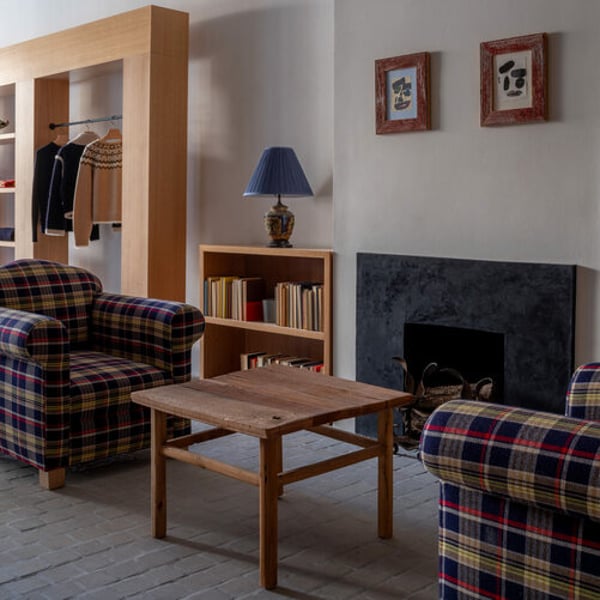
The space, created as a mountain apartment, combines a palette of warm, organic materials. Textures of natural stone and plaster are juxtaposed with custom fixtures and shelving in carved oak. Cobblestone floors, antique iron sconces and a custom-made fireplace nod to Spanish Revival style, while comfortable, oversized tartan-covered chairs invite guests to converse and relax.
Inside Guest In Residence’s store – Guest In Residence
Inspired by Hadid’s own outdoor holidays in the countryside, the fitting rooms mimic rustic cabins. Built from Douglas Fir wood and carpeted in bright colors, they’re offset by a calming limewash tone called “cashmere” on all walls. Hand-selected studio pottery, vintage pieces and artworks by artist Austyn Weiner add a colorful touch to the space. The store has been eco-designed and favors low-impact materials, including white oak clothes racks, forged metal lighting and antique hardware.
“While designing Guest In Residence’s first store in LA, our vision was to make the space feel as if it’s always been here,” said designer Yaoska Davila, founder of Yaoska Interiors. “We aspired to create an experience like you’re stepping into the home of a creative friend; it’s a deeply personal space, where you might stumble upon a painting studio in the solarium or a rustic wood-working shop in the garden. Shoppers are welcome to fully immerse themselves in this inspiring, unexpected and eclectic brand world.”
Upon its opening, a curated mix of the Fall 2024 and Winter 2024 collections are available for men and women. Both are rooted in the notion of everlasting style, for a seasonless wardrobe that’s timeless and long-lasting. These include hoodies, cable vests and cable shrunken crew in black, grey, green and yellow. There’s also a line of outerwear, including cropped and quilted puffer jackets.
Interior design by Yaoska Interiors at Guest In Residence store in LA – Guest In Residence
The LA store also hosts the brand’s Take-Back program, which allows customers to return gently worn Guest In Residence items to be recycled, in exchange for 10% off their next purchase. The returned items are then sent to Italy’s Re.Verso, a facility that reengineers recovered materials and transforms them into regenerated 100% wool and 100% cashmere. The concept promotes a circular economy and reduces textile waste by keeping yarns in use instead of sending them to a landfill.
“In turn, it lowers impact, saves resources and costs, fosters community involvement, and encourages customers to use their clothes in a more sustainable way,” explained the brand.
The LA store is Guest In Residence’s second freestanding location, joining its flagship at 21 Bond Street in New York City, which was also designed by Yaoska Interiors. The LA store also follows pop-ups in New York, Aspen and at Le Bon Marché in Paris.
Lawyers for Chinese online platform Shein return to a Paris court on Friday for a hearing on the French government’s request to suspend the firm’s website for three months, after childlike sex dolls and banned weapons were discovered on its marketplace.
Customers queue to enter the first physical space of Chinese online fast-fashion retailer Shein on the day of its opening inside the Le BHV Marais department store, the Bazar de l’Hotel de Ville, in Paris, France, November 5, 2025 – REUTERS/Sarah Meyssonnier/File Photo
Shein disabled its marketplace- where third-party sellers list their products- in France on November 5, after authorities found the illegal items for sale, but its main site selling Shein-branded clothing remains accessible. The French state wants the website suspended for a minimum of three months in the country, which it argues is needed for Shein to prove that its contents comply with the law.
It has invoked Article 6.3 of France’s digital economy law, which gives a judge powers to prescribe measures with the aim of preventing or halting harm caused by online content. France has also summoned major internet service providers Bouygues Telecom, Free, Orange, and SFR to the hearing, requesting they block Shein’s website. The court will have to decide whether a suspension is warranted, and whether it is in line with European Union law.
In a statement last week, the Paris prosecutor’s office said a three-month suspension could be deemed “disproportionate” under the case law of the European Court of Human Rights if Shein could prove it has stopped all sales of illegal goods. However, the prosecutor said it “fully backed” the government’s demand that Shein provide evidence of measures taken to end those sales.
France’s move comes amid broader scrutiny of Chinese giants such as Shein and Temu under the EU’s Digital Services Act, reflecting concerns about consumer safety, illegal product sales and unfair competition. Meanwhile in the US, Texas Attorney General Ken Paxton said on Monday he is investigating Shein to determine whether the fast fashion retailer violated state law related to unethical labour practices and the sale of unsafe consumer products.
China’s HongShan Capital Group (HSG) has sent a 2.5 billion euro ($2.91 billion) offer to private equity Permira to buy Italian luxury sneaker maker Golden Goose, with the aim of signing the deal by Christmas, daily la Repubblica reported on Friday.
Golden Goose is known for its luxury sneakers – goldengoose.com
Details still need to be defined but the offer gives the luxury group an enterprise value of 10 times the core profit expected by the end of the year, debt included, the newspaper said. Golden Goose’s revenues totalled 655 million euros in 2024, with an adjusted core profit of 227 million euros.
HSG has asked veteran fashion industry executive Marco Bizzarri to become Golden Goose’s future chairman, la Repubblica said, adding that the Chinese private equity aims to expand Golden Goose’s directly-managed stores, particularly in Asia, and plans to list the group in the medium-term.
Last year the Venice-based company, which sells sneakers for more than 500 euros a pair, shelved plans for an initial public offering on the Milan Bourse, citing market volatility caused by political uncertainty in Europe.
IKEA plans to source more products from factories in the United States, the Swedish furniture group’s top supply chain executive told Reuters, as President Donald Trump‘s tariffs drive up the cost of importing bookcases, mattresses and sofas.
IKEA logo is seen in this illustration taken, February 11, 2025 – REUTERS/Dado Ruvic/Illustration/File Photo
This marks a big shift for IKEA after the share of the company’s US-made products declined over the past decade. Inter IKEA, the brand franchiser, used to have a factory in Danville, Virginia, but shut it in 2019 and moved production back to Europe.
IKEA’s push to source products closer to where it sells them aims to support the retailer’s expansion in the US, its second-biggest market, and the wider region, where it has stores in Canada, Mexico, Chile, and Colombia, with plans to open in Costa Rica and Panama.
“We are designing our supply chain network to be much more resilient, robust, and responsive,” Susanne Waidzunas, Global Supply Manager at Inter IKEA said in an interview with Reuters, adding that the company’s stores in North and South America are very dependent on furniture being shipped in, with long lead times.
“The closer we can build, the faster we can react from a supply perspective, both when it goes up in demand but also when it goes down,” said Waidzunas. The plan to produce closer to US consumers predates this year’s tariff hikes and is part of a global initiative.
But the timing is now beneficial: IKEA prides itself on low prices but was forced to increase them on some products in the US to offset the tariff impact. The retailer’s sales have declined for two years running as it lowered prices to attract inflation-weary shoppers.
SBA Home, a Lithuanian supplier to IKEA, is ramping up its first US factory in Mocksville, North Carolina, a $70 million investment supported in part by Inter IKEA. The factory will make products for IKEA like top-selling KALLAX shelves.
Jurgita Radzevice, CEO of SBA Home, said manufacturing capacity at the largely automated factory, which is expected to produce 2 million pieces of furniture a year, is steadily increasing.
IKEA depends more on imports in the US than elsewhere. Just 15% of IKEA products sold in US stores are made in-country, down from 19% in 2014. In Europe, 70% of the products IKEA sells are made in the region, while the equivalent figure for Asia is 80%. Its top sourcing countries are China, Germany, Italy, Lithuania, and Poland.
Producing in the US is more expensive, Waidzunas said, but shipping products across the world is also more costly and more unpredictable now than before the COVID-19 pandemic. IKEA plans to buy more from existing US suppliers, which include Ohio-based Sauder Woodworking, and look for new suppliers particularly of bulky items, aiming, for example, to source most of its mattresses in the US.