Connect with us

Business

Indonesia bets a new sovereign wealth fund will finally unlock its potential
Published

on


Indonesian President Prabowo Subianto came to power last year off the back of a campaign with several grand promises. Chief among them: 8% annual economic growth by the end of his term in 2029.

His brainchild to get there is the country’s latest sovereign wealth fund, Danantara, short for Daya Anagata Nusantara, which means “the power of the future for Indonesia.” It’s tasked with boosting the economy, especially through domestic investments.

The fund is also taking over Indonesia’s dozens of state-owned enterprises (SOEs), consolidating and streamlining their operations to make them more competitive. The idea is that integrated management can lead to more effective and optimized national resources, resulting in higher economic growth and better jobs.

Yet critics have governance concerns because of a revised law that gives the president greater control of the entities and their billions of dollars in annual dividends. These concerns contributed to a dip in Indonesia’s stock market index when the fund was launched in late February. Danantara, which reports to the president, will eventually oversee all SOEs (including Global 500 companies Pertamina, the oil and gas giant, and electricity company Perusahaan Listrik Negara).

The idea of sovereign wealth funds—investment funds managed by state actors hoping to leverage their financial surplus—has existed since Kuwait set one up in 1953 to manage its oil revenues. This surplus can come from sales of natural resources in oil-rich nations like Saudi Arabia or Norway, foreign exchange as in China, or even bumper tax revenue in the case of Ireland. Sometimes the funds take an active role, backing up-and-coming startups, making a play for strategic sectors, or investing in companies based in their own country.

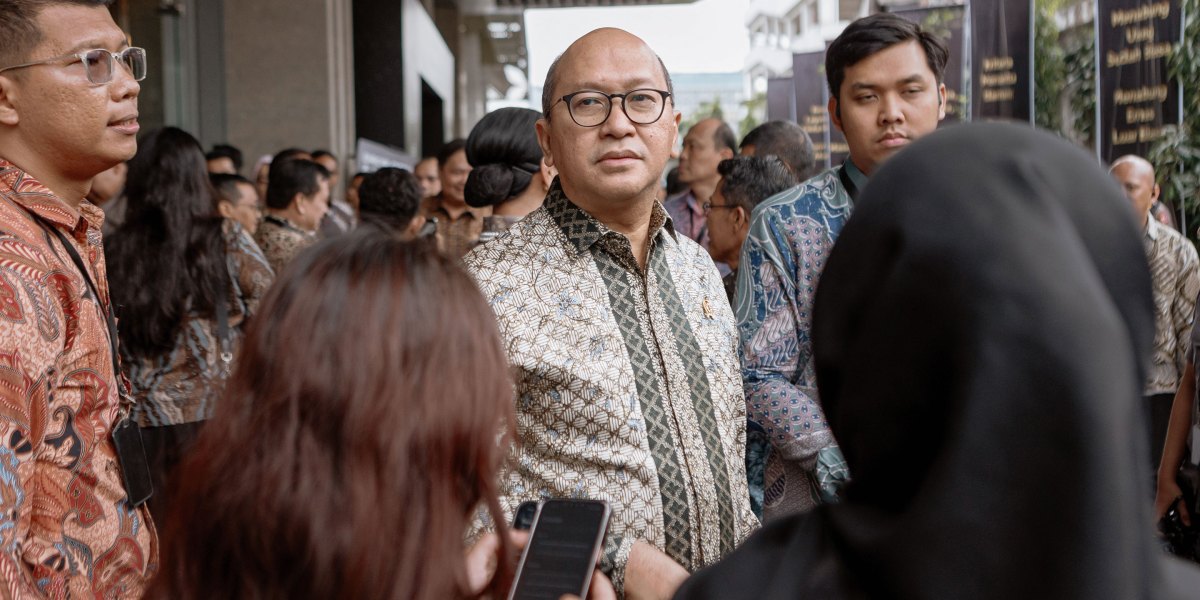
But Danantara is somewhat different in that it’s trying to manage and invest in its own state enterprises while investing surplus funds drawn from its SOEs’ dividends. The young entity’s CEO, Rosan Roeslani, argues this will finally help Southeast Asia’s largest economy develop its potential.

Indonesia’s stock market index dipped in late February
before climbing back up again in mid-April.

Chart by Fortune

“We have this dual role: How can we optimize assets from state-owned enterprises to create more value, and at the same time create quality jobs?” Rosan tells Fortune. As a sovereign fund, there need to be returns, he notes, but the priority is “sustainable economic growth.”

Southeast Asia’s largest economy

Indonesia accounts for roughly 40% of the region’s population and landmass. About 280 million people are spread over some 17,000 islands, and the country had a GDP of $1.4 trillion in 2024, according to World Bank data. That puts Indonesia in the top 20 economies globally.

While Indonesia was hard-hit during the Asian Financial Crisis of 1997–98, it was one of the region’s strongest performers during the 2008–09 Global Financial Crisis, growing by 4.6% in 2009. From 2010 to 2024 its economy grew by an average 4.74% a year, per the World Bank.

But the country trails some of its neighbors in GNI per capita, which reached $4,910 in 2024. That’s enough to categorize it as an upper-middleincome country by the World Bank’s definition. Yet GNI per capita in Singapore, Malaysia, and Thailand reached $74,750, $11,670, and $7,120, respectively.

That means not all of Indonesia’s people are earning as much as their regional peers—despite
being blessed with abundant natural resources, like oil, gas, and critical minerals.

But Rosan thinks Danantara can help Indonesia successfully leverage its resources. “We want to develop a value-added downstream industry; doing that will improve our human capital, create more quality jobs, and obviously create a better economic return,” he says.

Indonesia has already attracted investments to its nickel industry as part of its downstreaming strategy after banning the export of raw nickel ore in January 2020—well before Danantara.

A new phase

Danantara must also streamline the country’s dozens of SOEs (an effort started under previous president Joko Widodo) and make them more competitive. “In the past, sometimes [SOEs] think they’re likely to monopolize. When you don’t have competition, sometimesyou become more relaxed,” Rosan says.

Hilman Palaon, a research fellow at the Lowy Institute’s Indo-Pacific Development Centre, thinks Danantara marks a new phase. It’s “expected to play a key role in reshaping the SOE landscape: managing state investments, consolidating assets, and leading restructuring efforts,” he says.

That involves reducing red tape and unnecessary bureaucracy, as well as fixing Indonesia’s reputation for opaqueness and, sometimes, corruption.

“Maybe in the past, an SOE always had special treatment,” Rosan explains. “Usually if there’s a government project, there’s always priority that it should be awarded to another SOE. That kind of priority we are going to revise.”

Continued SOE reform is needed as these companies become increasingly important to the economy, notes Maxwell Abbott, an associate managing director and head of political risk and strategic intelligence for APAC at consultancy Nardello & Co.

The country has already taken a step in the right direction, he says: “In recent years, Indonesia has made significant progress in improving SOE performance and efficiency by consolidating the number of SOEs and improving anti-bribery protocols.”

Rosan argues that not all SOEs are saddled with this issue, but that SOEs in general should be more efficient, transparent, and digitized.

Artificial intelligence and digitization constitute one of eight sectors Danantara has targeted for investment, to grow Indonesia’s economy while raising the standard of living. Other sectors include renewable energy, food security, and health care.

“We are still way behind in terms of the health care industry. We still import 90% of our raw materials for pharmaceuticals,” Rosan says. “We are behind in terms of doctors…Just to meet the emerging-market standard, not OECD standard, we are short about 100,000 doctors.”

Danantara has already signed several memorandums of understanding or given loans to Indonesian companies in strategic sectors. It has an MOU with ACWA Power, a Saudi Arabian company specializing in desalination and green hydrogen tech, to explore renewable energy investments. Total funding is estimated to be as much as $10 billion.

It also has partnerships with QIA, Qatar’s sovereign wealth fund, and CIC, China’s sovereign wealth fund, aimed at facilitating investments to Indonesia. Domestically, Danantara has invested in Chandra Asri, a petrochemical and energy firm, and provided a $405 million loan to national airline Garuda Indonesia.

“Danantara’s early investment decisions show Prabowo wants to ensure domestic production of crucial industrial inputs and provide lifelines to struggling SOEs that play a prominent role in the national economy,” Abbott notes.

The legacy play

With more than $900 billion in assets and annual dividends of about $8 billion that can be used for investing, by Rosan’s estimation, Danantara isn’t just a new force in global finance; it’s a signal that Indonesia will now fully control its wealth responsibly, manage its resources with strategic foresight, and invest in its future.

“Danantara carries big ambitions,” says Palaon, the Lowy Institute research fellow. “It reflects Indonesia’s bold vision to break free from the middle-income trap and become a developed nation, but the real challenge lies in turning those ambitions into action.”

While Rosan has been a mainstay in Indonesian politics with different ministerial assignments, an ambassadorship to the U.S., and a role as Prabowo’s campaign manager and strategist, he’s also a finance guy. Before politics, he worked in banking and cofounded his own investment firm, Recapital Group.

“I came from the private sector and have actually been on the investment side. So this is [similar] to my previous job, investing in Indonesia or out of Indonesia,” he says.

Under him are several notable peers who also hail from the finance industry or the private sector, including Pandu Sjahrir, Danantara’s chief investment officer and an early backer of Southeast Asia tech giant Sea.

Danantara has also drafted non-Indonesians to sit on the board of advisors, serving on a voluntary and nonbinding basis: famed hedge fund manager Ray Dalio, prominent American economist Jeffrey Sachs, and former Thai prime minister Thaksin Shinawatra.

The two Americans are no strangers to the country: Dalio’s OceanX has been working with Indonesian officials to map its seabed, and Sachs previously advised the Indonesian government.

And while Thaksin’s role may raise some eyebrows because of corruption allegations, Rosan says Thaksin is respected in Southeast Asia and that his input would be useful.

If Danantara succeeds in transforming Indonesia’s economy and lifting living standards, then it will arguably bolster Prabowo’s legacy, which is still somewhat blotted by his time as an army commander during the Suharto-era dictatorship from the mid-1960s to the 1990s.

While more investments in the country coupled with more competitive SOEs would in theory create more jobs, Rosan is aware of the skepticism and expectation for the fund to perform.

“Obviously when a new entity receives more than $900 billion in total assets, the expectation is very high,” he says, adding that the fund will not only “perform” in terms of returns but will raise governance and compliance standards. “We are building trust right now by having the best talent, and also having good governance and transparency.”

It’s a strong claim. But when asked if he’s confident that the conversation around Danantara will be positive if he speaks to Fortune again in five years, Rosan responds with a firm yes. As he puts it, we’ll see “a lot of difference.”

This article appears in the August/September issue of Fortune with the headline “Danantara’s CEO thinks the new sovereign wealth fund can help Indonesia finally unlock its potential”


Source link

Continue Reading

Business

Rob Reiner, comedy legend who directed ‘When Harry Met Sally’ and ‘Spinal Tap,’ dead at 78

Published

on


Rob Reiner, the son of a comedy giant who went on to become one, himself, as one of the preeminent filmmakers of his generation with movies such as “The Princess Bride,” “When Harry Met Sally …” and “This Is Spinal Tap,” has died. He was 78.

Reiner and his wife, Michele Singer, were found dead Sunday at their home in the Brentwood neighborhood of Los Angeles. A law enforcement official briefed on the investigation confirmed that Reiner and Singer were the victims. The official could not publicly discuss details of the investigation and spoke to The Associated Press on condition of anonymity.

Authorities were investigating an “apparent homicide,” said Capt. Mike Bland with the Los Angeles Police Department. The Los Angeles Fire Department said it responded to a medical aid request shortly after 3:30 p.m.

Reiner grew up thinking his father, Carl Reiner, didn’t understand him or find him funny. But the younger Reiner would in many ways follow in his father’s footsteps, working both in front and behind the camera, in comedies that stretched from broad sketch work to accomplished dramedies.

“My father thought, ‘Oh, my God, this poor kid is worried about being in the shadow of a famous father,’” Reiner said, recalling the temptation to change his name to “60 Minutes” in October. “And he says, ‘What do you want to change your name to?’ And I said, ‘Carl.’ I just wanted to be like him.”

After starting out as a writer for “The Smothers Brothers Comedy Hour,” Reiner’s breakthrough came when he was, at age 23, cast in Norman Lear’s “All in the Family” as Archie Bunker’s liberal son-in-law, Michael “Meathead” Stivic. But by the 1980s, Reiner began as a feature film director, churning out some of the most beloved films of that, or any, era. His first film, the largely improvised 1984 cult classic “This Is Spinal Tap,” remains the urtext mockumentary.

After the 1985 John Cusack summer comedy, “The Sure Thing,” Reiner made “Stand By Me” (1986), “The Princess Bride” (1987) and “When Harry Met Sally …” (1989), a four-year stretch that resulted in a trio of American classics, all of them among the most often quoted movies of the 20th century.

A legacy on and off screen

For the next four decades, Reiner, a warm and gregarious presence on screen and an outspoken liberal advocate off it, remained a constant fixture in Hollywood. The production company he co-founded, Castle Rock Entertainment, launched an enviable string of hits, including “Seinfeld” and “The Shawshank Redemption.” By the turn of the century, its success rate had fallen considerably, but Reiner revived it earlier this decade. This fall, Reiner and Castle Rock released the long-in-coming sequel “Spinal Tap II: The End Continues.”

All the while, Reiner was one of the film industry’s most passionate Democrat activists, regularly hosting fundraisers and campaigning for liberal issues. He was co-founder of the American Foundation for Equal Rights, which challenged in court California’s ban on same-sex marriage, Proposition 8. He also chaired the campaign for Prop 10, a California initiative to fund early childhood development services with a tax on tobacco products. Reiner was also a critic of President Donald Trump.

That ran in the family, too. Reiner’s father opposed the Communist hunt of McCarthyism in the 1950s and his mother, Estelle Reiner, a singer and actor, protested the Vietnam War.

“If you’re a nepo baby, doors will open,” Reiner told the Guardian in 2024. “But you have to deliver. If you don’t deliver, the door will close just as fast as it opened.”

‘All in the Family’ to ‘Stand By Me’

Robert Reiner was born in the Bronx on March 6, 1947. As a young man, he quickly set out to follow his father into entertainment. He studied at the University of California, Los Angeles film school and, in the 1960s, began appearing in small parts in various television shows.

But when Lear saw Reiner as a key cast member in “All in the Family,” it came as a surprise to the elder Reiner.

“Norman says to my dad, ‘You know, this kid is really funny.’ And I think my dad said, ‘What? That kid? That kid? He’s sullen. He sits quiet. He doesn’t, you know, he’s not funny.’ He didn’t think I was anyway,” Reiner told “60 Minutes.”

On “All in the Family,” Reiner served as a pivotal foil to Carroll O’Connor’s bigoted, conservative Archie Bunker. Reiner was five times nominated for an Emmy for his performance on the show, winning in 1974 and 1978. In Lear, Reiner also found a mentor. He called him “a second father.”

“It wasn’t just that he hired me for ‘All in the Family,’” Reiner told “American Masters” in 2005. “It was that I saw, in how he conducted his life, that there was room to be an activist as well. That you could use your celebrity, your good fortune, to help make some change.”

Lear also helped launch Reiner as a filmmaker. He put $7.5 million of his own money to help finance “Stand By Me,” Reiner’s adaptation of the Stephen King novella “The Body.” The movie, about four boys who go looking for the dead body of a missing boy, became a coming-of-age classic, made breakthroughs of its young cast (particularly River Phoenix) and even earned the praise of King.

With his stock rising, Reiner devoted himself to adapting William Goldman’s 1973’s “The Princess Bride,” a book Reiner had loved since his father gave him a copy as a gift. Everyone from François Truffaut to Robert Redford had considered adapting Goldman’s book, but it ultimately fell to Reiner (from Goldman’s own script) to capture the unique comic tone of “The Princess Bride.” But only once he had Goldman’s blessing.

“At the door he greeted me and he said, ‘This is my baby. I want this on my tombstone. This is my favorite thing I’ve ever written in my life. What are you going to do with it?’” Reiner recalled in a Television Academy interview. “And we sat down with him and started going through what I thought should be done with the film.”

Though only a modest success in theaters, the movie — starring Cary Elwes, Mandy Patinkin, Wallace Shawn, André the Giant and Robin Wright — would grow in stature over the years, leading to countless impressions of Inigo Montoya’s vow of revenge and the risky nature of land wars in Asia.

‘When Harry Met Sally …”

Reiner was married to Penny Marshall, the actor and filmmaker, for 10 years beginning in 1971. Like Reiner, Marshall experienced sitcom fame, with “Laverne & Shirley,” but found a more lasting legacy behind the camera.

After their divorce, Reiner, at a lunch with Nora Ephron, suggested a comedy about dating. In writing what became “When Harry Met Sally …” Ephron and Reiner charted a relationship between a man and a woman (played in the film by Billy Crystal and Meg Ryan) over the course of 12 years.

Along the way, the movie’s ending changed, as did some of the film’s indelible moments. The famous line, “I’ll have what she’s having,” said after witnessing Ryan’s fake orgasm at Katz’s Delicatessen, was a suggestion by Crystal — delivered by none other than Reiner’s mother, Estelle.

The movie’s happy ending also had some real-life basis. Reiner met Singer, a photographer, on the set of “When Harry Met Sally …” In 1989, they were wed. They had three children together: Nick, Jake and Romy.

Reiner’s subsequent films included another King adaptation, “Misery” (1990) and a pair of Aaron Sorkin-penned dramas: the military courtroom tale “A Few Good Men” (1992) and 1995’s “The American President.”

By the late ’90s, Reiner’s films (1996’s “Ghosts of Mississippi,” 2007’s “The Bucket List”) no longer had the same success rate. But he remained a frequent actor, often memorably enlivening films like “Sleepless in Seattle” (1993) and “The Wolf of Wall Street” (2013). In 2023, he directed the documentary “Albert Brooks: Defending My Life.”

In an interview earlier this year with Seth Rogen, Reiner suggested everything in his career boiled down to one thing.

“All I’ve ever done is say, ‘Is this something that is an extension of me?’ For ‘Stand by Me,’ I didn’t know if it was going to be successful or not. All I thought was, ‘I like this because I know what it feels like.’”


Source link

Continue Reading

Business

Hero bystander who tackled Bondi gunman praised by Trump, Ackman

Published

on


A bystander who rushed and disarmed one of the Bondi Beach attackers has won praise from leaders around the world, including US President Donald Trump and hedge fund billionaire Bill Ackman, who announced a reward program for community heroes.

Extraordinary footage of the civilian’s actions began circulating on social media on Sunday, shortly after two men, later identified as a father and son, started shooting into a crowd gathered to celebrate the first day of Hanukkah. The massacre has left at least 16 people dead in the worst terrorist attack in Australia’s history. 

Read More: Sixteen People Killed in Bondi Beach Hanukkah Terror Attack 

In the mobile-phone video, which has not been verified by Bloomberg News, one of the attackers is standing near a tree and firing. A few meters away, a crouched man emerges from behind a parked car. He grabs the shooter from behind and wrestles the weapon from his hands. Local media named the bystander as Ahmed el Ahmed, a 43-year-old father-of-two from south Sydney. He was shot twice and is being treated in the hospital, according to reports.

He was also soon lauded for his feat. Trump said at the White House that Ahmed had saved many lives and expressed “great respect” for him. In Sydney, New South Wales Premier Chris Minns went further, describing Ahmed’s wrestle with the shooter as “the most unbelievable scene I’ve ever seen.”

“That man is a genuine hero and I’ve got no doubt there are many, many people alive tonight as a result of his bravery,” Minns said at a press conference late Sunday.

Australian Prime Minister Anthony Albanese also praised Ahmed, and other bystanders who helped treat victims in the immediate aftermath of the shooting. 

“People rushing towards danger to show the best of the Australian character,” Albanese told reporters Monday. “That’s who we are, people who stand up for our values.” 

Pershing Square Capital Management’s founder Ackman called Ahmed  “a brave hero” and said his hedge fund firm would establish a reward program for people who had carried out similar acts.

The top donor to a gofundme page set up for the “hero” who tackled the shooter is listed as William Ackman, who gave $99,999. More than $170,000 has been raised so far. 

Salesforce Inc. Founder and Chief Executive Officer Marc Benioff also expressed his gratitude for Ahmed in a post on X.


Source link

Continue Reading

Business

A ‘new era’ in the housing market is about to begin as affordability finally improves

Published

on


Next year should mark a shift in the housing market after years of largely being frozen in place, according to Mike Simonsen, chief economist at top residential real estate brokerage Compass.

Home sales flatlined amid unaffordable conditions after rising demand collided with tepid supply growth, pushing up home prices. Would-be buyers became so discouraged that demand cooled and remains slow.

Prices are now becoming more favorable for house hunters, a trend that should continue in 2026 and change the narrative in the housing market.

“In the next era, that story flips. So sales are starting to move higher, but prices are capped or maybe down. Incomes are rising faster than prices, and so affordability improves for the first time in a bunch of years,” Simonsen told CNBC on Friday. “It’s not a dramatic improvement, but it’s the start of the new era.” 

His view echoes a recent report from Redfin, which also cited stronger income and weaker homes prices as it predicted a “Great Housing Reset” in 2026.

In addition to potential buyers giving up on finding an affordable home, sellers have been giving up on finding someone willing to buy at the price they want.

As a result, the number of homes that were withdrawn from the market jumped this year. In June, these so-called delistings shot up 47% from a year earlier.

Simonsen said listing withdrawals tend to be owner-occupied homes, meaning they could be latent demand as well as supply. That’s because two transactions would be needed: owners want to buy a new home but must sell their current one.

“In an environment where conditions improve a little bit, we actually estimate that that’s a representation of shadow demand—people that want to move, people that have delayed moves for maybe four years now,” he said, adding that there are about 150,000 such homeowners.

His housing market outlook for a new era of improving affordability doesn’t depend on a steep drop in mortgage rates. In fact, a plunge might spur so much demand that prices would overheat.

Simonsen expects rates to stay in the low-6% range, allowing sales to grow while also keeping home prices in check as more inventory comes on the market.

The price environment is already showing auspicious signs for prospective buyers. More than half of U.S. homes have dropped in value over the last year, but homeowners can still sell with a net gain as values are up a median 67% since their home’s last sale, accordion to data from Zillow.

And a separate report fromZillow found that homebuyers are getting record-high discounts. While the typical individual discount remains $10,000, desperate sellers are increasingly offering multiple reductions as muted demand leaves homes on the market for longer. As a result, the cumulative price cut in October hit $25,000.

“Most homeowners have seen their home values soar over the past several years, which gives them the flexibility for a price cut or two while still walking away with a profit,” Zillow Senior Economist Kara Ng said in a statement last month. “These discounts are bringing more listings in line with buyers’ budgets, and helping fuel the most active fall housing market in three years. Patient buyers are reaping the rewards as the market continues to rebalance.”


Source link

Continue Reading

Trending

Copyright © Miami Select.