The shares of Inditex, the largest listed company on the Spanish stock exchange, rose 1.85% on the morning of Friday, December 12, to €56.1 per share, surpassing the record high set a year ago, when they fell just short of €56.
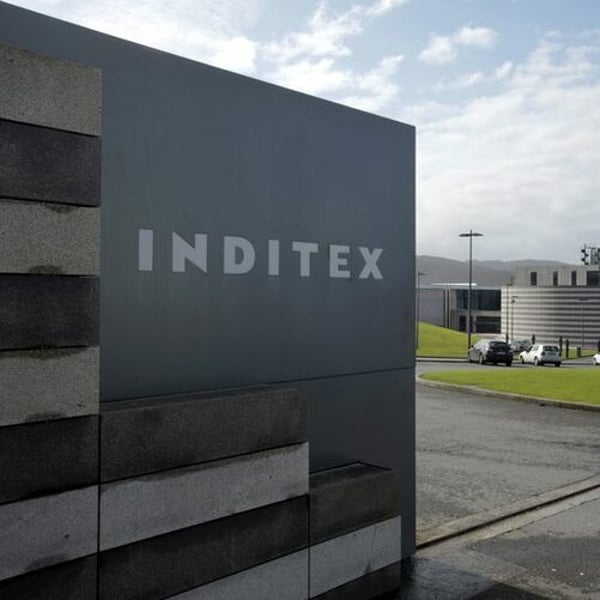
Inditex headquarters – Inditex
According to market data compiled by Europa Press, the textile conglomerate is up more than 12% in 2025 and now has a market capitalisation of over €174 billion.
That said, Inditex’s share price had been anaemic- if not negative- over the course of the year, as from mid-March to early this month the stock traded below 2024 closing levels and touched an August low of €40.8.
The rally of the past two weeks- which has propelled the new highs- is attributable to the company’s latest quarterly results, which beat market expectations across the board.
Specifically, on December 3, the conglomerate reported a record third quarter (August to October), with profit up 9% to €1.831 billion and sales up 4.9% to €9.814 billion.
Thus, Inditex recorded net profit of €4.622 billion during the first nine months of its 2025–2026 financial year (between February 1 and October 31), an increase of 3.9% year on year.
Since the day before these latest results were announced, Inditex has gained 14% on the stock market.
Moreover, this particular milestone for Inditex has coincided with a broader one for the Spanish stock market, as its benchmark index, the Ibex 35, surpassed 17,000 points on Friday for the first time in its history.
Analysts’ assessment
“Clear path ahead,” Bank of America analysts concluded two weeks ago following Inditex’s results presentation, after a year of doubts about the outlook for the apparel sector.
“The acceleration of growth bodes well for the first half of 2027 […] and should pave the way for improvements in earnings per share,” they said. They therefore reiterated their buy recommendation while raising their price target from €54 to €60.
eToro market analyst Javier Molina noted that Inditex beat market expectations and is consolidating its transition towards a more premium positioning at a time when the consumer cycle is showing signs of moderating.
“The third quarter was particularly solid and clearly exceeded consensus forecasts,” he said, while, in his view, the shift to the luxury segment is reflected in investment in flagship stores, the renovation of strategic locations and projects such as the new Zara building in Arteixo, focused on product and technology.
The company, according to Molina, shows a “remarkable ability to adapt” to consumer preferences, consolidating collections with higher perceived value.
“But this progress comes at a demanding moment in the cycle, and the market will be watching whether the company is capable of maintaining the level it has set for itself,” he warned.
For his part, IG analyst Sergio Ávila argued that in the short term these figures support Inditex maintaining a premium to the sector, although he also warned that the bar for expectations is “very high.”
“If the company continues to defend margins and control inventories, I see a higher likelihood of consolidation at elevated levels than of a deep correction,” he said.
The most optimistic firm on the Galician group is Citi, which raised its price target from €54 to €63, while other firms such as Berenberg lifted theirs from €52 to €62 and Santander increased its from €55 to €58.40.
This article is an automatic translation. Click here to read the original article.
On Thursday December 12, the Paris commercial court decided on the future of French premium ready-to-wear retailer IKKS. At the end of a receivership procedure involving several purchasing bids for IKKS, the court has approved the offer by Santiago Cucci, who was named president of the group’s holding company HoldIKKS last year, and Michaël Benabou, co-founder of event sales site Veepee.
Inside an IKKS store – IKKS
The court’s decision has put an end to months of uncertainty for IKKS’s employees. According to figures drawn up by the receivers at the end of August, the group’s staff numbered 1,287 worldwide, 1,094 of them in France. At the time, the group had 473 stores between France and 11 other countries, plus headquarters in the town of Saint-Macaire-en-Mauges and offices in Paris.
IKKS gave a design make-over to its collections in summer, and in September it applied for receivership, after the group’s main shareholders, US investment funds Avenue Capital, CarVal Investors and Marathon Asset Management, expressed their wish to sell the company.
The IKKS group, which operates the eponymous brand as well as One Step and ICode, is still a leading international ready-to-wear retailer in the premium segment, operating several hundred retail outlets (between directly owned and franchised stores, and concessions) in nine countries. The path to new ownership has been complex, since the group was split in several entities, and none of the purchasing bids referred to the group as a whole.
The winning bid’s details
Cucci and Benabou have convinced the court after recently revising their bid upwards. Initially, the bid related to 141 stores, 88 of them directly owned, and 391 company employees.
The deal was clinched after the bid was extended to include 219 stores in France: 92 of them directly owned, 100 franchised, plus 27 Galeries Lafayette concessions. The employees associated to the directly owned stores are 546.
Benabou and Cucci, a former senior executive at Levi’s and a strategic advisor to G-Star, have taken over the IKKS business and are planning to operate a more streamlined store fleet. They will focus on womenswear and menswear, while childrenswear has been put on hold.
The dossiers given to prospective buyers indicated that the IKKS brand accounted for 80% of the group’s revenue, that 64% of its revenue was generated by womenswear, 21% by childrenswear, and 15% by menswear. When the company applied for receivership, direct retail accounted for 77% of revenue, e-commerce (both B2B and B2C) for 20%, and the remaining 3% was generated through the wholesale channel.
Rejected bids
The bid by sustainable fashion brand Faguo, which had been revised to include 15 stores and 30 jobs, was rejected. French group Beaumanoir (which owns womenswear brands Morgan and Caroll) had teamed up with Faguo, offering €1 million to buy the IKKS brand name and some of the stores.
Another rejected bid was put forward by Salih Halassi’s company Amoniss, a shareholder in Pimkie which recently acquired Christine Laure and Chevignon. It initially bid for a minimum of 168 stores and 393 employees.
BCRI Holding, which recently bought Café Coton, initially offered to buy 67 stores with a total of 426 employees. While AA Investments (owner of Smallable, L’Exception and Bonne Gueule) was interested in IKKS’s intangible assets. Verdoso, new owner of The Kooples, withdrew its bid before the November 28 hearing.
Since none of the bids related to the Icode and One Step brands, and to IKKS childrenswear, some of the latter’s stores in France have now closed. The new owners are therefore concentrating on the IKKS brand, out of a group fleet that had 550 stores as of the end of 2024, though streamlining measures started in H1 this year.
The brand’s employees are now hoping IKKS will be able to regain momentum as a recognised name in the premium ready-to-wear segment.
Galeries Lafayette Paris Haussmann welcomes Louis Vuitton‘s latest beauty offering. Under the department store’s famous dome, the house presents, for the first time, a 40 square-metre corner entirely dedicated to its new make-up line, La Beauté Louis Vuitton.
Corner La Beauté Louis Vuitton Galeries Lafayette Paris Haussmann – DR
Louis Vuitton is part of the LVMH group and remains one of the world’s most influential luxury brands, thanks to its expertise in leather goods, fashion, and fragrances. The Galeries Lafayette Haussmann department store, owned by the family-run Galeries Lafayette Group, attracts millions of visitors every year and serves as an important showcase for the world’s leading fashion houses. It is an exceptional setting chosen by Louis Vuitton to present its new beauty proposition.
The house unveils its very first make-up collection, conceived as a new chapter in its vision of the art of travel. The artistic direction of the collection has been entrusted to Dame Pat McGrath, a leading figure in global make-up artistry. She envisions beauty as a means of self-expression and an everyday way of life.
To accompany the launch, Louis Vuitton has created a unique space on the ground floor of Galeries Lafayette. The corner is surrounded by an openwork metal structure featuring the diamond motif associated with the House. The atmosphere blends wood, woven leather and champagne-coloured metal to create a distinctly luxurious setting. The corner offers a personalised experience thanks to a dedicated consultation area, where customers can discover the products, receive advice and enjoy a made-to-measure moment.
The collection comprises three main ranges: LV Rouge with 55 lipstick shades, LV Baume with 10 shades, and LV Ombres with eight eye palettes. Each creation prioritises performance and a powerful sensory experience. The products feature an exclusive olfactory signature created by Louis Vuitton Master Perfumer Jacques Cavallier Belletrud. The refillable cases, designed by Konstantin Grcic, echo the house’s historic codes, marrying elegance and durability.
The space also features an exclusive lipstick trunk that brings together all the shades.
This article is an automatic translation. Click here to read the original article.
The historic outdoor event organised by Messe München ISPO took place in Bavaria for the final time, from November 30 to December 2. It gave ISPO the chance to present a final series of awards before its move to Amsterdam, where the trade show will be held from 2026.
ISPO Munich held its last edition at the end of 2025 – ISPO
This edition of the ISPO Awards was defined by three main criteria: circularity, multifunctionality, and technology. The winners were selected by an international jury and divided into several categories.
Comfortable, versatile products
In the Running/Trail Running category, gold went to The North Face for its Summit Vectiv™ Pro 3 shoe, recognised for its carbon plates, nitrogen-infused foam, and comfort. Completing the top five were Outopia (Vita Shell Jacket), Decathlon Kiprun (Kipnext shoe), Nedao (HexRise Active Running Long Sleeve T-shirt), and Mizuno (BreathDry Shell Jacket).
The latest generation of winners at the ISPO Awards in Munich was honoured – ISPO
The contest in the Mountaineering/Climbing category was won by Ohmega, Edelrid’s lightweight assisted-braking belay device. Its three-stage braking system, integrated pulley and suitability for all rope teams played an important role in this success. Edelrid and its Ohmega were followed by Blackyak with the Javari Suit, The North Face with the Summit 5050 AMK Hoodie, Mammut with the Crag Recycled Classic Rope, and Blackyak with the Watusi Light Suit.
Lightness, a key element in sports equipment
In the Hiking division, Rab’s Syclon XP 40 pack took top spot, thanks to its low weight, waterproofing and body-hugging Aerofit carrying system. Completing the top five were Kathmandu (XT Series Pack 40 backpack and Women’s XT Series Hybrid Octa Fleece Hooded Jacket), Rab again with its Mythic -6 down sleeping bag, and Simond with its MT900 ultralight backpack.
The award-winning products stood out for their durability, technical features and versatility – ISPO
Mammut’s Eiger Free Pro HS Bib Pants took first place in the Snow Sports category, thanks to their technical sophistication and durability. Helly Hansen (Sogn Patrol Shell jacket) and Elan (ACE GSX FX skis) completed the podium, followed by Pelliot with its The Limit Series One-Piece Down Coat.
Eco-responsibility, a must at the ISPO Awards
In the Lifestyle/Athleisure category, Impetus outpaced its rivals with the ImNatura T-shirt, recognised for its eco-friendly credentials. It finished ahead of Reima and its BugProof Hoodie Surista, Peak Performance and its R&D Helium Loop jacket, Bosideng and its 3-in-1 Smart Layering Kids Down Jacket, and Peak Design and its Roller Pro suitcase.
ISPO moves to Amsterdam in 2026 – ISPO
First prize in the Camping/Vanlife category went to Simond and its Single Wall Trekking Tent 2P UL Condensless, praised for its light weight and material efficiency. Simond was followed by Robens with the LightCore UL 3.1R Regular sleeping mat, Dometic with the Dometic CFX5 series cooler, Acebeam with the Keylight 500 torch, then Robens again with the Scoria Quilt UL +6°C Regular sleeping bag.
Versatile sports products are in vogue
Among the contenders in the Cycling/Commuting category, Bosideng took the gold award for the versatility and recycled materials used in its Circular Design Fashion and Functional Puffer jacket. Next came BBB Cycling with its BackStreet LED ERT helmet, Qiaodan with its Carbon Reduction Intelligent Wearable Luminous Riding Windbreaker, then Flectr with its Cargo Mate handlebar.
The new ISPO will now be organised by Messe München and Raccoon Media Group – ISPO
To bring this edition to a close, first prize in the Multisports category went to Helly Hansen for its Arctic Shield Pro Boot HT, whose technical capabilities won over the jury. The Norwegian brand finished ahead of Viking with its QuikGo GTX SL children’s shoe, Polartec with its AirCore x Montura Ritmo PTC AirCore Hooded Anorak, Acemate with its Tennis Robot, and EGGspander with its Your GYM ToGo! muscle-strengthening tool.
Future developments for the European Outdoor Group
This series of awards brought the last ISPO in Munich to a close, after fifty years in the Bavarian capital. The European Outdoor Group (EOG) took the opportunity to unveil the roadmap for its transformation programme, built around communications commitments (public relations, marketing, member recruitment) and events (ISPO, Outdoor Impact Summit and EOG Week) focused on environmental, social and regulatory issues.
EOG plans to increase its influence from 2026 onwards – ISPO
EOG’s future also lies in data management, according to its director, Christian Schneidermeier. The association will be developing its Outdoor Market Intelligence Service (OMIS) market analysis tool, implemented by Sporting Insights, and plans to roll it out in Germany this month and in France in early 2026, following a successful launch in the UK. For the time being, OMIS covers three million product references in its database, across 2,000 physical points of sale. According to EOG, the tool represents over €5 billion (2023–2025) in value and includes 1,000 brands represented.
EOG also plans to develop the Sustainability Data Exchange (SDEX) and a European retail directory, and to produce annual market reports, along with complementary projects. The aim is to make EOG a complementary player to ISPO, and to strengthen the European outdoor industry.
This article is an automatic translation. Click here to read the original article.