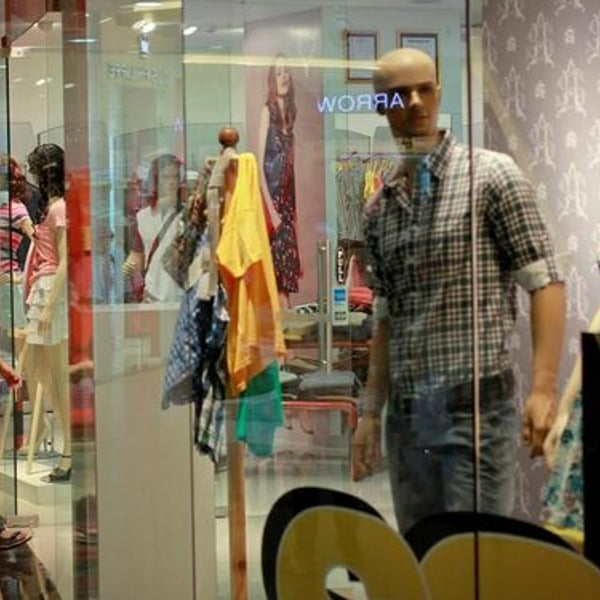
India’s overhaul of consumer tax stands to make everything from soaps to luxury SUVs cheaper, but global fashion brands such as Zara, Levi Strauss and Lacoste have been spooked by higher levies on all apparel priced at more than $29.
Reuters
The premium wear segment accounts for about 18% of an apparel industry worth $70 billion, says Datum Intelligence, spurred by a growing number of nouveau riche and brand-conscious youngsters in India.
The biggest tax reform in eight years by Prime Minister Narendra Modi’s government cuts levies to 5% on garments costing less than 2,500 rupees ($29), but items priced above that figure now face a higher levy of 18%.
Fashion companies worry about the impact of higher taxes on sales, since aspirational young people consider such purchases as a lifestyle upgrade, but remain sensitive to price, said two Indian garment executives dealing in foreign brands.
“Retail works on wafer-thin margins, and overheads like rents are extremely high,” said the chief executive of a foreign garment brand operating in India, who sought anonymity for fear of government reprisal. “Growth that we were expecting earlier won’t come now.”
The official added, “This is not a luxury. The 2,500-rupee price point is basic now.”
The higher taxes are also a double whammy for domestic garment makers whose thriving U.S. exports business is also reeling from President Donald Trump‘s tariffs of 50%.
India’s reform has not only drastically cut consumption levies on daily essentials and consumer electronics, but dealt a surprise win on Wednesday for pricey SUVs, reducing their tax rate to a flat 40%, versus up to 50% earlier.
Carmaker Mercedes-Benz has been reporting record sales in recent months, as consumption surges.
The higher rate on apparel could spell the “death knell for the industry”, the Clothing Manufacturers Association of India has said, as items costing more than 2,500 rupees are “consumed in large numbers by the common man and middle class”.
Most of the 875 new arrivals listed on Superdry India’s website, for example, are subject to the new 18% tax, with many jackets on offer priced upwards of $170 and shirts at $60.
On the Lacoste India website, men’s T-shirts can cost as much as $99, with not one priced below $29, the new threshold for the higher tax, set to take effect on September 22.
In press statements, the Association has flagged worries about the impact of the higher tax adding to the fallout from Trump’s tariff salvo. India’s Arvind Fashions for example, holds domestic franchisee rights for Tommy Hilfiger and Calvin Klein retail, but its affiliate, Arvind Ltd, makes foreign brands for export to destinations including the United States, which has a share of roughly 30%.
The Arvind Group did not respond to a request for comment. In India, foreign premium brands have been luring affluent youngsters by adding retail outlets and e-commerce offerings. Lululemon Athletica plans to enter the market in 2026.
The tax hikes will also apply to apparel from luxury goods makers Louis Vuitton, Dior and Versace.
Some customers may opt for cheaper more tax-efficient purchases while travelling abroad, but the hike to 18% from an earlier slab of 12% will have limited impact on India’s rich, said one luxury industry executive.
Another area of expenditure set for a hit will be clothes bought for weddings. Lavish marriage celebrations are big business, and urban families can easily spend thousands of dollars on items from traditional sarees to men’s jackets.
“Putting these clothes in the 18% slab will result in parents compelled to make inferior clothing for their favourite child on their favourite day,” the clothing association said.
French cosmetics giant L’Oreal said on Wednesday it will set up a beauty tech hub in the south Indian city of Hyderabad with an initial investment of over 35 billion rupees ($383.4 million).
L’Oréal
The hub aims to be a global base for AI-driven beauty innovation, create 2,000 tech jobs through 2030, and speed up the rollout of advanced AI beauty solutions, the company said in a statement.
Nicolas Hieronimus, L’Oreal’s CEO, and the state government of Telangana formalized the partnership at the World Economic Forum, Davos.
Telangana has rapidly emerged as a key investment and technology hub in southern India.
Bilateral trade between India and France stood at $15 billion in 2024, and Indian Prime Minister Narendra Modi and French President Emmanuel Macron have been forging warmer ties.
The two sides have also been working to recast their tax treaty since 2024 to modernize it by adapting global standards on tax transparency, Reuters reported in December.
Swarovski on Tuesday announced the appointment of Sindhu Culas to the role of president, general manager, North America at the Austrian jewelry maker.
Sindhu Culas – Courtesy
Based in the luxury firm’s New York City office, Culas will be responsible for “maximizing the Swarovski physical and digital presence and overall brand affinity in the U.S.,” according to a press release.
“We are thrilled to welcome Sindhu to Swarovski. Her vast leadership experience and passion for the brand make her an exceptional addition to our team,” said Kolja Kiofsky, chief commercial officer, Swarovski.
“With Sindhu guiding our next chapter in North America, we are looking ahead to an exciting future filled with creativity, operational excellence, and meaningful growth under our LuxIgnite strategy.”
A retail veteran with over 25 years of experience across omni‑channel retail and institutional investment management, Culas joins the crystal jewelry maker from G-Star, where she served as CEO of North America at the British denim and apparel brand.
She began her career as a buyer and planner at Macy’s, Talbots, and Lord & Taylor before being promoted to strategy and brand management at Macy’s. Later on, the executive served as senior vendor manager at Amazon and as senior vice president of e‑commerce and strategy for Calvin Klein.
“Watching Swarovski’s brand repositioning and momentum in recent years has been inspiring,” said Culas, in response to her new appointment.
“I’m excited to join this exceptional team, collaborate across the business, and help strengthen our position while accelerating growth throughout North America. It’s a remarkable moment for the brand, and I’m thrilled to contribute to the journey ahead.”
There are stories you simply couldn’t invent. The tale of Bourrienne Paris X, a finalist for the DHL 2025 Award, is one of them. The French shirtmaker for men and women, co-founded in 2017—among others—by two women with entirely different backgrounds, is now entering a phase that balances dynamic expansion with a quest for longevity, projecting growth of over 50% in 2025 and an equally high target for 2026.
Cécile Faucheur is the label’s artistic director – Bourrienne Paris X
The designer behind the Bourrienne Paris X collections is Cécile Faucheur. A former fashion design teacher, pattern cutter and stylist, she is now head of design at the brand she co-founded. Her research at the Musée de la Chemiserie in Argenton-sur-Creuse captivated both her and Charles Beigbeder (who had just taken over the Hôtel de Bourrienne in Paris), prompting them to dedicate a men’s shirting brand to the building.
Historical details and diverse trajectories
For her part, Carine Beigbeder, co-founder and CEO of Bourrienne Paris X, draws on a background that spans finance and entrepreneurship. She previously managed a listed small-cap fund at Financière Arbevel. Her analysis of companies’ business plans and strategies spurred her to take on an operational role—one she now fulfils at Bourrienne Paris X. A luxury brand, or at least on the way to becoming one, the label currently employs around ten people and is attempting to compete with luxury giants such as Hermès in a niche that has, until now, been very narrow: the shirt.
Carine Beigbeder aims to bring longevity to Bourrienne Paris X – Bourrienne Paris X
“The idea was to build a brand inspired by historical details and the shirtmakers of yesteryear. We realised that the men’s wardrobe had lost much of the richness it once had.”
Today, the Bourrienne Paris X wardrobe is rooted in both French stylistic heritage and modern fashion, having opened up to womenswear as early as its second season. This now accounts for more than half of the house’s turnover.
In search of quality materials
“For women, the shirt was a vehicle of emancipation as womenswear became uncorseted and a little freer. It wasn’t necessarily at the same time, but that’s not the point,” explained Beigbeder.
Bourrienne Paris X now goes beyond the shirt and has launched men’s trousers on pre-order, cut from a very heavy Belgian linen, “as if coated with a fine layer of beeswax, which gives it a very new and very innovative look,” in the CEO’s words.
Details play an important role in Cécile Faucheur’s work – Bourrienne Paris X
At Bourrienne Paris X, the linen comes from Belgium, the poplin from Italy, the embroidered trims inspired by the Hôtel de Bourrienne are made by a century-old manufacturer in northern France, the pleating by a Breton artisan, and the mother-of-pearl is sourced from Australia. The shirts, meanwhile, are made in Portuguese and Romanian workshops, and the house is considering other production sites elsewhere in Eastern Europe.
Priority given to digital
Soon to mark its tenth anniversary, Bourrienne Paris X is now in its third year of profitability. Struck by the Covid-19 pandemic after a loss-making start, the brand managed to “keep its head above water,” thanks to digital, which provides sufficient data to respond to its customers’ tastes. The company has self-financed its digital investments and plans to double them in 2026 to accelerate growth, a priority given that its e-commerce site generates over 50% of its sales.
Bourrienne Paris X is largely inspired by the Hôtel de Bourrienne – Hôtel de Bourrienne
Bourrienne Paris X also invests in SEO, and in Google, Pinterest and Meta campaigns tailored to each of the countries where it is sold, namely the United States, England, Switzerland, Canada and Australia. Customs duties, included in the final price across the Atlantic, are no longer an issue for the brand, thanks to the purchasing power of its American customers.
International expansion
With 60% of its sales generated abroad, the label is stocked by a number of department stores, including Le Bon Marché’s men’s department in Paris, as well as Bongénie in Geneva and Zurich, Lane Crawford in Hong Kong, and Isetan, Tomorrowland, United Arrows and Wako in Japan. This is why it is presenting its project to the DHL Prize jury this year.
The brand is a finalist for the DHL 2025 Award – Bourrienne Paris X
The brand remains based at 58 Rue d’Hauteville, opposite the Hôtel of the same name, in the 10th arrondissement of Paris. It’s not unusual for curious customers to be invited to discover the place that inspires the brand with each new collection. The brand’s desire to prioritise digital shapes its approach to welcoming investors, whose most valuable contribution would be their expertise.
For the time being, beyond the brand’s growth, Beigbeder is focused on a mission that is no less important: ensuring that Bourrienne Paris X stands the test of time. A “real challenge” consisting of remaining faithful to the house’s convictions and avoiding, as far as possible, the pull of passing trends.