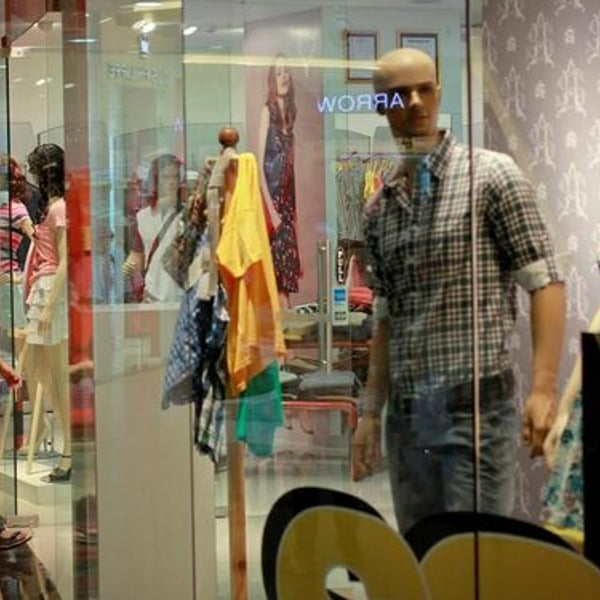
India’s overhaul of consumer tax stands to make everything from soaps to luxury SUVs cheaper, but global fashion brands such as Zara, Levi Strauss and Lacoste have been spooked by higher levies on all apparel priced at more than $29.
Reuters
The premium wear segment accounts for about 18% of an apparel industry worth $70 billion, says Datum Intelligence, spurred by a growing number of nouveau riche and brand-conscious youngsters in India.
The biggest tax reform in eight years by Prime Minister Narendra Modi’s government cuts levies to 5% on garments costing less than 2,500 rupees ($29), but items priced above that figure now face a higher levy of 18%.
Fashion companies worry about the impact of higher taxes on sales, since aspirational young people consider such purchases as a lifestyle upgrade, but remain sensitive to price, said two Indian garment executives dealing in foreign brands.
“Retail works on wafer-thin margins, and overheads like rents are extremely high,” said the chief executive of a foreign garment brand operating in India, who sought anonymity for fear of government reprisal. “Growth that we were expecting earlier won’t come now.”
The official added, “This is not a luxury. The 2,500-rupee price point is basic now.”
The higher taxes are also a double whammy for domestic garment makers whose thriving U.S. exports business is also reeling from President Donald Trump‘s tariffs of 50%.
India’s reform has not only drastically cut consumption levies on daily essentials and consumer electronics, but dealt a surprise win on Wednesday for pricey SUVs, reducing their tax rate to a flat 40%, versus up to 50% earlier.
Carmaker Mercedes-Benz has been reporting record sales in recent months, as consumption surges.
The higher rate on apparel could spell the “death knell for the industry”, the Clothing Manufacturers Association of India has said, as items costing more than 2,500 rupees are “consumed in large numbers by the common man and middle class”.
Most of the 875 new arrivals listed on Superdry India’s website, for example, are subject to the new 18% tax, with many jackets on offer priced upwards of $170 and shirts at $60.
On the Lacoste India website, men’s T-shirts can cost as much as $99, with not one priced below $29, the new threshold for the higher tax, set to take effect on September 22.
In press statements, the Association has flagged worries about the impact of the higher tax adding to the fallout from Trump’s tariff salvo. India’s Arvind Fashions for example, holds domestic franchisee rights for Tommy Hilfiger and Calvin Klein retail, but its affiliate, Arvind Ltd, makes foreign brands for export to destinations including the United States, which has a share of roughly 30%.
The Arvind Group did not respond to a request for comment. In India, foreign premium brands have been luring affluent youngsters by adding retail outlets and e-commerce offerings. Lululemon Athletica plans to enter the market in 2026.
The tax hikes will also apply to apparel from luxury goods makers Louis Vuitton, Dior and Versace.
Some customers may opt for cheaper more tax-efficient purchases while travelling abroad, but the hike to 18% from an earlier slab of 12% will have limited impact on India’s rich, said one luxury industry executive.
Another area of expenditure set for a hit will be clothes bought for weddings. Lavish marriage celebrations are big business, and urban families can easily spend thousands of dollars on items from traditional sarees to men’s jackets.
“Putting these clothes in the 18% slab will result in parents compelled to make inferior clothing for their favourite child on their favourite day,” the clothing association said.
China sold more goods to the world than ever in 2025, but export saleswoman Aimee Chen says it was the hardest of her roughly two-decade career. After US President Donald Trump‘s tariff hikes led to US orders plunging by a third, Chen’s pet products company moved to diversify geographies, chasing new and often lower-income markets like South America. The response mirrored China’s official trade policy, which led to a record $1.2 trillion surplus for 2025 despite new trade barriers.
Chinese flags flutter near containers stacked at the Yangshan Deep Water Port in Shanghai, China January 13, 2022. Picture taken January 13, 2022 – REUTERS/Aly Song/File Photo
Reuters interviews with 14 salespeople working on the frontlines of China’s export diversification push, however, reveal the costs and caveats behind the rosy headline trade figures. Four of the salespeople said that orders from the new markets were often smaller in volume and less lucrative than US sales, resulting in lower commissions and pay. Government data show profits at China’s industrial firms fell 13.1% year-on-year in November, the fastest pace in over a year.
Many of the employees also described longer working hours as well as greater intensity and uncertainty amid the export boom. “I’m very anxious,” said Chen, adding that she had recently experienced stress symptoms like hair loss and insomnia.
Mingwei Liu, director at the Center for Global Work and Employment at Rutgers University, said that China’s export strategy in alternative markets depended on firms chasing high volumes of cheap orders. Companies that succeed often give clients longer payment cycles and bear higher default risks, he said.
“This market reorientation increases the labour intensity, the emotional burden and income uncertainty faced by workers in export sales,” Liu said. China’s commerce ministry and human resources ministry, as well as the office which manages the cabinet’s media queries, did not respond to requests for comment.
China and the US have grown increasingly interconnected since Beijing’s 2001 accession to the World Trade Organization. Their relationship has also become more imbalanced, with their respective economic policies favouring production in the former country and consumption in the latter.
Some American retailers and Chinese producers have said they developed relationships that were so close that they could anticipate each other’s needs and red lines, making deals feel almost automatic. Chen, for instance, described her past interactions with US retailers in largely glowing terms. Clients in the world’s largest economy were often “easy-going” and signed deals quickly, she said.
By contrast, customers in new markets like to haggle on price, she said. Chinese shipments to the US fell 20% in 2025, though it remains a top export destination. Shipments rose 25.8% to Africa, 7.4% to Latin America, 13.4% to Southeast Asia, and 8.4% to the European Union last year.
While Washington and Beijing have had previous trade disputes, tensions escalated after Trump took office at the start of 2025. He raised tariffs to over 100% in April, before partially reversing and settling for a fragile detente. His re-election sent China’s export-oriented industrial complex into a rat race for foreign demand across the world.
Monica Chen, who has been selling auto parts for more than a decade in the eastern Zhejiang province, had long relied on email to keep business going. But with US tariffs in place, she’s had to fight harder to win business. That means ramping up business travel to as much as three times a month and cold-calling prospects.
“It’s very hard to develop new markets, they are basically saturated,” said Monica, who isn’t related to Aimee Chen. Her company ultimately responded by cutting prices to undercut other Chinese firms that are also looking for buyers abroad. The firm’s orders were down a third in value from 2024, Monica said.
With profits falling, companies have placed pressure on their sales agents. Cici Lv, 24, who has sold electric bicycle batteries since 2022 from the southern city of Shenzhen, earns about 5,000 yuan ($717) per month- not much more than workers in the factories that produce such units.
But while workers’ shifts come to an end, Lv said she is constantly on the clock talking to foreign clients. One of her peers, Rowan Wang, a sales rep for an exporter of agricultural equipment in eastern China, summed up the demands as “if we’re alive, we have to reply.”
Five of the salespeople also described struggles to manage less-affluent clients in markets with which they have little familiarity. Lv said she traded messages with one client for months, discussing everything from news events to lunch choices and religion. He eventually ordered just one battery, earning Lv a commission of less than $2.
A review of the top 100 most liked export-related posts on social media platform RedNote in the six months to mid-January found 37 that raised complaints about heightened job stress. Another six complained about unprofessional client interactions.
“Sometimes it messes with your mind,” said Lv, who said she’s fielded relationship proposals. The hardship described by the sales staff may be an early warning that China’s trade diversification success in 2025 could be hard to replicate in the years ahead, said Chen Bo, senior research fellow at the National University of Singapore’s East Asian Institute.
Economists have long argued that China has to develop local markets if it wants to end its deflationary cycle. Weak consumption pushes Chinese producers to compete overseas, often against each other, which brings revenue into the economy but erodes profits, Chen said. China “can’t maintain sustainable economic growth by relying on foreign markets,” the academic said.
Spanish designer David Catalán, whose eponymous label is registered in Porto, and Portuguese designer Miguel Vieira once again took to the runway at Milan Fashion Week, supported by Portugal Fashion. According to the organisers of the Portuguese project, the initiative was included in the official show calendar of Italy’s fashion capital, one of the most important stages in the global industry. Their autumn/winter 2026/2027 collections were presented at Fondazione Sozzani on the morning of Monday, January 19, one following the other.
Foto: Filippo Fior
While the “ASSEMBLED” collection marks David Catalán’s new approach to construction and functionality, the ‘A Tea in the Desert’ line “brings Miguel Vieira’s vision inspired by Bernardo Bertolucci’s The Sheltering Sky,” Portugal Fashion said in a statement.
“ASSEMBLED is the title of David Catalán’s collection for autumn/winter 26/27. The concept draws on the logic of traditional patchwork blankets, looking to their principles of construction, reinforcement, and layering as practical responses to cold, wear, and continued use,” the note explains. “Those principles are translated into menswear through panelled cuts, contrasting materials, and structured silhouettes, creating a winter wardrobe designed to be combined, adapted and worn in day-to-day life.”
“The pieces function as layered systems, with each element playing a specific role within the whole, combining structural rigour with a contemporary approach to menswear, and focusing on functionality, durability, and versatility.”
Foto: Filippo Fior
On his social media channels, David Catalán writes: “Inside the studio and in factories, where streetwear meets the precision of tailoring and youthful instinct intersects with craftsmanship, @davidcatalanbrand shapes a contemporary, fluid, and deeply personal voice.”
“Born in Spain, Catalán chose Porto as his base on arriving to study fashion- a city that has become integral to the growth of his brand and creative identity. Today, his work reflects an intercultural journey, combining relaxed tailoring, utilitarian elements, and a modern approach to menswear, rooted in quality and experimentation,” the post further explains, announcing that in Milan, “David Catalán takes to the runway at @milanfashionweek, representing Portugal via the Portugal Fashion platform. The ‘Assembled’ collection unfolds as a reflection on construction, layering and the dialogue between function and form- a collection that captures the energy of a new generation of menswear.”
Foto: Filippo Fior
“A statement shaped by versatility, movement and the freedom to build one’s identity through clothes,” the brand adds, underscoring: “Assembled. Versatility in every layer. Freedom in every step”.
Miguel Vieira then presented the ‘A Tea in the Desert’ collection, inspired by Bernardo Bertolucci’s film The Sheltering Sky, developed “from the arid landscapes of North Africa and the emotional intensity of the protagonists, translating these references into a tailoring proposal marked by contrasting textures, volumes and atmospheres.”
Foto: Isidore Montag
“The silhouette oscillates between structured shapes and more fluid lines, creating a constant tension between restraint and freedom,” it continues. “The colour palette includes ecru, beige, camel, brown, pink, and black, rendered in materials such as flannel, silk, alpaca, cashmere, fur, wool, and sequins. Details include prints developed in the atelier and hand-braided flannel, with accessories such as scarves, ties, and bags completing the collection.”
On its social media channels, the eponymous Miguel Vieira brand highlights “A Tea in the Desert. Rigor in every cut. Sensitivity in every detail”, reads a post on @miguelvieiraofficial, shared with @portugalfashion.
Foto: Isidore Montag
“Inside the atelier, where precision defines each line and tailoring becomes language, @miguelvieiraofficial continues a career shaped by mastery, discipline, and vision,” another publication explains. “With decades of close collaboration with the textile industry, the designer refines silhouettes that have long defined contemporary menswear. Each piece reflects a commitment to structure, detail, and the discreet confidence of impeccable tailoring”.
It further previews, in Milan, ‘A Tea in the Desert’, which reveals itself as “a new chapter in a work dedicated to men’s fashion, where rigour meets sensitivity and experience is transformed into expression.” In short: “A collection rooted in tailoring, elevated by time and guided by an enduring dialogue between fabric and form.”
Foto: Isidore Montag
After Milan, Portugal Fashion moves on to Paris and, subsequently, Copenhagen, continuing the autumn/winter 2026/2027 season with a series of actions aimed at buyers, the media, and industry professionals. This reinforces the presence of creations developed in Portugal across Europe’s main fashion centres, the organisation behind the Portuguese passerelle notes, as it invests beyond borders to take Portuguese talent and fashion labels further afield.
Portugal Fashion is a project run by ANJE- National Association of Young Entrepreneurs- with the support of its strategic partners and co-financed by SIAC- Support for Collective Actions- Internationalisation of Portugal 2030, within the scope of Compete 2030- Innovation and Digital Transition Programme- with funds from the European Union, through the European Regional Development Fund.
This article is an automatic translation. Click here to read the original article.
Paon-Paon is still little-known but is already making its presence felt. The fledgling French artisanal maison is setting up a snug nest at 11 rue du Dragon in Paris, where it will open on January 30. The store is the brainchild of CEO Emmanuel Gavache, who co-founded Paon-Paon with Aurélie Introzzi, the maison’s creative director.
Paon-Paon’s first collection is big on cowhide leather – Paon-Paon
Paon-Paon was founded in December 2025, entering the market with a range of women’s footwear featuring sandals, mules, pumps and booties, some of them characterised by curved shapes, others more sharply defined. The models come in a wide variety of colours and materials, from pink or white cowhide to black or gold metal-effect leather, black or blue cashmere uppers, and more. Paon-Paon’s shoes are priced between €500 and €700, hoping to attract Parisian women with an eye for detail and luxury.
A touch of extravagance and “groundbreaking” sourcing
Introzzi, the creative mind behind the brand, said that “I design shoes because I’m profoundly convinced that footwear can do much more than change a look. Shoes influence posture, and posture can transform one’s attitude and confidence, the way one enters a room and inhabits the world.” Introzzi’s aim is to add a touch of extravagance to luxury.
Barely three months old, Paon-Paon will open its first store in Paris at the end of January – Paon-Paon
Paon-Paon shoes are made in Milan by a single manufacturer, following the “groundbreaking” sourcing strategy devised by Gavache, who is well aware of future requirements for manufacturing transparency. For example, the shoes’ leather comes from calves raised close to the tanneries that treat the material. Gavache is keen to showcase Paon-Paon’s traceable sourcing practices, and said he can organise visits to the brand’s manufacturing partners.
“Self-styled” luxury is meaningless
While Paon-Paon’s artisanal products are currently all made in Italy, Gavache is hoping to eventually produce in France, though he laments the harsh climate making it difficult to set up in business in the country. Paon-Paon is looking to expand its range, and is planning to gradually introduce leather goods and ready-to-wear within the next two years. However, Gavache prefers to describe Paon-Paon as an “artisanal maison” rather than a luxury label. “Before being deservedly labelled as ‘luxury’, [a brand] needs to be truly well-established to be identified as such. I don’t think one can self-style one’s brand as a luxury one,” he said.
Paon-Paon shoes are all made in Italy, near Milan – Paon-Paon
The same quest for the meaning of the word ‘luxury’ is mirrored in Introzzi’s words. “Having spent 12 years creating and perfecting comfortable footwear – an obsession that’s always stayed with me – working alongside top-notch artisans in Italy, I developed a desire to go a step further, travelling the extra mile and returning to what truly drives me: human nature, the environment, materials, colours, the lived experience,” she said.
Pivotal first year for Paon-Paon
The third name in Paon-Paon’s executive triumvirate is Catherine Teurquetil, who started her career in fashion and advertising before founding a children’s stationery and home decoration brand, and later taking charge of the family’s wine estate. Her business experience now enables her to actively shape “[Paon-Paon’s] vision and main strategies,” she said. According to Teurquetil, the maison’s challenge in its first year is to develop a powerful image and the vision of an established brand.
Paon-Paon is keen to become a recognised player in the French luxury sector – Paon-Paon
Teurquetil also cast light on what drove her to take part in the Paon-Paon venture: “I was immediately attracted by its creative freedom and artistic vision, as both chime perfectly with my sense for luxury and fashion.” She added that “the team’s quality, my clear desire to link up again with a demanding creative environment, and the very strong prospect of future success, made it a no-brainer.”
“Tightly controlled” distribution
After a year of preparation and barely out of the trap, Paon-Paon is already available at Printemps in New York. A “symbolically strong” presence according to Gavache, who is working on a “tightly controlled” distribution footprint. In parallel, Paon-Paon launched online and at Parisian accessories store 58M, and is hoping to work with Le Bon Marché in the capital, and with Galeries Lafayette in other French cities.
Paon-Paon shoes are equipped with removable soles, which can be replaced in Italy – Paon-Paon
For now, Paon-Paon’s priority project is its Parisian store. It extends over 70 square metres, 40 of which are devoted to the retail area and 30 to a space for product alterations and personalisation. The latter service is set to be provided by French artisans. Paon-Paon shoes, with the goal of extending their useful life, are equipped with removable soles that can be replaced in the producer’s workshop in Italy.
A “groundbreaking” sourcing approach, longer-lasting products and luxury designs don’t seem to be enough for Gavache. He has a history of investing in new technology, and is planning to bring his experience in the sector to bear. For example, he is keen to use a LiDAR scanner with volunteer customers to adapt Paon-Paon shoes to their actual foot shapes. Because, while the maison is taking flight, it might as well spread its wings in avant-garde fashion.