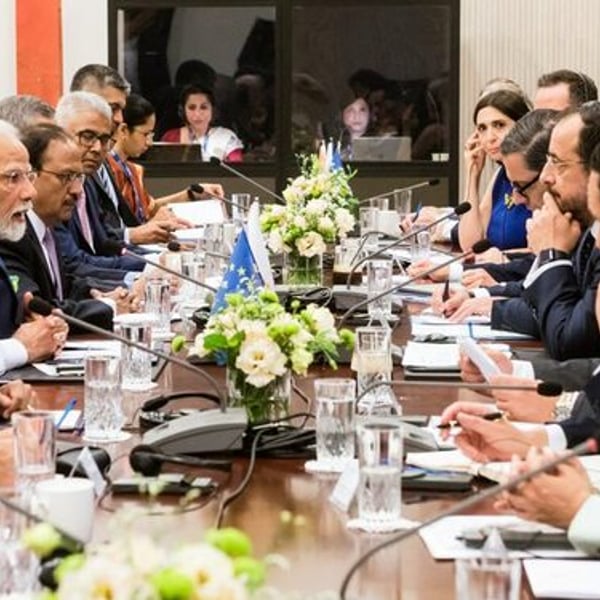
India and the European Union are holding potentially decisive trade negotiations in New Delhi this week, seeking to resolve differences over agriculture, dairy and non-tariff barriers to meet an ambitious end of year deadline for a deal, Indian government and EU sources said.
Reuters
New Delhi is seeking to deepen global partnerships after U.S. President Donald Trump doubled tariffs on Indian goods to 50% last month over India’s Russian oil purchases, hitting exports such as textiles, leather and chemicals.
Negotiations, relaunched in 2022, have gained pace since Trump’s re-election. Brussels too, faced with Trump’s tariffs, has accelerated its push for trade alliances, sealing deals with Mexico and the South American Mercosur countries and stepping up talks with India, Indonesia and the United Arab Emirates.
A pact with the EU could also draw India closer to the West, after unease over Prime Minister Narendra Modi’s recent visit to China for a summit attended by Russian President Vladimir Putin and other leaders.
“Talks with the EU are progressing well,” an Indian government source said, citing Modi’s call with European Commission President Ursula von der Leyen last week, when both leaders pledged to conclude a deal this year.
So far 11 of the 23 chapters under negotiations have been finalised, covering customs, digital trade, intellectual property, competition, subsidies, dispute settlement and anti-fraud measures, the source said. But sticking points remain.
India has ruled out concessions on agriculture and dairy, citing farmers’ livelihoods, while the EU is pressing for greater access to India’s market for automobiles and alcoholic beverages.
Differences also persist on rules of origin, food safety standards, labour and environmental obligations, and what Brussels views as restrictive Indian quality control orders that act as non-tariff barriers, an EU official said.
The sources spoke on condition of anonymity as the details about trade talks are not public.
India’s commerce ministry and the EU office in New Delhi did not immediately respond to email requests for comments.
Brussels is also pressing New Delhi over discounted Russian oil purchases, which EU officials say undermine sanctions against Moscow.
While unlikely to dominate the discussions, the issue could cast a pall over the negotiations and result in resistance in the European Parliament, which would have to approve any deal, EU officials said. European Agriculture Commissioner Christophe Hansen and EU trade chief Maros Sefcovic will be in Delhi later this week for discussions with Indian counterparts.
In parallel, the EU’s Political and Security Committee, led by Chair Delphine Pronk and comprising ambassadors of all 27 states, will visit India from September 10-14 for meetings with officials, defence executives and think tanks.
Another contentious issue is the EU’s carbon border tax, which will levy carbon-intensive imports such as steel and aluminium from 2026. Indian officials call it a disguised trade barrier while Brussels insists it is central to its climate policy.
EU officials said they were ready to offer flexibility in its implementation to address the concerns of small and medium-sized businesses.
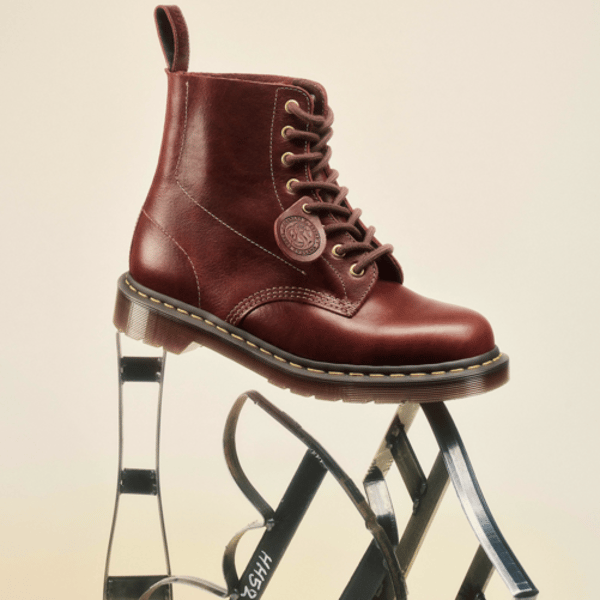
Dr Martens announced its independent non-executive director Robert Hanson has been continuing to purchase the brand’s stock, in what looks like a further positive sign for the global footwear retailer.
Dr Martens
In a release to the London Stock Exchange, Dr Martens said Hanson has just purchased another 104,000 shares, worth over £80,000. This is in addition to the 96,000 shares he purchased a week ago (8 December) to the tune of around £75,000.
Hanson, who joined the Dr Martens’ board in March as a non-executive director and was previously president of Americas at Levi’s as well holding CEO roles at American Eagle Outfitters. He looks to be banking on a positive future for Doc Martens (and his post) with directorship purchases taken as a sign they’re expecting an improving performance in the markets and at retail.
Dr Martens is currently working through a recovery from a major period of weakness and it seems to be yielding results. Its first half update in November showed progress, with the America recovering.
Six-month results for the FY26 period to late September showed the execution of its new strategy on track with full-price DTC revenue rising 6%.
But there were some negative figures with overall revenue on a reported basis dipping by 0.8% to £322 million. However, it would have risen by 0.8% at constant currency rates.
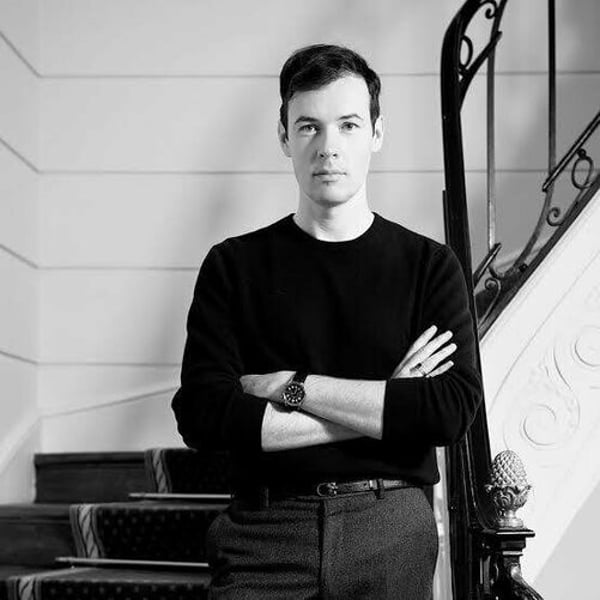
Leonard Paris is entering a period of transition: the brand and Georg Lux, its creative director since January 2021, have announced the end of their collaboration. In a statement issued by the house, Georg Lux describes this as “a precious chapter” in his career and notes the privilege of engaging with the brand’s heritage while imprinting it with his personal vision.
Georg Lux joined the house in 2021
The German designer joined the French luxury house to support a reinterpretation of its historic DNA. His collections sought to marry Leonard’s visual heritage, particularly its work with silk jersey and floral prints, with a more contemporary vocabulary tailored to an international clientele.
The end of a ‘fruitful’ collaboration
Yuichi Nishi, president of Leonard Paris, hailed the collaboration as ‘fruitful’ and highlighted the creative director’s ability to honour the house’s fundamental codes while showing creative boldness. The brand said it is approaching this transition “with serenity and ambition,” and announced that the details of the new creative direction will be unveiled shortly.
This change comes as Leonard faces a significant downturn in its business. According to the company’s financial statements for the year ending December 31 2024, net revenue totalled €6.77 million, compared with €7.26 million in 2023, confirming a pattern of erosion in recent years.
Declining financial results
This decline was accompanied by a net loss in 2024, following a loss already recorded the previous year, despite shareholder support and efforts to reposition the brand creatively. Georg Lux’s departure comes at a pivotal moment, when artistic renewal intersects with the brand’s economic challenges.
Acquired in 2022 by its long-standing Japanese partner Sankyo Seiko, Leonard has for several years been working to consolidate its positioning in a luxury market undergoing profound transformation, marked by intensifying competition and the greatly expanded communications capabilities of the major groups.
This article is an automatic translation. Click here to read the original article.
“Africa is not here to be discovered; Africa is here to be recognised.” With that assertion, Lulu Shabell, founder and CEO of the Lulubell Group, launches Álké Ball, an institution dedicated to securing global recognition for African fashion.
The institution’s work is underpinned by the Álké Fund – The Álké Ball
Grounded in art, heritage, knowledge, and enterprise, the Álké project seeks to catalyse a decisive shift: from sporadic visibility to an intentional, structured, unified and globally influential African authority. Its name is drawn from the word “Álkébulan,” regarded by some as among the oldest known names for the African continent.
“Before the modern vocabulary of luxury, there was Africa”
Drawing on her experience across more than 20 African countries, Lulu Shabell has supported designers, helped to expand the African fashion industry, and forged international connections through the Lulubell Group. Under her leadership at Álké Ball, a pan-African collective of designers, archivists, curators, researchers, and creative strategists has taken shape.
Together, they advance a shared thesis: that long before silk, cotton, and the modern vocabulary of luxury, there was Africa- a place where pattern was a language, textiles a code, and clothing a philosophy. In Africa, fashion has never been purely decorative; it was, and remains, a testament to lineage, mastery, and thought.
Taking action through a fund
At the heart of Álké’s mission is the Álké Fund, a permanent, continent-wide financing structure designed to ensure the long-term stability, independence, and global competitiveness of Africa’s creative industries. The Álké Fund will invest strategically in four interconnected pillars that support Africa’s creative sovereignty.
Álké Ball is the brainchild of entrepreneur Lulu Shabell – Lulubell Group
To advance education and skills, Álké will create pathways for the next generation of creators, artisans, and entrepreneurs, ensuring that intergenerational knowledge is actively passed on rather than lost (which is also the mission of 54 Faces, an association co-led by Judy Sanderson). The institution will also focus on manufacturing and production capacity, strengthening local value chains, and accelerating innovation across both artisanal and industrial systems.
A first edition in Cape Town
Álké Ball will mobilise around archives, the preservation of craft expertise, and research: safeguarding African textile histories, indigenous knowledge systems, and craft techniques through documentation, conservation, and active use. Finally, the collective will work to develop African brands by promoting sustainable commercial growth, operational stability, and long-term international expansion.
According to Lulu Shabell and the pan-African collective, the fund is not merely a financial instrument. It is also a concrete response to decades of underinvestment in Africa’s creative and cultural industries. Its inaugural edition will take place in Cape Town, with subsequent editions rotating among Africa’s cultural capitals.
This article is an automatic translation. Click here to read the original article.