
Fashion
In Riyadh, Stella McCartney closes an internationally focused fashion week, a pillar of Saudi Vision 2030

Published
October 22, 2025
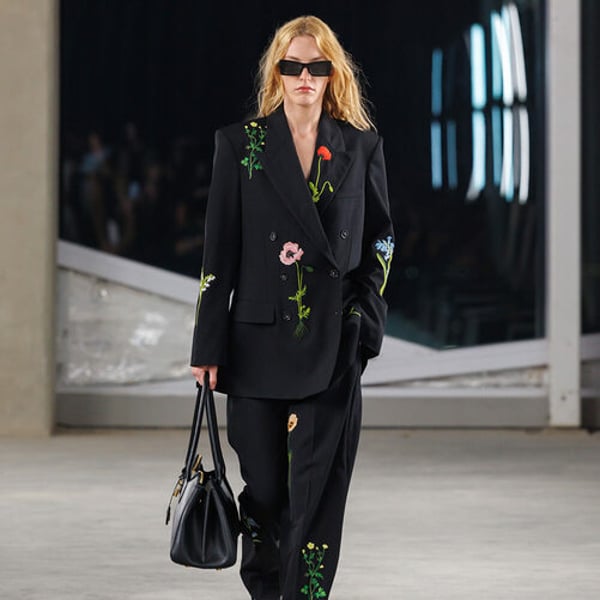
On Tuesday evening, Riyadh brought its third fashion week to a close. In a sign of the Saudi capital’s ambition, British label Stella McCartney capped six days of shows and presentations that primarily spotlighted local labels.
Staying true to her commitment to responsible materials, the designer—presenting her work in the Middle East for the first time—unveiled a selection of pieces from her spring/summer 2026 and autumn/winter 2025 collections. While several local influencers and celebrities wore the Briton’s creations, the audience gathered at the King Abdullah Financial District (KAFD) discovered Stella McCartney looks incorporating materials such as Yatay M, a vegan alternative to exotic leathers made from fungal mycelium; Sequinova plant-based sequins—a world first; more responsibly sourced viscose; as well as biodegradable mesh and regenerated silk.
Together with Vivienne Westwood’s opening show, this finale lent the event greater credibility and international visibility. In a country pursuing an ambitious events strategy—much as in sport, with star footballer Cristiano Ronaldo as ambassador for the kingdom of Salman bin Abdulaziz Al Saud—fashion has established itself as a pillar in which the state is investing. For the first time, Riyadh Fashion Week featured international designers and brands alongside local ones. The Saudi Fashion Commission, which coordinates fashion-related operations in the kingdom, aims to build momentum locally.

The strategy begins in the capital. Riyadh Fashion Week brings together personalities and socialites from across the Middle East (such as Georgina Rodriguez, Cristiano Ronaldo’s partner) and makes a bold statement in the heart of the city. By night, the emblematic Kingdom Center tower—recognisable by its needle’s-eye silhouette—screens a Fashion Week film across its 302-metre façade. A runway show was even projected on this gigantic screen.
Charm offensive
And the charm offensive appears to be working. In a country renowned for strict religious conservatism, where flamboyant dressing is not part of everyday life, the local gilded youth brave the city’s incessant three-lane traffic to join in and criss-cross the city. On the first level of the Mandarin Oriental hotel—with dreamlike staging—at a runway site set in the desert, in the heart of a palm grove, on the roof of a tower overlooking the capital or within Riyadh’s creative hub, they hurry to enter exceptional venues.
These moments heighten the contrasts. In the early evening, as the muezzin calls to prayer just a few metres away, crowds film themselves at the entrances to the shows and oblige the photo calls. Such moments are rare, for although women in Riyadh today are more likely to wear the hijab than the niqab, dress codes remain tightly codified. Around the shows, men wear the traditional thobe (a long-sleeved white robe) with the shemagh, the red-and-white chequered headscarf secured on the head, or sport head-to-toe looks from European luxury houses. Embroidery and pearls adorn the precious fabrics of women’s black abayas, with strands of hair escaping from their veils.
Visible luxury is expressed through exotic-leather bags, high-end shoes and layers of gold jewellery, while femininity is signalled by bold make-up. Occasionally, some wear glittering evening gowns that hug the body or reveal legs or shoulders—silhouettes echoed on the catwalk. While most local designers have only been active for a few years, affluent youth, often close to the designers, are enthusiastic about the event. And every show is an occasion for hearty applause.

“Each day is very different. The shows follow one another and it’s a mix of brands, a diversity of products and also a different audience. It’s nice to be able to see them all in succession,” said Burak Cakmak, CEO of the Saudi Fashion Commission, which organises the event and has been increasing the number of labels presented year after year.
“What I like is that you have the opportunity to see 40 shows and presentations that give a very good idea of the country’s fashion proposition, with couture and eveningwear brands, women’s and men’s ready-to-wear, but also mixed streetwear brands.”
Indeed, the moods vary widely from day to day. With its evening dresses, the historic Adnan Akbar house played with embroidery, working tulle, organza and silky fabrics in an haute couture approach. The offering remained substantial for the Middle Eastern market: at Ashwaq Almarshad, long trains, all-over floral embroidery and opulent draping riffed on the genre’s codes. Atelier Hekayat also explored these avenues, working with transparency and precious materials, and playing with different volumes.

In ready-to-wear, traditional Saudi dress and cultural references were revisited. At Abadia, traditional womenswear was reworked in new proportions. At Derza, traditional Al Sadu weaves and motifs were integrated into or printed onto garments. Mona Alshebil and Razan Alazzouni weaved elements of Middle Eastern culture into their distinctly working girl ready-to-wear, with discreet embroidery and graphic perforations. Some evening looks also reveal skin—at the back, the calves or even the midriff.
On the menswear and streetwear side, the proposals likewise draw on local references. Mihyar, channelling the wardrobe of the Saudi countryman, composes a jacket and trousers in boiled wool and reinterprets the Ghis, the traditional coat. This large hooded coat is the subject of multiple explorations, reworked in technical materials, with original prints or in oversized formats at Qormuz, Awaken and RBA. The label fully embraced tradition, sending models down the runway with hawks, a symbol of the Bedouins’ relationship with the desert.

The desert was also central to Cargo’s show, which delivered one of the most coherent and creative presentations, centred on travellers who had weathered a sandstorm. In this post-apocalyptic narrative, the brand explored urban and street silhouettes with camouflage prints and key fabrics—all clearly designed to resonate with the local audience.
The commission benefits from government support to develop the sector. While it multiplies international showcases, in Europe as well as in Asia, and brings in buyers and media from around the world, Saudi brands must also win over their local clientele.
“Over the past three years, it has become clear that we must focus above all on the Saudi market. The world has evolved considerably in market terms. Many regions are struggling to determine how to develop their business. For a long time, in Saudi Arabia, there was a limited supply of shops. And Saudis shopped abroad. But as the country evolves, more shops are opening, more experiences are being created and, in this context, local brands want to take advantage of it. They do not want to neglect their local consumer base when designing products. It’s a healthy base. They must first respect what the local community wants. Then build on that to see which other market is interested in the same product and plan distribution accordingly.”
For the time being, most of these brands are working to raise their quality and structure their organisation. For many, distribution is still in its infancy, but several, such as 1886 and Hindamme, are succeeding in attracting renowned outlets in the Middle East. Fashion week is also an opportunity for these designers to engage with an international ecosystem. The Fashion Commission brings in buyers, influencers and journalists from Europe and Asia. An agreement has also been signed with M.Seventy, the entity that manages the White Milano trade show, to present Saudi brands on its platforms.
This season, the show teams—from production to styling—comprised service providers and professionals seasoned by European fashion weeks, subjecting local brands to a high level of expectation. Over the past three years, local labels have been honing their approach in both style and production. While some, like Eleven, espouse a 100% local approach, many source materials from Italian textile houses and increasingly call on experienced ateliers, notably Italian and French. These ties could well deepen in future editions.
An opportunity for international brands
The Saudi Fashion Commission has taken a further step by opening its calendar to European labels. This gives Saudi brands an up-close view of the methods of long-established companies in the industry. And even when international brands present their collections in Riyadh, the intention is to link their presence to local players. The house of Vivienne Westwood worked with the cultural institution Art of Heritage, which preserves Saudi Arabia’s artisanal heritage, on a capsule collection of exclusive dresses finely embroidered by Saudi craftspeople—an approach that goes beyond simply selecting or adapting silhouettes to suit regional and religious conventions.

“By presenting a proposition that respects local culture, the brand has connected closely with many female consumers in the country. And I look forward to hearing the brand’s feedback on the commercial impact over the next six months,” said Cakmak.
“Major brands and groups with significant resources already have a strong marketing presence in the country. They carry out numerous activations, events, dinners and private presentations. But being part of Riyadh Fashion Week is a different way of telling their story. It’s the key moment when we present fashion in the country. And it draws the attention of the local consumer to the international brands taking part. For independent brands like Vivienne Westwood and Stella McCartney, it means they benefit from the whole system that’s in place during the week. They can then amplify the message very quickly to attract attention.”
With the presence of Stella McCartney and Vivienne Westwood—and certainly other names in coming seasons—the event is scoring points in its competition with other regional fixtures, where Dubai and Qatar lead the way, as well as against other emerging scenes in countries still young on the fashion-industry front. It is also a signal of openness intended to encourage international brands to establish themselves in the country.

With its Vision 2030 strategy, Saudi Arabia intends to develop new areas of its economy, including fashion and luxury, relying on the growth of tourism, which is set to play a key role.
“Vision 2030 aims to diversify the Saudi economy; to look beyond oil. Culture is certainly one of the main contributors to building this vision, along with tourism and sport,” explained Cakmak, who has been working with the Fashion Commission since 2020.
“With a young and educated population, all these sectors have a lot of potential and also represent an untapped opportunity for international players. Having initiated the movement in recent years, we now need to structure the fashion economy by connecting it to Saudi identity, culture and heritage, as well as tourist destinations, to propel this new narrative.”
With the gradual opening of the country—and the resulting competition to attract local consumers—the challenge for the Saudi Fashion Commission and Riyadh Fashion Week will be to help local brands grow and give them a voice in the market. To this end, an initial investment fund of €69 million (300 million riyals) was created with Merak Capital this autumn to finance development projects for brands and players in the country’s fashion ecosystem.
This article is an automatic translation.
Click here to read the original article.
Copyright © 2025 FashionNetwork.com All rights reserved.



Craigslist founder signs the Giving Pledge, and some of his fortune will go to a pigeon rescue

The Rock’s Daughter Dating Wrestler Tatyanna Dumas

More arrivals for Outlet Shopping at The O2 that’s on track for ‘stellar’ 2025
-

 Politics8 years ago
Congress rolls out ‘Better Deal,’ new economic agenda
-
Entertainment8 years ago
New Season 8 Walking Dead trailer flashes forward in time
-
Politics8 years ago
Poll: Virginia governor’s race in dead heat
-
Entertainment8 years ago
The final 6 ‘Game of Thrones’ episodes might feel like a full season
-
Entertainment8 years ago
Meet Superman’s grandfather in new trailer for Krypton
-
Politics8 years ago
Illinois’ financial crisis could bring the state to a halt
-
Business8 years ago
6 Stunning new co-working spaces around the globe
-
Tech8 years ago
Hulu hires Google marketing veteran Kelly Campbell as CMO