
Fashion
In Milan, Ferragamo, Stella Jean and MSGM bank on a vibrant summer
Published
September 28, 2025
Fever gripped Milan on Saturday, as Meryl Streep, in the midst of filming “The Devil Wears Prada 2”, was spotted in the front row at Dolce & Gabbana. In this effervescent atmosphere, the Milanese couturiers were particularly optimistic, banking on a rebound. For next summer, they are betting on a return to lightness and a sense of fun, with creations brimming with vitality. Their women’s ready-to-wear collections for spring/summer 2026 give pride of place to fluid, colourful garments, rich in detail, texture and print—particularly at Ferragamo, Stella Jean and MSGM.
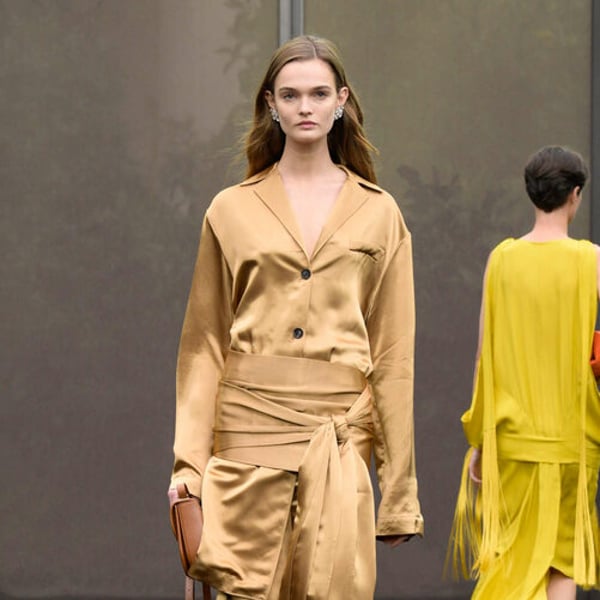
Class, sensuality, movement. With Maximilian Davis steering the aesthetic since 2022, Ferragamo continues its repositioning, cultivating a distinctive idea of luxury and elegance. Sophisticated silhouettes and exquisite materials remain, once again, the cornerstones of its wardrobe.
This season, the British designer played as never before with colour and texture, developing two strands: one feminine, the other more masculine.
The tailoring chapter embraced dark tones and an austere, almost wintry spirit, with sweeping coats, trench coats and a series of suits. Loose, pooling trousers came with swathing tuxedo jackets, cinched at the waist by a long, fringed satin scarf. At times, these suits assumed the ease of pyjamas and dressing gowns. Leather appeared, for instance, in a tank top paired with a straight suede skirt, while a short-sleeved little black dress came cut in vinyl.
The other side of the collection leaned into refined sensuality with diaphanous, often sheer fabrics, such as organza tops split vertically at the front, or lace slips inlaid with satin. Silk dresses stopped above the knee, sometimes extending into long, floor-skimming ribbons or fine fringing. This fringed detail also traced the flanks and cuffs, evoking the fluid, swinging looks of the 1920s.

Back on the Milan catwalks after a three-year absence, Stella Jean delivered a collection rich in colour and craftsmanship. Known for her cross-cultural fashion, the Italian-Haitian designer took guests this time to Bhutan, where she had various pieces produced by local craftswomen using ancestral techniques.
These included traditional Tego jackets and the kira dress (a rectangular piece of fabric wrapped around the body), made on handlooms. Another example: sleeveless coats woven from nettle fibres, onto which the designer had the various stages of production— from harvesting to weaving—embroidered in brightly coloured wool yarns.
With its vibrant palette and clever mix of prints and painted motifs, the collection skilfully fuses classic pieces with unique creations touched by the ethnic, such as intricately woven aprons, tapestries worn as bustiers or rugs wrapped around the waist as skirts. In tall fishermen’s waders worn musketeer-style, the models appear in multicoloured embroidered dresses, topped with straw hats—each one different—and adorned with bold shell necklaces.

Stella Jean’s high-end women’s ready-to-wear line has always spotlighted endangered artisanal skills, which she strives to preserve around the world.
“I said I’d be back on the catwalks when I had something to say. I’m back with two concrete proposals to safeguard the production chain. I’m appealing for VAT to be lowered for all craft-fashion products, and for our artisans to be able to benefit from self-certification,” the designer said backstage.
At the end of her show, Stella Jean came out brandishing the white T-shirt with the slogan “Grazie, Mr Armani”, which she wore in 2013, when the couturier showed his support by allowing her to stage her first show in Milan. “I wanted to pay him one last tribute. He did a lot for fashion. It’s thanks to him that Made in Italy has become a real passport around the world,” she said.

At MSGM, Massimo Giorgetti transformed his boutique in the centre of Milan, at the height of Saturday shopping, into a vast, glass-walled backstage and photo studio, where passers-by can observe through the broad shop windows—like an enormous aquarium—the different phases of putting a fashion show together, from fittings and make-up through to the shoot.
“I wanted to open the boutique to everyone’s view to celebrate the house and the teams. It’s a symbol, too. The place where we work and where we sell fashion,” explained the designer, who founded the label some fifteen years ago.
The streetwise, carefree girls of his early days have evolved into young women. They still display a fresh, joyful style, but with a slightly more refined touch. Their wardrobes took in elegant couture-flared dresses in cotton poplin and polka-dot chiffon numbers, little marled coats and floral-printed duchesse satin ones. Not forgetting the essential cardigan, reimagined in pop pink or orange and studded with metal.
Giorgetti proposes a fashion firmly anchored in the present, as evidenced by the models who leave the boutique and cut through the adjoining street before a delighted audience, bag tucked under the arm—just like in real life. They slip into pretty little dresses, tartan mini-skirts and hybrid T-shirts splicing motifs. They play with Breton stripes, mixing them with metallic silver pieces. A striped cropped jumper tossed over a white maxi shirt and wide-leg trousers is enough to give them instant flair.
This article is an automatic translation.
Click here to read the original article.
Copyright © 2025 FashionNetwork.com All rights reserved.