Connect with us

Business

If New Mexico can figure out universal child care, so can New York City

Published

on


The problem isn’t theoretical, it’s real and urgent for the approximately 445,000 New York City families with children under five years old. Many of those families – 80% in fact, can’t afford child care in the city. 

And it’s easy to see why. A 2024 study found that a family of four needs an annual income of $318,406 to live comfortably in New York City, but according to the U.S. Census Bureau the median household income in the city was just $79,713 in 2023. When you are coming up short by over $200,000 the idea of staying in the city becomes quickly untenable, especially when the cost of childcare accounts for so much of a family’s monthly budget. 

For childcare to be considered affordable according to national guidelines it needs to account for no more than 7% of a family’s budget. But with the average cost of daycare for infants and toddlers in the city clocking in between $18,000 and $26,000 a year, child care for one kid alone would eat up over 20% of the average family’s income. 

This impossible math is part of the reason why the majority of the people leaving the city are middle and lower income families. All of these families leaving translates to 186,000 fewer children in the city compared to just five years ago. A city without children, without families, is a city without a future.   

Without affordable, or ideally free, childcare, parents are left to make sacrifices that put the economy in peril: missing shifts, leaving children alone or in unsafe situations, cutting back hours, or dropping out of the workforce altogether.

We’ve already started to see that happen, and the pinch is coming first for women’s careers: Data from the Bureau of Labor Statistics shows that 212,000 women have left the workforce since January. This after women’s employment reached a record high of 75% in 2023. In a society that still sees women bearing the lion’s share of childcare and still earning 83 cents on every man’s dollar, when something has to give, it’s usually mom’s job. When we lose women in the workforce, the entire economy loses out. Women’s paid labor contributes an estimated $7.6 trillion to the U.S. Gross Domestic Product (GDP) annually, according to the Center for American Progress. 

So if all signs point to the need for universal childcare, what will it take to make it a reality?

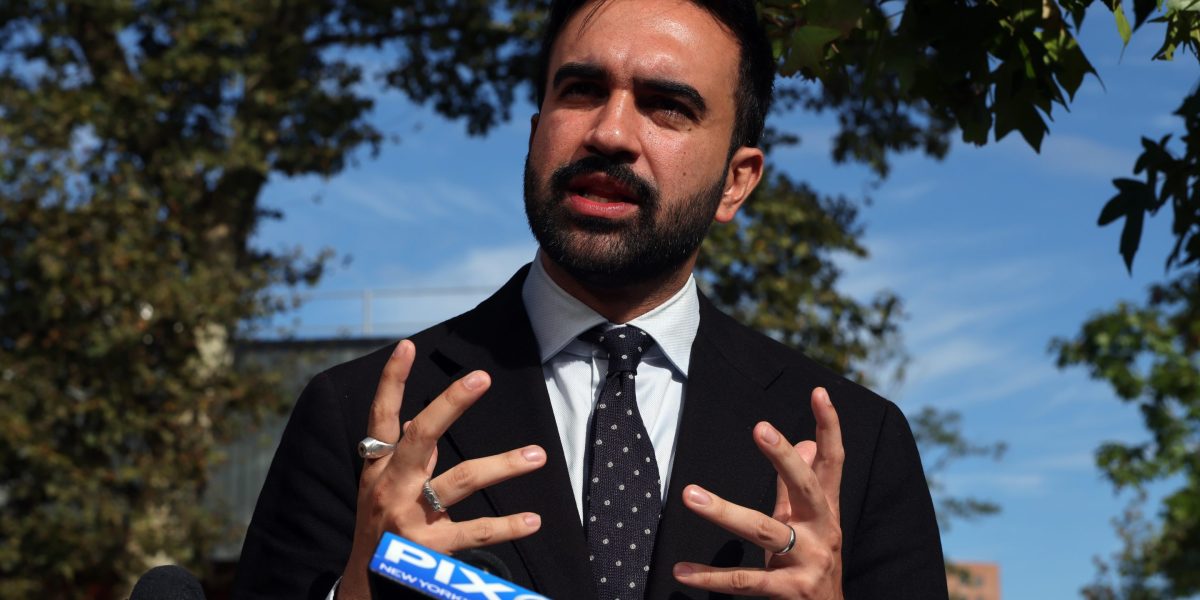
Mayoral candidate Zohran Mamdani promises to make childcare free for kids 6 weeks to 5 years old by subsidizing family care, paying teachers a living wage, easing regulatory burden to open more child care centers. 

Start up costs and regulations can be a huge barrier for childcare providers, says Gladys Jones, founder of ECE on the Move, a New York City family childcare advocacy group. Startup costs typically range from $10,000–$50,000, depending on necessary renovations, furnishings, licensing fees, insurance, and supplies. She says that family childcare providers have to navigate requirements from multiple agencies often with inconsistent guidance. 

Jones says she has heard from childcare providers who, even after navigating this complicated maze, still have their inspections delayed or have to make more costly changes to meet conflicting and confusing licensing and zoning mandates,  which leaves them to deplete their savings, and delay openings leaving families without care options.

In other words, New York’s bureaucracy is making it more difficult to offer childcare in the city. 

Child and family policy expert Elliot Haspel says the remedy is to “separate out three types of regulations: those that we know help ensure basic health and safety, those that we know help ensure a floor of quality, and those that have meager evidence that they do either of those things.”  

Once providers open centers, they are often making well below a living wage. According to Jones, family childcare providers in the city earn  between $14–$28/hour. “To support a liveable income in NYC, providers need compensation of $25–$30/hour,” she says. This would require consistent public investment, she adds.

When families can’t find childcare, they often lean on neighbors or family members to fill the gap. Haspel says there are two main ways to fund this type of support: make it much easier for family, friend or neighbor caregivers to register to be part of a child care subsidy system and make sure they are reimbursed at a good rate, or directly send money to families in order to compensate those types of caregivers. 

He says some states like Oklahoma and Colorado offer good models for registering and compensating these informal caregiving set ups. And there’s other precedents, too. “We do this better in other care situations,” Haspel says. “There are some good lessons to learn here from programs that pay relatives to care for people with long-term complex disabilities.” 

There’s precedent in other places in the U.S., too. New Mexico just announced it is making child care free for all residents regardless of income starting in November. “By investing in universal child care, we are giving families financial relief, supporting our economy, and ensuring that every child has the opportunity to grow and thrive,” Governor Michelle Lujan Grisham said in her announcement. 

Universal child care shouldn’t be a polarizing political issue. It’s just common sense. Most New Yorkers would agrvee it’s important that women stay in the workforce, and that families stay in the city. Businesses certainly want to see profits and the economy grow. The good news is there are plenty of viable solutions and a clear road map to get there.

The opinions expressed in Fortune.com commentary pieces are solely the views of their authors and do not necessarily reflect the opinions and beliefs of Fortune.

Fortune Global Forum returns Oct. 26–27, 2025 in Riyadh. CEOs and global leaders will gather for a dynamic, invitation-only event shaping the future of business. Apply for an invitation.


Source link

Continue Reading

Business

What happens to old AI chips? They’re still put to good use and don’t depreciate that fast

Published

on


New AI chips seem to hit the market at a quicker pace as tech companies scramble to gain supremacy in the global arms race for computational power.

But that begs the question: What happens to all those older-generation chips?

The AI stock boom has lost a lot of momentum in recent weeks due, in part, to worries that so-called hyperscalers aren’t correctly accounting for the depreciation in the hoard of chips they’ve purchased to power chatbots.

Michael Burry—the investor of Big Short fame who famously predicted the 2008 housing collapse—sounded the alarm last month when he warned AI-era profits are built on “one of the most common frauds in the modern era,” namely stretching the depreciation schedule. He estimated Big Tech will understate depreciation by $176 billion between 2026 and 2028.

But according to a note last week from Alpine Macro, chip depreciation fears are overstated for three reasons.

First, analysts pointed out software advances that accompany next-generation chips can also level up older-generation processors. For example, software can improve the performance of Nvidia’s five-year-old A100 chip by two to three times compared to its initial version.

Second, Alpine said the need for older chips remains strong amid rising demand for inference, meaning when a chatbot responds to queries. In fact, inference demand will significantly outpace demand for AI training in the coming years.

“For inference, the latest hardware helps but is often not essential, so chip quantity can substitute for cutting-edge quality,” analysts wrote, adding Google is still running seven- to eight-year-old TPUs at full utilization.

Third, China continues to demonstrate “insatiable” demand for AI chips as its supply “lags the U.S. by several generations in quality and severalfold in quantity.” And even though Beijing has banned some U.S. chips, the black market will continue to serve China’s shortfalls.

Meanwhile, not all chips used in AI belong to hyperscalers. Even graphics processors contained in everyday gaming consoles could work.

A note last week from Yardeni Research pointed to “distributed AI,” which draws on unused chips in homes, crypto-mining servers, offices, universities, and data centers to act as global virtual networks.

While distributed AI can be slower than a cluster of chips housed in the same data center, its network architecture can be more resilient if a computer or a group of them fails, Yardeni added.

“Though we are unable to ascertain how many GPUs were being linked in this manner, Distributed AI is certainly an interesting area worth watching, particularly given that billions are being spent to build new, large data centers,” the note said.


Source link

Continue Reading

Business

‘I had to take 60 meetings’: Jeff Bezos says ‘the hardest thing I’ve ever done’ was raising the first million dollars of seed capital for Amazon

Published

on


Today, Amazon’s market cap is hovering around $2.38 trillion, and founder Jeff Bezos is one of the world’s richest men, worth $236.1 billion. But three decades ago, in 1995, getting the first million dollars in seed capital for Amazon was more grueling than any challenge that would follow. One year ago, at New York’s Dealbook Summit, Bezos told Andrew Ross Sorkin those early fundraising efforts were an absolute slog, with dozens of meetings with angel investors—the vast majority of which were “hard-earned no’s.”

“I had to take 60 meetings,” Bezos said, in reference to the effort required to convince angel investors to sink tens of thousands of dollars into his company. “It was the hardest thing I’ve ever done, basically.”

The structure was straightforward: Bezos said he offered 20% of Amazon for a $5 million valuation. He eventually got around 20 investors to each invest around $50,000. But out of those 60 meetings he took around that time, 40 investors said no—and those 40 “no’s” were particularly soul-crushing because before getting an answer, each back-and-forth required “multiple meetings” and substantial effort.

Bezos said he had a hard time convincing investors selling books over the internet was a good idea. “The first question was what’s the internet? Everybody wanted to know what the internet was,” Bezos recalled. Few investors had heard of the World Wide Web, let alone grasped its commercial potential.

That said, Bezos admitted brutal honesty with his potential investors may have played a role in getting so many rejections.

“I would always tell people I thought there was a 70% chance they would lose their investment,” he said. “In retrospect, I think that might have been a little naive. But I think it was true. In fact, if anything, I think I was giving myself better odds than the real odds.”

Bezos said getting those investors on board in the mid-90s was absolutely critical. “The whole enterprise could have been extinguished then,” he said.

You can watch Bezos’ full interview with Andrew Ross Sorkin below. He starts talking about this interview gauntlet for seed capital around the 33-minute mark.

This story was originally featured on Fortune.com


Source link

Continue Reading

Business

Google cofounder Sergey Brin said he was ‘spiraling’ before returning to work on Gemini

Published

on


Google cofounder Sergey Brin thought retiring from Google in 2019 would mean quietly studying physics for days on end in cafés. 

But when COVID hit soon after, he realized he may have made a mistake.

“That didn’t work because there were no more cafés,” he told students at Stanford University’s School of Engineering centennial celebration last week, Business Insider reported.

The transition from president of Google parent company Alphabet to a 40-something retiree ended up not being as smooth as he imagined, and soon after he said he was “spiraling” and “kind of not being sharp” as he stepped away from busy corporate life.

Therefore, when Google began allowing small numbers of employees back into the office, Brin tagged along and put his efforts into what would become Google’s AI model, Gemini. Despite being the world’s fourth-richest man with a net worth of $247 billion, retirement wasn’t for him, he said.

“To be able to have that technical creative outlet, I think that’s very rewarding,” Brin said. “If I’d stayed retired, I think that would’ve been a big mistake.”

By 2023, Brin was back to work in a big way, visiting the company’s office three to four times a week, the Wall Street Journalreported, working with researchers and holding weekly discussions with Google employees about new AI research. He also reportedly had a hand in some personnel decisions, like hiring. 

Skip forward to 2025 and Brin’s plans for a peaceful retirement of quiet study are out the window. In February, he made waves for an internal memo in which, despite Google’s three-day in-office policy, he recommended Google employees go into the company’s Mountain View, Calif. offices at least every weekday, and that 60 hours a week was the “sweet spot” of productivity.

Brin’s newfound efforts at work may have been necessary as OpenAI’s release of ChatGPT in 2022 caught the tech giant off guard, after it had led the field of AI research with DeepMind and Google Brain for years.

To be sure, Google for its part has been rising in the AI race. Analysts raved last month about Gemini 3, the company’s latest update to its LLM, and Google’s stock is up about 8% since its release. Meanwhile, OpenAI earlier this month declared a “code red,” its highest alert level, to improve ChatGPT. 

Brin added in the talk at Stanford that Google has an advantage in the AI arms race precisely because of the foundation it laid over years through its neural network research, its custom AI chips, and its data center infrastructure.

“Very few have that scale,” he said.


Source link

Continue Reading

Trending

Copyright © Miami Select.