Connect with us

Business

‘I would beg the president’: Jamie Dimon, one of Wall Street’s top H-1B visa users, predicts ‘pushback’ because big employers need top expertise

Published

on


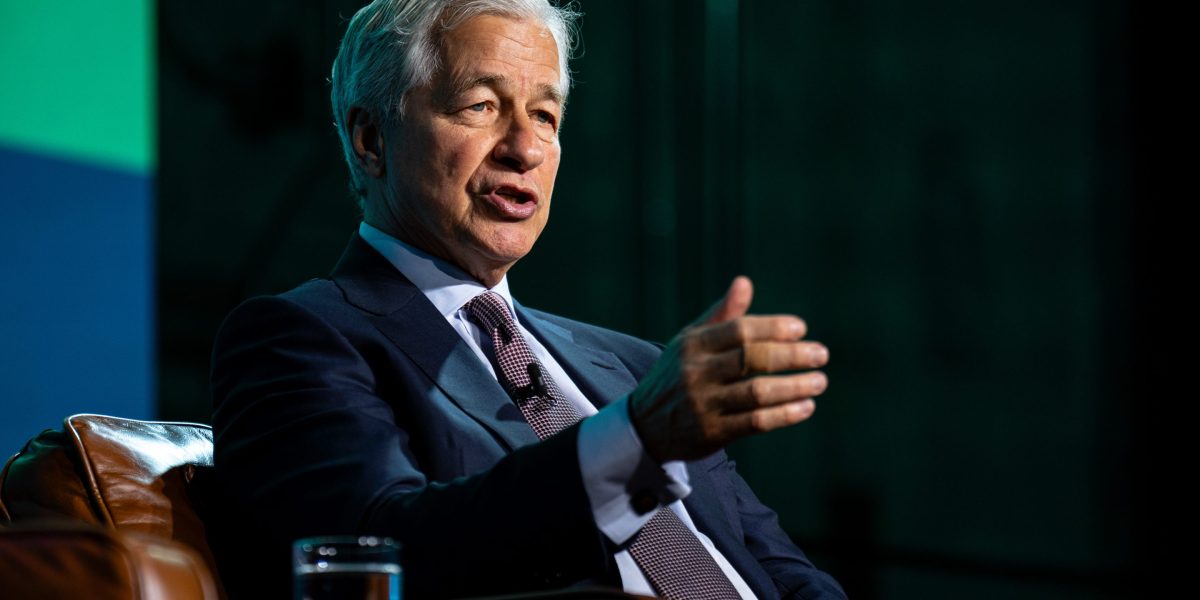
JPMorgan Chase CEO Jamie Dimon isn’t completely sold on President Donald Trump’s move to impose hurdles on skilled foreign workers entering the U.S.

Trump announced in an executive order a $100,000 fee for H-1B visas, which let U.S. employers temporarily hire non-U.S. workers, typically for specialized tech-sector jobs. The fresh six-figure, one-time fee will apply to new visas, not those with existing or renewed visas.

Dimon said while he’s in favor of “merit-based immigration,” the move will elicit resistance from U.S. companies who rely on expertise from non-U.S. employees. 

“I would beg the president. He has accomplished border control—that’s great. I mean, I think all nations want real border control; that helps make a nation. But after that, we should have good immigration,” he told CNBC at JPMorgan’s 10th Annual India Investor Conference on Tuesday. “I think there will be some pushback on the H-1Bs.”

JPMorgan is among the top companies in the U.S. to sponsor the H-1B visa, with 1,990 total certified H-1B filings in fiscal 2024, Business Insider reported, citing publicly available U.S. data. The bank will speak with stakeholders and policymakers about the shift, Times of India reported.

The JPMorgan boss joins a chorus of CEOs pushing back against the executive order, warning the proclamation would prevent U.S. companies from accessing top global talent, particularly to fill in-demand STEM positions. Others, including Nvidia’s Jensen Huang and OpenAI’s Sam Altman, have supported the measure as a way to ensure that only the highest talent is able to enter the country for work.

Dimon has said that for JPMorgan, H-1B visas allow the company to be nimble in moving employees to positions around the world.

“For us, visas matter because we move people around globally—experts who get promoted to new jobs in different markets,” he told Times of India.

“The challenge is that the U.S. still needs to remain an attractive destination,” he added. “My grandparents were Greek immigrants who never finished high school. America is an immigrant nation, and that’s part of its core strength.” 

JPMorgan’s broader warning

JPMorgan economists have further warned of the broader labor market impact of a $100,000 H-1B visa fee. In a report published Tuesday, bank analysts projected up to 5,500 fewer work authorizations per month as a result of the fee, unless all affected workers were able to get authorization through other means. Analysts calculated the figure by identifying 141,000 approved petitions for new employment in fiscal 2024, 65,000 of which required consular processing likely to be impacted by the $100,000 fee.

Constraints like H-1B visas have historically had unintended consequences on efforts to curb outsourced labor. A 2023 study by Britta Glennon, an assistant professor of management the University of Pennsylvania’s Wharton School, found barriers such as H-1B visas have actually encouraged the offshoring of high-skilled jobs for U.S. multinational companies, which are able to hire more foreign labor at their non-U.S. affiliates. About 80% of the research and development business in the U.S. comes from U.S. multinational firms.

“Artificial constraints on resources result in firms circumventing restrictive policies in ways that may not be anticipated by policy makers,” the study said.

A new visa fee could also “make it less attractive for foreign students to come to the United States to study,” the JPMorgan report said, as it may reduce the chance of graduates from outside the U.S. to find a stateside job after graduation. 

These negative consequences may not come to fruition, according to the JPMorgan analysts. For example, more foreign students may choose to attend higher education in the U.S. because the H-1B visa applies only to applicants “currently outside the U.S.,” and the number of visa petitions processed within the U.S. correlates with the number of individuals switching visa types, the majority of which are students.

The imposed fee would also likely not immediately impact the U.S. labor market, according to JPMorgan, as U.S. Citizenship and Immigration Services (USCIS) said in July it had reached its H-1B cap for fiscal 2026. USCIS will open its applications for fiscal 2027 next April.

Fortune Global Forum returns Oct. 26–27, 2025 in Riyadh. CEOs and global leaders will gather for a dynamic, invitation-only event shaping the future of business. Apply for an invitation.


Source link

Continue Reading

Business

JPMorgan CEO Jamie Dimon says Europe has a ‘real problem’

Published

on


JPMorgan Chase & Co. Chief Executive Officer Jamie Dimon called out slow bureaucracy in Europe in a warning that a “weak” continent poses a major economic risk to the US.

“Europe has a real problem,” Dimon said Saturday at the Reagan National Defense Forum. “They do some wonderful things on their safety nets. But they’ve driven business out, they’ve driven investment out, they’ve driven innovation out. It’s kind of coming back.”

While he praised some European leaders who he said were aware of the issues, he cautioned politics is “really hard.” 

Dimon, leader of the biggest US bank, has long said that the risk of a fragmented Europe is among the major challenges facing the world. In his letter to shareholders released earlier this year, he said that Europe has “some serious issues to fix.”

On Saturday, he praised the creation of the euro and Europe’s push for peace. But he warned that a reduction in military efforts and challenges trying to reach agreement within the European Union are threatening the continent.

“If they fragment, then you can say that America first will not be around anymore,” Dimon said. “It will hurt us more than anybody else because they are a major ally in every single way, including common values, which are really important.”

He said the US should help.

“We need a long-term strategy to help them become strong,” Dimon said. “A weak Europe is bad for us.”

The administration of President Donald Trump issued a new national security strategy that directed US interests toward the Western Hemisphere and protection of the homeland while dismissing Europe as a continent headed toward “civilizational erasure.”

Read More: Trump’s National Security Strategy Veers Inward in Telling Shift

JPMorgan has been ramping up its push to spur more investments in the national defense sector. In October, the bank announced that it would funnel $1.5 trillion into industries that bolster US economic security and resiliency over the next 10 years — as much as $500 billion more than what it would’ve provided anyway. 

Dimon said in the statement that it’s “painfully clear that the United States has allowed itself to become too reliant on unreliable sources of critical minerals, products and manufacturing.”

Investment banker Jay Horine oversees the effort, which Dimon called “100% commercial.” It will focus on four areas: supply chain and advanced manufacturing; defense and aerospace; energy independence and resilience; and frontier and strategic technologies. 

The bank will also invest as much as $10 billion of its own capital to help certain companies expand, innovate or accelerate strategic manufacturing.

Separately on Saturday, Dimon praised Trump for finding ways to roll back bureaucracy in the government.

“There is no question that this administration is trying to bring an axe to some of the bureaucracy that held back America,” Dimon said. “That is a good thing and we can do it and still keep the world safe, for safe food and safe banks and all the stuff like that.”


Source link

Continue Reading

Business

Hegseth likens strikes on alleged drug boats to post-9/11 war on terror

Published

on


Defense Secretary Pete Hegseth defended strikes on alleged drug cartel boats during remarks Saturday at the Ronald Reagan Presidential Library, saying President Donald Trump has the power to take military action “as he sees fit” to defend the nation.

Hegseth dismissed criticism of the strikes, which have killed more than 80 people and now face intense scrutiny over concerns that they violated international law. Saying the strikes are justified to protect Americans, Hegseth likened the fight to the war on terror following the Sept. 11, 2001 attacks.

“If you’re working for a designated terrorist organization and you bring drugs to this country in a boat, we will find you and we will sink you. Let there be no doubt about it,” Hegseth said during his keynote address at the Reagan National Defense Forum. “President Trump can and will take decisive military action as he sees fit to defend our nation’s interests. Let no country on earth doubt that for a moment.”

The most recent strike brings the death toll of the campaign to at least 87 people. Lawmakers have sought more answers about the attacks and their legal justification, and whether U.S. forces were ordered to launch a follow-up strike following a September attack even after the Pentagon knew of survivors.

Though Hegseth compared the alleged drug smugglers to Al-Qaida terrorists, experts have noted significant differences between the two foes and the efforts to combat them.

Hegseth’s remarks came after the Trump administration released its new national security strategy, one that paints European allies as weak and aims to reassert America’s dominance in the Western Hemisphere.

During the speech, Hegseth also discussed the need to check China’s rise through strength instead of conflict. He repeated Trump’s vow to resume nuclear testing on an equal basis as China and Russia — a goal that has alarmed many nuclear arms experts. China and Russia haven’t conducted explosive tests in decades, though the Kremlin said it would follow the U.S. if Trump restarted tests.

The speech was delivered at the Reagan National Defense Forum at the Ronald Reagan Presidential Foundation and Institute in California, an event which brings together top national security experts from around the country. Hegseth used the visit to argue that Trump is Reagan’s “true and rightful heir” when it comes to muscular foreign policy.

By contrast, Hegseth criticized Republican leaders in the years since Reagan for supporting wars in the Middle East and democracy-building efforts that didn’t work. He also blasted those who have argued that climate change poses serious challenges to military readiness.

“The war department will not be distracted by democracy building, interventionism, undefined wars, regime change, climate change, woke moralizing and feckless nation building,” he said.


Source link

Continue Reading

Business

US debt crisis: Most likely fix is severe austerity triggered by a fiscal calamity

Published

on


One way or another, U.S. debt will stop expanding unsustainably, but the most likely outcome is also among the most painful, according to Jeffrey Frankel, a Harvard professor and former member of President Bill Clinton’s Council of Economic Advisers.

Publicly held debt is already at 99% of GDP and is on track to hit 107% by 2029, breaking the record set after the end of World War II. Debt service alone is more than $11 billion a week, or 15% of federal spending in the current fiscal year.

In a Project Syndicate op-ed last week, Frankel went down the list of possible debt solutions: faster economic growth, lower interest rates, default, inflation, financial repression, and fiscal austerity. 

While faster growth is the most appealing option, it’s not coming to the rescue due to the shrinking labor force, he said. AI will boost productivity, but not as much as would be needed to rein in U.S. debt.

Frankel also said the previous era of low rates was a historic anomaly that’s not coming back, and default isn’t plausible given already-growing doubts about Treasury bonds as a safe asset, especially after President Donald Trump’s “Liberation Day” tariff shocker.

Relying on inflation to shrink the real value of U.S. debt would be just as bad as a default, and financial repression would require the federal government to essentially force banks to buy bonds with artificially low yields, he explained.

“There is one possibility left: severe fiscal austerity,” Frankel added.

How severe? A sustainable U.S. debt trajectory would entail elimination of nearly all defense spending or almost all non-defense discretionary outlays, he estimated.

For the foreseeable future, Democrats are unlikely to slash top programs, while Republicans are likely to use any fiscal breathing room to push for more tax cuts, Frankel said.

“Eventually, in the unforeseeable future, austerity may be the most likely of the six possible outcomes,” he warned. “Unfortunately, it will probably come only after a severe fiscal crisis. The longer it takes for that reckoning to arrive, the more radical the adjustment will need to be.”

The austerity forecast echoes an earlier note from Oxford Economics, which said the expected insolvency of the Social Security and Medicare trust funds by 2034 will serve as a catalyst for fiscal reform.

In Oxford’s view, lawmakers will seek to prevent a fiscal crisis in the form of a precipitous drop in demand for Treasury bonds, sending rates soaring.

But that’s only after lawmakers try to take the more politically expedient path by allowing Social Security and Medicare to tap general revenue that funds other parts of the federal government.

“However, unfavorable fiscal news of this sort could trigger a negative reaction in the US bond market, which would view this as a capitulation on one of the last major political openings for reforms,” Bernard Yaros, lead U.S. economist at Oxford Economics, wrote. “A sharp upward repricing of the term premium for longer-dated bonds could force Congress back into a reform mindset.”


Source link

Continue Reading

Trending

Copyright © Miami Select.