Connect with us

Business

I pioneered machine teaching at Microsoft. Building AI agents is like building a basketball team, not drafting a player 

Published

on


Salesforce’s latest agent testing/builder tool and Jeff Bezos’s new AI venture focused on practical industrial applications of AI show that enterprises are inching towards autonomous systems. It’s meaningful progress because robust guardrails, testing and evaluation are the foundation of agentic AI. But the next step that’s largely missing right now is practice, giving teams of agents repeated, structured experience. As the pioneer of Machine Teaching, a methodology for training autonomous systems that has been deployed across several Fortune 500 companies, I’ve experienced the impact of agent practice while building and deploying over 200 autonomous multi-agent systems at Microsoft and now at AMESA for enterprises around the globe. 

Every CEO investing in AI faces the same problem: spending billions on pilots that may or may not deliver real autonomy. Agents seem to excel in demos but stall when real-world complexity hits. As a result, business leaders do not trust AI to act independently on billion-dollar machinery or workflows. Leaders are searching for the next phase of AI’s capability: true enterprise expertise. We shouldn’t ask how much knowledge an agent can retain, but rather if it has had the opportunity to develop expertise by practicing as humans do. 

The Testing Illusion 

Just as human teams develop expertise through repetition, feedback and clear roles, AI agents must develop skills inside realistic practice environments with structured orchestration. Practice is what turns intelligence into reliable, autonomous performance.

Many enterprise leaders still assume that a few major LLM companies will develop powerful enough models and massive data sets to manage complex enterprise operations end-to-end via “Artificial General Intelligence.” 

But that isn’t how enterprises work. 

No critical process, whether it be supply chain planning or energy optimization, is run by one person with one skill set. Think of a basketball team. Each player needs to work on their skills, whether it be dribbling or jump shot, but each player also has a role on the team. A center’s purpose is different from a point guard’s. Teams succeed with defined roles, expertise and responsibilities. AI needs that same structure. 

Even if you did create the perfect model or reach AGI, I’d predict the agents would still fail in production because they never encountered variability, drift, anomalies, or the subtle signals that humans navigate every day. They haven’t differentiated their skill sets or learned when to act or pause. They also haven’t been exposed to expert feedback loops that shape real judgment.

How Machine Teaching Creates Practice

Machine Teaching provides the structure that modern agentic systems need. It guides agents to:

  • Perceive the environment correctly.
  • Master basic skills that mirror human operators.
  • Learn higher-level strategies that reflect expert judgment.
  • Coordinate under a supervisor agent that selects the right strategy at the right time.

Take one Fortune 500 company I worked with that was improving a nitrogen manufacturing process. Our agents practiced inside the AMESA Agent Cloud, improving through experimentation and feedback. In less than one day, the agent teams outperformed a custom-built industrial control system that other automation tools and single-agent AI applications could not match.

This resulted in an estimated $1.2 million in annual efficiency gains, and more importantly, gave leadership the confidence to deploy autonomy at scale because the system behaved like their best operators. 

Why CEOs and Leaders Need Practiced AI

Practice is what drives true autonomy in agents. I invite every leader to begin reframing a few assumptions:

  1. Stop thinking in terms of models and think in terms of teams. Every day interactions with systems like ChatGPT or Claude are powerful, but they reinforce a misconception that large language models are the path to enterprise autonomy.  Autonomy emerges from specialized agents that take on perception, control, planning and supervisory roles through a wide variety of technologies. 
  2. Identify where expertise is disappearing and preserve it within agents. Many essential operations rely on experts who are nearing retirement. CEOs should ask which processes would be most vulnerable if these experts left tomorrow. Those areas are the ideal starting point for a Machine Teaching approach. Let your top operators teach a team of agents in a safe practice environment so that their expertise becomes scalable and permanent.
  3. Recognize that you already have the infrastructure for autonomy. Years of investment in sensors, MES and SCADA systems, ERP integrations and IoT telemetry already form your organization’s backbone of digital twins and high-fidelity simulations. Success requires orchestration, structure, and leveraging the data foundation you already built.

The Payoff of Practice

When enterprises give agents room to practice before deployment, several things happen:  

  • Human teams begin to trust the AI and understand its boundaries. 
  • Leaders can calculate true ROI rather than speculative projections. 
  • Agents become safer, more consistent and aligned with expert judgment. 
  • Human teams are elevated rather than replaced because AI now understands their workflows and supports them.

Agents won’t truly perform without experience, and experience only comes from practice. The companies that invest in and embrace this framing will be the ones to break out of pilot purgatory and see real impact.

The opinions expressed in Fortune.com commentary pieces are solely the views of their authors and do not necessarily reflect the opinions and beliefs of Fortune.


Source link

Continue Reading

Business

Winter storm cancels more than 1,000 flights in the Northeast and Great Lakes regions as state of emergency declared in N.Y., N.J.

Published

on


More than a thousand flights were canceled or delayed across the Northeast and Great Lakes regions due to snow as thousands took to U.S. roads and airports during the busy travel period between Christmas and New Year’s.

As of Saturday morning, New York City had received just under three inches of snow — roughly half of what some forecasts had predicted. At least 1,500 flights were canceled from Friday night into Saturday, according to flight-tracking service FlightAware.

Newark Liberty International Airport, John F. Kennedy International Airport and LaGuardia Airport posted snow warnings on the social media platform X on Friday, cautioning that weather conditions could cause flight disruptions.

The National Weather Service warned of hazardous travel conditions from the Great Lakes through the northern mid-Atlantic and southern New England, with the potential for tree damage and power outages. Forecasters said the storm was expected to weaken by Saturday morning.

Ahead of the storm, New York Gov. Kathy Hochul declared a state of emergency for more than half of the state. Acting New Jersey Gov. Tahesha Way declared a state of emergency for all of New Jersey, “due to a severe winter storm causing dangerous weather conditions, including heavy snow, sleet, and freezing rain.”

“This storm will cause dangerous road conditions and impact holiday travel,” Way said in a statement. “We are urging travelers to avoid travel during the storm and allow crews to tend to the roads. Drivers should plan their travel accordingly, monitor conditions and road closures, and follow all safety protocols.”

This story was originally featured on Fortune.com


Source link

Continue Reading

Business

California drops lawsuit to reinstate federal bullet train funding as high-speed rail authority seeks private investors

Published

on


California this week dropped a lawsuit officials filed against the Trump administration over the federal government’s withdrawing of $4 billion for the state’s long-delayed high-speed rail project.

The U.S. Transportation Department slashed funds for the bullet train aimed at connecting San Francisco to Los Angeles in July. The Trump administration has said the California High-Speed Rail Authority had “ no viable plan ” to complete a large segment of the project in the farm-rich Central Valley.

The authority quickly filed a lawsuit, with Democratic Gov. Gavin Newsom calling the federal government’s decision “a political stunt to punish California.”

The authority said this week that it would focus on other funding sources to complete the project, which is estimated to cost more than $100 billion.

“This action reflects the State’s assessment that the federal government is not a reliable, constructive, or trustworthy partner in advancing high-speed rail in California,” an authority spokesperson said in a statement.

The Transportation Department did not respond to a request for comment. President Donald Trump and Transportation Secretary Sean Duffy have both previously criticized the project as a “train to nowhere.”

“The Railroad we were promised still does not exist, and never will,” Trump said on his social media platform Truth Social in July. “This project was Severely Overpriced, Overregulated, and NEVER DELIVERED.”

The authority’s decision to drop the lawsuit comes as the group seeks private investors to support the bullet train. The project recently secured $1 billion in annual funding from the state’s cap-and-trade program through 2045.

The program sets a declining limit on total planet-warming emissions in the state from major polluters. Companies must reduce their emissions, buy allowances from the state or other businesses, or fund projects aimed at offsetting their emissions. Money the state receives from the sales funds climate-change mitigation, affordable housing and transportation projects, as well as utility bill credits for Californians.

The rail authority said its shift in focus away from federal funding offers “a new opportunity.”

“Moving forward without the Trump administration’s involvement allows the Authority to pursue proven global best practices used successfully by modern high-speed rail systems around the world,” a spokesperson said in a statement.

This story was originally featured on Fortune.com


Source link

Continue Reading

Business

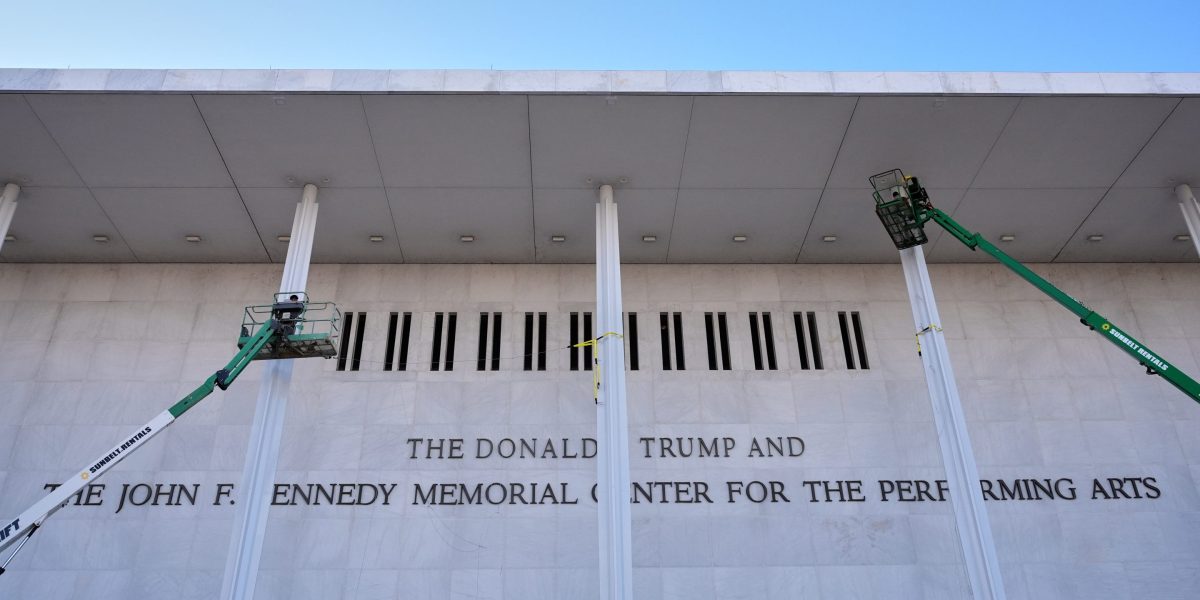
Kennedy Center seeks $1 million in damages from musician who canceled show after Trump name added

Published

on


The president of the Kennedy Center on Friday fiercely criticized a musician’s sudden decision to cancel a Christmas Eve performance at the venue days after the White House announced that President Donald Trump’s name would be added to the facility.

“Your decision to withdraw at the last moment — explicitly in response to the Center’s recent renaming, which honors President Trump’s extraordinary efforts to save this national treasure — is classic intolerance and very costly to a non-profit Arts institution,” the venue’s president, Richard Grenell, wrote in a letter to musician Chuck Redd that was shared with The Associated Press.

In the letter, Grenell said he would seek $1 million in damages “for this political stunt.”

Redd did not immediately respond to a request for comment.

A drummer and vibraphone player, Redd has presided over holiday “Jazz Jams” at the Kennedy Center since 2006, succeeding bassist William “Keter” Betts. In an email Wednesday to The Associated Press, Redd said he pulled out of the concert in the wake of the renaming.

“When I saw the name change on the Kennedy Center website and then hours later on the building, I chose to cancel our concert,” Redd said. He added Wednesday that the event has been a “very popular holiday tradition” and that he often featured at least one student musician.

“One of the many reasons that it was very sad to have had to cancel,” he told the AP.

President John F. Kennedy was assassinated in 1963, and Congress passed a law the following year naming the center as a living memorial to him.

Grenell is a Trump ally whom the president chose to head the Kennedy Center after he forced out the previous leadership. According to the White House, Trump’s handpicked board approved the renaming, which scholars have said violates the law. Kennedy niece Kerry Kennedy has vowed to remove Trump’s name from the building once he leaves office, and former House historian Ray Smock is among those who say any changes would have to be approved by Congress.

The law explicitly prohibits the board of trustees from making the center into a memorial to anyone else, and from putting another person’s name on the building’s exterior.


Source link

Continue Reading

Trending

Copyright © Miami Select.