Connect with us

Business

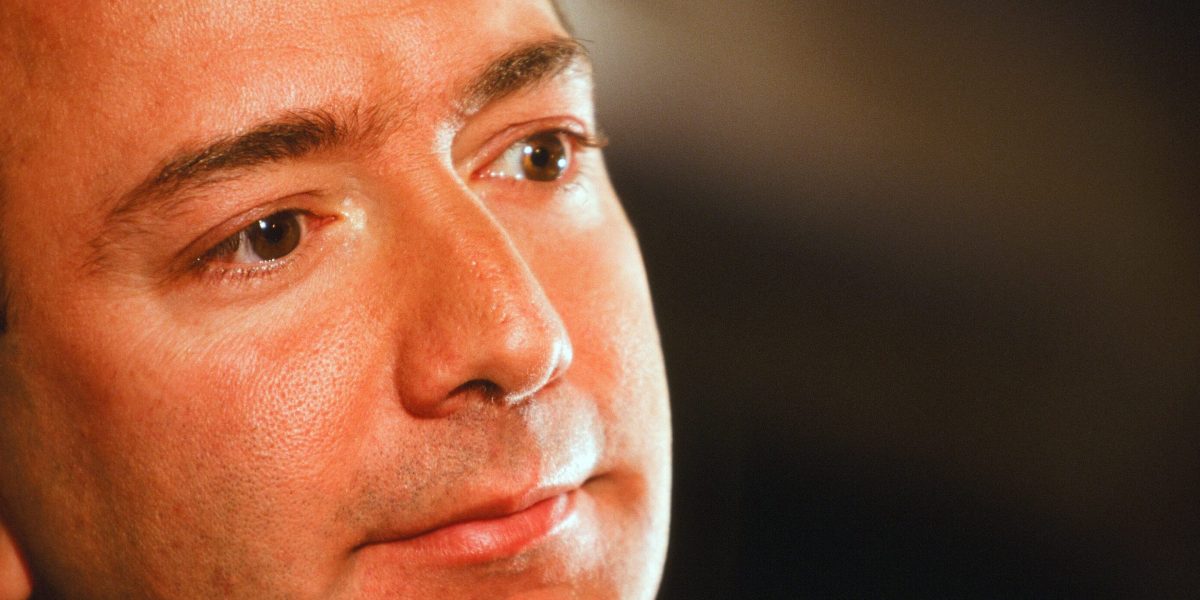
‘I had to take 60 meetings’: Jeff Bezos says ‘the hardest thing I’ve ever done’ was raising the first million dollars of seed capital for Amazon

Published

on


Today, Amazon’s market cap is hovering around $2.38 trillion, and founder Jeff Bezos is one of the world’s richest men, worth $236.1 billion. But three decades ago, in 1995, getting the first million dollars in seed capital for Amazon was more grueling than any challenge that would follow. One year ago, at New York’s Dealbook Summit, Bezos told Andrew Ross Sorkin those early fundraising efforts were an absolute slog, with dozens of meetings with angel investors—the vast majority of which were “hard-earned no’s.”

“I had to take 60 meetings,” Bezos said, in reference to the effort required to convince angel investors to sink tens of thousands of dollars into his company. “It was the hardest thing I’ve ever done, basically.”

The structure was straightforward: Bezos said he offered 20% of Amazon for a $5 million valuation. He eventually got around 20 investors to each invest around $50,000. But out of those 60 meetings he took around that time, 40 investors said no—and those 40 “no’s” were particularly soul-crushing because before getting an answer, each back-and-forth required “multiple meetings” and substantial effort.

Bezos said he had a hard time convincing investors selling books over the internet was a good idea. “The first question was what’s the internet? Everybody wanted to know what the internet was,” Bezos recalled. Few investors had heard of the World Wide Web, let alone grasped its commercial potential.

That said, Bezos admitted brutal honesty with his potential investors may have played a role in getting so many rejections.

“I would always tell people I thought there was a 70% chance they would lose their investment,” he said. “In retrospect, I think that might have been a little naive. But I think it was true. In fact, if anything, I think I was giving myself better odds than the real odds.”

Bezos said getting those investors on board in the mid-90s was absolutely critical. “The whole enterprise could have been extinguished then,” he said.

You can watch Bezos’ full interview with Andrew Ross Sorkin below. He starts talking about this interview gauntlet for seed capital around the 33-minute mark.

This story was originally featured on Fortune.com


Source link

Continue Reading

Business

Trump vows to fight ‘fraud’ in SNAP benefits for 42 million Americans

Published

on


President Donald Trump ’s administration is talking tough about SNAP, saying the government’s biggest food aid program is riddled with fraud that must be stopped.

His appointees are looking at Supplemental Nutrition Assistance Program from an enforcement perspective, seeing fraud as a major and expensive problem, perpetrated by organized criminal organizations, individual recipients and retailers willing to break the laws for profit.

“We know there are instances of fraud committed by our friends and neighbors, but also transnational crime rings,” Jennifer Tiller, a senior advisor to U.S. Agriculture Secretary Brooke Rollins, said in an interview.

Some experts agree that SNAP fraud is a major problem. But there is little publicly available data showing the extent of it, and others who study the program are skeptical about the scale.

“It you’re spending $100 billion on anything, you’re going to have some leakage,” said Christopher Bosso, a professor of public policy and politics at Northeastern University who published a book on SNAP.

The administration leans into fraud allegations

Of the $100 billion spent on SNAP a year, about $94 billion goes to benefits and the rest to administrative costs.

About 42 million people — or 1 in 8 Americans — receive SNAP benefits averaging about $190 per person per month. The number of recipients is in the same ballpark as the number of people in poverty — 36 million by the traditional measure and 43 million under a more nuanced one also used by the federal government.

Under federal law, most households must report their income and basic information every four to six months and be fully recertified for SNAP at least every 12 months.

The Trump administration has demanded that states turn over data on individual SNAP recipients including Social Security numbers, dates of birth and immigration status as part of its effort to root out fraud.

States with Republican governors, plus North Carolina, have complied. Most led by Democrats are pushing back in court, arguing that providing the data would violate recipients’ privacy.

The USDA says that from the records that have been shared, it found 186,000 deceased people — about 1% of participants in those states — receiving benefits and about 500,000 people — about 2.7% — receiving benefits in more than one jurisdiction.

The USDA has not made public detailed reports on the data and has not broken down the estimates by type of alleged fraud. The department also hasn’t answered questions about what portion of any improperly awarded benefits was actually spent and how much sat unclaimed on EBT cards after recipients moved or died.

The department estimated in a letter to the states that have refused to turn over data that the nationwide total combining fraud and undetected errors could be $9 billion a year or more. Democratic-led states responded in a letter last week that states already have systems to catch wrongdoing and that USDA isn’t explaining how it’s crunching the numbers.

Program participants can be perpetrators or victims of fraud

There are a lot of forms of wrongdoing.

SNAP benefits are put on EBT cards that recipients swipe in stores like debit cards. Organized crime groups put skimmers on EBT readers to get information used to make copies of the benefit cards and steal the allotments of recipients — or to use stolen identity information to apply for benefits for fictitious people. A Romanian man who was in the U.S. illegally pleaded guilty last year to skimming cards in California. Authorities say he took more than 36,000 numbers over three years.

A USDA employee pleaded guilty this year to accepting bribes in exchange for providing registration numbers for EBT card readers placed illegally in several New York delis. Authorities said more than $30 million passed through those terminals.

And three people were charged this year in Franklin County, Ohio, accused of using stolen benefits to order big quantities of energy drinks and candy — apparently to resell it.

Mark Haskins, who worked on USDA investigations from 2013 until leaving the department in August as branch chief of a special investigations unit, said there have been cases of retailers running similar operations. Several states are barring using SNAP for some junk food products with policies that kick in as soon as Jan. 1.

Haskins also says some legitimate recipients buy non-grocery items with SNAP benefits by persuading a store employee to ring up the wrong item — generally one that costs more than what’s being bought — or to sell benefit cards. He said he thinks those forms of fraud are more costly than the ones run by organized criminal groups.

Haskins and Haywood Talcove, CEO of LexisNexis Risk Solutions Government, which helps create fraud prevention strategies, both believe fraud costs significantly more than the USDA’s $9 billion estimate.

“The system is corrupt. It doesn’t need a fix here and there, it needs a complete overhaul,” said Haskins, who would like to see fewer retailers in the network and participants having to reapply, even if that makes it harder for qualified people to access benefits.

Advocates and researchers see a different system

The USDA last published a report on SNAP fraud in 2021. It covered what happened in from 2015 through 2017 and found that about 1.6% of benefits were stolen from recipients’ accounts.

The government replaced benefits that were stolen between Oct. 1, 2022 and Dec. 20, 2024. The value of replaced benefits over that time was $323 million — or about 24 cents for every $100 in SNAP benefits, though that’s believed to be an undercount.

It’s reports like those that lead advocates and academics who research SNAP to see fraud, while troublesome, as less than the massive problem the USDA makes it out to be.

Dartmouth College economist Patricia Anderson, who studies food insecurity, said in an email that the maximum benefits for a family of four are about $1,000 a month. “It really takes organized crime that is either stealing from the EBT cards or creating a lot of fake recipients out of whole cloth before the gain for the fraudster really starts to be worth it,” she said.

Jamal Brown, a 41-year-old food stamp participant who lives in Camden, New Jersey, said he’s witnessed people selling benefits to bodegas to get cash. And he’s had his benefits stolen by a skimmer.

He also said he had to deal with benefits being cut off after being told he missed an interview to recertify his need when a county welfare worker didn’t call him as planned.

“It’s always something that goes wrong,” Brown said, “unfortunately.”


Source link

Continue Reading

Business

Small businesses say Trump tariffs are hurting consumers—here’s what is getting more expensive

Published

on


NEW YORK (AP) — The Ah Louis Store in San Luis Obispo, California, turns into a winter wonderland every holiday season.

Green garlands, giant nutcrackers, baubles and bows go up in early November on the historic downtown building that houses the gift shop. Inside, customers can choose from over 500 different types of ornaments and a variety of holiday gift baskets.

“We really just make it a magical spot,” co-owner Emily Butler said. “Whether you come in or not, we want to make sure that we’re spreading that holiday joy.”

But Butler says she and her twin sister-business partner had to work harder this year to turn browsers into buyers and to make a profit. Many of the decorations and stocking stuffers they sell are made overseas and either did not arrive or got more expensive when President Donald Trump imposed unusually high taxes on imported goods, she said.

In response, the sisters focused their selection on more profitable items like nutcrackers and gift baskets. They’ve also noticed customers cutting back, selecting a $100 gift basket over the $150 version, or buying one ornament instead of several, Butler said..

“We’re definitely seeing more cautious spending this year,” she said.

Along with the unpredictable tariffs, stubborn inflation and weak hiring have shaken consumer confidence in the U.S. economy. The vast majority of U.S. adults say they’ve noticed higher than usual prices for groceries, electricity and holiday gifts in recent months, according to a December poll from The Associated Press-NORC Center for Public Affairs Research.

A Gallup index that summarizes Americans’ assessments of current economic conditions fell to a 17-month low in November. Consumers also indicated less enthusiasm for spending money on holiday gifts; their estimated gift budgets decreased $229 between October and November, the largest drop Gallup has recorded at that point of the holiday shopping season. The survey was conducted in November, partially during the government shutdown, which might have tempered spending plans.

However, the worst-case impact on consumer prices that many economists foresaw from the Trump administration’s tariff policies hasn’t materialized. Some products have been affected more than others. Here’s a look at what has happened with supplies and prices in popular gifting categories.

Games and toys

Game and toys were particularly susceptible to tariff-related price increases since the majority of the ones sold in the U.S. are made in China, according to industry trade group The Toy Association. The tariff rate the Trump administration imposed on Chinese goods became a rollercoaster that started at an additional 10%, peaked at 145% and ended up at 47%.

The uncertainty made it hard for toy shops to decide what to order for the holidays. Dean Smith, who co-owns independent toy stores JaZams in Princeton, New Jersey, and Lahaska, Pennsylvania, said the manufacturers in China that he buys toys from did not pass on their tariff costs all at once but he has seen their prices inch higher with every reorder.

Smith estimated that wholesale prices for 80% of his inventory went up anywhere from 5% to 20%. Some shoppers who don’t buy toys regularly might be surprised by price increases he adopted in turn, Smith said. A doll that sold for $20 to $25 last year now costs $30 to $35 at JaZams, he said.

“For folks with marginal incomes, this is going to be a very difficult holiday,” Smith said.

Electronics

Consumer electronics are mostly made in China and other Asian countries. In 2023, China accounted for 78% of U.S. smartphone imports, and 79% of laptop and tablet imports, according to the Consumer Technology Association trade group.

Best Buy said in May that it was raising prices due to tariffs. But CEO Corie Barry said late last month that the consumer electronics chain made sure to stock computers, phones and other products at different price levels, a decision she credited with helping Best Buy attract more lower-income shoppers.

“The consumer is not a monolith,” Barry told reporters.

Game consoles are always a popular holiday item, and console makers made news earlier this year when they announced price increases. Sony raised the price of the PlayStation 5 by $50 to $550 in August, following Microsoft and Nintendo raising prices for their game consoles.

Jewelry

Jewelry shoppers will likely see higher prices, but that has more to do with the soaring price of gold than tariffs so far, according to David Bonaparte, president & CEO of trade group Jewelers of America.

The varying tax rates Trump set for countries that import American goods with a total value less than their exports to the U.S. affected jewelry in various ways. Watches from Switzerland, for example, were subject to a 39% tariff from July 31 until the country struck a deal with the Trump administration last month to lower the import tax rate on its products to 15%.

India, which refines many of the diamonds sold in the U.S., rushed in shipments of the gemstones before a 50% tariff on the country’s products took effect on Aug. 27. Higher prices for jewelry made with diamonds shipped from India will likely start to be felt in 2026, Bonaparte said.

“It’s really a matter of what happens after Jan. 1,” he said. “If these tariffs are still in place, then prices will probably increase.”

Holiday decor

Holiday decorations are yet another category that mostly comes from overseas, particularly China.

Jeremy Rice co-owns House, a home-décor shop in Lexington, Kentucky, that specializes in artificial flowers, wreaths and table decorations. He said the tariffs slowed down production of much of his fall stock and seasonal merchandise like ribbon. Some larger and more expensive items he didn’t order at all because they would have been too expensive to retail.

Rice raised prices on the products he did get. The popular red berry stems that House long has carried increased from $8.95 last year to $10.95 due to higher import costs, he said.

“We sell thousands of these berry stems, and every time we sold one, I flinched from knowing what it should have been, knowing that our supplier paid more for them, which made us pay more for them, which made our customer pay more for them,” Rice said.

Shopping strategically

For those looking to avoid tariff-related price increases, John Harmon, managing director of technology research at technology consulting company Coresight Resarch, recommends checking out secondhand stores and discount retailers like T.J. Maxx, Marshall’s and HomeGoods. The off-price chains buy much of their inventory from leftover stock that would have entered the U.S. before new tariffs kicked in.

Joe Adamski, senior director at procurement services company ProcureAbility, said books, food and beverages are some of the domestically produced goods that make good gifts.


Source link

Continue Reading

Business

Down Arrow Button Icon

Published

on


A sweeping Reuters investigation has put a price tag on Meta’s tolerance for ad fraud: billions of dollars a year. For Rob Leathern, a former Meta executive who led the company’s business integrity operations until 2019, the findings expose a stark tension between revenue growth and consumer harm.

The report, published Monday, found that Meta generated roughly $18 billion in advertising revenue from China in 2024, around 10% of its global revenue, even as internal documents showed that nearly one-fifth of that (about $3 billion) came from ads tied to scams, illegal gambling, pornography, and other prohibited activity. Meta internally labeled China its top “scam exporting nation,” accounting for 25% of all scam and banned-product ads globally, according to the report.

Meta’s core social media platforms (Facebook, Instagram, WhatsApp) are blocked in China, but the company still earns billions from Chinese advertisers targeting global users.

The investigation, Leathern told Fortune, illuminates several issues with both Meta and the broader Chinese ad market. “It appears that a variety of business partners that Meta has are not conducting themselves in an ethical way and or there are employees of those companies that are not doing what they’re supposed to be doing,” he said. “It’s quite telling that Meta took down its entire partner directory, which obviously means that they must be reviewing their partners, and there’s a lot of them.”

“Scams are spiking across the internet, driven by persistent criminals and sophisticated, organized crime syndicates constantly evolving their schemes to evade detection. We are focused on rooting them out by using advanced technical measures and new tools, disrupting criminal scam networks, working with industry partners and law enforcement, and raising awareness on our platforms about scam activity. And when we determine that bad actors have violated our rules prohibiting fraud and scams, we take action,” a Meta spokesperson told Fortune in a statement.  

Meta communications chief Andy Stone, however, pushed back on the investigation, posting on Threads, “Once again, Reuters is misconstruing and misrepresenting the facts.” He argued that CEO Mark Zuckerberg’s “integrity strategy pivot”—which included instructing the China ads-enforcement team to reportedly “pause” its work—was to improve teams’ goals and “instruct them to redouble efforts to fight frauds and scams globally, not just from specific markets.” 

Stone also claimed that these teams have “doubled their fraud and scam reduction goal and over the last 15 months, user reports of scam ads have declined by well over 50%.”

The revelations published by Reuters echo—but far exceed—the AI-driven deepfake scheme earlier this year involving Goldman Sachs during which scammers used AI-generated videos of investment strategist Abby Joseph Cohen to lure retail investors into fraudulent WhatsApp groups via Instagram ads.

Reuters’ reporting suggests Meta’s China-linked scam problem is not an edge case or a blind spot, but an allegedly known and lucrative segment of its advertising business.

According to internal estimates cited by Reuters, Meta served as many as 15 billion “high-risk” fraudulent ads per day, generating roughly $7 billion annually. The company required a 95% confidence threshold before banning fraudulent advertisers; those falling below it were often allowed to continue operating, sometimes at higher fees. Meta also established a 0.15% revenue “guardrail” (about $135 million) as the maximum revenue it was willing to forgo to crack down on suspicious ads, even as it earned $3.5 billion every six months from ads deemed to carry “higher legal risk.”

Internal decision-making was explicit. When enforcement staff proposed shutting down fraudulent accounts, internal documents reviewed by Reuters showed they sought assurance that growth teams would not object “given the revenue impact.” Asked whether Meta would penalize high-spending Chinese partners running scams, the answer was reportedly “No,” citing “high revenue impact.” Internal assessments reportedly noted that revenue from risky ads would “almost certainly exceed the cost of any regulatory settlement,” effectively treating fines as a cost of doing business.

In late 2024, Meta reinstated 4,000 second-tier Chinese ad agencies that had previously been suspended, unlocking $240 million in annualized revenue—roughly half of it tied to ads violating Meta’s own safety policies, according to the investigation. More than 75% of harmful ad spending, Reuters found, came from accounts benefiting from Meta’s partner protections. The company also disbanded its China-focused anti-scam team.

An external audit commissioned by Meta from the Propellerfish Group reached a blunt conclusion when investigating fraud and scams on the platform: Meta’s “own behavior and policies” were promoting systemic corruption in China’s advertising ecosystem. Reuters reported that the company largely ignored the findings and expanded operations anyway.

Leathern, who reviewed the reporting and internal figures referenced in the report, told Fortune the scale of the problem was difficult to defend. “I was disappointed that the violation rates for the China-specific advertisers were as high as they were in the last year,” he said. “It’s disappointing, because there are ways to make it lower.”

His critique goes to the heart of the failure. Platforms, he said, should hold intermediary agencies accountable for the quality of advertisers they bring in. “If you’re measuring violation rates coming from certain partners, and those rates are above a threshold every quarter or every year, you can just fire your worst-performing customers,” he said.

“I think it’s important for us to have some sense of transparency into how policies are being enforced and what companies are doing in terms of reducing scams on their platforms,” Leathern added.

Over the last 18 months, Meta has removed or rejected more than 46 million advertisements placed via so-called resellers, or large Chinese ad firms. And more than 99% of ad accounts associated with resellers found to be violating the company’s fraud policies were proactively detected and disabled. 

Aside from a need for transparency, Leathern warned that prioritizing short-term revenue over trust ultimately threatens the business itself. “If people don’t trust advertisers, advertising, it reduces the effectiveness of that channel for all advertisers,” he said. “There’s a lot of risk to their business, directly and indirectly, from not doing a good enough job on stopping scams.”

The human cost is already visible. Reuters documented victims across North America and Asia, including U.S. and Canadian investors who lost life savings to fake stock and crypto ads, Taiwanese consumers misled into buying counterfeit health products, and a Canadian Air Force recruiter whose Facebook account was hijacked to run crypto scams. Meta’s own internal safety staff estimated the company’s platforms were “involved” in roughly one-third of all successful U.S. scams, linked to more than $50 billion in consumer losses.

The problem is intensifying as generative AI lowers the barrier for scammers. “You can create something that looks plausible far more easily than ever before,” Leathern said. “The speed and adaptability of criminals and their use of AI tools just makes the environment far more tricky.”

Yet Leathern said platforms like Meta have not been sufficiently transparent about how aggressively they are using those same tools to fight abuse. “We just don’t have a ton of insight into what they’re doing to reduce scams and fraud coming in through ads,” he said.

For Leathern, the investigation should be a turning point. “I hope they see this as an opportunity to improve things for people,” he said.


Source link

Continue Reading

Trending

Copyright © Miami Select.