With Hypecult emblazoned across his black T-shirt, French rapper Aupinard is delivering a set blending R&B rhythms with bossa nova sounds. It is Thursday evening in a former industrial workshop in Paris’s 11th arrondissement, now converted into an events venue. The perfect setting to bring together Parisian urban-culture influencers and personalities, as well as representatives from numerous brands, with a single objective: to celebrate the launch of a new streetwear e-commerce site, Hypecult.
Rapper Aupinard at the launch of Hypecult on September 25. – Paul Fogiel
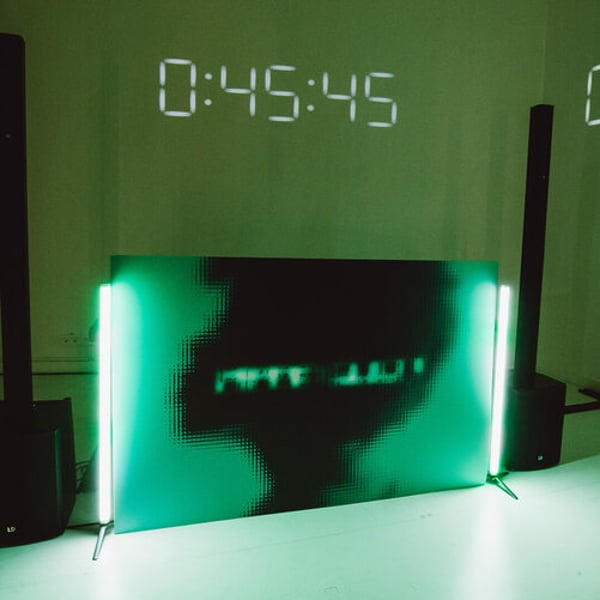
The concept behind this new player was unveiled with a live site launch at 7:30 pm and a scenography devised by the creative agency Wave, showcasing an on-trend selection from Clarks, New Balance, Saucony, Puma, Adidas and Dr. Martens.
Behind this new player is e-tailer Spartoo, which announced at the beginning of the year that it was preparing this launch for September. “We’re very proud to be launching a site dedicated to streetwear culture. Hypecult is aimed at 18-35-year-olds, with a particular focus on young women,” explained Boris Saragaglia, CEO of Spartoo. “We have worked with agencies specialising in this space. We’ve had very positive feedback from most brands, and Adidas and New Balance have been particularly supportive of the project.”
Hypecult is entering a market where bricks-and-mortar giants such as JD Sports, Foot Locker and Courir occupy significant space, and where a constellation of independent multi-brand retailers jostle for position.
Hypecult’s universe expressed through scenography and product showcasing – Paul Fogiel
At launch, the site features around fifty brands, mainly established names in ready-to-wear and footwear, with a total of more than a thousand products. Alongside Adidas and New Balance, Asics, Saucony, Patagonia, Levi’s, Hoff, Lacoste, Dickies, Daily Paper, Barbour and New Era have backed the newcomer.
“Some of these partners have a very wide offering, but we worked with them on the selection,” explained Spartoo’s CEO. “In sneakers, for example, we have access to Tier 1 and Tier 2 assortments, with trend-led models that are far more fashion-forward than those we offer on Spartoo. And, gradually, we’ll be adding a range of streetwear brands that are more niche but popular in this space.”
Edwin, Champion and Minimum will be arriving shortly, and Hypecult will also offer collections by Bisous Skateboard, Gramicci and Homecore.
As for the site’s UX—whether the typography used, colour codes, brand visuals and films, or its architecture—Hypecult aligns with the sector’s conventions. Particular attention has been paid to editorial content. Even though the Spartoo name does not appear on the site, the new entrant will have to prove its legitimacy in the sector. Boris Saragaglia pointed out that “there are many generalist fashion pure players, but there is a less competitive space available, particularly for women’s products and streetwear.”
However, while the setbacks of sites specialising in limited-edition sneakers have freed up space in e-commerce, many specialist multi-brand retailers across France have their own sites with tightly curated selections. Alongside heavyweight Parisian players Starcow and Shinzo, and SNS, which also has a shop in Paris, Hypecult will have to differentiate itself from the online activity of Marseille-based Hype, The Hype in Amiens and Hype-Shoes, which has boutiques in Nice and Cannes.
A prospect that doesn’t faze Spartoo’s co-founder.
“I see even greater potential than for Spartoo,” he said, stressing that Hypecult needs to take the time to establish itself within the community.
For the Grenoble-based company, which will present its quarterly results on Monday, this development also carries strategic weight. Against a backdrop of slowing activity among online players, Spartoo notes that its long-standing customer base, mainly women and families, is affected by consumer budget constraints. Diversifying its customer profiles with targeted propositions while offering the same level of service (free delivery and returns, payment in instalments, and customer service) should enable it to find new growth drivers and mitigate risk.
This article is an automatic translation. Click here to read the original article.
Not a label, not a lobby, not even a legal entity. That is how Arielle Lévy, president of the Une Autre Mode Est Possible (UAMEP) collective, characterises this nascent union. Animer, an acronym for “Acteurs Nationaux Indépendants Mode Engagée Régénérative,” aims to shine a light on all the initiatives undertaken by fashion stakeholders, from producers to brands, who are advancing responsible, regenerative fashion in France.
The union was founded by eight collectives involved in regenerative fashion – UAMEP
The union was officially launched on Monday January 19, following the petition initiated by Arielle Lévy against Shein in response to the watering down of the anti–fast fashion law. Titled “Paris deserves better than Shein,” the petition drew nearly 140,000 signatures. “I wanted us to unite because I realised how strong the civic voice was,” explains Arielle Lévy. “These collectives are doing superb work and, at a certain point, there is a desire to close ranks, to make society together,” she says.
“Breaking the isolation of initiatives across the regions”
In addition to UAMEP, a number of other collectives are behind Animer, including Fashion Revolution France, L’Âme du Fil (Angers), Collectif Baga (Marseille), Café Flax (Clermont-Ferrand), Le Comptoir de la mode responsable (Poitiers), Le Conservatoire de la Mode Vintage (Isère), and La Grande Collecte/Textile Lab (La Rochelle). “It’s a union of independent collectives, committed to their local areas and sharing the same societal project,” Arielle Lévy emphasises.
The union hopes to represent all French territories – Collectif Baga
The union plans to focus its efforts on the ground, working across supply chains, regions, practices and even our shared imagination. With “hundreds” of stakeholders already on board via the various founding collectives, Animer is built on ten key ideas: dignity, value-sharing, traceability as a common language, less and better, circular design, smart re-localisation, carbon sobriety, inclusion and plurality, cooperation rather than “sterile competition”, and proof through action.
Animer’s founders plan to bring together all the initiatives active in regenerative fashion across the country. The union hopes to become a preferred interlocutor in defending a societal project focused on respect for the earth, and for men and women. With the help of Fashion Revolution, it aims to act in the national interest by engaging the general public and the country’s institutions.
This article is an automatic translation. Click here to read the original article.
French cosmetics giant L’Oreal said on Wednesday it will set up a beauty tech hub in the south Indian city of Hyderabad with an initial investment of over 35 billion rupees ($383.4 million).
L’Oréal
The hub aims to be a global base for AI-driven beauty innovation, create 2,000 tech jobs through 2030, and speed up the rollout of advanced AI beauty solutions, the company said in a statement.
Nicolas Hieronimus, L’Oreal’s CEO, and the state government of Telangana formalized the partnership at the World Economic Forum, Davos.
Telangana has rapidly emerged as a key investment and technology hub in southern India.
Bilateral trade between India and France stood at $15 billion in 2024, and Indian Prime Minister Narendra Modi and French President Emmanuel Macron have been forging warmer ties.
The two sides have also been working to recast their tax treaty since 2024 to modernize it by adapting global standards on tax transparency, Reuters reported in December.
Swarovski on Tuesday announced the appointment of Sindhu Culas to the role of president, general manager, North America at the Austrian jewelry maker.
Sindhu Culas – Courtesy
Based in the luxury firm’s New York City office, Culas will be responsible for “maximizing the Swarovski physical and digital presence and overall brand affinity in the U.S.,” according to a press release.
“We are thrilled to welcome Sindhu to Swarovski. Her vast leadership experience and passion for the brand make her an exceptional addition to our team,” said Kolja Kiofsky, chief commercial officer, Swarovski.
“With Sindhu guiding our next chapter in North America, we are looking ahead to an exciting future filled with creativity, operational excellence, and meaningful growth under our LuxIgnite strategy.”
A retail veteran with over 25 years of experience across omni‑channel retail and institutional investment management, Culas joins the crystal jewelry maker from G-Star, where she served as CEO of North America at the British denim and apparel brand.
She began her career as a buyer and planner at Macy’s, Talbots, and Lord & Taylor before being promoted to strategy and brand management at Macy’s. Later on, the executive served as senior vendor manager at Amazon and as senior vice president of e‑commerce and strategy for Calvin Klein.
“Watching Swarovski’s brand repositioning and momentum in recent years has been inspiring,” said Culas, in response to her new appointment.
“I’m excited to join this exceptional team, collaborate across the business, and help strengthen our position while accelerating growth throughout North America. It’s a remarkable moment for the brand, and I’m thrilled to contribute to the journey ahead.”