Connect with us

Business

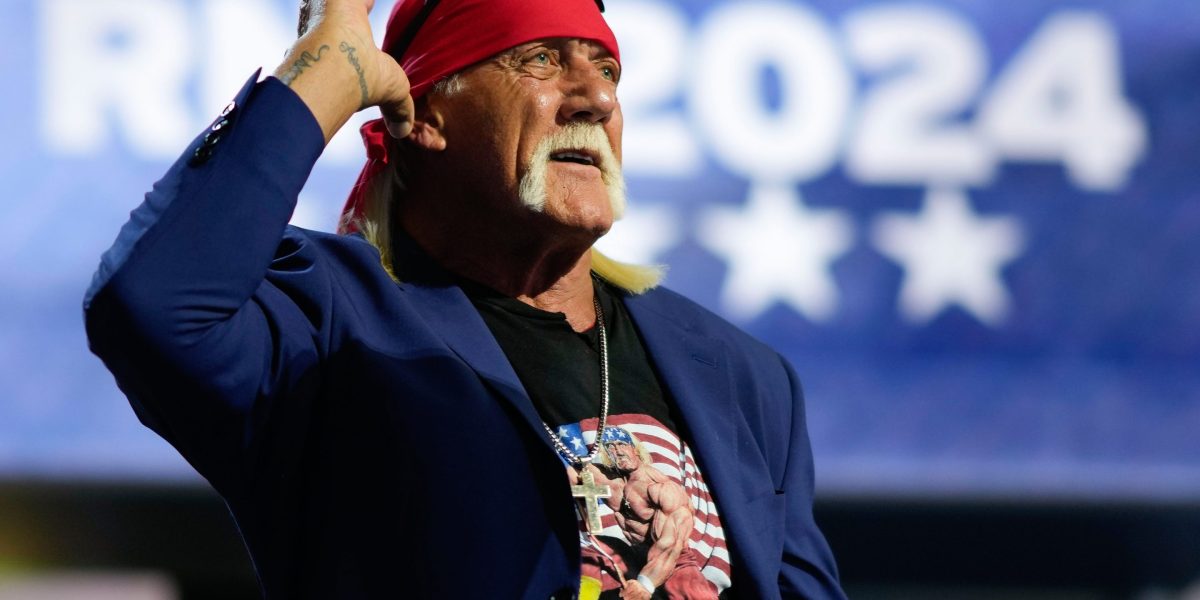
Hulk Hogan’s death is still under investigation by local police

Published

on


Police in Florida are still investigating the death last month of professional wrestling icon Hulk Hogan from what the medical examiner concluded was a heart attack.

The Clearwater Police Department said in a statement Thursday that the “unique nature of this case has required us to interview multiple witnesses and seek medical records from a variety of providers, and our detectives continue to do that.”

Hogan, whose real name was Terry Bollea, died July 24 at age 71 at a hospital after paramedics and police rushed to his beachfront home in Clearwater following a 911 call. That call, and police body camera video of the scene, has not yet been released as the investigation continues.

“All of this takes time,” the police statement said. “Until the investigation is completed, no records related to the case, including body camera footage, can be released.”

Police have previously said there was no evidence of foul play in Hogan’s death, so it’s not clear exactly what the police probe is looking into other than medical records. Hogan previously had leukemia and atrial fibrillation, an irregular heart rhythm, according to the medical examiner’s report that concluded the cause of death was natural.

Investigators have been working with Hogan’s family, including his son Nick and daughter Brooke, the statement said.

“We plan to meet with the family and brief them on the case to this point, and we will share the results of the investigation with the family prior to closing the case and releasing it to the public and media,” the police statement added.

No timetable for public release of the findings was given.

Hogan was perhaps the biggest star in WWE’s long history, known for both his larger-than-life personality and his wrestling exploits. He was the main draw for the first WrestleMania in 1985 and was a fixture for years, facing everyone from Andre The Giant and Randy Savage to The Rock and even WWE co-founder Vince McMahon.

Hogan won at least six WWE championships and was inducted into the Hall of Fame in 2005 and reinstated there in 2018. He had been removed from the Hall of Fame in 2015 after he was recorded making racial slurs against Blacks, for which he apologized.

Hogan was to be cremated but it wasn’t clear Thursday if that had happened yet. A well-attended but private funeral service was held Aug. 5 at a church in Indian Rocks Beach, Florida.

Introducing the 2025 Fortune Global 500, the definitive ranking of the biggest companies in the world. Explore this year’s list.


Source link

Continue Reading

Business

40% of Stanford undergrads receive disability accommodations—but it’s become a college-wide phenomenon as Gen Z try to succeed in the current climate

Published

on


The pandemic has shaken up college life for good: Since then, social media and AI have revolutionized classroom expectations, and the bar for landing a job after graduation has become impossibly high. Many are now questioning whether getting a degree was even worth it.

The ripple effect of those strains is already showing in campus accessibility offices,  where diagnoses of ADHD, anxiety, and depression are rising—and so are requests for extended time on coursework.

At Harvard, 21% of undergraduates received disability accommodations last year, an increase of more than 15% over the past decade, according to data published by the National Center for Education Statistics analyzed by the Harvard Crimson. Top schools like Brown, Cornell, and Yale reported similar numbers, roughly in line with national trends. But the increase is more pronounced at other institutions: 34% of students at UMass Amherst and 38% at Stanford are registered as disabled, according to The Atlantic

In the 2011-12 school year, the number of undergraduates with a disability was about 11%, based on U.S. Department of Education data—highlighting just how much of a dramatic shift this phenomenon has become.

One founder says students are trying to get a leg up in today’s tough job market

Experts note that many students have medical conditions that merit accommodations, and the increase is in part linked to broader access to mental-health care and reduced stigma around seeking support.

The rise has nonetheless drawn national attention, with some critics arguing that students are abusing the system to secure lighter workloads or an edge in hypercompetitive classrooms.

Derek Thompson, author of the recent bestseller Abundance called the numbers “mind-boggling,” arguing that colleges may be overcorrecting after years of underrecognizing disability. 

“America used to stigmatize disability too severely,” he wrote on X. “Now elite institutions reward it too liberally. It simply does not make any sense to have a policy that declares half of the students at Stanford cognitively disabled and in need of accommodations.”

Joe Lonsdale, a billionaire venture capitalist and Palantir cofounder, expressed similar concerns, suggesting some families are seeking diagnosis just to give students “a leg up.”

After all, the post-graduation job hunt has tightened into a numbers game few can win.

In 2023 and 2024, more than 1.2 million applications were submitted for just under 17,000 open graduate roles in the U.K., according to the Institute of Student Employers. And in the U.S., lawmakers warn the funnel is narrowing further. Sen. Mark Warner has warned that joblessness among recent graduates could hit 25% in the next two to three years, as AI reshapes entry-level work.

But in reality, there is no evidence of widespread misuse, and not all students registered with a disability receive accommodation in every class. Still, the scale of requests has raised questions among some faculty members about how accommodations intersect with academic expectations.

Faculty grapple with balancing support of students and avoidance of stigma

For instructors, the rise in accommodations can be challenging to navigate. Many say they want to support students with legitimate needs but worry that requesting clarification could be seen as insensitive or ableist.

One adjunct professor, posting to Reddit, said the number of students with accommodations has “increased exponentially” across the three schools where they teach.

“I had an increasingly large number of students at this particular school be given the accommodation to turn work in 48 hours late, and I got tired of constantly having to extend due dates for just them,” the professor wrote, noting that they themselves have ADHD and autism.

“The students I’ve had on this accommodation would use it pretty much every week since they were perpetually behind.”

Harry Lewis, former dean of Harvard College, expressed a related concern to the Harvard Crimson.

“The whole system of accommodations for things other than physical disabilities just seems badly mismatched with the educational purposes that students and faculty share,” he said.

However, Katy Washington, CEO of the Association of Higher Education and Disability, argued that students seeking accommodations are not “unfair burdens” on professors, and rather than questioning whether too many students qualify—which can perpetuate stereotypes—the focus should be on designing assessments that are inclusive for all learners.

“For decades, students with invisible disabilities were denied support because their struggles were dismissed as laziness or lack of effort,” Washington wrote in a letter to her organization’s members, shared with Fortune. “The rise in accommodations reflects a cultural shift toward acknowledging mental health, not a decline in academic integrity.”

A shifting skill-based job market could leave some students unprepared

For students, the increase in accommodations coincides with employers rethinking what actually matters in hiring. Fewer companies are prioritizing degrees, and more are evaluating on what they can do—through portfolio, projects, and real-world problem-solving.

Less than half of U.S. professionals at the director-level and above say a university degree is essential for getting ahead, according to LinkedIn. Moreover, nearly 1 in 5 job postings on the platform do not require a degree.

That shift could complicate the picture for students who’ve grown accustomed to extended deadlines or extra time. Whether a small number of students are abusing the system, workplace assessments typically don’t come with accommodations—and performance is often judged on speed, accuracy, and consistency.  Some Gen Zers have already faced the pink slip just months into the start of their career due to employers being unimpressed with some of their soft skills, like organization.

In other words: even as college becomes more flexible, the job market is moving in the opposite direction.


Source link

Continue Reading

Business

Black Lives Matter leader in Oklahoma City indicted on claims she used funds for vacations, groceries and real estate

Published

on


A federal grand jury indicted the leader of the Black Lives Matter movement in Oklahoma City over allegations that millions of dollars in grant funds were improperly spent on international trips, groceries and personal real estate, prosecutors announced Thursday.

Tashella Sheri Amore Dickerson, 52, was indicted earlier this month on 20 counts of wire fraud and five counts of money laundering, court records show.

Court records do not indicate the name of Dickerson’s attorney, and messages left Thursday at her mobile number and by email were not immediately returned.

According to the indictment, Dickerson served since at least 2016 as the executive director of Black Lives Matter OKC, which accepted charitable donations through its affiliation with the Arizona-based Alliance for Global Justice.

In total, BLM OKC raised more than $5.6 million dating back to 2020, largely from online donors and national bail funds that were supposed to be used to post bail for individuals arrested in connection with racial justice protests after the killing of George Floyd by a Minnesota police officer in 2020, the indictment alleges.

When those bail funds were returned to BLM OKC, the indictment alleges, Dickerson embezzled at least $3.15 million into her personal accounts and then used the money to pay for trips to Jamaica and the Dominican Republic, retail shopping, at least $50,000 in food and grocery deliveries for herself and her children, a personal vehicle, and six properties in Oklahoma City deeded to her or to a company she controlled.

The indictment also alleges she submitted false annual reports to the alliance stating that the funds were used only for tax-exempt purposes.

If convicted, Dickerson faces up to 20 years in federal prison and a fine of up to $250,000 for each count of wire fraud and 10 years in prison and fines for each count of money laundering.

In a live video posted on her Facebook page Thursday afternoon, Dickerson said she was not in custody and was “fine.”

“I cannot make an official comment about what transpired today,” she said. “I am home. I am safe. I have confidence in our team.”

“A lot of times when people come at you with these types of things … it’s evidence that you are doing the work,” she continued. “That is what I’m standing on.”

The Black Lives Matter movement first emerged in 2013 after the acquittal of George Zimmerman, the neighborhood watch volunteer who killed 17-year-old Trayvon Martin in Florida. But it was the 2014 death of Michael Brown at the hands of police in Ferguson, Missouri, that made the slogan “Black lives matter” a rallying cry for progressives and a favorite target of derision for conservatives.

The Associated Press reported in October that the Justice Department was investigating whether leaders in the Black Lives Matter movement defrauded donors who contributed tens of millions of dollars during racial justice protests in 2020. There was no immediate indication that Dickerson’s indictment is connected to that probe.


Source link

Continue Reading

Business

Hinge CEO bribed students with KitKats to get the $550 million-a-year business off the ground

Published

on


After more than a decade shaping modern romance, Justin McLeod is leaving Hinge behind to launch his next venture: Another dating app, with an AI twist, called Overtone.

Today, Hinge has more than 30 million users, with a date being set up every two seconds. But in 2011, when it launched, McLeod was just a young Harvard Business School student when he came up with the idea for the app “designed to be deleted.” And the fresh-faced, 20-something entrepreneur was so desperate for people to sign up to his app that he even bribed them with chocolate.

At the time, online dating largely took place on desktops and required real effort. The idea of swiping to find the love of your life (or a one-night stand) on your mobile phone seemed alien.

So convincing fellow students (who had no shortage of opportunities to meet people in class, dorms, and parties) to sign up to Hinge was challenging, McLeod tells Fortune.

“I remember the days of running around the college library in Washington, D.C., at this college, Georgetown, and bribing kids with KitKats to come try my app,” he laughs. “We would get dozens of users a day—maybe, if that.” 

Financing Hinge also required a lot of scrappiness, with McLeod recalling he had to “beg and borrow a lot” to get the app off the ground.

“I was out there networking and talking to as many people as I could and taking money from anyone who would give it to me. That’s just what it takes sometimes,” he says. “I was collecting—me—literally like, $5,000 checks and $10,000 checks to come and start Hinge.”

Hinge CEO’s big break came from a McKinsey job offer

These days, it’s hard enough landing an internship while studying—let alone walking straight into a full-time job right after graduating. But for McLeod, that wasn’t the case: He hadn’t even finished his second year of business school when McKinsey offered him a spot on its coveted grad scheme. 

A career in consulting would have set McLeod on a path to a six-figure salary, with Glassdoor estimating that the average consultant earns between $173,000 to $233,000 a year. McLeod’s sign-up bonus alone was $12,000.

It turned out to be the big break he needed—to finally get Hinge off the ground.

“I was able to keep putting off my offer for like a couple of years,” he recalls while adding that he “borrowed” the money to build his app.

“Once Hinge started to become successful and they saw I was the founder of it, they were like, ‘You’re probably not coming to be an analyst here are you?’ And, of course, by that time I had to pay it back.”

Why did McLeod choose the highly risky path of entrepreneurship when he could have had a comfortable career at McKinsey?

“I turned down my offer and started to work on Hinge, really because I was just so passionate about the idea. Once I started thinking about it, it was hard for me to stop. I really knew this was what I was meant to work on.”

Of course, it paid off: By 2015, Hinge had raised $26.35 million and had an estimated valuation of $75.5 million, before Match Group bought the company off McLeod for an undisclosed amount. 

The founder treated himself and his family to a nearly $13 million apartment in New York soon after. Meanwhile, Hinge brought in $396 million in 2023, last year and an estimated $550 million last year.

Advice for entrepreneurial Gen Z grads

Like McLeod, young people today aren’t dreaming of holding down a 9-to-5 gig after college or climbing the corporate ladder. Research consistently shows they want to be their own boss.

And they’re already making those dreams a reality: In fact, the second fastest-growing job title among Gen Z grads right now is “founder,” according to LinkedIn.

His advice for young entrepreneurs? “You have to be hopelessly idealistic and ruthlessly practical at the same time—that’s how you create something big and successful.”

“Some people who are like too in the hopelessly idealistic camp, dream, but never make something a reality, and people who are too in the ruthlessly practical camp do things but nothing that big or game-changing,” McLeod explains.

Instead, he says successful founders like himself constantly balance the two: Essentially dream big, but “pay attention to the very practical day-to-day realities in order to make that come to life.”

Meanwhile, to Gen Zers who don’t know what they want to do career-wise after school, his advice is to stop overthinking it—just give work a go, whether that’s starting your own business or dipping your toes in the rat race.

“I think people who get too self-involved in, like, what’s my career going to be? What am I going to do? They miss the opportunity to cultivate that passion, that interest for something out there in the world,” he says.

“I would never have figured out what I wanted if I just sat around like meditating about it. I had to work a summer in healthcare and realize that’s not it. I worked on a few other startup ideas before Hinge came to me and it was a lot of figuring out what I didn’t like or what didn’t resonate with me. But each time, I got a little bit smarter and a little bit closer.”

A version of this story originally published on Fortune.com on September 22, 2024.


Source link

Continue Reading

Trending

Copyright © Miami Select.