Connect with us

Fashion

HTC bets its open AI strategy to drive smartglasses sales

Published

on


By

Reuters

Published


December 22, 2025

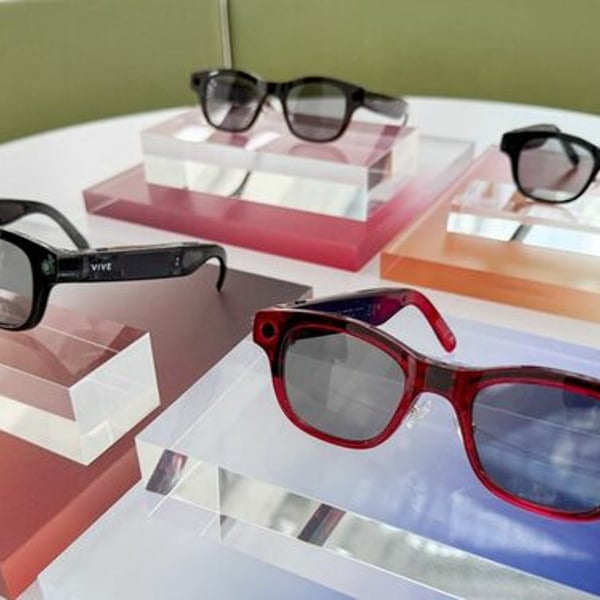
Taiwan’s HTC is betting its open platform strategy will allow it to build market share in the fast-growing smartglasses industry, as its newly launched AI-powered eyewear lets wearers choose which AI model they want to use, its executive said.

HTC’s VIVE Eagle AI smart glasses, launched in August, are displayed at the company’s headquarters, in Xindian, New Taipei City, Taiwan December 17, 2025 – Reuters/Wen-Yee Lee

“AI is advancing very fast, and large language model developers are engaged in an arms race that requires massive resources,” Charles Huang, senior vice president of global sales and marketing at HTC, told Reuters in an interview. “We want to leverage the strengths ⁠of different platforms instead of building a closed ecosystem.”

Its VIVE Eagle smartglasses support multiple AI platforms including Google’s Gemini and OpenAI, allowing users to benefit from improvements across ⁠various models, Huang said. By contrast, Meta’s smartglasses are supported by Meta AI, while Chinese smartglasses from brands such as Xiaomi and Alibaba are built around domestically developed AI models.

HTC launched the VIVE model, priced at HK$3,988 ($512), earlier this month in Hong Kong. It ‍plans to expand ‌sales to Japan and Southeast Asia in the first quarter of next year and to Europe ⁠and the US later in 2026.

Huang ‌said the Asia-first strategy reflects regional design considerations, noting that many smartglasses on the ‌market were built around a “Western fit” that might not suit Asian wearers. Asked whether the Hong Kong launch was a step towards entering China, Huang said China’s market was more complex, as foreign AI services were restricted and local data regulations required standalone servers within the country. “With all these requirements in place, ‍we need to be cautious and it will take some time to prepare,” he said.

Global shipments of smartglasses soared 110% in the first half of this year, with Meta taking 73% of the market, according ‌to research firm Counterpoint. Meta ⁠and ​partner EssilorLuxottica‘s “smart” Ray-Bans and Oakleys, which first launched in 2023, have captured the ⁠tech world’s attention ​by answering calls, taking pictures and playing music.

Analysts, however, have warned that privacy could become a growing concern. Meta, which owns Facebook, Instagram, and WhatsApp, is leveraging user data to power AI tools, a ​move that has drawn scrutiny over data practices. Huang added that user data was not used to train HTC’s AI models, and that it considered privacy and data ⁠security key differentiators from its rivals.

The launch of the VIVE ⁠AI smartglasses marks a renewed push by HTC into consumer-facing hardware, after it sold part of its extended reality headset and glasses unit to Google for $250 million earlier this year. 

© Thomson Reuters 2025 All rights reserved.


Source link

Continue Reading

Fashion

Coty appoints former Procter & Gamble executive Markus Strobel as interim chief executive

Published

on


By

AFP

Published


December 22, 2025

US cosmetics group Coty announced on Monday that it has appointed Markus Strobel as interim chief executive officer, effective January 1.

Markus Strobel – Coty

Markus Strobel, who spent 33 years of his career at Procter & Gamble, will take the reins at Coty “at a pivotal moment for the company,” according to a press release by Coty, “as a strategic review of the consumer beauty business is underway.”

Markus Strobel succeeds both Peter Harf, who will retire from Coty’s Board of Directors after more than thirty years of service, and Sue Nabi, who will step down as CEO after a five-year term, the release said.

“Harf’s leadership has helped shape Coty into a global beauty leader, while Nabi has overseen the launch of several major hit fragrances, including Burberry Goddess, and significantly reduced Coty’s net financial leverage,” the release said. “Both leave Coty on a solid footing for future profitable growth,” it added.

On the Paris stock exchange, Coty’s shares were down 5.54% at €2.65, while the wider market was 0.21% lower at around 09:40. Since the start of the year, the stock has fallen by more than 50%.

“I’m delighted to be joining Coty at this key moment. Building on Coty’s solid foundations, I see considerable potential to accelerate growth,” said Markus Strobel.

In September, Coty announced the launch of a strategic review of its consumer cosmetics division, with the aim of refocusing on perfumery by bringing together the “prestige” and “consumer” fragrance divisions.

But Coty is on the verge of losing the Gucci licence, as luxury group Kering, owner of the Italian brand, has sold its beauty division to the world’s leading cosmetics company, French group L’Oréal.

The group fell into the red in the 2024/25 financial year (which ended in late June) with a net loss of $381 million, compared with a net profit of $76 million a year earlier. Sales fell by 4% to $5.9 billion.

In the first quarter of the 2025/26 financial year, results were down, with net profit falling 19% to $64.6 million and sales down 6% to $1.58 billion.
 

This article is an automatic translation.
Click here to read the original article.

Copyright © 2025 AFP. All rights reserved. All information displayed in this section (dispatches, photographs, logos) are protected by intellectual property rights owned by Agence France-Presse. As a consequence you may not copy, reproduce, modify, transmit, publish, display or in any way commercially exploit any of the contents of this section without the prior written consent of Agence France-Presses.


Source link

Continue Reading

Fashion

Dune losses widen as results lag investment in growth

Published

on


Published


December 22, 2025

Dune — or more specifically Dune Topco Ltd — has filed its results for the year to February 2025 with turnover in the latest 53-week period falling to £137.6 million from £141.9 million in the previous 52-week year.

Dune

Gross profit dipped to £66.1 million from £68.2 million and the operating loss widened to £5.88 million from £2.7 million. The loss before tax was £7.4 million, almost double that of the £3.8 million loss in the previous year and the net loss for the period was £6.2 million, much worse than the almost-£1.7 million loss the year before.

The company talked of a challenging trading environment but also said that AW25 sees it trading strongly as demand for boots and bags has helped to drive like-for-like sales up in double digits.

It also faced the fact that it’s investing heavily in expansion and the fruits of this investment will be seen in the future rather than in the year in question. The company highlighted how its latest financial results “lag behind the strategic changes under way in the business”.

The company said that the year saw it with a clear strategy focused on “transitioning the business from a UK high street footwear retailer to a global footwear and accessories brand significantly distributed through partners”.

It delivered retail sales growth in the year, both overall and on a like-for-like basis, reflecting good progress in omnichannel in the UK market and in category development, in particular in accessories.

Beyond the UK, Dune International delivered growth in earnings in the year of consolidation of low-margin accounts with a heightened focus on development of key strategic markets supported by a reduction in admin costs.

During the period it opened one new outlet store and launched on two new online marketplace with a UK and European customer base. New stores and concessions were also opened in conjunction with its franchise partners in the Middle East, Australia, Libya, Croatia and the Philippines. 

It has also grown existing and new wholesale accounts in the UK and overseas, including in both concessions and online in the North American market. At the same time it’s been exiting UK stores that “no longer have the prospect of being profitable”.

Copyright © 2025 FashionNetwork.com All rights reserved.


Source link

Continue Reading

Fashion

KME sells Culti Milano stake to Emosia Group

Published

on


Published


December 22, 2025

KME Group has announced it will sell its stake in fragrance specialist Culti Milano, representing 77.17% of the share capital, to Berger International, the holding company of Emosia Group, one of France’s leading players in the home-fragrance sector (whose brands include Maison Berger Paris, My Jolie Candle, and Ambiances Devineau, among others). The transaction is valued at €45.8 million.

Culti Milano: Kme sells its stake to Emosia Group

“The sale completes the execution of KME’s strategy to concentrate its industrial holding activities on the management of KME SE, which is focused on the laminates sector, and makes a significant contribution to available financial resources,” the press release states.

With a workforce of 61, the Culti Group, which holds 11.94% of the share capital, recorded revenues of €20.8 million and EBITDA of €4.7 million in the 2024 financial year.

Active in nearly 70 countries, Emosia operates through a network of around 9,000 points of sale, runs five industrial sites, and generates turnover of over €110 million, about half of which is earned abroad.

“Emosia Group is pursuing a growth strategy centred on developing high value-added brands, and the acquisition of Culti enables it to integrate a premium brand that combines olfactory excellence, high-quality raw materials, distinctive design and brand experience,” the press release concludes. “As part of the transaction, Culti’s current management will remain in post, ensuring continuity of operations and supporting the continued development of the business.”

The closing of the transaction, subject to the fulfilment of customary conditions precedent, is scheduled for February 2026.

This article is an automatic translation.
Click here to read the original article.

Copyright © 2025 FashionNetwork.com All rights reserved.


Source link

Continue Reading

Trending

Copyright © Miami Select.