Connect with us

Business

How to watch or stream the opening game of the NFL’s 2025-2026 football season live, online, and free without cable: Fox, CBS, NBC, ESPN

Published

on


Pre-season in the NFL is always kind of a weird thing. Teams are shaking off the summer rust—and starters tend to ride the bench, to keep them healthy for the season ahead. Games, meanwhile, don’t have any real consequence, so it’s harder for fans to get invested in them. But now, the scores start to count.

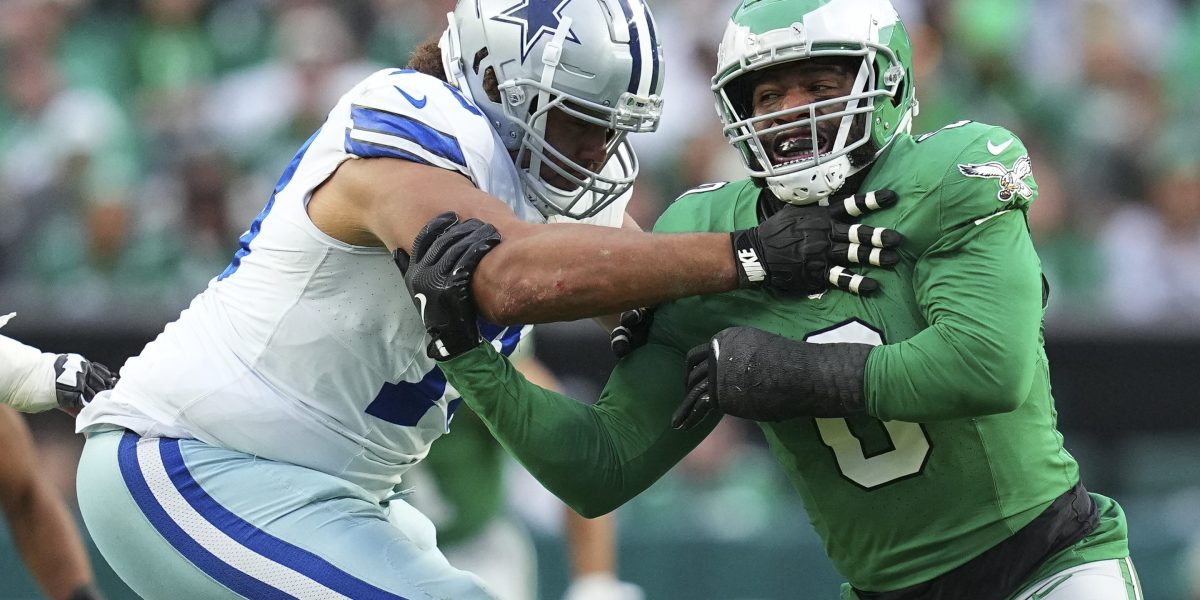
The 2025-2026 NFL season gets underway tonight in Philadelphia, where the defending Super Bowl champs will begin their quest to go back-to-back.

Like last year, this season will have a rolling start. There’s a single game tonight, with another (streaming exclusive) on Friday. Then, come Sunday, most of the rest of the league will take the field.

Here’s all you need to know about tonight’s season opener.

Which NFL teams are playing Thursday? And what channels are airing the games?

There’s no FOMO tonight, as the NFL is hosting just one game. As always, the home team is listed second.

Thursday, Sept. 4

Dallas Cowboys vs. Philadelphia Eagles, 8:20 p.m. ET on NBC

How can I watch the NFL season opener for free—even if I am out of market?

The best way to watch any sort of network programming for free on a big screen is with a good HD antenna. To ensure you’re getting the most reliable signal, be sure to test the antenna in multiple locations in your home.

Can I stream 2025-2026 NFL games live online if I don’t have a cable subscription?

Of course!

Peacock

NBC’s streaming service will give you access to several games, including tonight’s, all upcoming Sunday night matchups and on Thanksgiving. The seven-day free trial is no longer offered, unfortunately, so expect to pay an $8 or $14 monthly charge. (An annual plan starts at $80.)

Hulu with Live TV

This service is going away soon, but for now, you can sign up for $83 per month (with ads) or $95 per month without ads.

YouTubeTV

After a free trial, you can expect monthly charges of $83.

Sling TV

Dish Network’s Sling lower-tiered “Orange” plan will run you $46 per month. Adding the more comprehensive “Blue” plan bumps the cost to $61 per month. The seven-day free trial has disappeared, but you can buy a Day Pass, giving you 24-hours of Live TV for $5.

DirecTV Stream

Formerly known as DirecTV Now, AT&T TVNow and AT&T TV, this oft-renamed streaming service will run you $85 per month and up after the free trial option. (The package that includes NFL Network will run you $90 per month.)

Fubo TV

Another option whose lifespan is limited, this sports-focused cord-cutting service carries broadcast networks in most markets. There’s a seven-day free trial, followed by monthly charges of $85 and up, depending on the channels you choose.

Can I watch the NFL’s opening game on Amazon?

No. While Amazon Prime Video will normally carry Thursday Night Football, it does not have the broadcast rights to tonight’s game. The first matchup on Amazon this year will be the Washington Commanders facing the Green Bay Packers on Sept. 11.

Does the NFL offer any viewing packages to watch the games I want?

It does. You have three to choose from.

NFL App

The NFL App will let you stream games that are being broadcast locally in your market on Sundays. If you want to watch an “out of market” game, you’ve got two choices.

NFL+

Watch live local and out of market games and (with the premium subscription) replays. You’re looking at a $50 charge per season. ($100 for premium.)

NFL Sunday Ticket

YouTube once again is the home for this channel. Prices this year start at $83 per month for Sunday Ticket and YouTubeTV or $480 for just Sunday Ticket, if you’re a returning user (spanning the entirety of out-of-market games this season). New users can get a standalone Sunday Ticket subscription for $276.

Are there any new rules for the 2025-2026 season?  

After changing how kickoffs occurred last year, the NFL is making a few more tweaks in 2025-2026. After a touchback, the ball will now be placed on the 35-yard line, instead of the 25-yard line.

Onside kick rules are being adjusted as well. Teams will still have to declare their intention, but they can now make them at any point in the game, instead of just in the fourth quarter.

Overtime will be a bit different. Both teams will get a chance to possess the ball, even if the first team scores. (This, previously, was only the case in the postseason.) Overtime periods, also, will be limited to 10 minutes.

Fortune Global Forum returns Oct. 26–27, 2025 in Riyadh. CEOs and global leaders will gather for a dynamic, invitation-only event shaping the future of business. Apply for an invitation.


Source link

Continue Reading

Business

Fortune Article | Fortune

Published

on


Bitcoin is one of the world’s most battle-tested pieces of software. Launched in early 2009, the network has run continuously without being hacked, and today feels more secure than ever. There is, however, a threat on the medium-term horizon that threatens not only Bitcoin but every other type of software that relies on current encryption technology. That threat is quantum computing and, on Wednesday, Coinbase announced it has created a board of outside experts to prepare for its eventual arrival.

The board includes academics from Stanford, Harvard, and the University of California with specialties in fields like computer science, cryptography and fintech. Formally known as the Coinbase Independent Advisory Board on Quantum Computing and Blockchain, it is also composed of experts in blockchain and security from the Ethereum Foundation, the DeFi platform EigenLayer and from Coinbase itself.

In an interview with Fortune, Coinbase Chief Information Security Officer Jeff Lunglhofer explained how the arrival of quantum computing could defeat current encryption mechanisms, including the ones employed to protect the wallets and private keys held by Bitcoin owners.

“In simple terms, modern cryptography relies on hard math problems that would take thousands of years for a modern computer to solve,” he said. “But when we have a million times the horsepower [with quantum computing], that will provide the computation power to solve them.”

While the security threat of quantum computing is real, it is unlikely to be an urgent issue for at least a decade, according to Lunglhofer. His view is consistent with other experts who note that, while companies like Google and IBM have been building quantum computers for years, the current generation of these machines can only operate at a small scale and are not close to being able to crack the algorithms that protect Bitcoin and other networks.

The purpose of the new Advisory Board, says Lunglhofer, is to explore the coming impact of quantum computing in a “non-hype based way.” This will include promoting efforts by the blockchain industry, which are already underway, to update Bitcoin and other networks so that they are resistant to quantum-based attacks.

Currently, the Bitcoin network secures wallets by means of private keys, which are long strings of random numbers and letters that are visible to their owners, but that can only be guessed by means of an impossibly long series of trial-and-error attempts. When the quantum computing era arrives, it will be possible to guess a private key using trial-and-error. In response, Lunglhofer says, blockchain experts anticipate that Bitcoin and other networks will respond by creating larger keys and, at the same time, introducing “noise” to make the location of the key harder to detect in the first place.

All of this will require blockchain networks to introduce and deploy these defensive upgrades, a process that is likely to take years. In the interim, the new Advisory Board will begin publishing research papers and issuing position statements to help the crypto industry prepare for the arrival of quantum computing. The group plans to publish its first paper, which will focus on quantum’s impact on the consensus and transaction layers of blockchain, in the next month or two.

“Quantum computing is both a technological opportunity and a security challenge. By bringing together the foremost experts in the world, Coinbase is ensuring that the blockchain ecosystem is prepared, not just reactive,” said Yehuda Lindell, Head of Cryptography at Coinbase, in a statement.


Source link

Continue Reading

Business

The Walmart C-suite reshuffle shows how the retailer sees itself now: as a tech company

Published

on


When Walmart last week announced that David Guggina, its U.S. e-commerce chief executive, would become CEO of its nearly $500 billion U.S. division, one thing stood out in his résumé: Unlike his predecessors, Guggina has no experience running stores and has never held a merchandising role, at Walmart or elsewhere. These are two classic job requirements in retail. Incoming Walmart CEO John Furner, for example, who has run U.S. operations since 2019, began his Walmart career as an hourly associate in 1993, and held roles in merchandising, operations, and sourcing.

But there’s another realm of experience that Guggina does have in spades: e-commerce, automation, and supply chain. And by putting him atop the division that generates 69% of company revenue, Walmart is signaling that it now sees itself as a tech company, as well as a retailer. Guggina has spent eight years at Walmart, after nine years at arch-rival Amazon.com. In its announcement, Walmart touted Guggina’s work in building delivery capabilities to serve 95% of U.S. households in under three hours, and said his appointment “positions him to continue to drive our goal of being America’s favorite place to shop.”

In the last decade, after years of fits and starts, Walmart has emerged as a formidable e-commerce player, with U.S. digital sales of almost $100 billion a year—still far behind Amazon, but well ahead of any other U.S. retailer. In its most recent quarter, Walmart’s U.S. e-commerce rose 27%. That has been the result of billions in investments to integrate Walmart’s 4,600 stores with its e-commerce operations. This work has helped ensure faster shipping while also integrating technology more effectively into things like inventory management, supply chain, and in-store customer service. Guggina was instrumental in those achievements, working under Furner, who will become Walmart Inc’s new CEO next week.

“This is a unique moment in retail,” Guggina said in a LinkedIn post about his appointment. “AI is changing how people shop, and customer expectations are higher than ever. But no one is more prepared to usher in the next era of retail.”

The timing of Guggina’s promotion was fitting: It came soon after Walmart moved its shares from the New York Stock Exchange to the Nasdaq exchange, where tech giants such as Amazon, Google, and Microsoft list their shares. In December, Walmart said the move underscores its “technology-forward approach.” 

Guggina isn’t the only techy whose star is rising at Walmart. The company also appointed Seth Dallaire chief growth officer for Walmart U.S., charging him with pushing Walmart U.S. further beyond traditional retail into tech-heavy lines of business—including its booming advertising, media, and online marketplace ventures. Dallaire is a veteran of Instacart and Amazon.

Walmart is considered by analysts to be well ahead of other retailers in AI-assisted shopping. In October, it announced a partnership with OpenAI to allow shoppers to browse and buy Walmart products directly inside ChatGPT, using a built-in instant checkout feature. Last week, Walmart and Google announced their own shopping tool. Also last week, Walmart’s executive vice president for AI acceleration, product and design, Daniel Danker, suggested at a conference that the company was developing auto-ordering for the replenishment of staples.

Bolstering Walmart’s tech and AI aura has had the additional benefit of lifting the company’s stock: In the last year, Walmart shares have risen 27%, double the S&P 500’s growth and trouncing Amazon’s 1% increase.

This story was originally featured on Fortune.com


Source link

Continue Reading

Business

The rise of on-demand leadership in the AI economy

Published

on


A quiet but consequential shift is underway in the executive labor market. Companies are rethinking how they access senior judgment in the AI era. 

Rather than defaulting to full-time executive roles that command lofty salaries and long-term overhead, companies are increasingly turning to experienced consultants, strategists, and advisors to provide leadership on a limited and targeted basis.

This is not a dilution of leadership, but a recalibration of where experience delivers the most value.

According to LinkedIn’s latest Jobs on the Rise report, the fastest-growing roles in the U.S. economy sit at the intersection of AI and strategy. AI engineers claimed the top spot, while AI consultants and strategists ranked No. 2 overall. Strategic advisors and consultants also placed in the top 10. Together, the data show that as execution becomes cheaper, human judgment becomes more valuable.

The underlying driver is the implementation gap. After years of AI experimentation, organizations are struggling to convert tools into returns. While they do not lack models or software, many lack orchestration. Companies are increasingly turning to AI consultants and strategists to align technology with business realities, governance, and incentives, work that requires credibility, cross-functional fluency, and the kind of judgment typically associated with senior leadership roles.

The labor market now reflects a clear division of labor. Demand is rising simultaneously for full-time technical AI talent and for senior professionals who can translate those capabilities into business outcomes. As companies scale internal AI teams, they are increasingly relying on external advisors and consultants to provide the judgment required to direct that work at critical moments.

The supply side of this shift is shaped by organizational reality. Executives continue to make daily decisions, but AI has concentrated risk into fewer, more complex, and higher-impact choices around operating models, capital allocation, and governance. Rather than expanding permanent headcount, companies are bringing in experienced external leaders to guide those decisions when the stakes are highest.

The economics reinforce the model. Although senior advisors and consultants often command higher hourly rates, their total annual cost is typically a fraction of a comparable full-time executive role because they are engaged for a limited scope and time. Just as important, this approach allows organizations to draw on multiple forms of expertise rather than binding themselves to a single permanent hire.

The talent profile filling these roles is equally telling. Many of these advisors are former founders, CEOs, and COOs. Experience functions as a filter. LinkedIn’s data shows that many of the fastest-growing strategic roles carry a median of eight or more years of experience. These are not entry-level positions, but mid- or second-act careers for professionals with deep industry context.

The rise of founders and independent consultants on the Jobs on the Rise list also signals that this shift is driven by talent behavior, not just employer demand. Senior professionals are increasingly opting for career paths that offer autonomy, variety, and the opportunity to leverage their skills rather than committing to a single organization in an uncertain environment.

As AI automates and cheapens execution, the market value of human judgment, strategy, and accountability rises. As a result, pricing power shifts from doing the work to deciding what work should be done and how it should scale.

In this environment, experience is the moat. What is often described as “fractional leadership” is better understood as the unbundling of executive judgment from full-time roles. Over time, this model is likely to become not a stopgap but a structural response to the redistribution of value, risk, and expertise in the AI economy.

Join us at the Fortune Workplace Innovation Summit May 19–20, 2026, in Atlanta. The next era of workplace innovation is here—and the old playbook is being rewritten. At this exclusive, high-energy event, the world’s most innovative leaders will convene to explore how AI, humanity, and strategy converge to redefine, again, the future of work. Register now.


Source link

Continue Reading

Trending

Copyright © Miami Select.