Connect with us

Business

How to watch or stream Friday’s exclusive streaming game of the NFL’s 2025-2026 football season live, online, and free without cable: YouTube

Published

on


Less than two years ago, the idea of an NFL game being aired exclusively on a streaming system was revolutionary. Now, it’s almost commonplace, but for some fans, it can still be a frustrating affair.

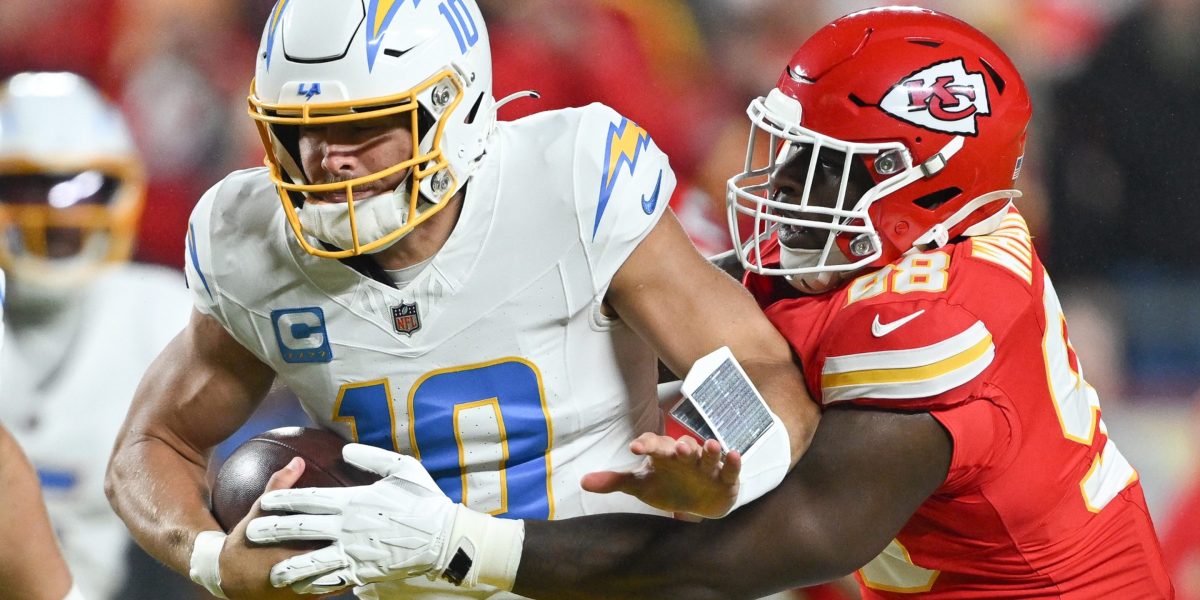
Game two of the 2025-2026 NFL Season takes place tonight, but you won’t find it aired on television. Instead, YouTube will be the exclusive home for the matchup of the Chiefs and Chargers. That’s another shift in viewing habits for many people, but, on the upside, it’s one that won’t require them to sign up for another service.

Like last year, this season is off to a rolling start. The Cowboys and Eagles kicked things off last night and on Sunday, there is the usual tsunami of games.

Here’s all you need to know about tonight’s streaming exclusive.

Which NFL teams are playing Friday? And what channels are airing the games?

There’s no FOMO tonight, as the NFL is hosting just one game. As always, the home team is listed second.

Friday, Sept. 5

Kansas City Chiefs vs. Los Angeles Chargers, 8:00 p.m. ET on YouTube

How can I watch the NFL season opener for free—even if I am out of market?

In short, you can’t. Normally, we’d suggest a good HD antenna here, but that won’t do you any good for tonight’s game.

Can I stream 2025-2026 NFL games live online if I don’t have a cable subscription?

Since it’s a streaming exclusive, of course, but you’ll only have one option.  

YouTubeTV

After a free trial, you can expect monthly charges of $83.

Can I watch the NFL’s opening game on Amazon?

No. Amazon Prime Video’s first matchup this year will be the Washington Commanders facing the Green Bay Packers on Sept. 11.

Why is this game being streamed on YouTube?

YouTube already has a partnership with the NFL as it is the home of NFL Sunday Ticket. But this goes a bit further than that. This will be the first time YouTube broadcasts an NFL game live, but it has streamed other major events, including Coachella earlier this year.

The NFL is hoping to reach a broader, younger audience, which tunes in more to streaming services than traditional broadcast television. Exclusive deals also are more lucrative for the league.

Will any other games be streaming exclusives this year?

Yes, several more in fact.

Amazon will largely be the exclusive home of Thursday Night Football once again, with the exception of Thanksgiving (though it will air an exclusive game on Black Friday). On Oct. 20, ESPN+ will exclusively carry to the Seattle Seahawks vs Houston Texans game.

On Christmas Day, both Netflix and Amazon will each host a streaming exclusive game. And Peacock will have an exclusive of its own on Dec. 27.

Does the NFL offer any viewing packages to watch the games I want?

It does. You have three to choose from.

NFL App

The NFL App will let you stream games that are being broadcast locally in your market on Sundays. If you want to watch an “out of market” game, you’ve got two choices.

NFL+

Watch live local and out of market games and (with the premium subscription) replays. You’re looking at a $50 charge per season. ($100 for premium.)

NFL Sunday Ticket

YouTube once again is the home for this channel. Prices this year start at $83 per month for Sunday Ticket and YouTubeTV or $480 for just Sunday Ticket, if you’re a returning user (spanning the entirety of out-of-market games this season). New users can get a standalone Sunday Ticket subscription for $276.

Why is this game taking place in Brazil?

The NFL wants to become known as more than an American sport. Brazil could be a key part of that international expansion, with over 38 million fans, the league says. The first international game was held in Mexico City in 2005 and since then, the NFL has played in several international cities, including London and Munich, Germany. This is the second year in a row the league has opened the season in Brazil.

Fortune Global Forum returns Oct. 26–27, 2025 in Riyadh. CEOs and global leaders will gather for a dynamic, invitation-only event shaping the future of business. Apply for an invitation.


Source link

Continue Reading

Business

Gates Foundation, OpenAI unveil $50 million ‘Horizon1000’ initiative to boost healthcare in Africa through AI

Published

on


In a major effort to close the global health equity gap, the Gates Foundation and OpenAI are partnering on “Horizon1000,” a collaborative initiative designed to integrate artificial intelligence into healthcare systems across Sub-Saharan Africa. Backed by a joint $50 million commitment in funding, technology, and technical support, the partnership aims to equip 1,000 primary healthcare clinics with AI tools by 2028, Bill Gates announced in a statement on his Gates Notes, where he detailed how he sees AI playing out as a “gamechanger” for expanding access to quality care.

The initiative will begin operations in Rwanda, working directly with African leaders to pioneer the deployment of AI in health settings. With a core principle of the Foundation being to ensure that people in developing regions do not have to wait decades for new technologies to reach them, the goal in this partnership is to reach 1,000 primary health care clinics and their surrounding communities by 2028.

“A few years ago, I wrote that the rise of artificial intelligence would mark a technological revolution as far-reaching for humanity as microprocessors, PCs, mobile phones, and the Internet,” Gates wrote. “Everything I’ve seen since then confirms my view that we are on the cusp of a breathtaking global transformation.”

Addressing a Critical Workforce Shortage

The impetus for Horizon1000, Gates said, is a desperate and persistent shortage of healthcare workers in poorer regions, a bottleneck that threatens to stall 25 years of progress in global health. While child mortality has been halved and diseases like polio and HIV are under better control, the lack of personnel remains a critical vulnerability.

Sub-Saharan Africa currently faces a shortfall of nearly 6 million healthcare workers, ” a gap so large that even the most aggressive hiring and training efforts can’t close it in the foreseeable future.” This deficit creates an untenable situation where overwhelmed staff must triage high volumes of patients without sufficient administrative support or modern clinical guidance. The consequences are severe: the World Health Organization (WHO) estimates that low-quality care is a contributing factor in 6 million to 8 million deaths annually in low- and middle-income countries.

Rwanda, the first beneficiary of the Horizon1000 initiative, illustrates the scale of the challenge. The nation currently has only one healthcare worker per 1,000 people, significantly below the WHO recommendation of four per 1,000. Gates noted that at the current pace of hiring and training, it would take 180 years to close that gap. “As part of the Horizon1000 initiative, we aim to accelerate the adoption of AI tools across primary care clinics, within communities, and in people’s homes,” Gates wrote. “These AI tools will support health workers, not replace them.”

AI as the ‘Third Major Discovery

Gates noted comments from Rwanda’s Minister of Health Dr. Sabin Nsanzimana, who recently announced the launch of an AI-powered Health Intelligence Center in Kigali. Nsanzimana described AI as the third major discovery to transform medicine, following vaccines and antibiotics, Gates noted, saying that he agrees with this view. “If you live in a wealthier country and have seen a doctor recently, you may have already seen how AI is making life easier for health care workers,” Gates wrote. “Instead of taking notes constantly, they can now spend more time talking directly to you about your health, while AI transcribes and summarizes the visit.”

In countries with severe infrastructure limitations, he wrote, these capabilities will foster systems that help solve “generational challenges” that were previously unaddressable.

As the initiative rolls out over the next few years, the Gates Foundation plans to collaborate closely with innovators and governments in Sub-Saharan Africa. Gates wrote that he himself plans to visit the region soon to see these AI solutions in action, maintaining a focus on how technology can meet the most urgent needs of billions in low- and middle-income countries.


Source link

Continue Reading

Business

On Netflix’s earnings call, co-CEOs can’t quell fears about the Warner Bros. bid

Published

on


When it comes to creating irresistible storylines, Netflix, the home of Stranger Things and The Crown, is second to none. And as the streaming video giant delivered its quarterly earnings report on Tuesday, executives were in top storytelling form, pitching what they promise will be a smash hit: the acquisition of Warner Brothers Discovery.

The company’s co-CEOs, Ted Sarandos and Greg Peters, said the deal, which values Warner Brothers Discovery at $83 billion, will accelerate its own core streaming business while helping it expand into TV and the theatrical film business. 

“This is an exciting time in the business. Lots of innovation, lots of competition,” Sarandos enthused on Tuesday’s earnings conference call. Netflix has a history of successful transformation and of pivoting opportunistically, he reminded the audience: Once upon a time, its main business entailed mailing DVDs in red envelopes to customers’ homes. 

Despite Sarandos’ confident delivery, however, the pitch didn’t land with investors. The company’s stock, which was already down 15% since Netflix announced the deal in early December, sank another 4.9% in after-hours trading on Tuesday. 

Netflix’s financial results for the final quarter of 2025 were fine. The company beat EPS expectations by a penny, and said it now has 325 million paid subscribers and a worldwide total audience nearing 1 billion. Its 2026 revenue outlook, of between $50.7 billion and $51.7 billion, was right on target.  

Still, investors are worried that the Warner Bros. deal will force Netflix to compete outside its lane, causing management to lose focus. The fact that Netflix will temporarily halt its share buybacks in order to accumulate cash to help finance the deal, as it disclosed towards the bottom of Tuesday’s shareholder letter, probably didn’t help matters. 

And given that there’s a rival offer for Warner Bros from Paramount Skydance, it’s not unreasonable for investors to worry that Netflix may be forced into an expensive bidding war. (Even though Warner Brothers Discovery has accepted the Netflix offer over Paramount’s, no one believes the story is over—not even Netflix, which updated its $27.75 per share offer to all-cash, instead of stock and cash, hours earlier on Tuesday in order to provide WBD shareholders with “greater value certainty.”) 

Investors are wary; will regulators balk?

Warner Brothers investors are not the only audience that Netflix needs to win over. The deal must be blessed by antitrust regulators—a prospect whose outcome is harder to predict than ever in the Trump administration.

Sarandos and Peters laid out the case Tuesday for why they believe the deal will get through the regulatory process, framing the deal as a boon for American jobs.

“This is going to allow us to significantly expand our production capacity in the U.S. and to keep investing in original content in the long term, which means more opportunities for creative talent and more jobs,” Sarandos said.

Referring to Warner Brothers’ television and film businesses, he added that “these folks have extensive experience and expertise. We want them to stay on and run those businesses. We’re expanding content creation not collapsing it.”

It’s a compelling story. But the co-CEOs may have neglected to study the most important script of all when it comes to getting government approval in the current administration; they forgot to recite the Trump lines. 

The example has been set over the past 12 months by peers such as Nvidia’s Jensen Huang and Meta’s Mark Zuckerberg. The latter, with his company facing various federal regulatory threats, began publicly praising the Trump administration on an earnings call last January. 

And Nvidia’s Huang has already seen real dividends from a similar strategy. The chip company CEO has praised Trump repeatedly on earnings calls, in media interviews, and in conference keynote speeches, calling him “America’s unique advantage” in AI. Since then, the U.S. ban on selling Nvidia’s H200 AI chips to China has been rescinded. The praise may have been coincidental to the outcome, but it certainly didn’t hurt.

In contrast, the president went unmentioned on Tuesday’s call. How significant Netflix’s omission of a Trump call-out turns out to be remains to be seen; maybe it won’t matter at all. But it’s worth noting that its competitor for Warner Bros., Paramount Skydance, is helmed by David Ellison, an outspoken Trump supporter. 

It’s a storyline that Netflix should have seen coming, and itmay still send the company back to rewrite.


Source link

Continue Reading

Business

Americans are paying nearly all of the tariff burden as international exports die down, study finds

Published

on


After nearly a year of promises tariffs would boost the U.S. economy while other countries footed the bill, a new study shows almost all of the tariff burden is falling on American consumers. 

Americans are paying 96% of the costs of tariffs as prices for goods rise, according to research published Monday by the Kiel Institute for the World Economy, a German think tank. 

In April 2025 when President Donald Trump announced his “Liberation Day” tariffs, he claimed: “For decades, our country has been looted, pillaged, raped, and plundered by nations near and far, both friend and foe alike.” But the report suggests tariffs have actually cost Americans more money.

Trump has long used tariffs as leverage in non-trade political disputes. Over the weekend, Trump renewed his trade war in Europe after Denmark, Norway, Sweden, France, Germany, the United Kingdom, the Netherlands, and Finland sent troops for training exercises in Greenland. The countries will be hit with a 10% tariff starting on Feb. 1 that is set to rise to 25% on June 1, if a deal for the U.S. to buy Greenland is not reached. 

On Monday, Trump threatened a 200% tariff on French wine, after French President Emmanuel Macron refused to join Trump’s “Board of Peace” for Gaza, which has a $1 billion buy-in for permanent membership. 

“The claim that foreign countries pay these tariffs is a myth,” wrote Julian Hinz, research director at the Kiel Institute and an author of the study. “The data show the opposite: Americans are footing the bill.” 

The research shows export prices stayed the same, but the volume has collapsed. After imposing a 50% tariff on India in August, exports to the U.S. dropped 18% to 24%, compared to the European Union, Canada, and Australia. Exporters are redirecting sales to other markets, so they don’t need to cut sales or prices, according to the study.

“There is no such thing as foreigners transferring wealth to the U.S. in the form of tariffs,” Hinz told The Wall Street Journal

For the study, Hinz and his team analyzed more than 25 million shipment records between January 2024 through November 2025 that were worth nearly $4 trillion.They found exporters absorbed just 4% of the tariff burden and American importers are largely passing on the costs to consumers. 

Tariffs have increased customs revenue by $200 billion, but nearly all of that comes from American consumers. The study’s authors likened this to a consumption tax as wealth transfers from consumers and businesses to the U.S. Treasury.   

Trump has also repeatedly claimed tariffs would boost American manufacturing, butthe economy has shown declines in manufacturing jobs every month since April 2025, losing 60,000 manufacturing jobs between Liberation Day and November. 

The Supreme Court was expected to rule as soon as today on whether Trump’s use of emergency powers to levy tariffs under the International Emergency Economic Powers Act was legal. The court initially announced they planned to rule last week and gave no explanation for the delay. 

Although justices appeared skeptical of the administration’s authority during oral arguments in November, economists predict the Trump administration will find alternative ways to keep the tariffs.


Source link

Continue Reading

Trending

Copyright © Miami Select.