
Politics
How one Florida congressional district may get caught up in battle for control of U.S. House
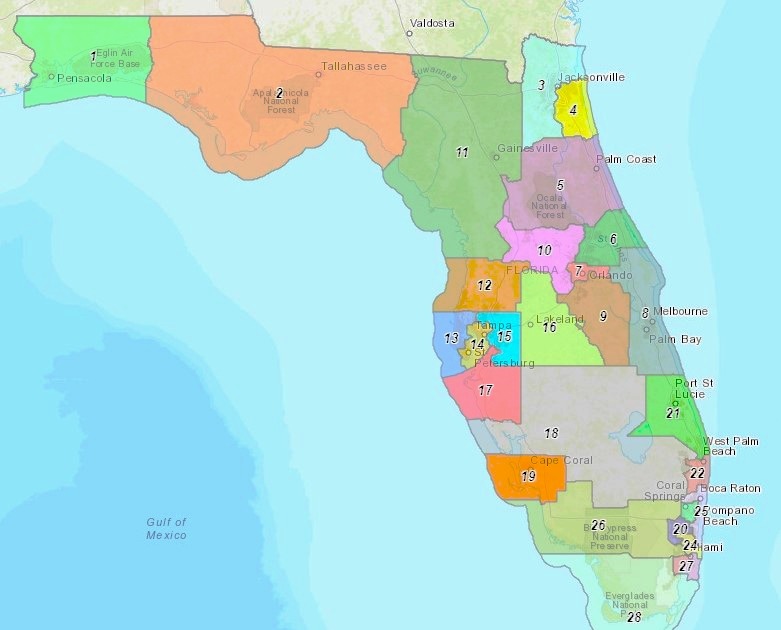
In Central Florida, residents, local officials and activists in the Democratic-held Florida’s 9th Congressional District are preparing for a potential shake-up if they become entangled in the national battle over control of the U.S. House.
The majority Hispanic district, which encompasses Osceola County and parts of Orange and Polk counties, is one of several Democratic seats in Florida that may be targeted for redistricting by Republicans in a Special Session in April sought by Gov. Ron DeSantis. The district is represented by U.S. Rep. Darren Soto, a fourth-term Democrat and first Floridian of Puerto Rican descent to serve in Congress.
Democrats in the district said any move to change its boundaries to push them out and add more Republicans is unfair and wrong, while members of the GOP believe they would be better represented if there’s a change in their favor.
States typically redistrict once a decade to account for population changes after the decennial census; Florida completed the process in 2022. Mid-decade redistricting is rare, and this year’s move to do so is largely perceived as a partisan maneuver to maintain Republican control of Congress before the Midterms. Republicans had already targeted Soto’s seat as one to flip, regardless of whether it is redistricted.
Responding to President Donald Trump’s call for Republican-led states to redraw their congressional districts, similar efforts in California would flip five Republican-held seats in regions like the Central Valley, Sacramento, and San Diego to Democrats.
Florida’s most recent maps faced criticism in 2022 for eliminating a predominantly Black district in north Florida and unseating one of the state’s few Black Representatives. The state’s highest court upheld the map after legal challenges. Republicans ultimately gained four seats, for 20 out of 28 total.
Federal law — the Voting Rights Act of 1965 — prohibits racial gerrymandering. It protects minority districts from being diluted in such a way that would unseat their representatives. The law was intended to more fairly give candidates of color a way into office.
In Florida, the Fair Districts Amendments, which voters passed in 2010, wrote into the state’s constitution a ban on political gerrymandering, too: “No apportionment plan or district shall be drawn with the intent to favor or disfavor a political party or an incumbent.” A state Supreme Court ruling last year watered down the provisions but didn’t eliminate them.
The U.S. Supreme Court is expected to rule this year on whether the federal law will remain in place. If the court strikes down the law, DeSantis wrote on X that the decision will necessitate redistricting in Florida.
Tania Galiñanes, 53, a Democrat who has lived in Osceola County since 1994, said she believes that drawing congressional maps simply to favor one party over another is wrong.

“It should be based on the data, not based on ideology,” said Galiñanes, who has previously been registered as a Republican and independent.
On the other side, Maureen Cooper, 49, a Republican who has lived in Kissimmee for about a year, said her life would be better if she were represented in Washington by a member of the same party.
“I feel like they have more family values in mind and represent my beliefs,” she said.
DeSantis, who announced in January that the Legislature will hold a Special Session to address redistricting after lawmakers wrap up their Regular Session in mid-March, said redistricting will help ensure the state’s growing population is “represented fairly and constitutionally.”
Critics said it amounts to partisan gerrymandering and that redrawing maps so close to the November congressional elections will sow confusion among voters. Florida’s redistricting effort already drew a lawsuit from two residents claiming DeSantis’ plan was unconstitutional. The Florida Supreme Court shot down the petition Feb. 27, saying DeSantis is allowed to call the special session.
Soto’s Office declined to make him available for an interview but pointed to social media statements calling the plan “cheating” and “an unlawful attack on our democracy.”
“Cheaters gotta cheat,” Soto posted on X in January. “His (DeSantis’) plan is to violate the FL Constitution at the last minute to jam the courts. But will the legislature and the courts go along with this injustice?”
DeSantis’ Office did not respond to an email request for comment.
Nationally, Democrats said Republicans started the highly unusual mid-decade political arms race for control of the narrowly GOP-led House. Now, as many as 10 states across the country have either passed new maps or are considering plans to refashion district boundaries, including Texas, California, New York, Ohio and Virginia, among others. As Republican states try to boost their number of GOP House members in Washington, Democrats are counterpunching with their own redistricting.
In CD 9, Democrats make up a plurality of registered voters at 40%, according to 2022 data from the Florida Department of State, while non-party affiliated voters are the next largest group with 36%, and Republicans are 23%.
In the 2024 presidential contest, Democrat Kamala Harris narrowly topped Trump in the district, according to various estimates although no official results are available for congressional districts, while Soto cruised to victory over his Republican rival with about 55% of the vote.
CD 9 has a relatively young population, with only 14% of residents 65 or older, according to Census figures. More than half the district — 53% — is Hispanic, 36% is white, 10% is Black, and 4% is Asian.
It’s possible the redrawn maps could consolidate CD 9 with the other central Florida Democratic-held seat, the adjacent Florida’s 10th Congressional District, into one, potentially forcing the two districts’ current lawmakers to face off in a Primary. CD 10 is represented by U.S. Rep. Maxwell Frost, an Orlando Democrat who was elected in 2022 and, at 29, is the youngest member of Congress and is the first Generation Z member to serve. His Office didn’t respond to an email request for comment.
All eight Democrat-represented districts in Florida could be in jeopardy this year, said Aubrey Jewett, a political science professor at the University of Central Florida. Most observers expect the GOP to try to flip between two and five Democratic seats. Areas that swung blue by close margins, including districts in South and central Florida, are most likely to be affected.
It’s also possible the new districts backfire against Republicans, Jewett said. The new maps could split solidly Republican districts into ones with only a slight Republican majority. That, combined with high Democratic voter turnout, could give Democrats an opportunity to flip seats in their favor.
“Partisan gerrymandering might not be fair, it might not be good, it might not be healthy for American democracy, but it’s not unconstitutional,” Jewett said.
With the possibility that the new maps may be drawn shortly before the Midterms, Democrats and voting rights advocates say the stage is set for confusion at the polls. They argue that at this point it’s just a guessing game as to which districts may be affected and how they will be reshaped.
“We don’t know what to tell our voters, other than that we don’t feel that a mid-census redistricting is ever the answer,” said state Rep. Kelly Skidmore of Palm Beach, the Democratic policy chair, at a news conference in January.
Mark Cross, a Republican state committeeman from Osceola County, said he supports mid-decade redistricting because the political makeup of the district is shifting.
“Even though we are a Democratic county, we’re trending Republican, especially in the bigger races, because people understand that the Republican Party is the party of common sense,” Cross said, adding that he hopes a Republican representative would be able to wrangle more federal funding for the district in a GOP-led Congress and do more to boost the economy and cut regulations.
For their part, Osceola County Democrats plan on hosting voter-education events as usual ahead of the midterms, no matter when and how maps are redrawn.
Stephen Wells, Chair of the Osceola County Democratic Committee, said he is concerned that if the seat flips Republican the area would see more “continual everyday nonsense” — citing increased immigration enforcement and tariffs.
For now, Wells said Osceola Democrats will “work through the process” and register as many new voters as possible — with an anti-GOP motivational message.
“It’s just letting the voters know, ‘Hey, this is just another way of them trying to limit how you can influence your government,’” he said.
To the Rev. Kathy Schmitz, co-President of the League of Women Voters of Orange County, the right thing to do is clear: Don’t redistrict at all.
“There’s no new data on which to make a new map,” she said, noting that the League, known for its nonpartisan voter-education efforts, has visited Tallahassee to lobby against redrawing the maps. “There’s no justification for redistricting other than political gerrymandering.”
Schmitz added, “Nobody’s not quite sure what to do, and I think that’s a real frustration.”
___
This story was produced by Fresh Take Florida, a news service of the University of Florida College of Journalism and Communications. The reporter can be reached at [email protected]. You can donate to support our students here.