Connect with us

Business

How Macy’s, Dillard’s, and Nordstrom are getting their groove back this holiday season

Published

on


A Los Angeles Times headline in 1995 asked, “Can the department store survive?” A quarter century later, CNN proclaimed that “America has turned its back on big department stores.”

These are just two of many obituaries predicting the imminent demise of the U.S. department store—and all that pessimism has been backed by the data. Department stores have been losing market share for decades, first to big-box discounters like Walmart and Target in the 1980’s and 90’s, and more recently to Amazon. The department store’s percentage of total U.S. retail sales has fallen from about 14% in 1993 to only 2.6% last year.

But now, perhaps improbably, there are new signs of life in the retail format, with growth this year at Macy’s, Bloomingdale’s, Dillard’s, Nordstrom, and Belk—and signs of stabilization at J.C. Penney and Kohl’s.

The path that department stores are taking back into shoppers’ favor is a return to what made them popular in the first place: well-maintained and attractive spaces with attentive staff, a well-chosen selection of products, and enticing new brands. Many chains are finding that fewer stores are better, and have been shutting down locations to maintain quality and brand congruence.

With most products available online, often at lower prices, department stores must offer some real value to the brick-and-mortar shopper. But it’s an uphill climb to reverse some of the erosion of standards that have diminished the appeal of department-store shopping. Competition with the Walmarts, Targets, and T.J. Maxxes of this world led many department store companies to cut corners and skimp on retail flourishes, eroding their raison d’être in the shopper’s mind.

“You know what was tough about department stores?” Macy’s Inc. CEO Tony Spring recently told Fortune. “We didn’t execute well. A bad store, no matter what you call it, is going to fail.”

A string of bad seasons

And indeed many did fail. In 2020 alone, Neiman Marcus, J.C. Penney, Lord & Taylor, and Bon-Ton Stores filed for bankruptcy protection. They were already struggling before they were pushed over the edge by a pandemic that kept shoppers away for months. A couple of years before that, Barneys New York and Sears did the same, eventually going out of business altogether.

As Spring told Fortune, Macy’s recent success—including its best quarter for sales growth in three years—is thanks to a playbook focused on less store clutter, a more focused assortment of products and brands, and more staffing in key departments such as women’s shoes and dresses.

Rival Dillard’s, a primarily Southern and Southwestern chain with 290 stores, has also seen modest growth by following those basic retail precepts. Unlike many of its mall-based peers, Dillard’s has rarely deviated from its formula of neat stores and thoughtful product discovery, and is roughly the same size today as it was 15 years ago by revenue and store count—unlike chains that expanded rapidly, then closed scores of stores.

Another department store that appears to be staging a comeback is Nordstrom, which went private this summer to revitalize its business outside of Wall Street’s glare. It has seen sales rise 4.1% in the first half of 2025. Belk, a privately held Southern chain, is seeing growth too, though more modest, according to industry estimates.

Department stores, like this Nordstrom in Chicago, are making spaces that are more inviting to shoppers.

Jeff Schear/Getty Images for Nordstrom

Still, it’s too early to pop the champagne. Dillard’s and Macy’s modest comparable sales growth of about 1% last quarter is hardly the mark of a roaring retail renaissance. And Penney and Kohl’s are still seeing sales declines, albeit less severe than just a few quarters ago.

Meanwhile, some companies are still deep in the doldrums: Saks Global recently said its sales fell 13% last quarter. In that case, the decline is largely because vendors are not sending it enough merchandise given recent delays in getting payment from the debt-laden company. Clearly, department stores are not out of the woods.

Catering to the bargain-seekers

The holiday season, during which department stores get nearly a third of their annual sales, will be a major test of their nascent comeback. The Mastercard Economics Institute has forecast that sales will rise 3.6% November and December, a slower clip compared to last year’s holiday season. And shoppers are likely to be particularly bargain-hungry, meaning they will be holding out for deals, a trend department store executives are already seeing.

“Many Americans are more stressed than ever about holiday spending, and wallets are stretched,” JCPenney chief customer and marketing officer Marisa Thalberg said in a recent presentation of the retailer’s holiday season strategy. The company’s response? To offer more deals, and earlier in the season.

Kohl’s Chief Marketing Officer Christie Raymond expects shoppers will visit stores more often during the Thanksgiving to Christmas period, but buy less during each visit and gravitate to cheaper products as they feel the economic pinch.

“We are seeing trading down,” Raymond said at a media briefing in October at Kohl’s design office in Manhattan. “Whereas some customers were maybe purchasing a premium brand, we are seeing them trade down to private brands.” This could bode well for the success of Kohl’s recent efforts to refresh its long languishing store brands.

Even the high-end store Nordstrom, with its well-heeled clientele, is emphasizing more low-priced items than usual this year. At its New York flagship, Nordstrom has built a two-story area to showcase giftable items, with about 800 products that cost less than $100.

Back to the future

A century ago, department stores began a golden age in which they were at the forefront of America’s burgeoning consumer economy. They were grand behemoths, typically in city centers, where shopping was an event—rather than the constant pastime it is today, often done by scrolling on a device.

These were memorable experiences: a trip to JCPenney to buy a Sunday best suit; the thrill of choosing the perfect debutante ball gown at Neiman Marcus; or the much-anticipated purchase of a new household appliance at Sears.
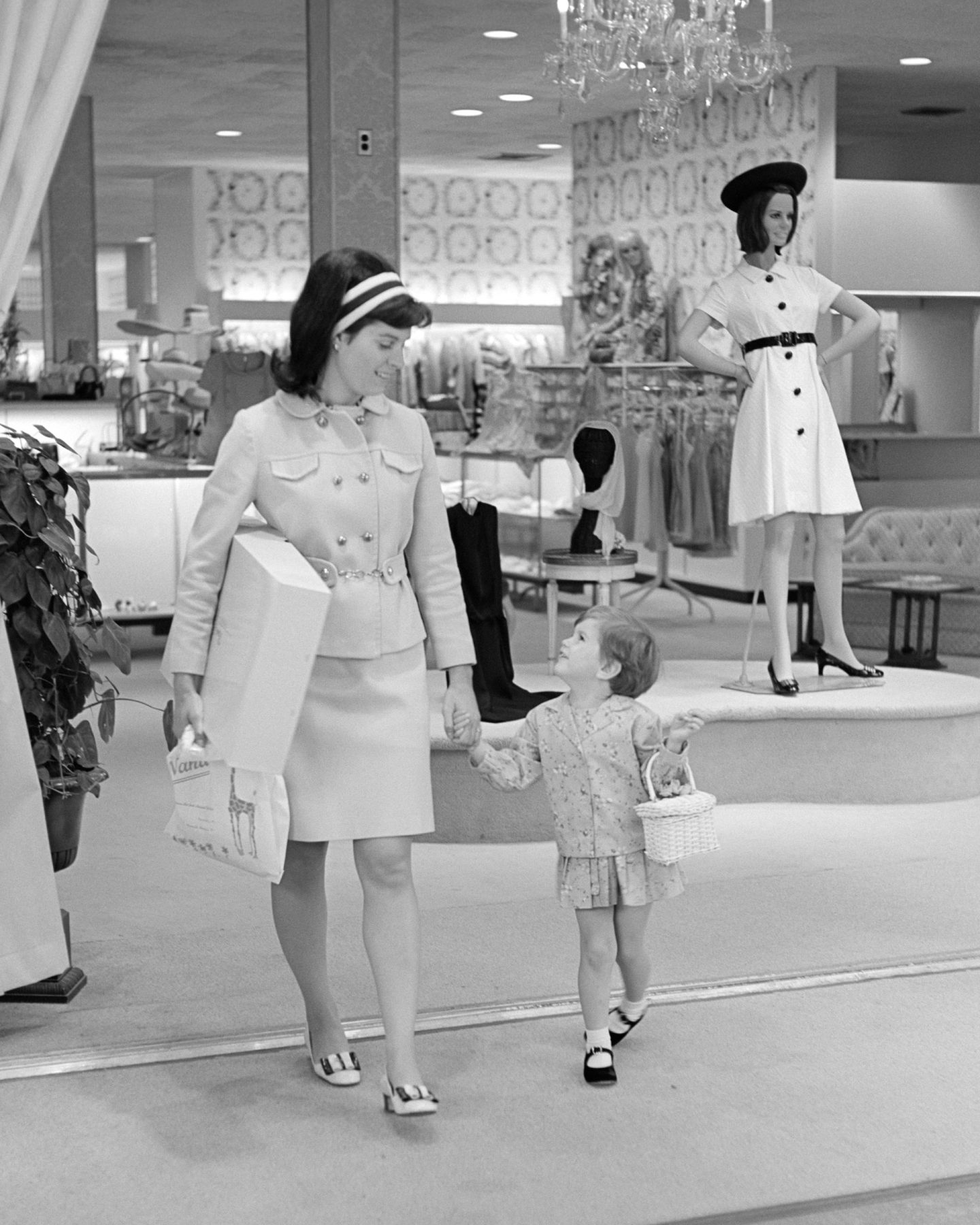
In the 1960s, going shopping was still an event.

H. Armstrong Roberts/ClassicStock/Getty Images

In the 1950’s, Macy’s, Sears and Penney began expanding with large, multi-level stores thanks to the mushrooming of suburban malls across the country.

But a couple of decades later, the rise of big-box retailers that boasted lower prices, like Walmart and Target, challenged that supremacy. And by the 1990’s, department stores were in secular decline. The rise of Amazon and e-commerce more broadly didn’t help.

Amid all this change, department stores started to seem rather old-fashioned, a sea of sameness offering tired brands in badly lit, boilerplate stores where everything seemed to eventually end up in the discount bin. Under pressure, department stores tried to cut margins by reducing staffing, which made them feel messy and untended.

And several leaned into consolidation—which in some ways compounded the problem. When Macy’s purchased May Department Stores in 2006 and acquired regional chains such as Marshall Field’s, it found itself with too many stores, too near each other.

Shifts in consumers’ tastes also dealt a blow: Customers were no longer wowed by being sprayed with perfume upon entry to the beauty section, preferring the less didactic way of selling beauty products that have made the more youth-friendly brand Ulta Beauty a phenomenon in the last decade.

Efforts to compete with Amazon during its ascent in the 2010s had department stores playing catchup on supply chain prowess and integrating stores with e-commerce—sometimes to the detriment of in-store experience. “They forgot what they existed for,” said Joel Bines, a former retail consultant with AlixPartners and a current director of North Carolina-based Belk. ”It became all about efficiency and conglomeration and homogenization.”

In search of fashion authority

Now the pendulum is swinging back toward a focus on how department stores look and feel for customers, the merchandise they sell, and on standing out from the others. A big part of that is undoing the expansions of previous decades: Macy’s is prioritizing 125 of its stores, or a third of its fleet, while closing dozens more stores in the next two years. And JCPenney shed hundreds of stores in its 2020 bankruptcy and is now down to 650 locations, from 1,100 a decade ago.

But as the adage goes in the retail industry, you can’t shrink your way back to greatness. Department stores still have to make a compelling case for consumers to come back.

And there’s ground to regain with the brands department stores sell as well. Luxury brands have sought to distance themselves from the increasingly shabby in-store experience and ubiquitous mark-downs at department stores. For years, fashion companies like Ralph Lauren pulled their products from Macy’s stores to sell more of their products direct to consumers online and at their own stores.

But now, Macy’s CEO Spring, who is credited with revitalizing Bloomingdale’s in the decade he led that chain, is betting that the retailer’s massive reach, with 40 million customers, combined with its improved stores, can restore the brand’s “fashion authority” and lure top brands back.

Department stores are also looking to partner with new brands. JCPenney, for instance, will be selling exclusive items by designer Rebecca Minkoff for the 2025 holiday season.

Winning back older customers

To recreate a premium shopping experience, department stores have to find the right balance between stocking enough variety to serve a range of customers and not cluttering stores with too many products. To that end, Nordstrom and Macy’s are among the chains trimming down their assortments.

That does leave retailers less margin for error and requires a better mastery of data analytics to improve demand forecasting—making sure that what is on offer matches what shoppers want. That will be a challenge for some chains. “They are dealing with this beast of too much data and not enough actionable insights,” says Shelley Kohan, a professor at Fashion Institute of Technology in New York and a former Macy’s executive, noting that this is an area where AI can help.

Still, even if all these chains do renew themselves, no one should expect them to suddenly re-emerge as a big threat to the likes of Walmart or T.J. Maxx. Trying to win new, younger shoppers is expensive and may end up being futile. Some analysts say that’s why department stores should focus on older shoppers, who have much more disposable income. “While some are chasing the finicky Gen Z and millennials, they should really be focused on recapturing Gen X,” says FIT’s Kohan.

Winning back those existing consumers who remember the glamor and delight of an old-fashioned department store shopping spree is the key, says Bines. “Your priors become buyers again, and the buyers become loyal,” he says. “It’s a self-perpetuating cycle. And then maybe you can win some new shoppers.”


Source link

Continue Reading

Business

Nvidia’s CEO says AI adoption will be gradual, but we still may all end up making robot clothing

Published

on


Nvidia CEO Jensen Huang doesn’t foresee a sudden spike of AI-related layoffs, but that doesn’t mean the technology won’t drastically change the job market—or even create new roles like robot tailors.

The jobs that will be the most resistant to AI’s creeping effect will be those that consist of more than just routine tasks, Huang said during an interview with podcast host Joe Rogan this week. 

“If your job is just to chop vegetables, Cuisinart’s gonna replace you,” Huang said.

On the other hand, some jobs, such as radiologists, may be safe because their role isn’t just about taking scans, but rather interpreting those images to diagnose people.

“The image studying is simply a task in service of diagnosing the disease,” he said.

Huang allowed that some jobs will indeed go away, although he stopped short of using the drastic language from others like Geoffrey Hinton a.k.a. “the Godfather of AI” and Anthropic CEO Dario Amodei, both of whom have previously predicted massive unemployment thanks to the improvement of AI tools.

Yet, the potential, AI-dominated job market Huang imagines may also add some new jobs, he theorized. This includes the possibility that there will be a newfound demand for technicians to help build and maintain future AI assistants, Huang said, but also other industries that are harder to imagine.

“You’re gonna have robot apparel, so a whole industry of—isn’t that right? Because I want my robot to look different than your robot,” Huang said. “So you’re gonna have a whole apparel industry for robots.”

The idea of AI-powered robots dominating jobs once held by humans may sound like science fiction, and yet some of the world’s most important tech companies are already trying to make it a reality. 

Tesla CEO Elon Musk has made the company’s Optimus robot a central tenet of its future business strategy. Just last month, Musk predicted money will no longer exist in the future and work will be optional within the next 10 to 20 years thanks to a fully fledged robotic workforce. 

AI is also advancing so rapidly that it already has the potential to replace millions of jobs. AI can adequately complete work equating to about 12% of U.S. jobs, according to a Massachusetts Institute of Technology (MIT) report from last month. This represents about 151 million workers representing more than $1 trillion in pay, which is on the hook thanks to potential AI disruption, according to the study.

Even Huang’s potentially new job of AI robot clothesmaker may not last. When asked by Rogan whether robots could eventually make apparel for other robots, Huang replied: “Eventually. And then there’ll be something else.”


Source link

Continue Reading

Business

The ‘Mister Rogers’ of Corporate America shows Gen Z how to handle toxic bosses

Published

on


After two decades of climbing the corporate ladder at companies ranging from ABC, ESPN, and Charter Communications (commonly known as Spectrum), Timm Chiusano quit it all to become a content creator. 

He wasn’t just walking away from high titles, but a high salary, too. In his peak years, Chiusano made $600,000 to $800,000 annually. But in June of 2024, after giving a 12-week notice, he “responsibility fired himself” from his corporate job as VP of production and creative services at Charter.

He did it all to help others navigate the challenges of a workplace, and appreciate the most mundane parts of life on TikTok.

@timmchiusano

most people are posting their 2024 recaps; these are a few of my favorite moments from the year that was, but i need to start reintroducing myself too i dont have a college degree, no one in my life knew that until i was 35 when i eventually got my foot in the door in my early 20’s after a few years of substitute teaching and part time jobs, i thought for sure i had found the career path of my dreams in live sports production i didn’t think i had a chance of surviving that first college football season but i busted my ass, stuck around and got promoted 5 times in 5 years then i met a girl in Las Vegas, got married in 7 months, and freaked out about my career that had me travelling 36 weeks a year i had to find a more stable “desk job”, i was scared shitless that i was pigeonholed and the travel would eventually destroy my marriage i crafted a narative for espn arguing they needed me on their marketing team because of my unique perspective coming from the production side i got rejected, but kept trying and a year i got that job the 7 years with espn were incredible, but also exhausting and raised all kinds of questions about corporate america, toxic situations, and capitalism in general why was i borderline heart attack stressed so often when i could see that my ideas were literally generating 2,000 times the money that i was getting paid? in 2012 i had a kid and in 2013 i got the biggest job of my career to reinvent how to produce 20,000 commercials a year for small business it took 12 rounds of interviews, a drug test i somehow passed, and a background check that finally made me tell my wife of 8 years that i didnt have a college degree they brought me in the thursday before my first day and told me what i told grace in that clip the next decade was an insane blur; i saw everything one would ever see in their career from the perspective of an executive at a fortune 100 i started making tiktoks, kinda blacked out at some point in 2019 and responsibly fired myself in 2024 to see what i might be capable of on my own with all the skills i picked up along my career journey now the mission is pay what i know forward, and see if i can become the mr rogers of corporate america cc: @grace beverley @Ryan Holiday @Subway Oracle

♬ original sound – timm chiusano

What started as short-video vlogs on just about anything in 2020 (reviews on protein bars, sushi, and sneakers) later transitioned to videos on growing up, and dealing with life’s challenges, like coming to terms when you have a toxic boss. Today, his platform on TikTok has over 1 million followers

With the help of going viral from his “loop” format where videos end and seamlessly circle back to the beginning, he began making more videos as a side-hustle on top of his day-to-day tasks in the office.

“How can I get people to be smarter and more comfortable about their careers in ways that are gonna help on a day-to-day basis?” Chiusano told Fortune.

Today, he could go by many titles: former vice president at a Fortune 100 company, motivational speaker, dad, content creator, or as he labels himself, the Mister Rogers of Corporate America. 

Just as the late public television icon helped kids navigate the complexities of childhood, Chiusano wants to help young adults think about how to approach their careers and their potential to make an impact. 

“Mister Rogers is the greatest of all time in his space. I will never get to that level of impact. But it’s an easy way to describe what I’m trying to do, and it consistently gives me a goal to strive for,” he said. “There are some parallels here with the quirkiness.”

Firing himself after 25 years in the corporate world

Even with years in corporate, Chiusano doesn’t resemble the look of a typical buttoned-up executive. Today, he has more of a relaxed Brooklyn dad attire, with a sleeve of tattoos and a confidence to blend in with any trendy middle aged man in Soho. During our interview, he showed off one of the first tattoos he got: two businessmen shaking hands, a reference to Radiohead’s OK Computer album.

“This is a dope ass Monday in your 40s,” began one of his videos.

It consisted of Chiusano doing everyday things such as eating leftovers, going to the gym, training for the NYC marathon, taking out the trash, dropping his daughter off at school, a rehearsal for a Ted Talk, eating lunch with his wife, and brand deal meetings. Though the content sounds pretty normal, that’s the point. 

“The reason why I fired myself in the first place was to be here,” he says in the video while picking his daughter up from school.

Today, Chiusano spends his days making content on navigating workplace culture, public speaking, brand deals, brand partnerships, executive coaching, writing a book, and the most important job: being a dad to his 13-year-old daughter Evelyn.

“I’m basically flat [in salary] to where I was, and this is everything I could ever want in the world,” he said. “The ability to send my kid to the school she’s been going to, eat sushi takeout almost as much as I’d like, and do nice things for my wife.”

In fact, when sitting inside one of his favorite New York City spots, Lure Fishbar, he keeps getting stopped by regulars who know him by name. He points out that one of his favorite interviews he filmed here was with legendary filmmaker Ken Burns.

Advice to Gen Z

In a time where Gen Z has been steering to more unconventional paths, like content creation or skill trades rather than just a 9-to-5 office job, Chiusano opens up a lens to what life looks like when deciding to be present rather than always looking for what’s next—a mistake he said he made in his 20s. 

Instead, he wants to teach the younger generation to build skills for as long as you can, but “if you are unhappy, that’s a very different conversation.”

“I think some people will make themselves more unhappy because they feel like that’s what’s expected of a situation,” he said.

“I would love to be able to empower your generation more, to be like somebody’s gonna have to be the head of HR at that super random company to put cool standards and practices in place for better work-life balance for the employees.” 


Source link

Continue Reading

Business

Mark Zuckerberg says the ‘most important thing’ he built at Harvard was a prank website

Published

on


For Mark Zuckerberg, the most significant creation from his two years at Harvard University wasn’t the precursor to a global social network, but a prank website that nearly got him expelled.

The Meta CEO said in a 2017 commencement address at his alma mater that the controversial site, Facemash, was “the most important thing I built in my time here” for one simple reason: it led him to his wife, Priscilla Chan.

“Without Facemash I wouldn’t have met Priscilla, and she’s the most important person in my life,” Zuckerberg said during the speech.

In 2003, Zuckerberg, then a sophomore, created Facemash by hacking into Harvard’s online student directories and using the photos to create a site where users could rank students’ attractiveness. The site went viral, but it was quickly shut down by the university. Zuckerberg was called before Harvard’s Administrative Board, facing accusations of breaching security, violating copyrights, and infringing on individual privacy.

“Everyone thought I was going to get kicked out,” Zuckerberg recalled in his speech. “My parents came to help me pack. My friends threw me a going-away party.”

It was at this party, thrown by friends who believed his expulsion was imminent, where he met Chan, another Harvard undergraduate. “We met in line for the bathroom in the Pfoho Belltower, and in what must be one of the all time romantic lines, I said: ‘I’m going to get kicked out in three days, so we need to go on a date quickly,’” Zuckerberg said.

Chan, who described her now-husband to The New Yorker as “this nerdy guy who was just a little bit out there,” went on the date with him. Zuckerberg did not get expelled from Harvard after all, but he did famously drop out the following year to focus on building Facebook.

While the 2010 film The Social Network portrayed Facemash as a critical stepping stone to the creation of Facebook, Zuckerberg himself has downplayed its technical or conceptual importance.

“And, you know, that movie made it seem like Facemash was so important to creating Facebook. It wasn’t,” he said during his commencement speech. But he did confirm that the series of events it set in motion—the administrative hearing, the “going-away” party, the line for the bathroom—ultimately connected him with the mother of his three children.

Chan, for her part, went on to graduate from Harvard in 2007, taught science, and then attended medical school at the University of California, San Francisco, becoming a pediatrician.

She and Zuckerberg got married in 2012, and in 2015, they co-founded the Chan Zuckerberg Initiative, a philanthropic organization focused on leveraging technology to address major world challenges in health, education, and science. Chan serves as co-CEO of the initiative, which has pledged to give away 99% of the couple’s shares in Meta Platforms to fund its work.

You can watch the entirety of Zuckerberg’s Harvard commencement speech below:

For this story, Fortune journalists used generative AI as a research tool. An editor verified the accuracy of the information before publishing. 


Source link

Continue Reading

Trending

Copyright © Miami Select.