Good morning. As artificial intelligence reshapes how people work, some business leaders are betting less on replacing employees—and more on helping them adapt to the technology.
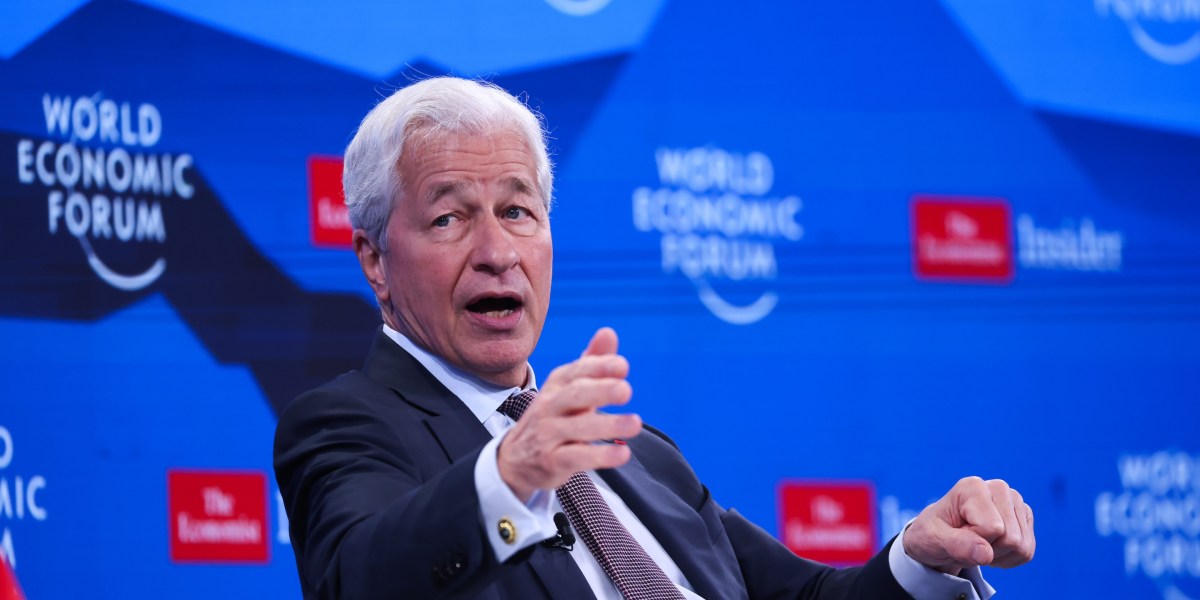
Jamie Dimon, CEO of JPMorgan Chase, the U.S.’s largest bank, has emerged as one of the most vocal executives urging caution about AI’s impact on jobs. Dimon expects to employ fewer workers in the next five years, but he warned that rushing into AI-driven layoffs without safeguards could backfire, potentially triggering “civil unrest,” he said recently while speaking at the World Economic Forum meeting in Davos, Switzerland, Fortune reported.
Dimon said he would even welcome government bans on replacing large numbers of workers with AI if that were necessary to “save society.” He also insisted that companies must plan for the human consequences of automation. “I have a plan to retrain people, relocate people, income-assist people,” Dimon said of the 300,000-plus employees on his payroll.
Regarding the AI boom set to take hold in enterprises, there is significant computing power needed to underpin it all. For more on that topic, I recommend a Fortune feature by my colleague Sharon Goldman, “At the edges of the AI data center boom, rural America is up against Silicon Valley billions.”
Building a future where AI uplifts human talent
Dimon is not alone in calling for AI strategies that put people at the center. Also in Davos, Microsoft President Brad Smith took on what he described as a defining question for leaders during a Harvard Business Review executive panel session: “Can technology be a platform that enables people to get better?” He framed the future of work as a race between humans and machines. “If we’re just going to say today, ‘the best we are today is the best we’re ever going to be,’ then computers will outpace us,” he said.
Smith argued that the outcome changes if each advance in AI is used to upgrade human capability rather than replace it. If workers can use smarter machines to get better at their jobs, he suggested, then in many areas “machines will never catch up.” “You talk about leadership,” he added. “Are we not going to use, as employers and as leaders, technology as tools to help our employees get better themselves?”
Those questions are becoming more urgent as AI moves from experimentation to everyday use. This year, AI is shifting from the pilot and testing phase to enterprise-wide scaling as worker access to AI tools expands, according to Deloitte’s State of AI in the Enterprise 2026 report. Surveyed companies have broadened worker access to AI by around 50% in just one year. While only about one-quarter of respondents said their organizations have moved 40% or more of their AI experiments into production so far, more than half expect to reach that level in the next three to six months.
Yet the report also highlights a gap that connects directly to the concerns raised in Davos. Insufficient worker skills are cited as the biggest barrier to integrating AI into the business, even as fewer than half of companies are making significant changes to their talent strategies. For leaders like Dimon and Smith, the message is clear: the real test of AI leadership may be less about how quickly companies adopt new tools and more about how effectively they help their people keep up.
Bénédicte de Bonnechose was appointed CFO of the Michelin Group, effective June 1. She will succeed Yves Chapot. A member of the Michelin Executive Committee since Jan. 1, 2021, Bonnechose currently supervises the Urban and Long-Distance Transportation Business lines, as well as the European region. She joined the Michelin Group in April 2019 as deputy group CFO.
Dan Karpel was appointed interim CFO of Caleres (NYSE: CAL), a portfolio of consumer-driven footwear brands, effective immediately. Karpel also serves as the company’s SVP and chief accounting officer. He succeeds Jack Calandra, who is leaving Caleres at the end of the month to pursue other opportunities. His departure is not related to any disagreement with the company. The company started an external search for a permanent successor.
Big Deal
Organizational AI adoption has not changed meaningfully from the previous quarter, according to a new Gallup report. In Q4 2025, 38% of U.S. employees said their organization has integrated AI technology to improve productivity, efficiency and quality, while 41% said their organization has not implemented AI tools and 21% said they don’t know. These results are similar to Q3 figures.
Gallup reports that employees in technology, finance and higher education show the highest levels of AI use, especially compared with employees in retail, manufacturing and health care.
However, the report also finds that employees who already use AI at work did so slightly more often in the fourth quarter of 2025 than in the prior quarter, continuing a gradual increase since 2023. The share of employees who use AI daily has grown from 10% to 12%, and frequent use—defined as engaging with AI at work at least a few times a week—has edged up three points to 26%.
Courtesy of Gallup
Going deeper
“Minnesota-based CEOs, including Fortune 500 bosses, call for ‘immediate de-escalation of tensions’ after fatal shooting” is a Fortune article by Jason Ma.
In an open letter Sunday from the Minnesota Chamber of Commerce, more than 60 CEOs said the business community has been working behind the scenes with officials for several weeks.
“With yesterday’s tragic news, we are calling for an immediate de-escalation of tensions and for state, local and federal officials to work together to find real solutions,” CEOs state in the letter.
Overheard
“Retailers did not ask to be put into the middle of America’s political and legal fight over immigration. But they are being drafted nonetheless, and need to scream these facts loudly from the mountaintops to de-escalate a worsening situation.”
—Jeffrey Sonnenfeld, professor and founder of the Yale Chief Executive Leadership Institute, and Steven Tian, a research director at the institute, and a former analyst for Rockefeller Capital Management, write in a Fortune opinion piece.