Connect with us

Business

How Expedia’s CTO is using AI to transform work for 17,000 employees—and travel for millions

Published

on


Ramana Thumu, the chief technology officer at Expedia Group, says there’s no “AI Center of Excellence” at the online travel agency that sits in an ivory tower and mandates how everyone should be using artificial intelligence.

“We are democratizing AI across the entire company,” says Thumu. “Every employee, every team, and every workflow.”

Some examples of how this plays out include the creation of Expedia’s “AI playground,” which gives employees access to more than 60 different large language models—including from OpenAI, Google’s Gemini, Meta’s Llama, and Anthropic’s Claude—to build their own AI agents. Since January 2025, employees have built more than 1,500 different AI agents and around 6,000 monthly sessions occur within the secure AI agent builder environment on a monthly basis. 

Around two-thirds of Thumu’s software developer workforce have embraced AI coding assistant tools including Copilot, Claude Code, and Cursor, often resulting in an estimated 20% productivity lift. Thumu says he wants to bring more “joy” to coding by giving them a broad set of AI tools to infuse in their workflows. He vows that more efficiency won’t necessarily mean fewer jobs. “That’s not how I see it,” Thumu adds. “It’s an improvement which means you can get more work done, much faster, and higher quality work.” 

And last year, Expedia began to embed AI “squads,” teams of around four to six AI engineers that work with various business divisions ranging from legal, procurement, human resources, and marketing, collaboratively working alongside AI “champions” for each of those segments to figure out where AI can possibly be implemented to handle some manual tasks. 

Every one of these AI investments are being measured, ranging from velocity and cycle time for the AI coding assistant tools, and within customer service, tracking how AI is speeding up the time it takes to resolve a customer query. For the broader employee population, Expedia is measuring usage and the impact on workflows. If the company doesn’t see the right adoption or outcomes for these tools, Thumu says Expedia is quick to reassess and adjust its approach.

“We are absolutely testing a lot of experiences and placing a lot of bets to make sure which ones stick and where we scale, and when the test is not wildly successful, fail fast and take those learnings to do something different,” says Thumu.

He joined Expedia, which ranks No. 312 on the Fortune 500, in late 2024 after a decade in technology leadership roles at sports-merchandising company Fanatics. As Expedia’s CTO, Thumu says his core AI priorities include testing and deploying internal productivity use cases, customer-facing external applications that will lean more heavily on multi-step agentic AI, and a focus on data as well as partner support from large language model providers.

“The same transformation that is happening inside the company is going to show up to hundreds of millions of travelers,” says Thumu.

External applications of AI include Expedia Trip Matching, which debuted in June and allows travelers to share any publicly available travel reel that caught their attention on Instagram and then share that reel directly with Expedia. The travel company will then use AI to produce a customized itinerary and travel tips that are based on the content that was originally created by an influencer.

In October, Expedia also served as a pilot partner—along with Booking.com, Zillow, and Spotify—for what’s known as “Apps in ChatGPT,” a feature that aims to further integrate the chatbot with external brands. As an example, a ChatGPT user can type in: “Expedia, find me a hotel in Paris for under $600 per night in March” and it will pull up a list with prices and links that go to Expedia’s site.

The company also developed an AI customer service agent that’s built on Amazon Web Services, which can help travelers with simple tasks including cancelling a hotel booking, getting a refund status, or changing their books so they don’t need to call a human agent. Expedia says this AI agent handles 143 million conversations a year and resolves over 50% of traveler queries.

As Expedia moves forward with embracing more agentic AI capabilities, Thumu stresses that the company will prioritize stitching together the technology in a manner so one AI companion can help customers effortlessly through all touchpoints. He doesn’t want to build one AI companion that helps book hotels, another to handle discovery for excursions, and yet another to address customer service questions. 

“We are trying to bring those together,” says Thumu. “To make sure that from a customer standpoint, it’s one agentic experience. There is a lot of work to be done, but we are in the initial stages.”

John Kell

Send thoughts or suggestions to CIO Intelligence here.

NEWS PACKETS

AI’s health care embrace continues to accelerate. Anthropic debuted a new offering within its Claude chatbot that can access medical information, an offering that’s intended for both large organizations and consumers. As Fortune reports, health-related questions are a leading consumer for AI chatbots and while Anthropic has historically been more focused on serving enterprises, this latest offering is an indication that Anthropic would like to make real inroads with consumers. Separately, OpenAI launched ChatGPT Health, which allows users to connect their medical records and wellness apps to the chatbot. But AI companies pushing into heath care need to be careful to closely guard consumer data and avoid inaccurate outputs. An investigation by the Guardian uncovered that some of Google’s AI Overviews provided false or inaccurate information when asked about blood tests.

Apple taps Google’s Gemini for AI-enabled Siri. The iPhone maker has inked a multiyear pact with Google to lean on the latter company’s Gemini to power its AI features, including a big upgrade for Siri that’s expected later in 2026. While the companies didn’t share details about the financials behind the deal, Bloomberg has previously reported that Apple was planning to pay about $1 billion a year to utilize Google AI. The deal is the latest sign that Google is continuing to make serious gains in the AI race against top rival OpenAI.

Nvidia to invest $1 billion in a new AI lab with Eli Lilly. The AI chip maker and pharmaceutical giant behind blockbuster drugs including Type 2 diabetes treatment Mounjaro and antidepressant Prozac are joining forces to build a facility in Silicon Valley that will aim to speed up the use of AI in drug discovery, a costly and time-intensive process. On top of that, the companies say that they see opportunities to apply AI across clinical development, manufacturing, and commercial operations, leveraging multimodal models, agentic AI, robotics, and digital twins.

Moody’s says data centers will need $3 trillion through 2030. The credit ratings company forecasts that at least $3 trillion of data-center investments will be needed to support building facilities, computer equipment, and new capacity to support the rising demand in AI and cloud computing. A big chunk of that spending will come directly from some of the world’s most valuable companies, as Moody’s says six players—Microsoft, Amazon, Alphabet, Oracle, Meta Platforms, and CoreWeave—are forecasted to spend $500 billion on data center investments in 2026, Bloomberg reports.

Walmart expands drone delivery program. Walmart and drone operator Wing, a unit of Google parent Alphabet, have announced that they plan to make package deliveries by sky available to tens of millions of shoppers by expanding the service to more than 270 Walmart locations by the end of 2027. The Wall Street Journal reports that Wing estimates that more than 40 million Walmart shoppers would have access to the service, up sharply from roughly 2 million mostly limited to the Dallas-Fort Worth and Atlanta regions today. Drone deliveries have been an enticing technology application intended to make it even easier to deliver online orders, but most actual applications have been restricted to just a few markets.

ADOPTION CURVE

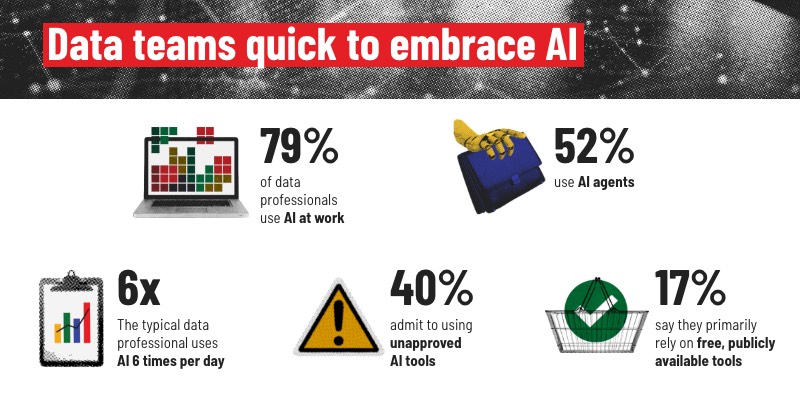
Data professionals are using unauthorized AI tools way more than they should be. Four out of every ten data professionals admitted that they use unauthorized AI at work, and 17% say they are primarily relying on free, publicly available AI tools, according to a recent survey conducted by tech training provider General Assembly. Devanshu Mehrotra, lead instructor of data science and data analytics at General Assembly, tells Fortune that these figures represent an expectation gap between employers and their workforce.

“Employees are expected to be more productive,” says Mehrotra. But, “they are not being given enough instructions and training to understand how to do it properly, or they are not given the tools that are required, and so they end up going the shadow AI route.”

He added that enterprises should more clearly communicate when and where AI should be used and also delineate the difference between a high risk use case that could expose sensitive data externally and lower-risk activities, like asking a chatbot general queries. AI policies, Mehrotra adds, “needs to be more focused on how you can use AI, what education you need to use or have before you can use AI, and what are approved versus unapproved use cases of AI.”

Courtesy of General Assembly

JOBS RADAR

Hiring:

Fortrea is seeking a chief data officer, based in Durham, North Carolina. Posted salary range: $200K-$250K/year.

Redesign Health is seeking a VP of technology, AI ventures, based in New York City. Posted salary: $198K/year.

Armada is seeking a head of engineering for the federal program, based in Seattle. Posted salary range: $187.4K-$235K/year.

AppFolio is seeking a SVP of engineering, based in San Diego. Posted salary range: $324K-$405K/year.

Hired:

Airbnb has appointed Ahmad Al-Dahle to the role of CTO, joining the home-sharing technology company from Meta, where he led the Facebook parent company’s generative AI efforts and the team behind the Llama family of open source models. Prior to Meta, Al-Dahle spent over 16 years at Apple, where he was one of the technologists behind the iPhone’s display and multitouch systems and also worked on the first Apple Watch.

Nationwide has promoted Misty Kuamoo to serve as CTO and SVP of Nationwide Financial, following the appointment of Michael Carrel, who was appointed CTO for the overall enterprise in December 2025. Kuamoo will be responsible for all technology solutions that support the insurer’s financial services businesses. She has served as a technology leader within Nationwide for more than five years.

The Timken Company promoted John Szarka to the new position of CTO after he most recently served as a vice president for the manufacturer of engineered bearings and industrial motion products. Szarka has worked at Timken for more than two decades, beginning as a sales engineer and earning steady promotions throughout his career, becoming a division president beginning in 2017.

GitLab has appointed Siva Padisetty as CTO to lead software engineering, operations, and the customer support teams for the software development platform. Padisetty succeeds Sabrina Farmer, who stepped down from her role and will remain in an advisory capacity through January 31. Previously, Padisetty served as CTO at web tracking software company New Relic.

1Password appointed Nancy Wang as CTO, where she will lead the global engineering team and steer the AI strategy for the password-management service provider. Wang previously served as general manager and director of engineering and product for AWS’ data protection business. She was also previously a founding product manager at data security company Rubrik. 

Curated For You appointed Brad Klingenberg as CTO, where he will lead the engineering and data science teams for the e-commerce technology company. Klingenberg previously served as a c-founder for three years at the software startup Naro and worked as chief algorithms officer for smoothie company Daily Harvest and online personal styling service Stitch Fix.

Amerisure has expanded Amjed Al-Zoubi’s role to now serve as chief information and data officer, broadening his scope to lead the commercial property and casualty insurance company’s analytics and AI efforts. Al-Zoubi initially joined Amerisure in 2018 as a VP of applications systems and had served as CIO since 2020. He also previously served as an IT director for USAA and CUNA Mutual Group.

Validity promoted Matt Gore to serve as CTO from SVP of engineering for the software provider. Gore joined Validity through the company’s acquisition of email marketing software company Litmus last year, where he served as chief product and technology officer.

Benchmark Electronics announced the appointment of Josh Hollin as SVP and CTO, succeeding Jan Janick, who will retire on January 16. Most recently, Hollin served as VP of engineering and technical program management at camera company GoPro. Prior to GoPro, Hollin held senior leadership roles at recycling infrastructure startup AMP Robotics and electronics manufacturer Flex.

Darktrace has appointed Terry Doyle as CIO and is also joining the cybersecurity company’s executive committee. As CIO, Doyle will establish and steer a newly consolidated enterprise IT and data team. Most recently, he served as group CIO at internet solutions provider Team Internet Group. He also previously held senior CIO roles at RWS, a provider of translation services.


Source link

Continue Reading

Business

Denmark and Greenland agree to form working group over the future of the territory

Published

on


A top Danish official said Wednesday that a “fundamental disagreement” over Greenland remains with President Donald Trump after holding highly anticipated White House talks with Vice President JD Vance and Secretary of State Marco Rubio.

The two sides, however, agreed to create a working group to discuss ways to work through differences as Trump continues to call for a U.S. takeover of the semiautonomous territory of NATO ally Denmark.

“The group, in our view, should focus on how to address the American security concerns, while at the same time respecting the red lines of the Kingdom of Denmark,” Danish Foreign Minister Lars Løkke Rasmussen told reporters after joining Greenland’s foreign minister, Vivian Motzfeldt, for the talks. He added that it remains “clear that the president has this wish of conquering over Greenland.”

Trump is trying to make the case that NATO should help the U.S. acquire the world’s largest island and says anything less than it being under American control is unacceptable.

Denmark, meanwhile, announced plans to boost the country’s military presence in the Arctic and North Atlantic as Trump tries to justify his calls for a U.S. takeover of the vast territory by repeatedly claiming that China and Russia have their designs on Greenland, which holds vast untapped reserves of critical minerals.

The president did not take part in Wednesday’s meeting. In an Oval Office exchange with reporters following the talks, he reiterated his commitment to acquiring the territory.

“We need Greenland for national security,” Trump said. He added: “We’ll see how it all works out. I think something will work out.”

Before the meeting, Trump took to social media to make the case that “NATO should be leading the way” for the U.S. to acquire the territory.

“NATO becomes far more formidable and effective with Greenland in the hands of the UNITED STATES,” Trump wrote. “Anything less than that is unacceptable.”

NATO Secretary General Mark Rutte has sought to keep an arms-length away from the dispute between the most important power and the other members of the 32-country alliance unnerved by the aggressive tact Trump has taken toward Denmark.

Both Løkke Rasmussen and Motzfeldt offered measured hope that the talks were beginning a conversation that would lead to Trump dropping his demand of acquiring the territory and create a path for tighter cooperation with the U.S.

“We have shown where our limits are and from there, I think that it will be very good to look forward,” Motzfeldt said.

Denmark bolstering presence in Arctic

In Copenhagen, Danish Defense Minister Troels Lund Poulsen announced an increase in Denmark’s “military presence and exercise activity” in the Arctic and the North Atlantic, “in close cooperation with our allies”.

Poulsen said the stepped-up military presence was necessary in a security environment in which “no one can predict what will happen tomorrow.”

“This means that from today and in the coming time there will be an increased military presence in and around Greenland of aircraft, ships and soldiers, including from other NATO allies,” Poulsen said.

Other NATO allies were arriving in Greenland along with Danish personnel, he said. Poulsen declined to name the other countries contributing to an increased Arctic presence, saying that it is up to the allies to announce their own participation.

The new security commitments, at least those publicized by Greenland’s allies, appeared modest.

Germany said it would send 13 personnel this week to Greenland “to explore the framework for potential military contributions” on the island. Sweden announced Wednesday it was sending an unspecified number of personnel to Greenland for military exercises. And two Norwegian military personnel also were being sent to Greenland to map out further cooperation with allies, the country’s defense minister, Tore O. Sandvik, told newspaper VG.

NATO is also looking at how members can collectively bolster the alliance’s presence in the Arctic, said a NATO official who was not authorized to comment publicly and spoke on condition of anonymity. The official added there’s consensus “that security in the High North is a priority.”

Greenlanders want the US to back off

Greenland is strategically important because, as climate change causes the ice to melt, it opens up the possibility of shorter trade routes to Asia. That also could make it easier to extract and transport untapped deposits of critical minerals which are needed for computers and phones.

Trump says Greenland is also “vital” to the United States’ Golden Dome missile defense program. He also has said he wants the island to expand America’s security and has repeatedly cited what he says is the threat from Russian and Chinese ships as a reason to control it.

“If we don’t go in, Russia is going to go in and China is going to go in,” Trump argued anew Wednesday. “And there’s not a thing that Denmark can do about it, but we can do everything about it.”

But experts and Greenlanders question that claim, and it has become a hot topic on the snow-covered main street in Greenland’s capital, where international journalists and camera crews have descended as Trump continues his takeover talk.

“The only Chinese I see is when I go to the fast food market,” heating engineer Lars Vintner said. He said he frequently goes sailing and hunting and has never seen Russian or Chinese ships.

In interviews, Greenlanders said the outcome of the Washington talks didn’t exactly evince confidence that Trump can be persuaded.

“Trump is unpredictable,” said Geng Lastein, who immigrated to Greenland 18 years ago from the Philippines.

Maya Martinsen, 21, said she doesn’t buy Trump’s arguments that Greenland needs to be controlled by the U.S. for the sake maintaining a security edge in Arctic over China and Russia. Instead, Martinsen said, Trump is after the plentiful “oils and minerals that we have that are untouched.”

Greenland “has beautiful nature and lovely people,” Martinsen added. “It’s just home to me. I think the Americans just see some kind of business trade.”

Denmark has said the U.S., which already has a military presence, can boost its bases on Greenland. The U.S. is party to a 1951 treaty that gives it broad rights to set up military bases there with the consent of Denmark and Greenland.

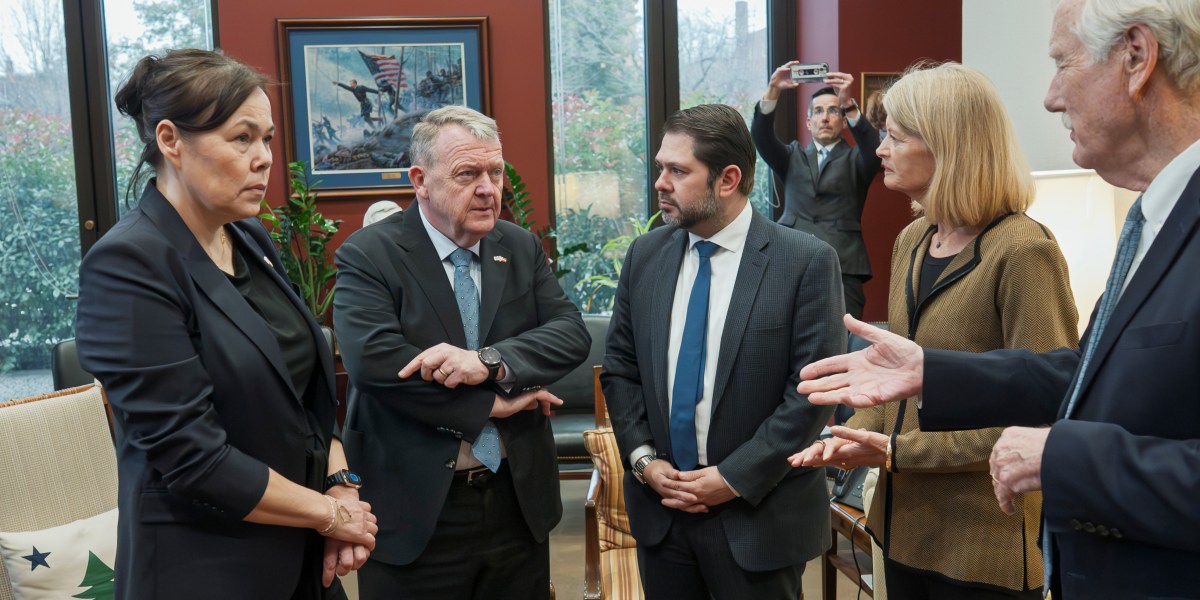
Løkke Rasmussen and Motzfeldt, along with Denmark’s ambassador to the U.S., planned to meet later Wednesday with senators from the Arctic Caucus. A bipartisan delegation of U.S. lawmakers is also heading to Copenhagen this week to see Danish and Greenlandic officials.

Both Løkke Rasmussen and Motzfeldt said while they remain at loggerheads with Trump, it remains critical to keep talking.

“It is in everybody’s interest — even though we disagree — that we agree to try to explore whether it is doable to accommodate some of the concerns while at the same time respecting the integrity of the Danish kingdom’s territory and the self-determination of the Greenlandic people,” Løkke Rasmussen said.

___

Burrows reported from Nuuk, Greenland and Ciobanu from Warsaw, Poland. Associated Press writers Stefanie Dazio and Geir Moulson in Berlin, Lisa Mascaro, Aamer Madhani and Will Weissert in Washington and Catherine Gaschka in Paris contributed to this report.


Source link

Continue Reading

Business

Rural America is getting a bailout, but not from Trump—billionaires are riding to the rescue

Published

on


Rural America is getting a bailout.

Billionaires are increasingly stepping in to plug gaps in services, education, and opportunity that many small towns say have been ignored for years. While Washington remains gridlocked over how to revive areas left behind by industrial and demographic change, a growing class of wealthy donors is quietly reshaping the economic future of the countryside with nine-figure checks and thousands of acres of land.

Minnesota billionaire Glen Taylor, who built Taylor Corp. into a printing empire and became his state’s wealthiest resident, is now redirecting a significant slice of his fortune back to the rural communities that raised him. The 84-year-old former dairy farm kid from outside Comfrey, Minnesota (pop. 376 as of 2024), is transferring farmland and securities worth roughly $100 million into the Taylor Family Farms Foundation, with a specific mandate to support rural areas in Minnesota and Iowa.

Rather than offering a one-time cash infusion, Taylor’s gift is structured to generate income for years, building on a 2023 transfer of about $173 million in farmland that already funds grants through regional nonprofit partners. Taylor said the move is rooted in his own upbringing in southern Minnesota, where he worked on farms and raised chickens, and in a desire to “make a positive impact on the lives of others in a region that I love so much,” Taylor said in a statement to the Observer.​

Billionaire rural wave

Taylor is part of a broader pattern in which ultrawealthy donors are focusing explicitly on small-town and rural America rather than the big-city universities and museums that long dominated philanthropy. Investment banker Byron Trott, who grew up in Union, Missouri, has pledged $150 million to a network of universities to boost enrollment from rural students, a push that has already helped drive a 20% increase in applications.

Philanthropist MacKenzie Scott has similarly turned her attention to rural education, donating $36 million to North Carolina institutions such as Robeson Community College and Bladen Community College to bolster opportunities in some of the country’s poorest counties. Together, these gifts signal a recognition among billionaires that the country’s economic and political fault lines increasingly run between thriving metros and struggling rural regions—and that private money can move faster than federal policy.

Politics, power and dependence

The surge of billionaire attention comes as rural voters remain a core political base for Trump, whose “forgotten men and women” rhetoric helped power his return to the White House but has not translated into a sweeping federal revival plan for small-town America. In that vacuum, philanthropists like Taylor, Trott, and Scott are effectively writing their own rural policy agendas through foundations and grantmaking, deciding which towns get ambulances, which fire departments get radios, and which students get a shot at college.

Trump’s administration has announced a $12 billion bailout for farmers in the wake of a wipeout amid his tariff regime, particularly for soybeans. At one point in 2025, as Trump and Treasury Secretary Scott Bessent announced support for like-minded ally Javier Milei in Argentina, China cut its U.S. soybean purchases to zero and began buying them from Argentina instead. After a Trump-Xi summit, China resumed soybean purchases, and more recently Argentina has repaid its full $20 billion credit line. Kentucky soybean farmer Caleb Ragland told the Associated Press in early January that Trump’s aid for farmers was “a Band-Aid on a deep wound. We need competition and opportunities in the market to make our future brighter.”

For this story, Fortune journalists used generative AI as a research tool. An editor verified the accuracy of the information before publishing.


Source link

Continue Reading

Business

Highway 1 along Big Sur reopens after 3 years of closures amid tourism-destroyin landslide

Published

on


A 90-mile (145-kilometer) section of California’s Highway 1 along the famous Big Sur coast finally reopened Wednesday after three years of closures and repairs following a series of landslides and a roadway collapse that hampered tourism on the scenic route.

The reopening around midday came three months ahead of schedule, and business owners say that should give travelers plenty of time to plan their spring and summer road trips.

“Today is a monumental milestone for us,” said a relieved Colin Twohig, general manager of the Big Sur River Inn. “We’re hitting the light at the end of the tunnel after three long years.”

The first shutdown came in January 2023 when a series of powerful atmospheric rivers triggered a major landslide. The highway was buried again the following year during another wet winter, when a lane also collapsed down a cliff near the Rocky Creek Bridge.

The traffic stoppage between Carmel and Cambria cut off access to Big Sur, an isolated stretch of the state’s central coast where misty, forested mountains rise up from the ocean. What used to be a short drive between the southern and northern sections — with tiny Big Sur Village roughly in the middle — became an eight-hour trek inland and then back toward the seashore.

The isolated area, home to fewer than 2,000 residents, is known for its panoramic hiking trails along high cliffs and craggy beaches where seals and sea lions sometimes sprawl out. The late “Tropic of Cancer” author Henry Miller lived there for nearly two decades starting in the 1940s, and there’s now a library devoted to his work.

Highway 1 is famously a must for California visitors traveling between Los Angeles and San Francisco, and Twohig said he looks forward to seeing tourists in cars and motorhomes back on the road.

Twohig estimated that his inn, with 22 guest rooms, a large restaurant and a general store, saw a 20% drop in business. He said the road closure directly following COVID-19 restrictions was a one-two punch. The inn spent the down time making improvements and marketing heavily to entice California residents to visit during the off-seasons.

“When you have a hospitality business, you really rely on the busy season, and when there is no busy season, it can be a hard pill to swallow,” he said. “Having that lifeline back is huge.”

There were multiple closures at various locations throughout the past three years, and the last stretch that remained shut was a 7-mile (11-kilometer) span near Lucia, according to the California Department of Transportation, or Caltrans.

Gov. Gavin Newsom announced the opening on social media, thanking Caltrans for the speedy work in “reviving a vital economic lifeline for local business owners and residents affected by the closure.”

Caltrans, which has called Highway 1 the jewel of the state highway system, placed steel and concrete to shore up the collapsed cliffside.


Source link

Continue Reading

Trending

Copyright © Miami Select.