Business
How Dr. Becky Kennedy built Good Inside parenting platform into a $34 million business
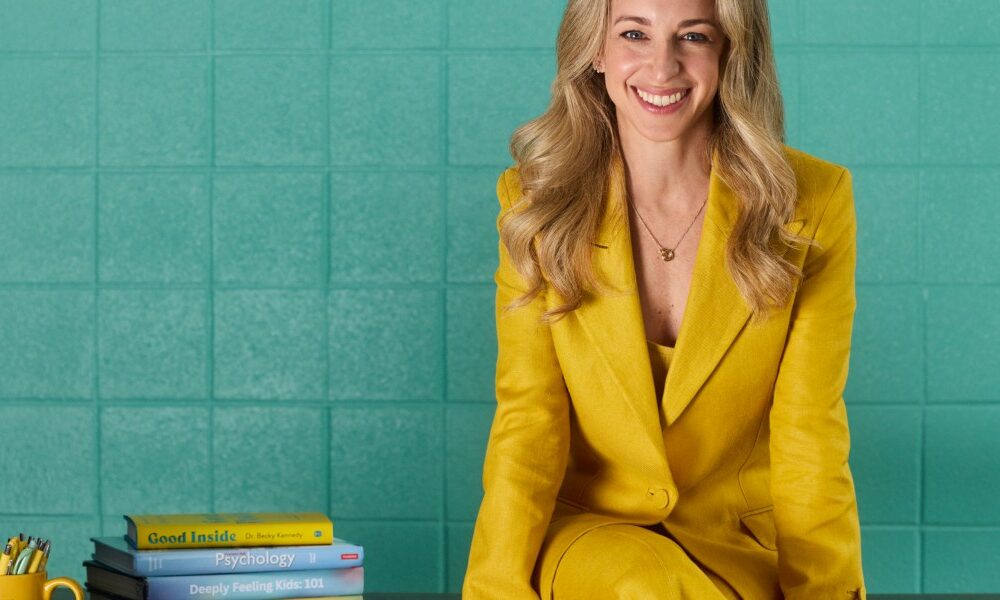
Just over five years ago, Dr. Becky Kennedy did not have an Instagram account. The married mother of three was a practicing psychologist in Manhattan who counseled families in person. But as the COVID pandemic trapped parents at home with restless kids, she launched herself on Instagram, taking to the masses what would become her signature parenting concepts: modeling emotional regulation, setting boundaries, and recognizing so-called “deeply feeling” kids who are, in her words, “more porous to the world.” A few months later, she started a company, Good Inside—a nod to her belief that all children are good inside.
Almost instantly, her bare-bones videos resonated with working-from-home, schooling-from-home millennial parents (mostly moms), seeking tips and tricks, as well as Kennedy’s reassurance that they were doing a good job, even in their tear-their-hair-out state.
Since then, Kennedy has grown her Instagram audience to 3.4 million and now funnels those followers into her booming Good Inside empire, which includes digital memberships, a podcast, brand partnerships, and books. The business, with more than 60 employees, is profitable and generated $34 million in revenue last year, a nearly 50% increase year-over-year, Fortune is first to report.
Kennedy says she never set out to be a founder; the Good Inside business grew organically out of the positive response she received on Instagram from parents, and her sense that they needed her help. “Parenting is the hardest job in the world,” she says. “It’s the one we care the most about, and it’s the one we’re given the least education and support for.” Today’s parents are seeking to improve their skills at home the same way they might hone their management skills at work, she says: “Parenting,” she explains, “is the ultimate form of leadership.”
Dr. Becky’s ‘magic potion’
Kennedy’s goal is for Good Inside to provide more comprehensive parenting support than any one self-help book can offer. The Good Inside app features multi-part parenting workshops, snackable content like a 3-minute video of Kennedy explaining “how to get your kid to stay in their bed,” and a private community where subscribers ask for advice and share their parenting wins: One mom crowdsources ideas for books related to grief and sadness; another touts progress on teaching her kid how to lose graciously.
Kennedy is among the many social media influencers who have launched business models that are not dependent on the platforms—Instagram, TikTok—that fueled their rise. Influencers can fall into the trap of essentially being “Uber drivers for Instagram or TikTok,” says Sean Branagan, director of the Center for Digital Media Entrepreneurship at Syracuse University. “You’re waiting for the assignment and the money; you’re not in control of where your business is going.” Kennedy has monetized her social media following by creating an affinity group—rather than seeking mass appeal—and she “cares for, stimulates, and advances” her audience with her paid offerings, Branagan says. “What she has is a magic potion, and it’s about more than her face and name.”
Good Inside digital memberships cost between $23.25 and $28 a month and the platform passed 100,000 subscribers in the third quarter of last year. The company has raised one round of funding, $10.5 million from VC firms including Alexa von Tobel’s Inspired Capital, in 2023. It’s otherwise bootstrapped by Kennedy and her co-founder Erica Belsky, another psychologist Kennedy met while studying at Columbia who is married to Scott Belsky, an early investor in Uber and Pinterest and an unofficial advisor to the company. Kennedy says she has no immediate plans to raise more money, but is open to the possibility.
One of the flashiest ways Good Inside is serving parents at the moment is with its AI chatbot GiGi. Kennedy says she’s “pragmatic;” she knows parents are asking ChatGPT and Claude their middle-of-the-night and mid-meltdown questions. She envisions GiGi as a trusted space for parents; one that fosters more of a “two-way relationship” that connects the dots for users. “A parent might ask about three very different things in three different sessions, but on our end, we see the thread throughout, and can serve up what they might be missing and what might be a helpful next step,” Kennedy says. That kind of predictive support can help get parents out of “fire-extinguishing mode,” Kennedy says. “I always tell parents, better than knowing how to extinguish a fire is actually just having fewer fires.”
Professionalizing parenting
There are critics of Kennedy’s gentle-parenting-adjacent advice, but still others have taken issue with the business she’s built around it. Kennedy is often lumped in with parenting influencers who, critics say, breed anxiety among parents (mostly moms) by selling the concept of there being a “right” way of parenting and then charging for it. The proliferation and easy availability of parenting resources generally, from digital resources to AI chatbots, can cause today’s parents additional stress by inviting them to check and double-check things they might otherwise do without a second thought, says Charlotte Faircloth, professor of family and society at the University College London Social Research Institute.
In defending herself and her business, Kennedy returns to the idea that seeking help with parenting—and paying for it—is not all that different from pursuing coaching of other kinds. “I’ve never heard anyone say that executive coaches make CEOs anxious, right? I don’t hear anyone saying money managers make people anxious with their finances, or basketball coaches or sports psychologists make athletes anxious in those fields.”
She also suggests that criticism of her learning-focused business model carries hints of misogyny. “Women especially, are told this narrative of maternal instinct,” she says. “If that’s true, then every single moment of parenting becomes a barometer of whether you’re good enough: ‘Do I have the natural instinct to do this right?’ That’s a very, very overwhelming, shame-inducing space to be in.”