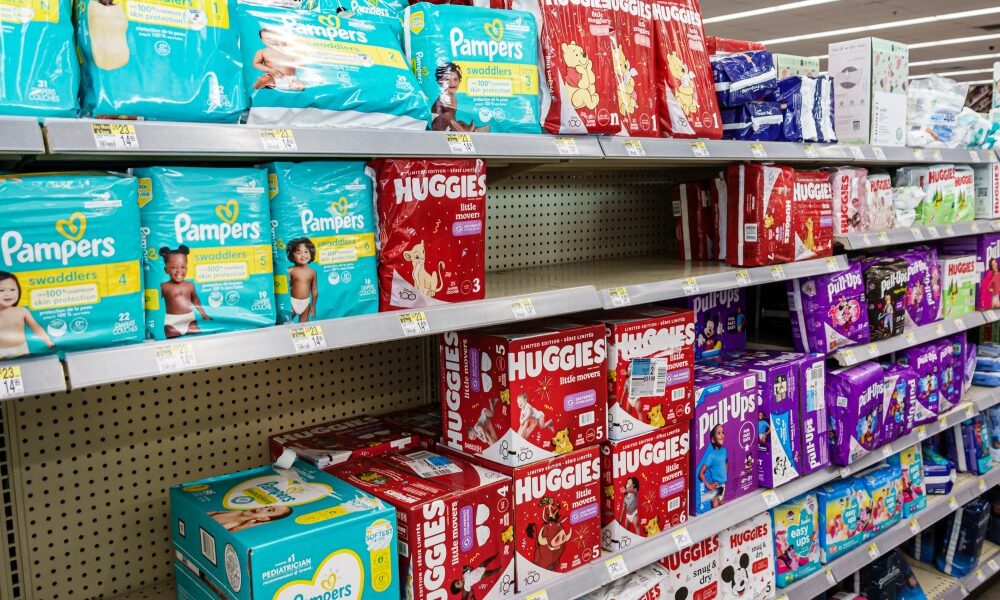
When Procter & Gamble designed its premium Pampers Amore line, launched in the U.S. in March, the consumer products giant focused on the diapers’ greater absorbency, a cashmere-like feel, and superior skin protection properties to make it stand out from the pack.
Amore was P&G’s first new line for newborns and toddlers since 2018, and it’s been an early success. Sales are expected to hit $100 million in its first year, and it was a key contributor to P&G’s best quarter for organic sales growth in nearly three years. It also embodies how the company plans to convince consumers to stomach higher prices—a 108-pack of Amore diapers are 10% more expensive than Pampers Swaddlers—even as they battle inflation and demand more for their money.
Last week, P&G reported that organic sales, a metric that strips away the impact of currency movements and of acquisitions and divestitures, rose 4% in its first fiscal quarter of 2027, its best performance in 11 quarters. The performance reassured Wall Street that new P&G CEO Shailesh Jejurikar can navigate the tough climate for consumer goods. Shares rose 6% Thursday on the results, their biggest jump since 2020.
Bargains below, innovation above
Like many consumer products brands and food and beverage makers, P&G is confronting shoppers feeling pinched by rising prices and a growing chasm between the purchasing power of well-heeled consumers and the bargain hunting of those who are struggling.
Jejurikar told analysts last week that the strong quarter results reflected P&G’s “sharpened execution of our integrated strategy.” On the lower end of the economic spectrum, that strategy has offered consumers lower prices and new pack sizes of household staples. (In its most recent quarter, average price in P&G’s baby, feminine, and family care unit fell 1.2%.) On the higher end, P&G is offering product innovation—like its Amore diapers—that can command higher prices. Another recent P&G innovation was the creation last year of Pantene’s Abundant & Strong haircare line aimed at women struggling with hair loss, drawing on P&G research linking scalp oxidative stress with poorer scalp conditions and hair quality.
“We know how to grow these categories and win with superior innovation, better execution, and clear communication.,” CFO Andre Schulten, a 30-year P&G veteran, told CNBC in an interview last week.
Reversing a slide
Under Jejurikar’s predecessor Jon Moeller, P&G managed inflation by raising prices just enough to protect revenue without alienating consumers. It also pruned its portfolio of more stagnant products to focus on those with better growth prospects. But during Moeller’s time as CEO, which ran from 2021 through 2025, P&G’s organic sales growth gradually shrank, slipping from 7% in fiscal 2023 to 1% in fiscal 2026.
The recent results sharply reversed that decline.
“[The results] should bolster confidence that its innovation and value interventions are restoring underlying growth,” Bloomberg Intelligence analyst Diana Gomes said in a research note.
The innovation mandate
Jejurikar has witnessed many ups and downs at the consumer products behemoth. He started at Procter & Gamble in 1989 as assistant brand manager of personal health care in India. He joined P&G’s global leadership team in 2014, later becoming CEO of its largest business unit, Fabric & Homecare, in 2019. Two years later, he was promoted to operating chief, the same position Moeller held before he became CEO. The company named Jejurikar chairman this summer.
The current two-year restructuring program that began under Moeller and included 7,000 job cuts is halfway done. But Jejurikar has been tasked with more than just seeing that effort through. His mandate is to re-energize P&G’s innovation machine so it can protect its market share and its pricing power with a constant flow of new products.
The company has to again “step out from the pack and lead,” Jejurikar told Wall Street analysts soon after becoming CEO on Jan. 1. The question now is whether shoppers counting every dollar will keep paying for products like cashmere-soft diapers once the novelty fades and if inflation keeps biting.