Last spring, the financial indicators were favourable and Barbara Bui returned to profit in its 2024 financial year. This marked an important milestone, given that in July 2024 the French brand had placed itself under the protection of the Paris Commercial Court (now the Economic Affairs Court) by filing for receivership. Founded in 1987 by the eponymous designer and its CEO, William Halimi, the company remains 65% owned by its founders and their families, with the free float accounting for 35% of the capital of the Euronext Paris-listed company.
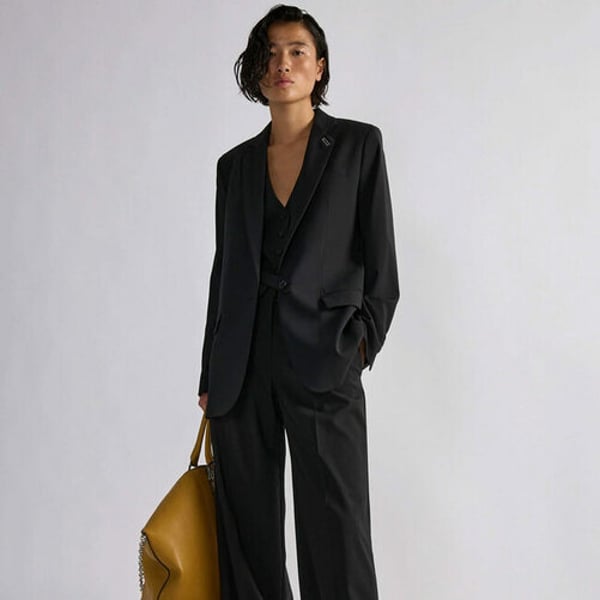
Barbara Bui silhouette – Barbara Bui
In 2024, the company recorded growth but struggled to finance it owing to the absence of a banking partner, according to management.
“We had entered the Covid period with a healthy business, because we had made organisational efforts beforehand. As with many companies, the pandemic had a significant impact on our sales. Fortunately, the state‑guaranteed loan (PGE) was a very effective mechanism that enabled us to cope,” recalls William Halimi. “But the issue was that the scheme didn’t anticipate that the economic consequences would persist for more than two years. And repaying the loans over five years, when business was still sluggish, was very onerous. We should have been able to spread these repayments over the longer term.” The executive then found that, with the PGE and a textile sector deemed risky by banks, the company was unable to secure banking support.
“In our line of work, bank credit lines are essential to finance growth. But all too often, bankers lump all brands into the same ‘textile’ category. We are positioned in luxury, with distinctive creations and an international growth focus. It’s not the same risk profile as a mid-market brand with a heavy domestic retail network limited to France.”
After more than two years of financing growth, management resigned themselves to filing for receivership. “It was a difficult decision for us. This brand is our baby. In a way, it cast a shadow over the company and our work,” recalls the co-founder. “And in reality, it was a wonderful experience. Right from the start of the procedure, our case was very well received, with strong engagement from the court and the administrators. As a listed company, we’re used to setting a clear course and keeping our commitments. And I really got the feeling that they were all there to save Barbara Bui.”
For the CEO, receivership allowed the company to continue operating. The brand then worked by focusing on its fundamentals, reducing the number of SKUs, prioritising its directly managed operations, and seeking savings in order to move closer to break-even.
In 2024, sales rose by 3% to 12.4 million euros. Above all, it generated a net profit of 242,000 euros, while reducing its operating loss. Its gross margin improved significantly. A trend that continued in 2025. These advances enabled the company to emerge from receivership on a high note, with the court approving its continuation plan on January 9.
As part of this plan, the company restructured a declared debt of 10.3 million euros, of which 5.3 million euros were officially recognised after analysis of the declarations by the administrators. This restructuring strategy rests on three main levers: securing 600,000 euros in debt waivers agreed with partners; bullet repayment at maturity of 1.1 million euros in shareholder current accounts provided by the co-founders; and spreading the remaining balance of 3.2 million euros over a period of nine years.
Barbara Bui can rely on its three Paris boutiques, located on avenue Montaigne, rue de Grenelle, and rue des Saints-Pères, whose sales are rising steadily.
According to the company, which will publish its sales figures for 2025 in the first quarter of 2026 and its annual results at the end of April, last year saw double-digit growth in its direct sales channels, with a 14% increase in the Paris boutiques and a 65% increase on its e-commerce site.
The brand, which plays with revisited tailoring and references to rock and new wave, all with high-quality materials, is also distributed through around 100 multi-brand retailers worldwide, compared with 140 before the receivership was announced.
“Our entire team of around sixty people was fully involved during the receivership, and this resulted in superb performances in our boutiques,” explains William Halimi. “But receivership often paralyses retailers. Now that we’re out of the procedure, we’ll be able to win back some of our former partners, who will be reassured.”
The brand, which continues to self-finance its development, is preparing new propositions to appeal to export markets, which already account for a quarter of its business, in the coming seasons. And it is embracing a modest but profitable growth strategy to assert its uniqueness in the market.
This article is an automatic translation. Click here to read the original article.
An industrial building occupied by Italian fashion group Salvatore Ferragamo on the outskirts of Florence caught fire, Italian fire services said on Thursday.
Ferragamo is known for its luxury footwear, clothing, and accessories – Reuters
The fire has been put out and no one was injured, they said. Two teams and two fire engines intervened at 12:50 p.m. (1150 GMT) in Sesto Fiorentino, a north-western suburb of the Tuscan capital city, which is home to several factories serving the luxury leather industry.
“The firefighters extinguished the fire, which affected the extraction system outside the industrial building” and cooling operations were underway, the Florence fire department said in a statement.
Ferragamo was not immediately available for comment.
Kering’s Balenciaga and resolutely independent Manolo Blahnik announced a first-time collaboration on Thursday on a trio of styles created for the Fall 2026 collection.
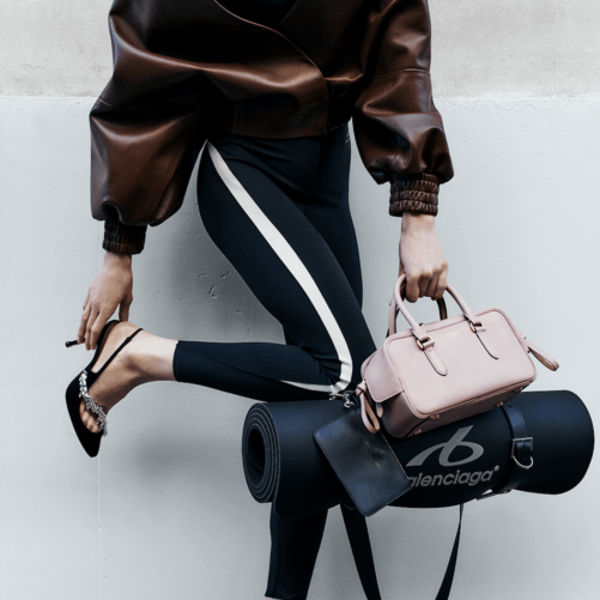
Manolo Blahnik x Balenciaga
They said it’s “an exchange shaped by shared values and an admiration for couture tradition. The partnership reflects the House of Balenciaga’s enduring commitment to artisanal mastery, as well as creative director Pierpaolo Piccioli’s distinct approach to fashion, long inspired by the legacy of Cristóbal Balenciaga”.
It makes sense for the two labels to work together given their dual Spanish roots, as well as “the elegance of craft that unites them”.
So what does the capsule comprise? There’s a low-heeled mule and a slingback with either a 105mm or 50mm heel. With a décolleté cut, we’re told “the silhouettes reveal skin, the body, a display intrinsically linked to the primacy of the human form”.
The styles are “in and of themselves a dialogue, a duet, drawn from designs from the Manolo Blahnik archive, chosen by Piccioli, and fused together. All three are executed in silk-satin, proposed in various colours and lined in Balenciaga grey”.
Each shoe style also features crystal embroidery across a low-cut vamp, something for which Blahnik is known. The company said the embellishments “simultaneously recall archival Blahnik designs and [reference] the 1960s bijoux created by Cristóbal Balenciaga”.
Manolo Blahnik said that “Don Cristóbal Balenciaga is, to me, the ultimate designer. I have adored his work for as long as I can remember. As a Mediterranean boy myself, I have always felt a deep connection to his Spanish culture and sensibility. To be partnering with Balenciaga, and with Pierpaolo, fulfils a lifelong dream. [His] direction for Balenciaga resonates profoundly with my own ideas of how the modern woman should dress in 2026, a vision of timeless elegance rooted in craftsmanship and enduring beauty.”
Portuguese group Impetus is working with Straight Lines AI, which specialises in artificial intelligence solutions for the fashion industry, to develop products faster and more efficiently.
Impetus partners with American AI company
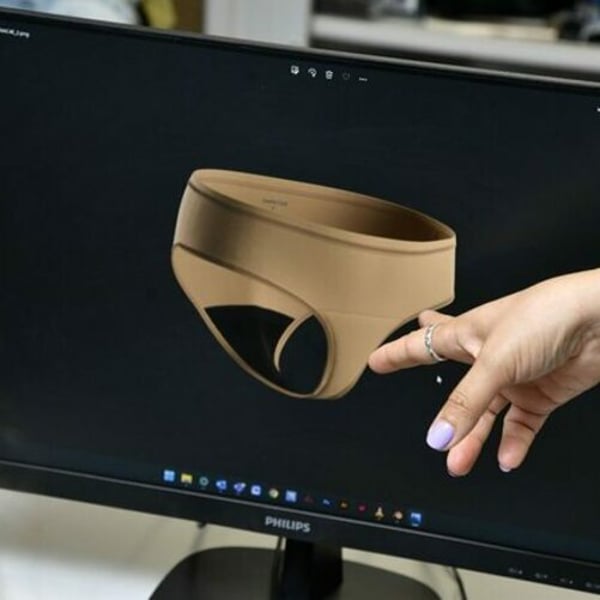
As part of this collaboration, Impetus will integrate the Straight Lines AI Creative Design Platform into its creative processes, with the aim of streamlining and accelerating product development, boosting operational efficiency and reducing costs, while also shortening the time-to-market for new underwear collections.
“At Straight Lines AI, we are committed to transforming the fashion industry with our state-of-the-art artificial intelligence solutions,” says Dale Kort, CEO of Straight Lines AI. “We are thrilled to partner with Impetus and to support the company in harnessing the power of AI to enhance its design capabilities, optimise operations, and bring innovative products to market more efficiently,” he adds.
Recognised for the quality of its underwear collections, Impetus views the integration of artificial intelligence as a strategic opportunity to bolster creativity and innovation. Using the Straight Lines AI platform will enable it to automate more labour-intensive tasks, freeing teams to focus on creative development and product design.
“Through this partnership with Straight Lines AI, we will optimise our processes, cut costs and devote more time to what we love most: designing quality products for everyone,” says Nuno Sousa, designer and head of Impetus’s 3D implementation project. “This collaboration will help us increase our efficiency and continue to innovate in this market,” he believes.
Impetus’s commitment to artificial intelligence is not new, as it is already one of the company’s drivers of innovation. On various occasions, including the second episode of the podcast Entre Linhas e Bytes (Between Lines and Bytes), part of the Texp@ct project, which Impetus leads, Nuno Sousa has underlined the central role that 3D technologies currently play at Impetus, highlighting their direct impact on efficiency, collaboration and sustainability in product development. According to the designer, the company already develops between 500 and 600 products per season using 3D and has dispensed with traditional photo shoots, using digital images for presentation and commercialisation.
This article is an automatic translation. Click here to read the original article.





 Politics8 years ago