Connect with us

Politics

How Americans’ views of racial discrimination have shifted since 2021, according to AP-NORC polling
Published

on


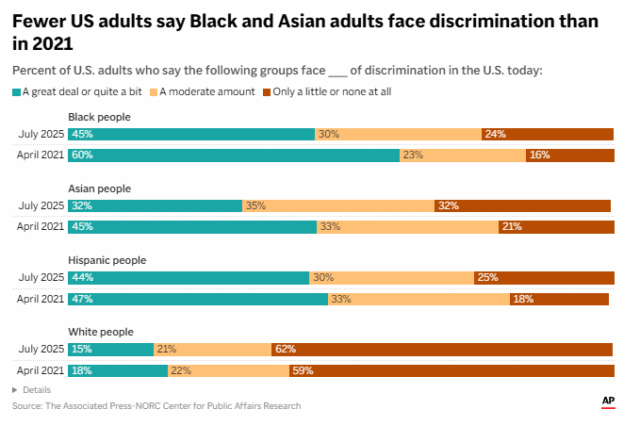
Slightly less than half of U.S. adults believe that Black people face “a great deal” or “quite a bit” of discrimination in the United States, according to a new poll. That’s a decline from the solid majority, 60%, who thought Black Americans faced high levels of discrimination in the spring of 2021, months after racial reckoning protests in response to the police killing of George Floyd.

Significant numbers of Americans also think diversity, equity and inclusion efforts, also known as DEI, are backfiring against the groups they’re intended to help, according to the survey from The Associated Press-NORC Center for Public Affairs Research, including many people who belong to those groups.

The findings suggest Americans’ views on racial discrimination have shifted substantially since four years ago, when many companies launched efforts to promote diversity within their workforces and the products they sold.

Since then, many of those companies have reversed themselves and retreated from their diversity practices, a trend that’s accelerated this year under pressure from President Donald Trump, a Republican who has sought to withhold federal money from schools and companies that promote DEI.

Now, it’s clear that views are changing as well as company policies.

Claudine Brider, a 48-year-old Black Democrat in Compton, California, says the concept of DEI has made the workplace difficult for Black people and women in new ways.

“Anytime they’re in a space that they’re not expected to be, like seeing a Black girl in an engineering course … they are seen as only getting there because of those factors,” Brider said. “It’s all negated by someone saying, ‘You’re only here to meet a quota.’”

Reversal in views of racial discrimination

The new poll finds 45% of U.S. adults think Black people face high levels of discrimination, down from 60% in the spring of 2021. There was a similar drop in views about the prevalence of serious discrimination against Asian people, which fell from 45% in the 2021 poll — conducted a month after the Atlanta spa shootings, which killed eight people, including six women of Asian descent — to 32% in the current survey.
There’s no question the country has backtracked from its “so-called racial reckoning” and the experiences of particular groups such as Black people are being downplayed, said Phillipe Copeland, a professor at Boston University School of Social Work.

Americans’ views about discrimination haven’t shifted when it comes to all groups, though. Just under half of U.S. adults, 44%, now say Hispanic people face at least “quite a bit of discrimination,” and only 15% say this about White people. Both numbers are similar to when the question was last asked in April 2021.

Divisions on the impact of DEI on Black and Hispanic people

The poll indicates that less than half of Americans think DEI has a benefit for the people it’s intended to help.

About 4 in 10 U.S. adults say DEI reduces discrimination against Black people, while about one-third say this about Hispanic people, women and Asian people. Many — between 33% and 41% — don’t think DEI makes a difference either way. About one-quarter of U.S. adults believe that DEI actually increases discrimination against these groups.

Black and Hispanic people are more likely than White people to think DEI efforts end up increasing discrimination against people like them.

About 4 in 10 Black adults and about one-third of Hispanic adults say DEI increases discrimination against Black people, compared with about one-quarter of White adults. There is a similar split between White adults and Black and Hispanic adults on assessments of discrimination against Hispanic people.

Among White people, it’s mostly Democrats who think DEI efforts reduce discrimination against Black and Hispanic people. Only about one-quarter of White independents and Republicans say the same.

Pete Parra, a 59-year-old resident of Gilbert, Arizona, thinks that DEI is making things harder for racial minorities now. He worries about how his two adult Hispanic sons will be treated when they apply for work.

“I’m not saying automatically just give it to my sons,” said Parra, who leans toward the Democratic Party. But he’s concerned that now factors other than merit may take priority.

“If they get passed over for something,” he said, “they’re not going to know (why).”

About 3 in 10 say DEI increases discrimination against White people

The new poll shows that Americans aren’t any more likely to think White people face discrimination than they were in 2021. And more than half think DEI doesn’t make a difference when it comes to White people or men.

But a substantial minority — about 3 in 10 U.S. adults — think DEI increases discrimination against White people. Even more White adults, 39%, hold that view, compared with 21% of Hispanic adults and 13% of Black adults.

The recent political focus on DEI has included the idea that White people are more often overlooked for career and educational opportunities because of their race.

John Bartus, a 66-year-old registered Republican in Twin Falls, Idaho, says that DEI might have been “a good thing for all races of people, but it seems like it’s gone far left.” It’s his impression that DEI compels companies to hire people based on their race or if they identify as LGBTQ+.

“The most qualified person ought to get a job based on their merit or based on their educational status,” said Bartus, who’s White.

Brider, the Black California resident, objects to the notion that White people face the same level of discrimination as Black people. But while she thinks the aims of DEI are admirable, she also sees the reality as flawed.

“I do think there needs to be something that ensures that there is a good cross-section of people in the workplace,” Brider said. “I just don’t know what that would look like, to be honest.”

The AP-NORC poll of 1,437 adults was conducted July 10-14, using a sample drawn from NORC’s probability-based AmeriSpeak Panel, which is designed to be representative of the U.S. population. The margin of sampling error for adults overall is plus or minus 3.6 percentage points.

___

Republished with permission of The Associated Press.


Post Views: 0


Source link

Continue Reading

Politics

Miles Davis tapped to lead School Board organizing workshop at national LGBTQ conference

Published

on


Miles Davis is taking his Florida-focused organizing playbook to the national stage.

Davis, Policy Director at PRISM Florida and Director of Advocacy and Communications at SAVE, has been selected to present a workshop at the 2026 Creating Change Conference, the largest annual LGBTQ advocacy and movement-building convention.

It’s a major nod to his rising role in Florida’s LGBTQ policy landscape.

The National LGBTQ Task Force, which organizes the conference, announced that Davis will present his session, “School Board Organizing 101.” His proposal rose to the top of more than 550 submissions competing for roughly 140 slots, a press note said, making this year’s conference one of the most competitive program cycles in the event’s history.

His workshop will be scheduled during the Jan. 21-24 gathering in Washington, D.C.

Davis said his selection caps a strong year for PRISM Florida, where he helped shepherd the organization’s first-ever bill (HB 331) into the Legislature. The measure, sponsored by Tampa Democratic Rep. Dianne Hart, would restore local oversight over reproductive health and HIV/AIDS instruction, undoing changes enacted under a 2023 expansion to Florida’s “Parental Rights in Education” law, dubbed “Don’t Say Gay” by critics.

Davis’ workshop draws directly from that work and aims to train LGBTQ youth, families and advocates in how local boards operate, how public comment can shape decisions and how communities can mobilize around issues like book access, inclusive classrooms and student safety.

“School boards are where the real battles over student safety, book access, and inclusive classrooms are happening,” Davis said. “I’m honored to bring this training to Creating Change and help our community build the skills to show up, speak out, and win — especially as PRISM advances legislation like HB 331 that returns power to our local communities.”

Davis’ profile has grown in recent years, during which he jumped from working on the campaigns and legislative teams of lawmakers like Hart and Miami Gardens Democratic Sen. Shevrin Jones to working in key roles for organizations like America Votes, PRISM and SAVE.

The National LGBTQ Task Force, founded in 1973, is one of the nation’s oldest LGBTQ advocacy organizations. It focuses on advancing civil rights through federal policy work, grassroots engagement and leadership development.

Its Creating Change Conference draws thousands for four days of training and strategy-building yearly, a press note said.


Source link

Continue Reading

Politics

Kevin Steele seeks insight from conservative leaders at Rick Scott-led summit

Published

on


State Rep. Kevin Steele’s campaign for Chief Financial Officer already enjoys political support from U.S. Sen. Rick Scott. The Dade City Republican attended a summit headlined by the Senator to also gain some policy insight and mentoring.

Steele was among the attendees for the Rescuing the American Dream summit held on Thursday in Washington, D.C. He said it was a quest for knowledge that drew him to Capitol Hill to hear the discussion.

“The way you do things better in the future is by learning from people who have already accomplished something,” Steele told Florida Politics at the event.

Scott gave a shoutout to Steele from the stage. The Governor already endorsed Steele, who is challenging the appointed Chief Financial Officer Blaise Ingoglia in 2026. At the summit, Scott both promoted conservative successes in the first year of President Donald Trump’s second term and laid out visions on issues from health care reform to cryptocurrency.

Steele called the panel discussions “amazing” and instructive on tackling affordability issues in Florida.

“If we don’t start addressing those things head first, we’re going to fall behind,” Steele said. “I think we’ve lost several million jobs in the state of Florida over the past six or seven years. Learning from Rick Scott and how to bring jobs back to the state is a good thing. And I think that we need to start tackling some of the big, big things that we need to attack.”

That includes addressing property insurance premiums head on and evaluating the property tax situation.

While he will be challenging a Republican incumbent in a Primary, Steele voiced caution at comparing his philosophy too directly with Ingoglia, a former Republican Party of Florida Chair with a history of animus with Scott.

But he did suggest Ingoglia’s recent scrutinizing of local governments may be starting at the wrong place when it comes to cutting spending.

“We need to start focusing on state down, instead of going to a county and pointing out flaws there,” Steele said. “There’s a lot of issues at the state level that we can address, some of which we are, some of which I’ve submitted different bills to address. I think that there’s a lot of waste and abuse at the state level that we can focus on.”


Source link

Continue Reading

Politics

Darren Soto refuses to call for Sheila Cherfilus-McCormick’s resignation

Published

on


U.S. Rep. Darren Soto is refusing to say whether indicted U.S. Rep. Sheila Cherfilus-McCormick should vacate her seat in Congress.

Video obtained by Florida Politics shows Soto being confronted on Capitol Hill. “Will you call on Sheila Cherfilus-McCormick to resign?” the videographer asks.

Initially, Soto remains silent, but the questioner suggests that silence shows “support” for someone who “stole $5 million in health care funds for the most vulnerable.” The Kissimmee Democrat then responds but continues walking away from the camera. He then conflates a censure motion against U.S. Rep. Cory Mills, a New Smyrna Beach Republican, and Cherfilus-McCormick, a Miramar Democrat.

“Both Mills and Cherfilus-McCormick, both will have due process. Thank you,” Soto said.

Both Cherfilus-McCormick and Mills remain the subjects of ongoing House Ethics Committee investigations. But only Cherfilus-McCormick now faces criminal prosecution for alleged financial crimes.

A grand jury in November indicted Cherfilus-McCormick on charges she stole $5 million in disaster relief funds to finance her 2021 congressional campaign.

The indictment alleges that Cherfilus-McCormick and her brother, Edwin Cherfilus, secured funding intended for a COVID vaccine distribution program, but when overpayments were made, she routed the spending through several accounts that later donated the funds as campaign contributions.

Minority Leader Hakeem Jeffries said pursuant to House rules that Cherfilus-McCormick had to give up her ranking status on the Subcommittee on the Middle East and North Africa. Local Democrats have started to issue calls for the Miramar Democrat’s resignation. But there have been no calls from Democratic members of Congress.

U.S. Rep. Greg Steube, a Sarasota Republican, has said if she won’t resign, he will move for her expulsion.

The National Republican Congressional Committee (NRCC), which lists Soto as a target in 2026, slammed Soto’s unwillingness to criticize a fellow Democrat.

“Darren Soto’s refusal to call on Sheila Cherfilus-McCormick to resign is unacceptable,” said NRCC spokesperson Maureen O’Toole. “Floridians deserve a representative who fights for them, not his taxpayer-thieving colleague.”


Source link

Continue Reading

Trending

Copyright © Miami Select.