Connect with us

Politics

How Americans’ views of racial discrimination have shifted since 2021, according to AP-NORC polling
Published

on


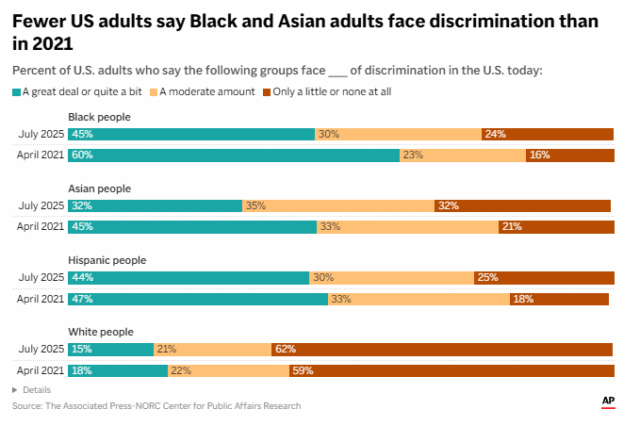
Slightly less than half of U.S. adults believe that Black people face “a great deal” or “quite a bit” of discrimination in the United States, according to a new poll. That’s a decline from the solid majority, 60%, who thought Black Americans faced high levels of discrimination in the spring of 2021, months after racial reckoning protests in response to the police killing of George Floyd.

Significant numbers of Americans also think diversity, equity and inclusion efforts, also known as DEI, are backfiring against the groups they’re intended to help, according to the survey from The Associated Press-NORC Center for Public Affairs Research, including many people who belong to those groups.

The findings suggest Americans’ views on racial discrimination have shifted substantially since four years ago, when many companies launched efforts to promote diversity within their workforces and the products they sold.

Since then, many of those companies have reversed themselves and retreated from their diversity practices, a trend that’s accelerated this year under pressure from President Donald Trump, a Republican who has sought to withhold federal money from schools and companies that promote DEI.

Now, it’s clear that views are changing as well as company policies.

Claudine Brider, a 48-year-old Black Democrat in Compton, California, says the concept of DEI has made the workplace difficult for Black people and women in new ways.

“Anytime they’re in a space that they’re not expected to be, like seeing a Black girl in an engineering course … they are seen as only getting there because of those factors,” Brider said. “It’s all negated by someone saying, ‘You’re only here to meet a quota.’”

Reversal in views of racial discrimination

The new poll finds 45% of U.S. adults think Black people face high levels of discrimination, down from 60% in the spring of 2021. There was a similar drop in views about the prevalence of serious discrimination against Asian people, which fell from 45% in the 2021 poll — conducted a month after the Atlanta spa shootings, which killed eight people, including six women of Asian descent — to 32% in the current survey.
There’s no question the country has backtracked from its “so-called racial reckoning” and the experiences of particular groups such as Black people are being downplayed, said Phillipe Copeland, a professor at Boston University School of Social Work.

Americans’ views about discrimination haven’t shifted when it comes to all groups, though. Just under half of U.S. adults, 44%, now say Hispanic people face at least “quite a bit of discrimination,” and only 15% say this about White people. Both numbers are similar to when the question was last asked in April 2021.

Divisions on the impact of DEI on Black and Hispanic people

The poll indicates that less than half of Americans think DEI has a benefit for the people it’s intended to help.

About 4 in 10 U.S. adults say DEI reduces discrimination against Black people, while about one-third say this about Hispanic people, women and Asian people. Many — between 33% and 41% — don’t think DEI makes a difference either way. About one-quarter of U.S. adults believe that DEI actually increases discrimination against these groups.

Black and Hispanic people are more likely than White people to think DEI efforts end up increasing discrimination against people like them.

About 4 in 10 Black adults and about one-third of Hispanic adults say DEI increases discrimination against Black people, compared with about one-quarter of White adults. There is a similar split between White adults and Black and Hispanic adults on assessments of discrimination against Hispanic people.

Among White people, it’s mostly Democrats who think DEI efforts reduce discrimination against Black and Hispanic people. Only about one-quarter of White independents and Republicans say the same.

Pete Parra, a 59-year-old resident of Gilbert, Arizona, thinks that DEI is making things harder for racial minorities now. He worries about how his two adult Hispanic sons will be treated when they apply for work.

“I’m not saying automatically just give it to my sons,” said Parra, who leans toward the Democratic Party. But he’s concerned that now factors other than merit may take priority.

“If they get passed over for something,” he said, “they’re not going to know (why).”

About 3 in 10 say DEI increases discrimination against White people

The new poll shows that Americans aren’t any more likely to think White people face discrimination than they were in 2021. And more than half think DEI doesn’t make a difference when it comes to White people or men.

But a substantial minority — about 3 in 10 U.S. adults — think DEI increases discrimination against White people. Even more White adults, 39%, hold that view, compared with 21% of Hispanic adults and 13% of Black adults.

The recent political focus on DEI has included the idea that White people are more often overlooked for career and educational opportunities because of their race.

John Bartus, a 66-year-old registered Republican in Twin Falls, Idaho, says that DEI might have been “a good thing for all races of people, but it seems like it’s gone far left.” It’s his impression that DEI compels companies to hire people based on their race or if they identify as LGBTQ+.

“The most qualified person ought to get a job based on their merit or based on their educational status,” said Bartus, who’s White.

Brider, the Black California resident, objects to the notion that White people face the same level of discrimination as Black people. But while she thinks the aims of DEI are admirable, she also sees the reality as flawed.

“I do think there needs to be something that ensures that there is a good cross-section of people in the workplace,” Brider said. “I just don’t know what that would look like, to be honest.”

The AP-NORC poll of 1,437 adults was conducted July 10-14, using a sample drawn from NORC’s probability-based AmeriSpeak Panel, which is designed to be representative of the U.S. population. The margin of sampling error for adults overall is plus or minus 3.6 percentage points.

___

Republished with permission of The Associated Press.


Post Views: 0


Source link

Continue Reading

Politics

Ron DeSantis says GOP must go on offense ahead of Midterms to bring back ‘complacent’ voters

Published

on


Gov. Ron DeSantis is continuing to warn Republicans that next year’s Midterm contests may not go their way if the party doesn’t change course.

He recommends that Republicans make a strong case for what they will do if they somehow retain control of Congress next year, given that “in an off-year Midterm, the party in power’s voters tend to be more complacent.”

But DeSantis, who himself served nearly three terms in Congress before resigning to focus on his campaign for Governor in 2018, says House Republicans haven’t accomplished much, and they need to be proactive in the time that’s left.

“I just think you’ve got to be bold. I think you’ve got to be strong. And I think one of the frustrations with the Congress is, what have they done since August till now? They really haven’t done anything, right?” DeSantis explained on “Fox & Friends.”

“I’d be like, every day, coming out with something new and make the Democrats go on the record, show the contrast.”

The Governor said the economy and immigration are two issues that would resonate with voters.

On immigration, DeSantis believes his party should remind voters that President Donald Trump stopped the “influx” of illegal border crossers given passage when Joe Biden was in power.

After providing contrast to some of his policy wins through the end of 2023 in Florida, DeSantis suggested that the GOP needs to blame the opposition party regarding continued economic struggles.

“Democrats, they caused a lot of this with the inflation and now they’re acting like … they had nothing to do with it,” he said.

DeSantis’ latest comments come after Tuesday’s narrow GOP victory in deep-red Tennessee, in yet another election where a candidate for Congress underperformed President Donald Trump.

Republican Matt Van Epps defeated Democrat Aftyn Behn by roughly 9 points in the Nashville area seat. That’s less than half the margin by which Trump bested Kamala Harris in 2024. This is after U.S. Reps. Randy Fine and Jimmy Patronis won by smaller margins than expected in Special Elections in Florida earlier this year.

Though partisan maps protect the GOP in many cases, with just a seven-vote advantage over Democrats in Congress there is scant room for error.

Bettors seem to believe the House will flip, with Democratic odds of victory at 78% on Polymarket on Friday morning.


Source link

Continue Reading

Politics

Ron DeSantis again downplays interest in a second presidential run

Published

on


The question won’t go away.

Gov. Ron DeSantis may be out of state, just like he was when he ran for President in 2024, but that doesn’t mean he’s eyeing another run for the White House.

“I’ve got my hands full, man. I’m good,” he told Stuart Varney during an in-studio interview Friday in New York City, responding to a question about his intentions.

DeSantis added that it was “not the first time” he got that question, which persists amid expectations of a crowded field of candidates to succeed President Donald Trump.

“I’m not thinking about anything because I think we have a President now who’s not even been in for a year. We’ve got a lot that we’ve got to accomplish,” the term-limited Governor told Jake Tapper last month when asked about 2028.

It may be for the best that DeSantis isn’t actively running, given some recent polls.

DeSantis, who ran in 2024 before withdrawing after failing to win a single county in the Iowa caucuses, has just 2% support in the latest survey from Emerson College.

Recent polling from the University of New Hampshire says he’ll struggle again in what is historically the first-in-the-nation Primary state. The “Granite State Poll,” his worst showing in any state poll so far, shows the Florida Governor with 3% support overall.

In January 2024, DeSantis had different messaging after leaving the GOP Primary race.

“When I was in Iowa, a lot of these folks that stuck with the President were very supportive of what I’ve done in Florida. They thought I was a good candidate,” DeSantis said. “I even had people say they think that I would even do better as President, but they felt that they owed Trump another shot. And so I think we really made a strong impression.”

But that was then, this is now.


Source link

Continue Reading

Politics

First place at stake for Jaguars vs. Colts

Published

on


How big is Sunday’s game for the Jaguars?

According to The Athletic, the Jaguars have an 83% chance of making the playoffs entering the weekend. That’s a pretty good bet. At 8-4, the Jaguars are currently in the third spot in the AFC.

However, Jacksonville stands a 42% chance of winning the division, slightly better than Sunday’s opponent, the Indianapolis Colts (8-4), who sit at 34% to win the AFC South.

With both games against the Colts still on the schedule and matchups with the struggling New York Jets, a trip to Denver to face the surging Broncos, and the season finale at home against the Tennessee Titans, the Jaguars need only to win the games they should win to make the playoffs.

Leaving the Colts games aside for the moment, if the Jaguars simply beat the Jets and Titans, they would have 10 wins. That is almost certainly enough to earn a postseason spot.

So, in a way, Sunday’s game against the Colts isn’t make-or-break. However, if the Jaguars want to win the division and host a playoff game, at least one win over the Colts is essential. Should the Jaguars win Sunday, they would hold a 1-game advantage over the Colts and, for the time being, hold the head-to-head tiebreaker over Indianapolis.

By one metric, the Jaguars can increase their playoff odds to 95% with a victory on Sunday. Even with a loss, they are a good bet to make the playoffs as a wild-card team. But the chance to start the postseason with a home game is a powerful advantage, one that division winners enjoy.

Health will be a major factor in Sunday’s game. The Jaguars hope to have wide receiver/kick returner Parker Washington and defensive end Travon Walker back in the lineup. Both missed some or all of last week’s game but practiced in a limited basis this week. Starting left tackle Walker Little and safety Andrew Wingard remained in the concussion protocol this week. Starting right guard Patrik Mekari returned from concussion protocol on Wednesday.

The Colts are also dealing with injuries. Cornerback Sauce Gardner did not practice this week, while quarterback Daniel Jones continues to play with a fracture in his leg.

The key matchup could be strength vs. strength. Indianapolis running back Jonathan Taylor leads the NFL in rushing with 1,282 yards, while the Jaguars are the league’s top rush defense, allowing opponents only 82.4 yards per contest. No running back has run for more than 90 yards against the Jaguars this season, and only one, Houston’s Woody Marks, has rushed for more than 70 yards in a game. Taylor averages nearly 107 yards per game this season.

The Jaguars last made the playoffs in 2022 in Doug Pederson’s first season as head coach. Liam Coen is trying to replicate the feat.

Interestingly, the game is one of three in the NFL this weekend with first place on the line.

The Baltimore Ravens host the Pittsburgh Steelers Sunday. Both teams are 6-6, and the winner will lead the AFC North. The Chicago Bears (9-3) also travel to Green Bay to face the Packers (8-3-1), with the winner taking the top spot in the NFC North.


Source link

Continue Reading

Trending

Copyright © Miami Select.