Connect with us

Business

How AI is redefining finance leadership: ‘There has never been a more exciting time to be a CFO’

Published

on


Good morning. This year has shown that AI isn’t just a buzzword anymore—it’s redefining finance. 

In covering AI, I’ve spoken with CFOs across industries who are focused on value creation and developing real-world use cases for AI to reshape everything from forecasting and financial planning to strategic decision-making. As data moves faster than ever, finance leaders are asking a new question: not what AI could do, but how it can truly transform the enterprise. I’ve also talked with industry experts and researchers about topics ranging from the ROI of AI to “prompt-a-thons” and debates over whether AI will turn CFOs into chief capital officers.

Finance chiefs are signaling the next big evolution—2026 will be the year of enterprise-scale AI. Pilot programs and proofs of concept are giving way to avenues for full-scale deployment as CFOs expect AI to deliver measurable value: faster decisions, leaner operations, and predictive insights that can provide a competitive edge. However, that level of transformation comes with new demands—governance, data integrity, and human oversight matter more than ever.

I recently asked finance chiefs from leading companies how they expect AI to redefine what it means to lead in finance. For instance, Zane Rowe, CFO at Workday, told me: “There has never been a more exciting time to be a CFO with AI unlocking new opportunities for value creation through unprecedented data and insights. Most of the focus has been on experimentation and discovering the art of the possible, but this year, leaders will shift from ‘What can AI do?’ to ‘How do we build the foundation for scale?’ They will manage a more nuanced AI portfolio that balances launching pilots with rolling out proven solutions, and they will prioritize the unglamorous but critical work of data governance, process redesign, and maintenance of new technologies. Success in 2026 will be defined by how we mature our AI strategy to ensure it is both agile, durable, and enterprise-grade.”

Shifting from the perspective of a major tech company to a beauty and cosmetics leader, Mandy Fields, CFO at e.l.f. Beauty offered this prediction: “From where a CFO sits, AI simultaneously helps broaden our view to get a better macro picture and can help put a sharper focus on very specific points of interest. e.l.f. Beauty is growing globally, and AI has visibility across it all. Going into next year, we’ll continue to explore how we best leverage AI in finance to lean into its strengths. It’s a pretty similar approach to our high-performance teamwork culture in which we encourage the team to pursue and thrive in the areas where they have expertise, learn continuously and move at e.l.f. speed.”

You can read more insights from over a dozen CFOs on how AI will shape finance in 2026 in my complete article here.

This is the final CFO Daily of 2025. The next issue will land in your inbox on Jan. 5. Thank you for your readership—and wishing you a wonderful holiday season. See you in 2026!

Sheryl Estrada
sheryl.estrada@fortune.com

This story was originally featured on Fortune.com


Source link

Continue Reading

Business

Southern California in ‘great danger’ from Christmas flooding

Published

on


Residents of Southern California were bracing Wednesday for a powerful winter storm forecast to bring dangerous flooding as well as rock and mudslides to the region, threatening property and snarling holiday travel plans.

Peak rainfall in parts of the region is expected to reach as high as 1.5 inches per hour, according to the National Weather Service. The foothills and mountains south of Point Conception, which include parts of Los Angeles and Santa Barbara, are projected to receive up to nine inches (25 centimeters) of rain by 10 p.m. local time on Christmas Eve. The rain will continue to fall on Thursday, Christmas Day, and a total of 14 inches could soak the region (35 centimeters) by Friday.

“Severe, widespread flash flooding is expected,” the US Weather Prediction Center said in a forecast early Wednesday. “Lives and property are in great danger.”

Coastal regions of Southern California will receive multiple months’ worth of rain in a span of one to three days, according to AccuWeather.

Some Los Angeles County residents have already been ordered to evacuate areas that are vulnerable to mudslides and officials warned of possible road closures, airport delays and flight cancellations.

Read more: Southern California Faces ‘High Risk’ Floods as Storm Hits

Forecasters were also urging Californians to drive with care and never attempt to drive through flooded roadways. 

Join us at the Fortune Workplace Innovation Summit May 19–20, 2026, in Atlanta. The next era of workplace innovation is here—and the old playbook is being rewritten. At this exclusive, high-energy event, the world’s most innovative leaders will convene to explore how AI, humanity, and strategy converge to redefine, again, the future of work. Register now.


Source link

Continue Reading

Business

The K-shaped economy is carrying a ticking time bomb into 2026

Published

on


The U.S. economy grew at a 4.3% annual rate in the third quarter, blowing past economists’ expectations and delivering the kind of headline that signals strength heading into the new year. Consumers went on an unusually strong spending tear while corporations cinched $166 billion in capital gains. President Donald Trump and his team wasted no time celebrating, taking a victory lap over those dour economists who had warned of doom and gloom, declaring the “Trump economic golden age is FULL steam ahead.”

Well, slow down, those dour economists replied. There’s something missing in this boom: the jobs. Hiring this year, at best, has stalled, and at worst has collapsed: unemployment has climbed to 4.6%, and even Fed Chair Jerome Powell has warned recent data may be overstating job gains. 

This is the puzzle economists are now trying to reconcile. In a typical recovery, strong GDP growth shows up first in hiring, then in paychecks, and finally in consumer spending. But in this quarter, it’s reversed: spending is here without jobs. So how does an economy grow at a 4.3% annual rate when households aren’t actually earning more, and in fact, still fighting sticky inflation?

“I’ve never seen anything like it,” KPMG’s chief economist Diane Swonk told Fortune. “To have this stagflation in the inflation and unemployment rate, and to not have it in growth is highly unusual, and something’s got to give.”

A tale of two economies

There are two parts of the story of how the economy arrived here. The first is that households are spending without income growth. Real disposable income was essentially flat in the third quarter—literally 0% growth. Americans did not gain purchasing power. Yet, they made up the difference through savings drawdowns, credit, or by absorbing costs they cannot avoid. The GDP report itself points to where that pressure is concentrated: mostly in services, and within services, healthcare was a leading driver.

Americans spent the most on healthcare last quarter since the Omicron wave of 2022, Swonk said. Outlays on outpatient care, hospital services, and nursing facilities rose at one of the fastest paces in years, reflecting aging demographics and higher medical prices, but also the growing use of costly GLP-1 weight-loss drugs, which continue to push up spending even after adjusting for inflation. 

This was not a classic discretionary splurge, then. It was spending families had little ability to defer. That distinction matters, because spending driven by necessity behaves very differently from spending driven by rising paychecks. When households are paying more for healthcare, insurance, child care, or elder care, they are not signaling confidence; rather, they are absorbing pressure. And with real disposable income flat, those costs are not being met by wage growth, but by thinner savings and deferred choices elsewhere, Swonk said. 

The problem, then, is when that pressure eases in early 2026 as tax refunds surge and withholding changes put more cash temporarily back into paychecks, the boost could act as a “sugar high”: a short-term lift to spending that does not fix the underlying problem of weak job creation and stagnant real income. 

“We will feel more broad-based gains as we get into 2026,” Swonk said, “but at what price?” 

The concern, she added, is that stimulus layered on top of already elevated service-sector inflation could make price pressures “stickier,” not relieve them.

The second part of the story—and the one most Fortune readers will already recognize—is that this economy is no longer moving as a single system. It is splitting into a “K-shape,” and what looks like resilience at the top increasingly masks fragility underneath.

The GDP report makes that divergence hard to miss. Alongside surging consumer spending, corporate profits from current production jumped by $166 billion in the third quarter, a dramatic acceleration from the prior period. At the same time, investment fell, led by a sharp drawdown in private inventories as businesses got rid of their pandemic-era hoarding. Businesses are not broadly expanding capacity, or hiring aggressively, or even hiring at all. They are extracting margins, managing costs, and in many cases waiting. They have learned how to grow without hiring, Swonk said.

“We are seeing most of the productivity gains we’re seeing right now as really just the residual of companies being hesitant to hire and doing more with less,” she said. “Not necessarily AI yet.” In other words, businesses are squeezing output from a fixed or shrinking workforce, not expanding payrolls to meet new demand.

The K-shaped economy, fully matured

On one side of that K are affluent households and asset holders, whose spending continues to be supported by strong equity markets in jubilation after an historic year of AI spending, elevated home values, and corporate profit growth. On the other side are workers and lower- and middle-income households, whose spending, as already mentioned, is increasingly shaped by constraint rather than confidence, accounting for the consistent “affordability crisis.” The headline GDP number combines both groups into a single figure, but the lived economy does not.

Swonk noted that recreational services—travel, leisure, premium experiences—remain a bright spot, but are overwhelmingly carried by higher-income households. Even there, the data reveals stress beneath the surface. Vacation activity in August, she said, was the second-lowest on record for that month, trailing only August 2020. Airlines and hotels are still filling premium seats, but that demand is increasingly concentrated at the top.

The danger, Swonk argued, is that these two engines behave very differently over time. Spending supported by asset appreciation can persist as long as markets cooperate. Spending driven by necessity, however, cannot. 

“When you’re carrying an economy by wealth effects and affluent households, as opposed to employment gains and generating new paychecks, you’re vulnerable if there’s any correction in equity markets,” Swonk said. She described how quickly that channel can reverse: foot traffic slows, discretionary spending pulls back, and high-end demand evaporates far faster than headline GDP data would suggest.

“When you divorce growth from employment gains, you’ve got a problem,” Swonk said. “And this is before the real effects of AI have even set in.”




Source link

Continue Reading

Business

The biggest Powerball jackpots in history—and where the winning tickets were sold

Published

on


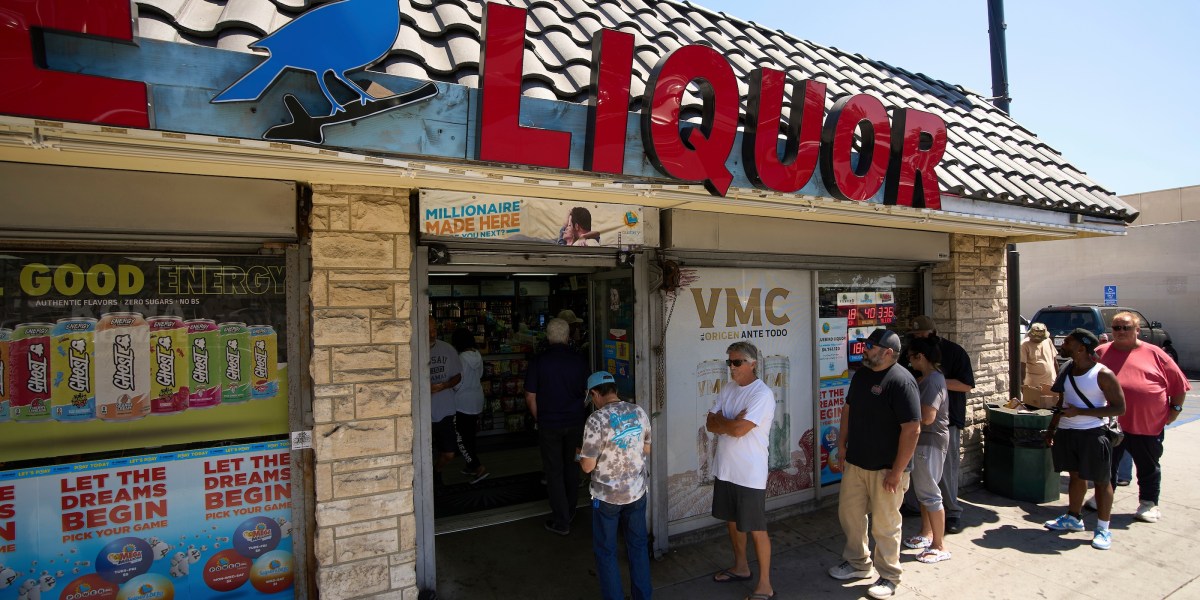
The Powerball jackpot has grown to an estimated $1.7 billion for Wednesday night’s drawing after lottery officials said no ticket matched all six numbers drawn Monday night.

The U.S. has seen more than a dozen lottery jackpot prizes exceed $1 billion since 2016. Here is a look at the largest U.S. jackpots won and the places where the winning tickets were sold:

1. $2.04 billion, Powerball, Nov. 7, 2022. The winning ticket was sold at a Los Angeles-area gas station.

2. $1.787 billion, Powerball, Sept. 6, 2025. The winning tickets were sold in Missouri and Texas.

3. $1.765 billion, Powerball, Oct. 11, 2023. The winning ticket was sold at a liquor store in a tiny California mountain town.

4. $1.602 billion, Mega Millions, Aug. 8, 2023. The winning ticket was sold at a supermarket in Neptune Beach, Florida.

5. $1.586 billion, Powerball, Jan. 13, 2016. The winning tickets were sold at a Los Angeles-area convenience store, a Florida supermarket and a Tennessee grocery store.

6. $1.537 billion, Mega Millions, Oct. 23, 2018. The winning ticket was sold at a South Carolina convenience store.

7. $1.348 billion, Mega Millions, Jan. 13, 2023. The winning ticket was sold at a Maine gas station.

8. $1.337 billion, Mega Millions, July 29, 2022. The winning ticket was sold at a Chicago-area gas station.

9. $1.326 billion, Powerball, April 7, 2024. The winning ticket was sold at an Oregon convenience store.

10. $1.269 billion, Mega Millions, Dec. 27, 2024. The winning ticket was sold at a gas station in Northern California.


Source link

Continue Reading

Trending

Copyright © Miami Select.