Connect with us

Business

How a mountaintop Chilean winery is harnessing the earth’s energy to disrupt the global wine market
Published

on


The origin story of Stonevik—the latest introduction from Viña Vik, a pioneering winery neighbored by its sister hotel in central Chile—is rooted some 3,000 feet above sea level, in a mountaintop forest between the Andes and the Pacific, amidst a circle of century-old oak trees. Here, in amphorae handcrafted from clay sourced from the Vik estate and half-buried in the earth, the wine ages, untouched by human hands—culminating in a literally groundbreaking blend Vik bills as “the ultimate natural wine, crafted by nature, in nature.” 

Stonevik marks a new milestone in Vik’s quest to become one of the world’s most renowned wineries—a passion project that began in 2004 when its owners, Norwegian investor and entrepreneur Alexander Vik and his wife, Carrie, embarked on a wildly ambitious mission.  

“We put together a scientific team with the objective of finding one of the best terroirs in the world, to make some of the best Bordeaux-style red wines in the world,” says Alexander Vik.   

That epic two-year search ultimately led to the Millahue Valley, nestled in the foothills of the Andes within the greater Cachapoal Valley, a hundred miles south of Santiago. In 2006, the Viks purchased an 11,000-acre swath of virgin wilderness there called Lugar de Oro (“Golden Place”) by the area’s indigenous Mapuche people—perhaps a reference to how the rose-hued horizon shimmers just above the surrounding hills. 

An aerial view of VIK Chile, which neighbors the VIK Winery in Chile’s Millahue Valley.

Courtesy of Vik Retreats

More than two decades since the seeds of the Viks’ idea were first sown, this enchanting hinterland has steadily evolved into an oenophile’s Xanadu, seemingly worlds away from civilization, where winemaking, art, and architecture converge with exuberant nature. The addition of Stonevik to Vik’s award-winning lineup gives wine lovers another reason to visit.  

Vik’s terroir encompasses a pristine landscape composed of 12 valleys, each with its own microclimate and distinct exposures, and all cooled by Pacific coastal breezes and winds from high in the Andes. With the expert guidance of chief winemaker Cristián Vallejo, whom the Viks hired to oversee Vik’s viticulture and viniculture, a thousand acres of Cabernet Sauvignon, Carménère, Syrah, Cabernet Franc, and Merlot were planted.  

“We knew that this terroir was truly exceptional,” Alexander Vik continues, “and that if we did things correctly, we could produce wines that would enter the pantheon of the world’s great wines.” 

The next order of business was to build a winery. In 2007, the Viks launched a global competition to tap the brightest minds in the business; renowned Chilean architect, Smiljan Radic, won with an avant-garde design that minimizes impact on the landscape and champions sustainability. The white stretched-fabric roof resembles a wing, whose translucence eschews the need for artificial light in the daytime. A sloping plaza fronts the entrance, where running water trickles toward the glass-walled building beneath a striking river rock installation, naturally cooling the cellar below. Walkways crosshatch the sprawling space, immersing visitors in a stunning tableau that is both organic and otherworldly.  

VIK Chile’s bronzed titanium roof signals the property’s artistic bent.

Courtesy of Vik Retreats

Inside, most of the building lies underground to maximize natural insulation and conserve energy. Rows of amber-lit barrels stacked three high flank an aisle leading to the tasting room, where an accent wall displays a mélange of gold-toned metal shards that appear to hover in midair like a grand mobile, an arresting homage to the Mapuche’s moniker for the region’s natural grandeur. 

The winery’s light footprint dovetails with Vik’s holistic winemaking philosophy. Guided by a steadfast commitment to environmental stewardship, Vik embraced a virtually no-intervention approach from the outset, using only native yeasts and no additives or filtration. All grapes are harvested at night, when they’re at their lowest temperature, to preserve their quality and acidity. These measures (and many others) ensure the purest expression of Vik’s terroir.  

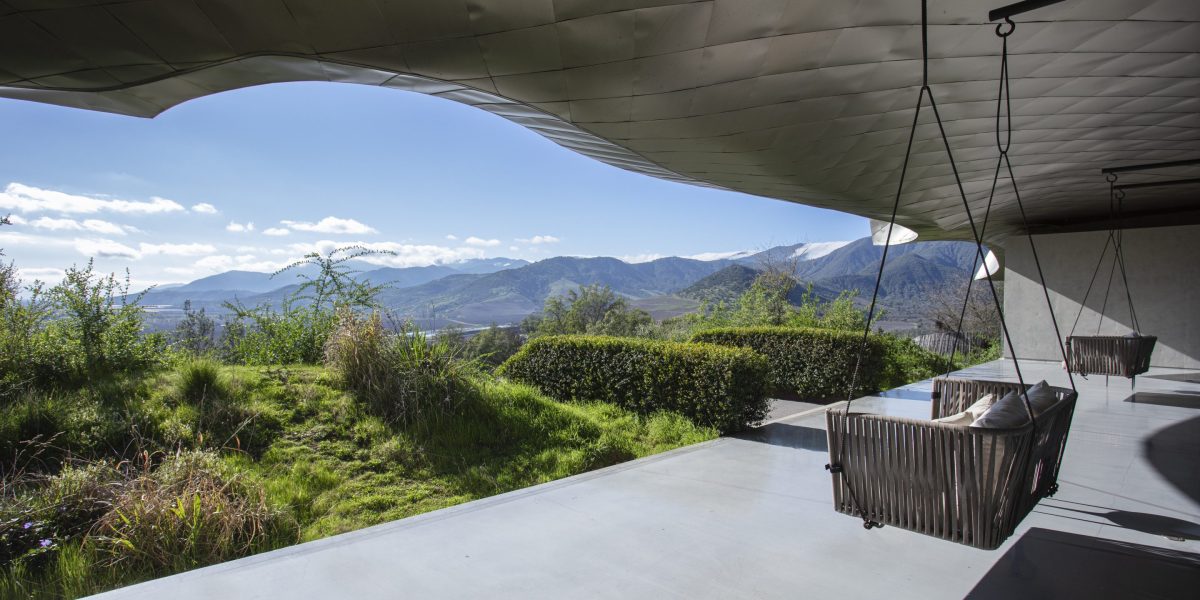
In 2014—a year before Vik’s first commercial wine, a 2010 vintage of its eponymous flagship blend, entered the market—VIK Chile opened its doors, completing Vik’s metamorphosis into a world-class escape. (The Viks opened their first hotel, Estancia Vik, in Uruguay in 2009; the Vik Retreats portfolio now includes two other Uruguayan outposts and a hotel in Milan.) Perched on a hill with panoramic views of the winery, the vineyards, and the valley beyond, the luxury hotel—whose free-form bronzed titanium roof seems to undulate in the unrelenting sun—is arguably the country’s most iconic getaway, and a dazzling complement to the winery. 

The hotel’s 22 suites were each designed by a different artist.

Courtesy of Vik Retreats

Contemporary art, the Viks’ other prevailing passion, informs every inch of the hotel. The couple recruited a slew of artists to design the 22 themed suites, whose floor-to-ceiling windows frame Millahue’s jaw-dropping vistas. “Vicky Money” features a bathroom adorned with 50,000 one-euro-cent coins, while a replica of Dali’s iconic Mae West “Lips” sofa commands attention in “Valenzuela,” a riot of color with a Mondrian-inspired floor. A central courtyard—where a Zen garden presides over a border of vibrant blooms—celebrates the natural world, and common spaces showcase unique works by artists including German painter and sculptor Anselm Kiefer and Chilean painter Roberto Matta. Puro Vik, a collection of seven stand-alone glass bungalows with themes ranging from holographic art to 18th-century France, and with bathrooms that each feature a different marble, comprise the newest accommodations. 

Vik’s vintages join forces with elevated cuisine at Milla Milla, the hotel’s glass-walled signature restaurant, where dishes like grilled red octopus with potato foam and duck magret with blueberry sauce earn raves. La Huerta, an alfresco eatery in the property’s two-acre organic garden, makes an idyllic lunch spot, thanks to plates beautifully composed of 250 varieties of fruits, vegetables, herbs, and eggs, topped with edible flowers. Activities like horseback rides through the vineyards and birdwatching walks along mountain trails can be easily arranged for guests—a well-heeled, international mix of couples, families, and wine enthusiasts—while winery tours and tastings loom large in the Vik experience.  

Since Vik’s founding, the endlessly complex, ever-evolving relationship between wine and nature has fueled its winemaking—an ongoing journey most recently manifested in Stonevik. In 2018, Vik became an entirely circular winery, meaning every element used in its production comes from the property—including its barrels, which were previously sourced from France. Winemaker Vallejo began crafting Vik’s own barrels with French oak staves, toasting them with 300-year-old Chilean oak that had fallen within the reserve to integrate the terroir directly into the wood—a process he dubbed “barroir.” In 2023, he approached the Viks with an idea to take the circular concept a step further.  

STONEVIK is aged for eight months in amphorae half-buried in the ground.

Courtesy of Vik Retreats

“Circular wine normally means growing and harvesting grapes on your land and aging the wine in your winery, but no one had yet returned to nature to close the circle,” he recalls. “I suggested we create a wine and take it in amphorae up to the forest, to let it be their guardian and help us age it.” Intrigued, the Viks agreed.   

When Vallejo happened upon the ring of oak trees—a relative anomaly in nature—during his search for the perfect location for this new venture, he felt an energy he couldn’t identify. He summoned a geologist to investigate what, if anything, was happening below ground; the geologist subsequently determined that a fault line intersected with a water vein in the circle’s center. That nexus created a natural electromagnetic field that generates a kind of circular pulse, which Vallejo says explains the trees’ unusual growth.  

He then consulted a machi (a traditional healer in Mapuche culture), who identified the energy point’s exact location with no knowledge of the geologist’s findings; and an astronomer, who advised how best to arrange the amphorae within the circle to optimally align with the sun, moon, and stars. After a month in Vik’s “barroir” barrels, the wine—a blend of Cabernet Franc, Cabernet Sauvignon, and Carménèrerests in seven amphorae in the forest enclave until December 21, the summer solstice in the Southern Hemisphere, when it is bottled and ready for sale. Annual production is limited to 800 cases, given the small capacity of its unique aging process.   

Wine barrels flank the aisle that leads to the entrance to VIK Winery’s tasting room.

Courtesy of Vik Retreats

Stonevik joins three other flagship wines—Vik (its premier blend), Milla Cala, and La Piu Belle—in Vik’s production. Its 2023 and 2024 vintages each earned 98 points from leading wine critic James Suckling—a notable achievement for a wine aged less than one year with no intervention.  

As for the future, Alexander Vik is optimistic.  

“We’re way ahead of our expected timeline for the vineyard and the winemaking,” he says. “Each vintage is better than the prior one, as the vines become more established and more capable.”  

Vallejo’s take befits an unlikely tale that began in an untouched, aureate wilderness and that continues to unfold.  

“I think of our wines as a book: Every glass is a chapter, every sip is a page,” he says. “They really tell the story of this terroir. When you connect with our wines, you can follow this story, and in every glass—every sip—you feel something different.”  


Source link

Continue Reading

Business

Miss Universe co-owner gets bank accounts frozen as part of probe into drugs, fuel and arms trafficking

Published

on


Mexico’s anti-money laundering office has frozen the bank accounts of the Mexican co-owner of Miss Universe as part of an investigation into drugs, fuel and arms trafficking, an official said Friday.

The country’s Financial Intelligence Unit, which oversees the fight against money laundering, froze Mexican businessman Raúl Rocha Cantú’s bank accounts in Mexico, a federal official told The Associated Press on condition of anonymity because he was not authorized to comment on the investigation.

The action against Rocha Cantú adds to mounting controversies for the Miss Universe organization. Last week, a court in Thailand issued an arrest warrant for the Thai co-owner of the Miss Universe Organization in connection with a fraud case and this year’s competition — won by Miss Mexico Fatima Bosch — faced allegations of rigging.

The Miss Universe organization did not immediately respond to an email from The Associated Press seeking comment about the allegations against Rocha Cantú.

Mexico’s federal prosecutors said last week that Rocha Cantú has been under investigation since November 2024 for alleged organized crime activity, including drug and arms trafficking, as well as fuel theft. Last month, a federal judge issued 13 arrest warrants for some of those involved in the case, including the Mexican businessman, whose company Legacy Holding Group USA owns 50% of the Miss Universe shares.

The organization’s other 50% belongs to JKN Global Group Public Co. Ltd., a company owned by Jakkaphong “Anne” Jakrajutatip.

A Thai court last week issued an arrest warrant for Jakrajutatip who was released on bail in 2023 on the fraud case. She failed to appear as required in a Bangkok court on Nov. 25. Since she did not notify the court about her absence, she was deemed to be a flight risk, according to a statement from the Bangkok South District Court.

The court rescheduled her hearing for Dec. 26.

Rocha Cantú was also a part owner of the Casino Royale in the northern Mexican city of Monterrey, when it was attacked in 2011 by a group of gunmen who entered it, doused gasoline and set it on fire, killing 52 people.

Baltazar Saucedo Estrada, who was charged with planning the attack, was sentenced in July to 135 years in prison.


Source link

Continue Reading

Business

Elon Musk’s X fined $140 million by EU for breaching digital regulations

Published

on


European Union regulators on Friday fined X, Elon Musk’s social media platform, 120 million euros ($140 million) for breaches of the bloc’s digital regulations, in a move that risks rekindling tensions with Washington over free speech.

The European Commission issued its decision following an investigation it opened two years ago into X under the 27-nation bloc’s Digital Services Act, also known as the DSA.

It’s the first time that the EU has issued a so-called non-compliance decision since rolling out the DSA. The sweeping rulebook requires platforms to take more responsibility for protecting European users and cleaning up harmful or illegal content and products on their sites, under threat of hefty fines.

The Commission, the bloc’s executive arm, said it was punishing X because of three different breaches of the DSA’s transparency requirements. The decision could rile President Donald Trump, whose administration has lashed out at digital regulations, complained that Brussels was targeting U.S. tech companies and vowed to retaliate.

U.S. Secretary of State Marco Rubio posted on his X account that the Commission’s fine was akin to an attack on the American people. Musk later agreed with Rubio’s sentiment.

“The European Commission’s $140 million fine isn’t just an attack on @X, it’s an attack on all American tech platforms and the American people by foreign governments,” Rubio wrote. “The days of censoring Americans online are over.”

Vice President JD Vance, posting on X ahead of the decision, accused the Commission of seeking to fine X “for not engaging in censorship.”

“The EU should be supporting free speech not attacking American companies over garbage,” he wrote.

Officials denied the rules were intended to muzzle Big Tech companies. The Commission is “not targeting anyone, not targeting any company, not targeting any jurisdictions based on their color or their country of origin,” spokesman Thomas Regnier told a regular briefing in Brussels. “Absolutely not. This is based on a process, democratic process.”

X did not respond immediately to an email request for comment.

EU regulators had already outlined their accusations in mid-2024 when they released preliminary findings of their investigation into X.

Regulators said X’s blue checkmarks broke the rules because on “deceptive design practices” and could expose users to scams and manipulation.

Before Musk acquired X, when it was previously known as Twitter, the checkmarks mirrored verification badges common on social media and were largely reserved for celebrities, politicians and other influential accounts, such as Beyonce, Pope Francis, writer Neil Gaiman and rapper Lil Nas X.

After he bought it in 2022, the site started issuing the badges to anyone who wanted to pay $8 per month.

That means X does not meaningfully verify who’s behind the account, “making it difficult for users to judge the authenticity of accounts and content they engage with,” the Commission said in its announcement.

X also fell short of the transparency requirements for its ad database, regulators said.

Platforms in the EU are required to provide a database of all the digital advertisements they have carried, with details such as who paid for them and the intended audience, to help researches detect scams, fake ads and coordinated influence campaigns. But X’s database, the Commission said, is undermined by design features and access barriers such as “excessive delays in processing.”

Regulators also said X also puts up “unnecessary barriers” for researchers trying to access public data, which stymies research into systemic risks that European users face.

“Deceiving users with blue checkmarks, obscuring information on ads and shutting out researchers have no place online in the EU. The DSA protects users,” Henna Virkkunen, the EU’s executive vice-president for tech sovereignty, security and democracy, said in a prepared statement.

The Commission also wrapped up a separate DSA case Friday involving TikTok’s ad database after the video-sharing platform promised to make changes to ensure full transparency.

___

AP Writer Lorne Cook in Brussels contributed to this report.


Source link

Continue Reading

Business

Nvidia CEO says U.S. data centers take 3 years, but China ‘can build a hospital in a weekend’

Published

on


Nvidia CEO Jensen Huang said China has an AI infrastructure advantage over the U.S., namely in construction and energy.

While the U.S. retains an edge on AI chips, he warned China can build large projects at staggering speeds.

“If you want to build a data center here in the United States from breaking ground to standing up a AI supercomputer is probably about three years,” Huang told Center for Strategic and International Studies President John Hamre in late November. “They can build a hospital in a weekend.”

The speed at which China can build infrastructure is just one of his concerns. He also worries about the countries’ comparative energy capacity to support the AI boom.

China has “twice as much energy as we have as a nation, and our economy is larger than theirs. Makes no sense to me,” Huang said.

He added that China’s energy capacity continues to grow “straight up”, while the U.S.’s remains relatively flat.

Still, Huang maintained that Nvidia is “generations ahead” of China on AI chip technology to support the demand for the tech and semiconductor manufacturing process.

But he warned against complacency on this front, adding that “anybody who thinks China can’t manufacture is missing a big idea.”

Yet Huang is hopeful about Nvidia’s future, noting President Donald Trump’s push to reshore manufacturing jobs and spur AI investments.

‘Insatiable AI demand’

Early last month, Huang made headlines by predicting China would win the AI race—a message he amended soon thereafter, saying the country was “nanoseconds behind America” in the race in a statement shared to his company’s X account.

Nvidia is just one of the big tech companies pouring billions of dollars into a data center buildout in the U.S., which experts tell Fortune could amount to over $100 billion in the next year alone.

Raul Martynek, the CEO of DataBank, a company that contracts with tech giants to construct data centers, said the average cost of a data center is $10 million to $15 million per megawatt (MW), and a typical data centers on the smaller side requires 40 MW.

“In the U.S., we think there will be 5 to 7 gigawatts brought online in the coming year to support this seemingly insatiable AI demand,” Martynek said.

This shakes out to $50 billion on the low end, and $105 billion on the high end.


Source link

Continue Reading

Trending

Copyright © Miami Select.