
Politics
House Republicans pass campus political activity bill amid Democrats’ warning of ‘chilling effect’
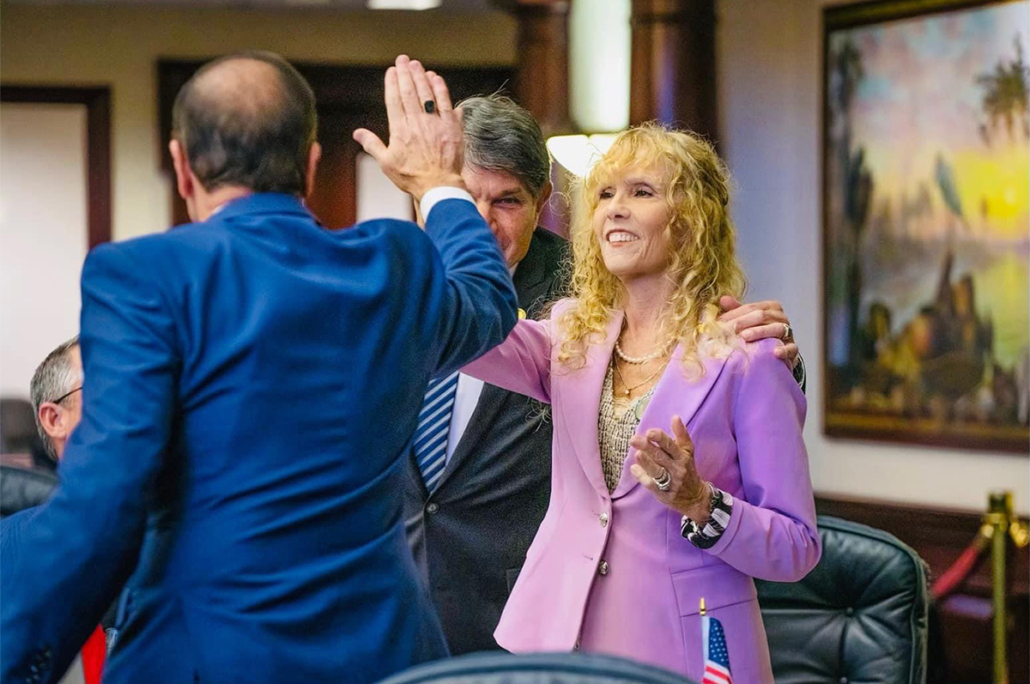
Legislation requiring Florida’s higher education institutions to better explain campus rules for political activity just cleared the House floor on a party-line vote. It will now head to the Senate, where its companion hasn’t been heard all Session.
House members voted 81-30 for the bill (HB 725), with zero “yes” votes from Democrats, who decried the proposal as an effort to further stifle speech and expression in education.
The measure’s sponsor, Highland Beach Republican Rep. Peggy Gossett-Seidman, described it another way: “sensible and surprising.”
“It’s sensible because it answers so many questions concerning political activities at our institutions of higher learning,” she said.
“It’s surprising because the answers were right here all along, in each of our university and college’s policy manuals and in our federal codes at the IRS.”
Gossett-Seidman, who significantly pared down the bill’s effects during the Committee process, said HB 725 is simply meant to bring clarity to a disjointed system of guidance. It aims to make political neutrality regulations — already codified under the IRS, she said — more visible and understandable.
HB 725 would require each public institution of higher education to inform students, teachers and faculty online and during orientation about the Campus Free Expression Act, which protects First Amendment activities like protests, speeches and leafleting in outdoor areas on campus while banning restrictive “free speech zones.”
“These policies are affixed in each (university and college) policy manual in different forms,” Gossett-Seidman said. “Some read like a long novel, some like a short story and others like CliffsNotes. This bill takes the codes and makes them a state statute. That’s where folks look for guidance, not diving into IRS codes or the policies at colleges.”
The bill would also direct the Board of Governors and the State Board of Education to adopt rules and regulations outlining limits on political campaign activity by state universities and Florida College System institutions, consistent with their status as tax-exempt entities.
One month before a Primary, each institution would have to email employees and prominently post online a summary of permissible political activities, such as nonpartisan voter registration events and candidate forums open to all qualified candidates, and prohibited activities, including campaigning while on duty or implying institutional endorsement.

Gossett-Seidman said she has seen “several instances” of higher-ed servers being used for campaign emails and college logos used on campaign materials — both of which are prohibited.
There have also been voter registration drives, she continued, that turned away potential registrants because of the political party they wanted to join.
“We’re just addressing keeping everything fair and equal,” she said.
Democrats in the chamber warned Wednesday of a “chilling effect” HB 725 could bring.
“Encouraging political activity in higher education fosters civic engagement and prepares students to (participate) in democracy,” Hollywood Democratic Rep. Marie Woodson said. “This bill could hinder that. It would affect … marginalized groups as well that rely on these platforms to voice their concerns and advocate for a change.”
Orlando Democratic Rep. Anna Eskamani asked about the bill’s provision directing the two higher-ed overseers to adopt rules for on-campus political activities and what guardrails there are to prevent policies exceeding Gossett-Seidman’s expressed intention for the bill.
Eskamani said the bill lacks distinctions between student fees and “E&G dollars” — education and general funds — and that lack of clarity could blur the line between lawful on-campus activities and those restricted by federal law.
“If you’re campaigning while wearing a UF sweater or a UCF sweater, are you now indirectly violating this bill?” she said.
Gossett-Seidman said she didn’t see how the state could add strictures beyond what the federal code provides.
Fort Lauderdale Democratic Rep. Daryl Campbell disagreed, taking exception with what he framed as a transfer of power from the Legislature to a pair of state agencies over which the Governor has control.
“We write laws. That is our job. When something touches speech, political participation or disciplinary authority in higher education, that is our core public policy — First Amendment territory where precision matters. Instead, we are saying to two executive bodies, ‘Figure it out.’ How has that worked out before?”
Campbell referenced guidelines for African American history standards that the Florida Board of Education adopted in 2023, which drew national criticism for, among other things, requiring lessons on slavery to include how slaves learned skills while in bondage that could be “applied for their personal benefit.”
“When executive bodies have broad discretion and vague direction, they expand it. Then we sit here and say, ‘That’s not what we meant,’” he said. “If we do not mean to chill speech, then we should define exactly what is prohibited. If we do not mean to suppress lawful civic engagement, then we should not codify what already exists.”
HB 725, in its current form, is markedly different from the measure Gossett-Seidman filed last year, re-filed in September and replaced in December, before she substituted new language this month to pare down its scope.
As originally written, HB 725 would have created an extensive regulatory framework governing political activity on higher-ed campuses. It would have required institutions to promote debates, granted equal access to candidates, mandated prior approval for candidates and political entities before they appear on campus, restricted partisan activity, regulated student political organizations, prohibited the use of institutional property and emails for campaigns, required annual staff training, mandated compliance monitoring by state Boards and required post-election reporting to state officials.
The version now bound for the Senate, conversely, centers largely on notification, guidance and rulemaking requirements.
The upper-chamber companion of Gossett-Seidman’s bill (SB 1736) by Stuart Republican Sen. Gayle Harrell is substantively identical to HB 725 as originally written.
It still awaits a first hearing before the first of three Committees to which it was referred in mid-January.
Sine Die is scheduled for March 13.