
Politics
House passes HOA bill allowing owners to dissolve Boards, clarifying dispute resolution paths
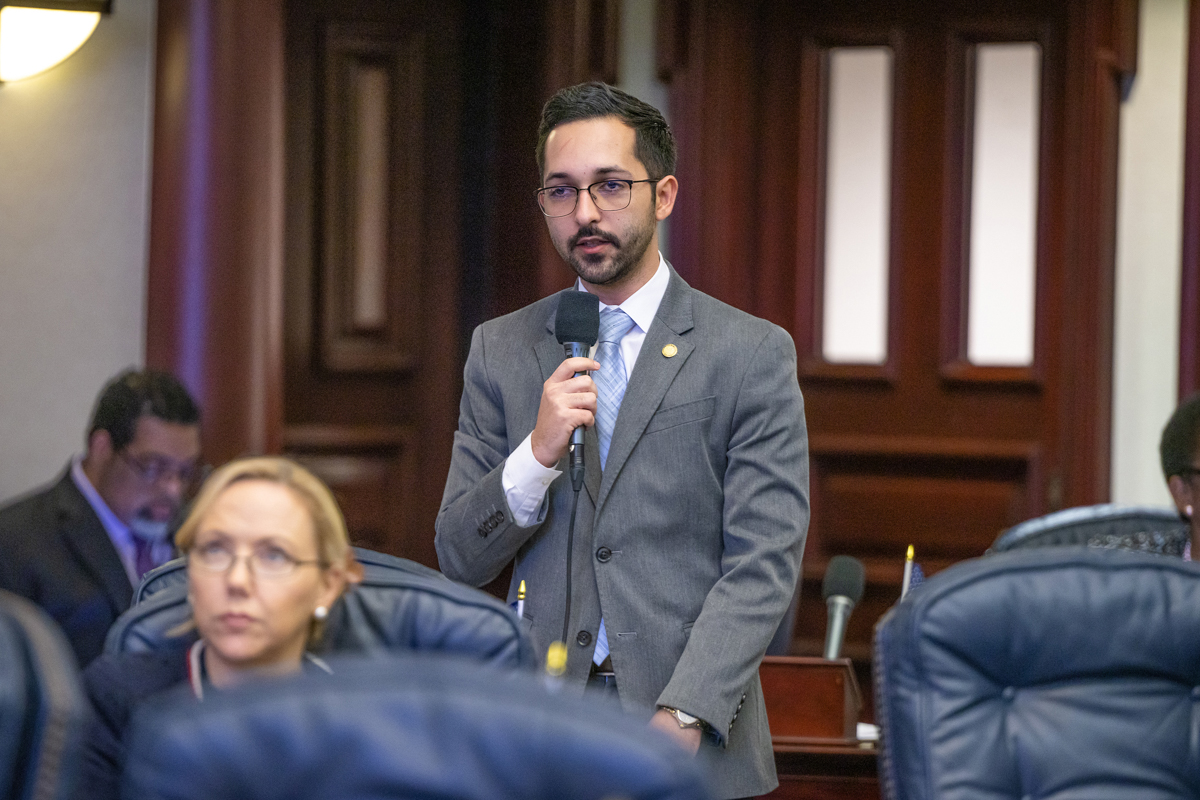
Legislation designed to overhaul how condo and homeowners association (HOA) disputes are resolved — described by its sponsor, Miami Republican Rep. Juan Porras, as the largest reform bill of its kind — just won overwhelming House approval.
It’s now on the way to the Senate, where its upper-chamber analogue has been less successful in advancing this Session.
House members voted 108-2 for the measure (HB 657), which would make numerous changes to Florida laws governing community associations, including HOAs, condominiums and cooperative associations, to increase transparency, strengthen oversight and provide new mechanisms to resolve disputes.
Porras called HOAs, in their current form, “a failed experiment” that have “run amok” due to wide regulatory loopholes currently in state statutes.
“We have allowed, for too long in this chamber, to have a lack of complete oversight over what I believe is the smallest yet most powerful form of government,” he said. “This bill is just the first step in reaching that much-needed transparency and accountability for over half our state, and for the first time, people are going to have a real voice.”
HB 657 would implement three major changes to Florida’s HOA laws.
First, it would address transparency issues by creating a state-funded court process to address condo and HOA disputes, which would replace an existing pre-lawsuit mediation process required today.
Second, it would provide processes for the dissolution of HOAs. Porras has stressed this would not be a one-size-fits-all approach, and there would be several necessary steps — petition gathering, an election and final approval by a Judge — before an organization could be terminated.
Third, the measure would address a lack of accountability that malfeasant HOA Board members now enjoy by mandating that HOAs include “Kaufman language” in their governing documents that require organization bylaws to change in accordance with changes in state law automatically.
A condo association member from Coral Springs took exception with that last provision during HB 657’s first Committee stop in January, warning that the Kaufman language provision would essentially “hand over a blank check to (the) Legislature” to write future laws undermining homeowner rights. The HOA Board dissolution part, the man said, would leave properties without management and upkeep, leading to devaluation and a “fire sale environment” for opportunistic real estate investors, the man argued.

Porras somewhat addressed contention over the provision ahead of the House floor vote Thursday. He said many HOAs and condo associations in Florida have been more successful than they should have been in fighting state legislation because their bylaws don’t include language saying their rules are “amendable from time to time.”
“They essentially are saying that their HOAs supersede state law, which I think is not just irresponsible, but I think it’s offensive to all the members of this body, that we pass legislation and then we have HOAs saying that they’re better than the policies that we provide,” he said.
Florida’s former condominium ombudsman, Spencer Hennings, detailed the problem during a Senate panel discussion on HOA enforcement — or lack thereof — in late 2023, calling his agency and others with oversight responsibilities “toothless” in addressing malfeasance.
The way Florida statutes are now written, he said, wrongdoers on condo and HOA Boards can consistently evade punishment or removal.
“The current system is very good if the Board are good actors, but if the Board is corrupt and if the Board are bad actors — and this is a very small minority of condominium associations — it is my opinion that the current system is not (effective),” he said.
“Unit owners basically have no rights, (and if Board members are) stealing money, if they’re concealing records (or) doing something nefarious, good luck asking them to step down. Their response is going to be, ‘Sue me.’”
Board members today can technically be removed either through the next annual election or through a recall supported by a majority of unit owners. But Hennings argued a Board member can simply refuse to step down, even after a recall succeeds.
The dispute then goes to arbitration through the Department of Business and Professional Regulation, but those decisions are nonbinding and cannot be enforced. If the arbitrator sides with unit owners and the Board member still refuses to leave, the only option is for residents to file a lawsuit in circuit court.
Those cases, Hennings said, can take years and cost unit owners significant legal fees. And by the time the case progresses, he said, the next Board election often occurs, causing the court case to be dismissed as moot.
In recent years, there have been multiple high-profile cases of HOA Board corruption.
Examples include the Hammocks HOA fraud scandal involving upward of $13 million in stolen funds, the Turnberry on the Green condo President’s arrest for racketeering, fraud and grand theft in 2024, a case last year in which the Ro Mont South Condominium President allegedly stole $15,000 in association money to cover personal expenses, and a scheme in Tarpon Springs allegedly involving more than $754,000.
Porras said the Hammocks HOA in his district has more than 60,000 residents. The same week he was sworn in, he continued, the HOA’s heads were arrested on multiple racketeering, money laundering and bribery charges.
“It got to the point where there were literal receipts under the floorboards of the clubhouse,” he said. “To this day, there are tens of millions of dollars that have still not been recovered from my community. So, if that’s not a great example, I have more than a dozen to give you.”
HB 657 passed with “no” votes from St. Pete Beach Republican Rep. Linda Chaney and St. Petersburg Democratic Rep. Lindsay Cross. Neither argued against the bill on the floor or explained their opposition to it.
Before the vote, Porras accepted an amendment from Weston Democratic Rep. Robin Bartleman requiring notification of the relevant county or city government when HOA members initiate a process to dissolve their Board.
He said he’ll continue working on legislation to further address the issue for the rest of his House career.
“Know that HOAs are not going to be held unaccountable,” he said.
The path forward for HB 657 remains unclear, as its analogue across the rotunda (SB 1498) by Fleming Island Republican Sen. Jennifer Bradley stalled out last month after advancing through the first of three Committees to which it was referred.