
Politics
House panel advances Marie Woodson bill to better protect children of arrested parents
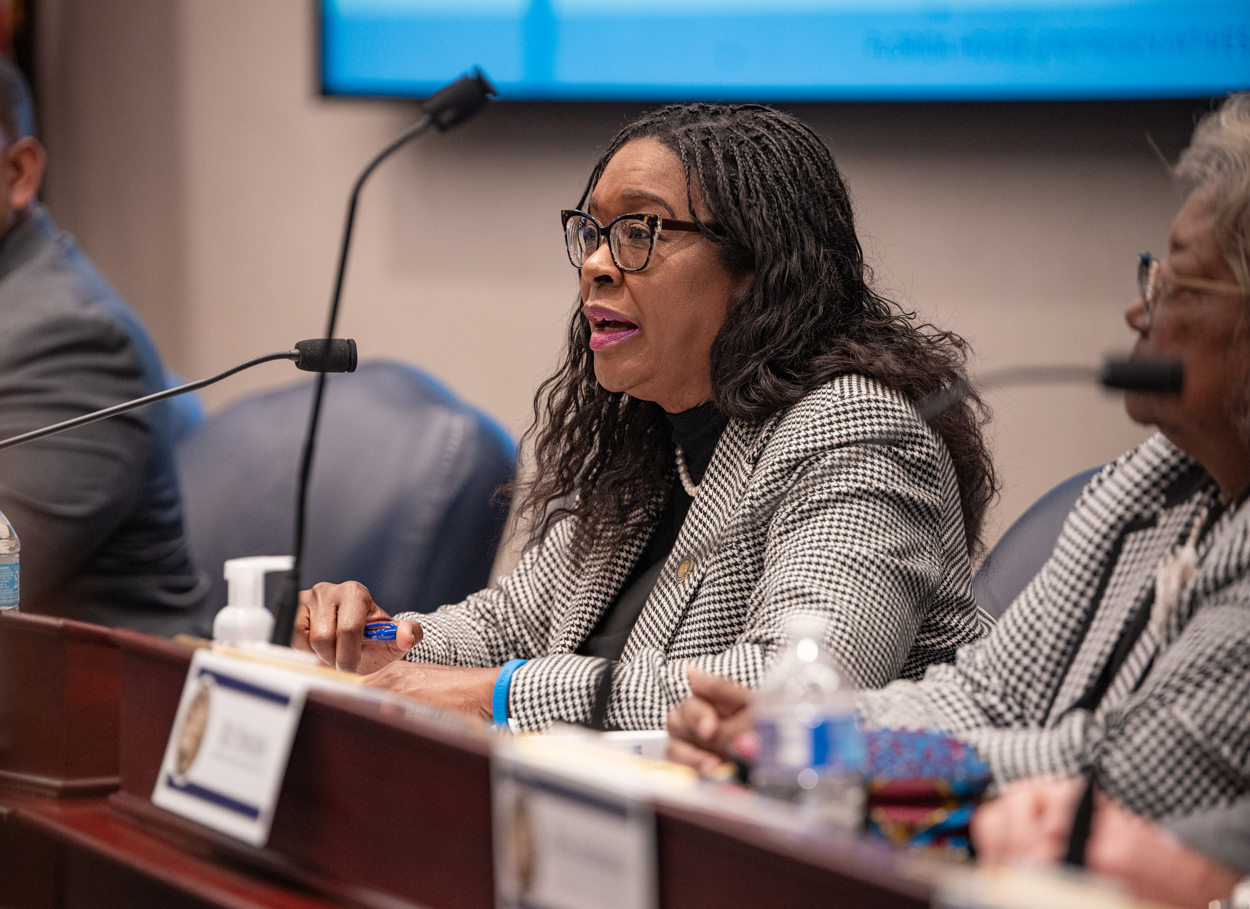
Legislation to ensure children aren’t left in dangerous situations when police arrest their parents took its first step forward in the House this week after it received bipartisan praise and some constructive criticism.
Members of the House Criminal Justice Subcommittee voted unanimously for the bill (HB 83) by Hollywood Democratic Rep. Marie Woodson, which would simply require booking officers to ask arrestees if they are the guardian of a minor child.
If the person says yes, the officer would have to ask follow-up questions to determine whether the child is safe with a responsible guardian and whether someone needs to be contacted to confirm the child’s care.
The officer must also verify the child’s safety and current location. If the officer knows or suspects the child does not have an available, responsible adult to provide supervision, the officer must notify the state’s central abuse hotline through the Department of Children and Families.
Woodson, a former adult and juvenile justice counselor, said she has seen troubling cases of children left alone at home for long periods that her bill could help prevent.
“Simple questions can prevent serious harm. The bill doesn’t add complicated process. It just requires officers to ask basic questions,” she said.
“Right now, whether an officer asks about children can vary by county or individual. This bill sets a clear, uniform standard so every child gets the same protection.”
Paulette “Tinkerbell” Pfeiffer, the founder and Executive Director of Silent Victims of Crime, whom Woodson credited for inspiring the bill, said she has waited five decades for legislation like HB 83.
“And that’s because (for) 50 years, I’ve been watching children of prisoners disappear underneath cars, in parks and left in schools because nobody picks them up,” she said. “It’s not anybody’s specific fault, but there is no law to protect the children.”
Pfeiffer said her group, in collaboration with several others, including the Office of the Miami-Dade County Chief Justice Ariana Fajardo Orshan, has worked to fill the safety gap that HB 83 could hope to end. There are 15,000 children in Miami-Dade alone whose parents are in prison, she said, and many later end up behind bars themselves.

And the stories are horrifying. Pfeiffer spoke of one 7-year-old boy who was left alone for six months and was found eating his own excrement.
“There was no food, and he couldn’t leave the house because he had all kinds of issues,” she said.

Pfeiffer said it’s understandable that arresting officers are focused on other, more immediate things, like apprehending a suspect while minimizing potential harm to them and others.
“But how about when they’re being processed? Make the arrest, but when you’re being processed, please look at the possibility that this parent may say, ‘Yes, my child is in danger. Yes, I left my two kids in a basement locked up. I thought my husband was going to pick them up,’” she said.
“When they make an arrest and give them one phone call, they’re going to call a lawyer and may ask the lawyer, ‘Would you please take care of my kids? I left them alone.’ This mom that left the two kids alone in the basement never came back. She thought she was coming back that afternoon. The children died.”
Davie Democratic Rep. Mike Gottlieb, a criminal defense lawyer, thanked Woodson for filing HB 83, but noted a problem with the legislation in its current form. He asked Woodson if she was open to working with him to improve the bill. She said yes.
The issue, Gottlieb said, relates to a Florida law that elevates criminal penalties for manufacturing or possessing certain drugs near children. In such cases, a parent may invoke their right to remain silent, prohibiting a booking officer from asking them questions that might incriminate them — even if it would help save a child’s life.
But there’s a potential fix, Gottlieb continued. He pointed to Florida’s Accident Report Privilege, which requires police officers to document certain details following a car accident, including statements from at-fault drivers, victims and witnesses.
Under the privilege, a statement taken from an at-fault driver cannot be used against them later in a personal injury lawsuit.
“If we do something like that here, it’ll actually encourage people to talk more about the fact that their children are in harm’s way,” he said. “They’ll know that the statement they’re making will not be used against them, that they left the child in a dangerous situation.”
HB 83 will next go to the House Human Services Subcommittee. It does not have a Senate companion.